
A source-attributed account
The first rice and its season
Mahanti describes Nuakhai, also called Nabanna, on Bhadraba’s bright-fortnight fifth day. The name joins newness with eating. His account centres the newly harvested crop; this is not evidence that every field’s harvest is complete.1
A source-attributed account
What the historical account can establish
P. K. Singh’s September2012 essay says the exact origin is unknown. It presents Ramai Dev’s adoption of the festival as oral tradition, and reports a 1991 order for a common observance day. Neither a contemporary medieval witness nor that order has been inspected here. These are research leads, not a settled founding date.3
A source-attributed account
A family’s first offering
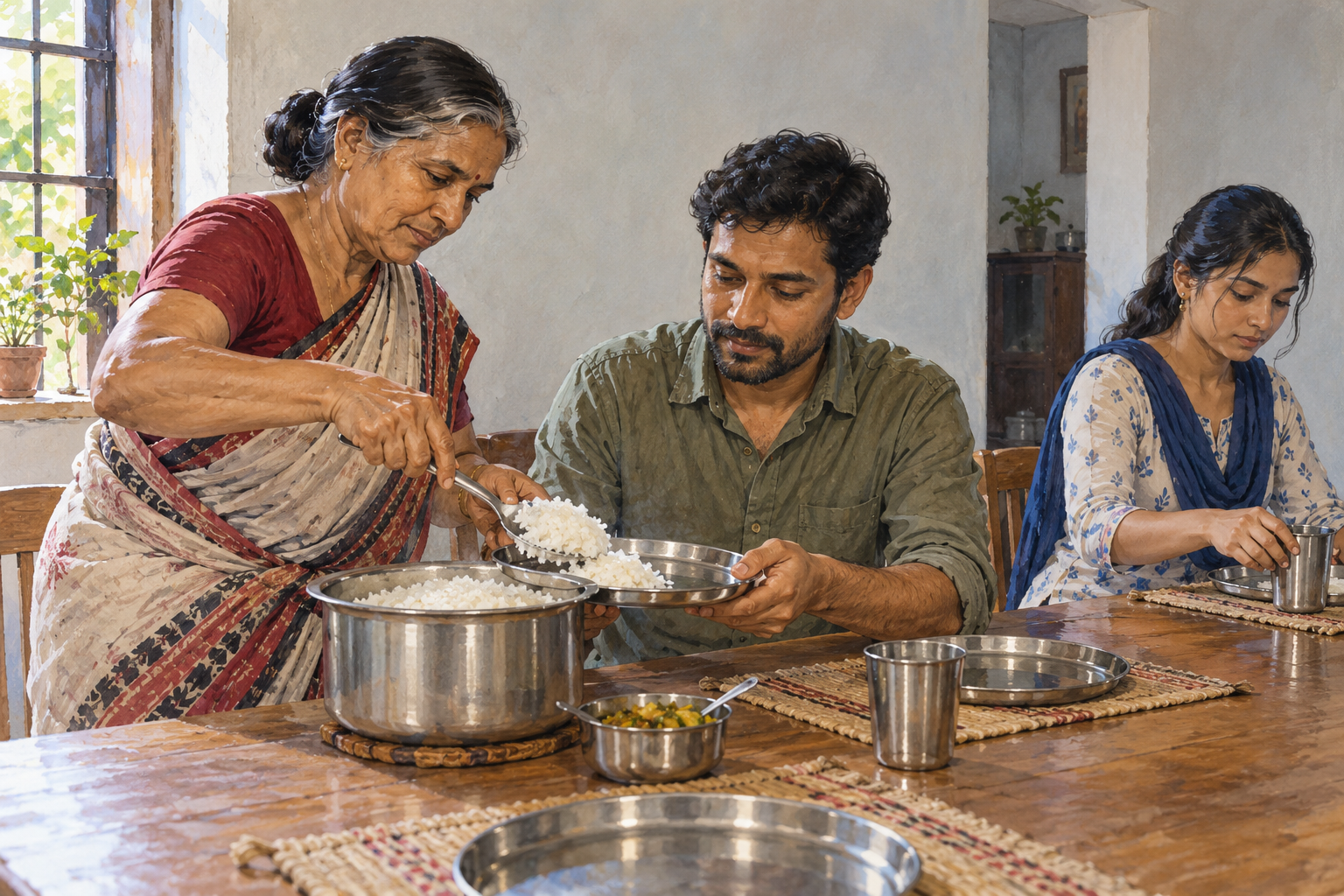
In Kesavan’s Bargarh fieldwork, the village priest distributes new grain. Ground new-season grain mixed with jaggery is offered to deities and ancestors, then shared with family members from a leaf bowl. This is one ethnographic account; its anonymized village is not a visitor location.2
A source-attributed account
The meal has several documented forms
Mahanti names jau or kheeri and arisa made with the new grain. Singh names manda pitha and khiri among offerings, then lists rice, dal, vegetables, hendua karadi khata and saga bhaja in the communal meal. These descriptions should not be merged into a compulsory menu.13
A source-attributed account
Skills and preparation
Singh describes rice grinding with pestles, collecting leaves and women’s advance preparation. These details identify practical work. They do not establish measured temperatures, ratios, storage life or health benefits. Preparation names require further locality-specific evidence before becoming recipes.3
A source-attributed account
Greetings, kinship and their limits
Kesavan describes unmarried sisters performing rites for brothers and receiving gifts, followed by greetings among neighbours. She interprets new rice and family relationships together. Her analysis also retains unequal gender roles; ritual honour cannot be treated as proof of equality.2
What remains to be established
An origin comparison is not a chronology
Mahanti suggests a connection with Vedic crop offerings. This comparative interpretation does not establish an unbroken lineage or the age of today’s Nuakhai. A stronger history needs dated texts, local records and careful comparison of changes. No single katha has been established as a universal foundation for this agrarian festival.1
Reading before a visit
How visitors can use this record
Bhadraba provides a browsing season, while individual event dates and serving offers need separate confirmation. The recorded dishes are leads for asking about local food. No restaurant, household invitation, public feast, annual date or booking is verified. A diaspora gathering or temple rite must be identified on its own terms.
Questions worth carrying forward
- Can the original 1991 calendar/holiday order and its exact scope be recovered?
- What dated evidence supports the Ramai Dev tradition, beyond later retellings?
- How do offerings and calendars differ across western Odisha communities and temples?
- Which named cooks can document grain processing and regional recipes, with consent?
These are invitations for future, consented conversations. They are not reports of interviews already conducted.
Footnotes & Sources
Checked 2026-10-07. Human editorial and Odia review pending. A recorded story does not establish the date an observance began.
- Fading Festivals of Odisha: A peep into the religious practices in Odisha
Colonel J. C. Mahanti (Retired) · Publication date not established
Author compilation drawing on memories, texts and consulted observers. Publication year unestablished; the preface gives Matrunavami, Aswina 1935 without a calendar-era explanation here. Decline, exclusivity and early-origin claims not adopted as established facts.
The first rice and its season: Printed p.121 / PDF137 ↩
The meal has several documented forms: Mahanti p.122 / PDF138; Singh p.25 / PDF3 ↩
An origin comparison is not a chronology: Printed p.121 / PDF137, proposed Vedic connection ↩
- Rice culture and sacred siblingship: Nua Khai and Bhai Jiuntia celebrations in Western Odisha, India
Indhubala Kesavan · 2025-12-17
Primary ethnographic study: eleven months of fieldwork within May2022–December2023, Bargarh district. Haliapali is a participant-requested village pseudonym, not a visitor destination. Project conducted no interviews; no image permissions claimed.
A family’s first offering: Printed pp.28–29 / PDF14–15; saved original visually inspected ↩
Greetings, kinship and their limits: Printed pp.28–31 / PDF14–17; broader gender discussion pp.27–28 ↩
- Nuakhai: Festival of Social Harmony
Dr. P. K. Singh · 2012-09
Authored cultural essay, author credited as Curator-in-Charge, Archaeology Section, Odisha State Museum. Original three-page publisher PDF inspected. Oral origin tradition and uninspected 1991-order assertion remain attributed, not established chronology; meal lists do not establish a universal recipe or current venue.
What the historical account can establish: Printed pp.23–24 / PDF1–2; origin and calendar paragraphs ↩
The meal has several documented forms: Mahanti p.122 / PDF138; Singh p.25 / PDF3 ↩
Skills and preparation: Printed p.24 / PDF2, household preparations ↩
Read the series introduction, The Year That Feeds Us.