
Nilagiri’s Stone Utensils: A Craft for the Table
A plate, a bowl, a drinking vessel: Odisha’s stonework has a domestic scale. Nilagiri, in Balasore district, is associated with stone utensils. The state’s Directorate of Handicrafts identifies it as a stone-carving centre alongside Soro and Baulagadia; a 2022 planning document explicitly names Nilagiri’s carving and utensils together.1
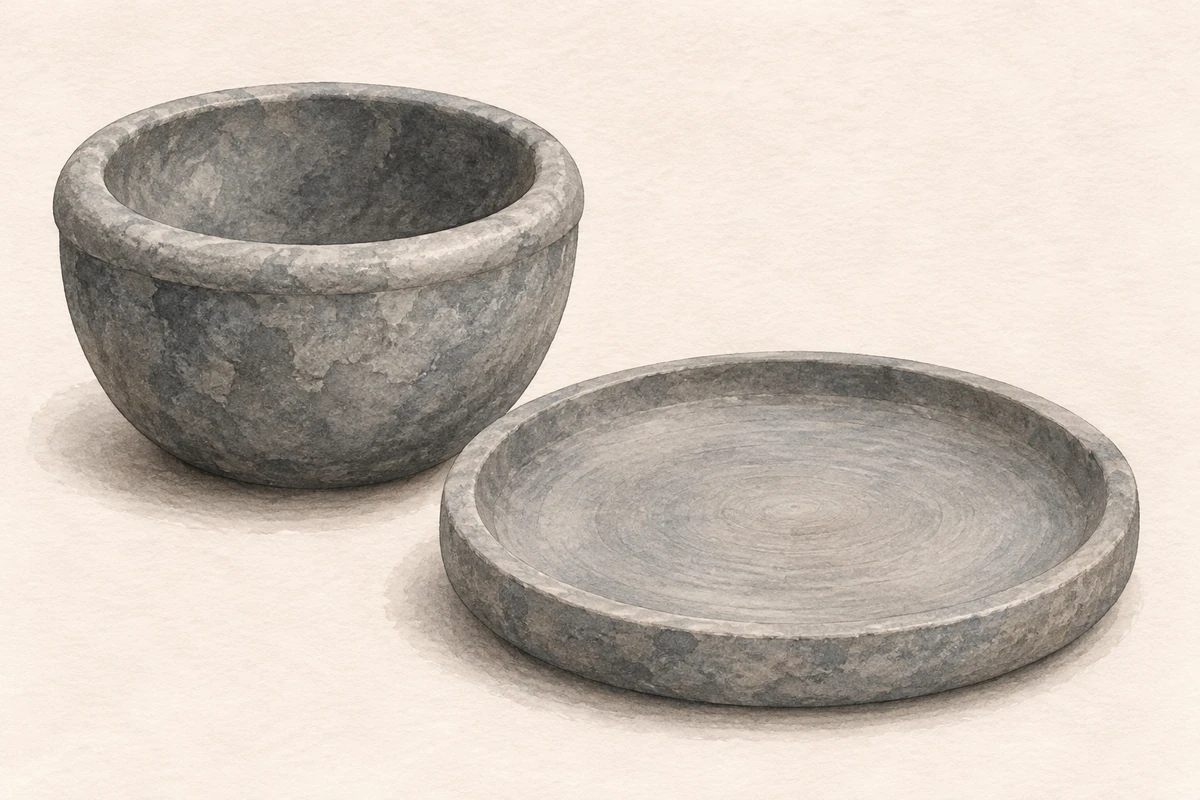
Utkalika’s account of Odisha stonecraft describes utensils made by turning and polishing on a kunda, or lathe. Its examples include plates, bowls, cups with saucers and tumblers. In the same account, a figure takes shape through an outline marked on a stone block, followed by the removal of unwanted material with a chisel. These are different ways of approaching a form: the round vessel and the carved figure ask us to look for different kinds of work.3
Utkalika describes stonework across Odisha. The local association is separately documented: writing in Odisha Review in November 2023, Chittaranjan Mishra identifies Nilagiri with stone utensils. His surrounding discussion includes domestic stone tools from other parts of the state, a reminder that a shared material can serve several purposes and belong to distinct local practices.4
A useful way to look at a stone bowl is to follow its profile: the rim, the curve into the hollow and the base that supports it.
Footnotes & Sources
-
Directorate of Handicrafts, Odisha, List of Identified Craft Clusters, Balasore entry; Expression of Interest, 2022, proposed craft-registration scope. The latter records a proposal, not a completed registration. ↩
-
Illustration: Project Odisha. Original interpretive artwork accompanying this article; it does not reproduce an identified utensil or document a Nilagiri workshop. ↩
-
Utkalika, “Stone Carving”, paragraphs on figure carving and stoneware utensils. The account covers Odisha broadly. ↩
-
Chittaranjan Mishra, “Folk and Tribal Elements in Indian Art,” Odisha Review, November 2023, p.30 (issue PDF, PDF p.48). ↩
Further reading
Suggest an update. GitHub submissions are public; omit private contact details and consent documents.