
Sonepur · Literature and living memory
Ahimanikya and Sashisena at the temple without a door
In Sonepur, Odisha—also known locally as Suvarnapura—a doorless memorial is widely known as Sashisena Temple or Nimuhi Mandir. To approach it is to remain outside, facing a monument whose best-known story is about two people refusing to remain apart. The familiar name does not establish that it functioned as a shrine with an installed deity and regular puja. 123
Their names are Sashisena and Ahimanikya. She is a princess; he grows up in a minister’s household, with a supernatural origin that short retellings often leave out. Their love becomes a tale of departure, captivity, recognition and repeated rescue. Official accounts describe the building as a memorial to their bond. 412
The story below follows the surviving Prachi Samiti edition of Pratap Ray’s Odia poem, identifying other versions where they differ. The poem, local remembrance and the physical monument supply different kinds of evidence. A temple visited by characters in the story is not thereby the building standing in Sonepur today; the survival of that building does not establish the lovers as historical people.
The memorial in photographs
These are two views of the present memorial. The first is the oldest photograph located in this research. No verified photograph of the earlier ruined temple has yet been found.
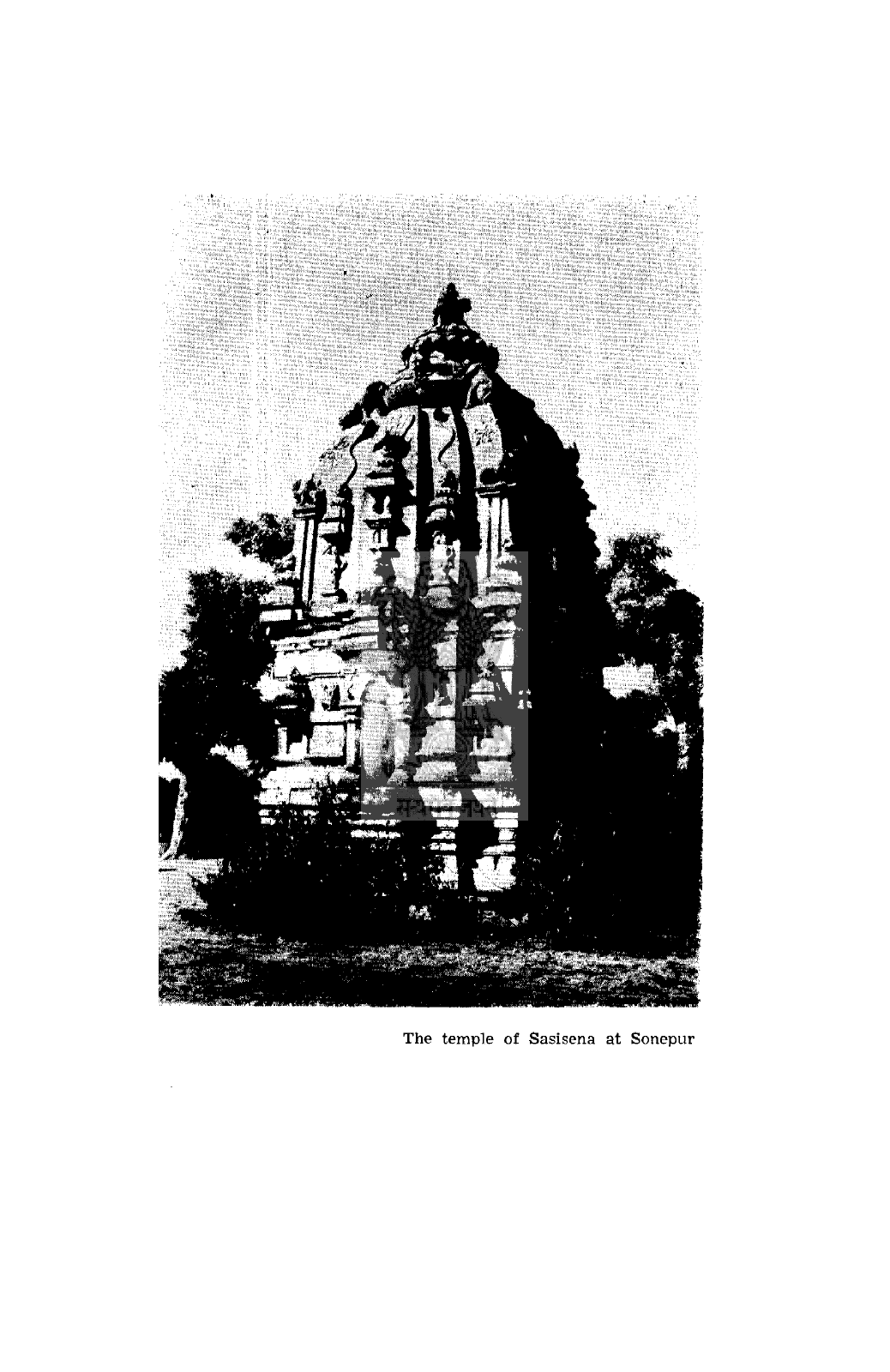
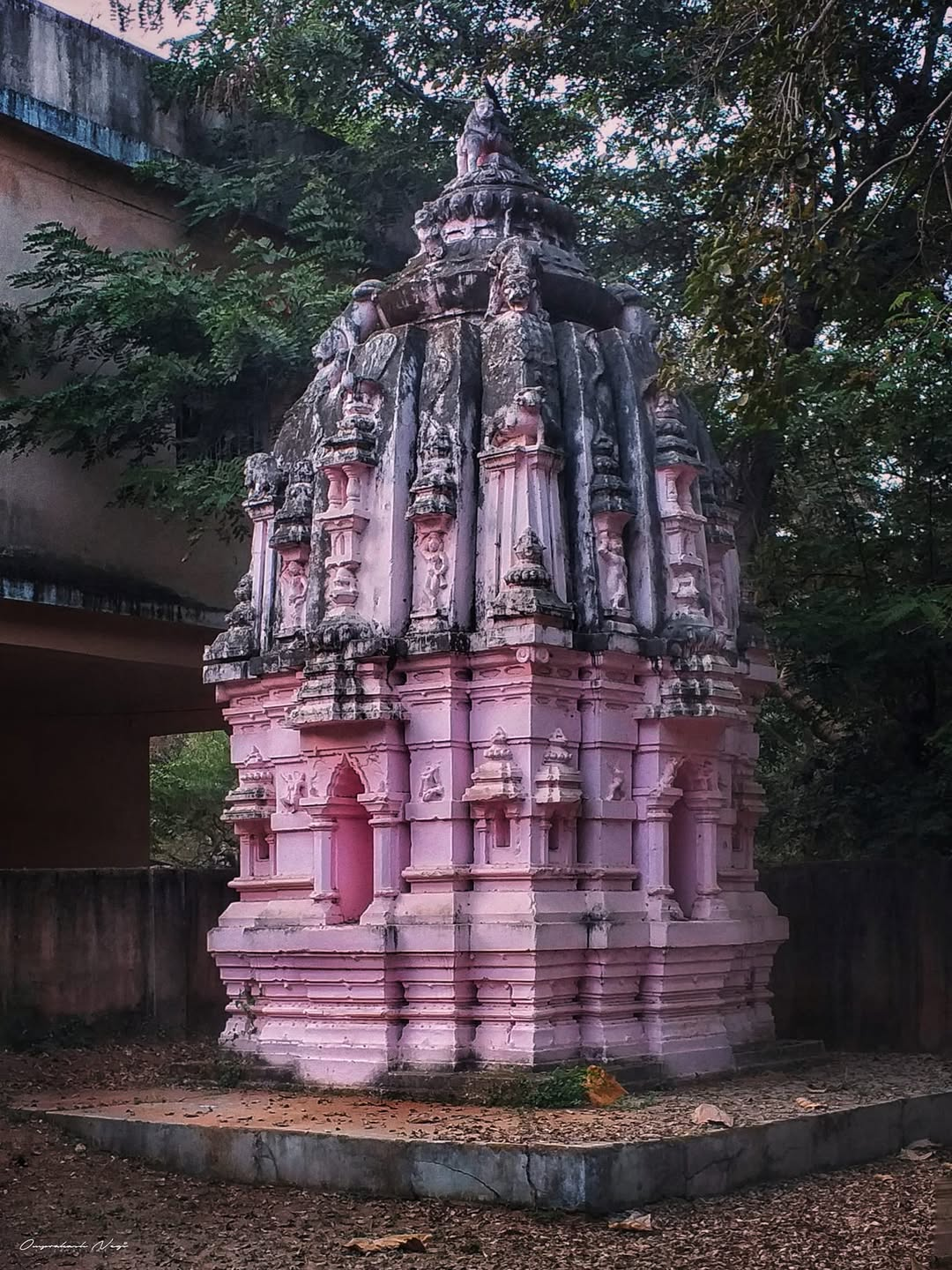
The tower’s outline and arrangement of exterior carvings invite comparison; the later view also shows its painted surface and built surroundings. Different angles and the old scan’s limited detail prevent a stone-by-stone assessment. These images do not establish when repairs or repainting occurred, or whether an entrance ever existed.
A child with two origins
The poem begins its human story in Amaravati, where King Vikrama Keshari rules and Kushala Ramana serves as minister. The minister’s wife, Lilavati, prays for a son. What follows belongs unmistakably to the poem’s supernatural world: a serpent arrives among flowers, becomes a jewel necklace and then a boy. The child enters the minister’s family through this miraculous sequence. 4
Later, the narrator calls Ahimanikya Bisheheri’s son, born on earth at his mother’s command. The Prachi edition’s editor identifies Bisheheri as Durga in a footnote. This gives the character a specific goddess connection within the poem, without establishing a separate tradition of worshipping Ahimanikya. 4
His name carries this origin story. In Sanskrit, ahi means serpent, while māṇikya means ruby; maṇi is the broader word for a jewel or gem. The poem gives its own explanation. When Lilavati asks her husband to name the child, the minister recalls the serpent becoming a jewel necklace and chooses Ahimanikya. 45
ମନ୍ତ୍ରୀ ବୋଲେ ଅହି ହୋଇ ମାଣିକ୍ୟମାଳ ।
ଅହିମାଣିକ୍ୟ ନାମେଣ ଅଟେ ସୁଲଳ ।Meaning The minister says: the serpent became a jewel necklace; Ahimanikya is a fitting, beautiful name.
This is a naming scene in the poem itself. It describes transformation; it does not say that a jewel was removed from a serpent’s head. The separate Kathalahari folktale calls its hero Abhimanyu, so its naming should not be substituted for this passage. 46
Was Ahimanikya a prince of Sambalpur? The strongest evidence for his identity comes from the Odia poem itself. In the digitised Prachi Samiti edition of Pratap Ray’s Shashisena, Sashisena says:
ମନ୍ତ୍ରୀ ତନୟ ୟେହୁ ମୋର ପତି ।
Meaning This minister’s son is my husband.
“Minister’s son” describes his human household; it is not the whole account of his origin. “Dewan’s son,” used in later accounts, is compatible with that description. A 2022 history paper calls him a prince, but supplies no genealogy making him a prince of Sambalpur. Neither the human parentage nor the supernatural birth establishes a historical royal lineage. 47
In Suvendu Meher’s modern poem Nirbana, the speaker imagines surrendering like Ahimanikya, whom the poem calls a “Shabara prince.” That description has not been corroborated in the older sources examined here; its basis in an oral variant or a poetic reinterpretation remains unresolved. 8
Amaravati and the names of Sonepur
Amaravati is the kingdom named at the beginning of the poem, where Sashisena and Ahimanikya grow up. Pabitra Mohan Nayak places it near present-day Chandikhol and identifies the main setting of the later story as Kamantapur, or Sonepur. The 1968 Balangir Gazetteer instead introduces Sashisena as a western Odisha chief’s daughter. These identifications vary; the poem’s Amaravati should not be treated as an earlier name for Sonepur. 4910
For Sonepur itself, Suvarnapura is a historically documented name. The Subarnapur Gazetteer discusses it in connection with copperplate inscriptions and identifies Suvarnapur with modern Sonepur. This is firmer ground for the town’s older name than the romance alone. It does not establish the earliest name the settlement ever had, or prove the lovers were historical people. 1
This difficulty was recognised before today’s online retellings. In his collected historical studies published in 1969, Paramananda Acharya challenged an identification of the romance’s Vikramakesari with the Ramacharita’s Vikramaraja, pointing to differences between literary versions. His criticism concerns that identification; it neither proves the lovers existed nor proves that no historical people could have inspired the story. 11
A love interrupted
Sashisena and Ahimanikya study with the same teacher and fall in love. Their teacher conducts their marriage in secret, beneath a mango tree. Afterwards, he warns of punishment if the king discovers it and advises them to leave for another land. 4
Their shared life is later interrupted by Jnanadei Maluni, whose name appears in several spellings. Attracted to Ahimanikya, she uses supernatural power to keep him captive: a sheep by day, a man by night. 4
The transformation is the tale’s most memorable image. Within its supernatural world, Ahimanikya physically becomes a sheep and returns to human form. We can also read that change as an image of captivity and lost autonomy: he is still himself, but his outward appearance prevents others from understanding what has happened to him. This symbolic reading does not establish that the poet intended a coded account of hypnosis, or that a person historically changed species.
Maluni’s first encounter with him is more nuanced than the short retellings suggest. The narrator describes the effect of her glance:
କଟାକ୍ଷେ କୁମର ମନ ମୋହିଲା ବାଳୀ ।
Meaning Her sidelong glance captivated the young man’s mind.
He sits beside her, but explains that his beloved requested the flowers he has come to buy. She says she has not seen him in the town before and asks his name and where he comes from. Their conversation presents a new encounter, without a lost-love backstory. 4
Initial fascination is present; a freely chosen continuing relationship is not established. The narrator describes him as her captive. His later message to Sashisena explicitly names his captor and asks for rescue. Maluni’s later affectionate address to him expresses her desire, without proving his reciprocation. 4
“Love triangle” can describe the three intersecting desires, provided it does not suggest a sustained romance freely chosen by all three. The poem shows an established couple, a moment of attraction and a captivity from which Ahimanikya wants release. Maluni acts as an antagonist in this episode; sympathy for her longing would be a reader’s interpretation, not a documented explanation based on earlier heartbreak.
Mantra and power in the poem
Pratap Ray gives Maluni’s magic a specific form. She recites a mantra while placing a flower garland around Ahimanikya’s neck:
ମନ୍ତ୍ର ପଢ଼ି ଫୁଲମାଳା ଗଳାରେ ଦେଲା ।
Meaning Reciting a mantra, she placed the flower garland around his neck.
She then gives him a scented object; on smelling it, he becomes a sheep. The garland becomes a tether, and she leads him home. The text makes magical captivity explicit, without giving the mantra’s words or identifying a historical school of practice. 4
Nayak’s later literary history identifies Jnanadei Maluni as one of Sonepur’s seven Tantric sisters. That places her within a regional interpretation of the story. In the poem’s account of the spell, however, the directly identifiable term is mantra; the inspected passage does not explicitly call her a Tantrika, Dakini or Yogini. Calling her magic Tantric therefore requires distinguishing the poem’s language from the scholar’s classification. Neither her powers nor the goddess’s assistance tells us the poet’s personal religious affiliation. 49
The woman who brings him back
At first, Sashisena knows that Ahimanikya has disappeared. She wonders whether another woman has enchanted him, but her lament does not identify Maluni or the sheep transformation. She appeals to the goddess Mahamaya and makes a conditional offering vow, including male goats. The goddess grants her a male form and directs her towards royal service and eventual reunion. This is a bodily transformation within the poem, more than a change of clothing. The vow belongs to the story; it is not evidence of offerings performed at Nimuhi. 4
As Shashidhara, she acquires a position at court and becomes the king’s apparent son-in-law. A temple gathering gives her a way to search among the visitors. Maluni brings Ahimanikya there at night: he is in human form, dressed by her as a woman. He recognises Sashisena’s face despite her changed form and leaves writing at the temple entrance. His message names Maluni, describes being held as a black sheep and restored to human form at night, and asks his beloved to rescue him. 4
ଜ୍ଞାନଦେଈ ମାଲୁଣୀ କରିଛି ମୋତେ ବନ୍ଦୀ ।
Meaning Jnanadei Maluni has made me captive.
This gathering is an event inside the poem. It cannot establish an old festival at Nimuhi, or a former entrance to the present doorless monument.
The next morning, Sashisena finds the message and recognises Ahimanikya’s handwriting. This is the explicit disclosure of his fate in the inspected sequence. She erases the writing, completes her morning duties and calls for the animals associated with the completion of her year-long vow. Among them, she specifically demands the black sheep in Jnanadei’s house. In context, this demand provides a way to bring the hidden captive before her. 4
Maluni disputes the claim. Shashidhara then orders attendants into her house, telling them to untie the sheep in the inner room and bring it out. Once it is produced, she orders Maluni to make it human. Maluni angrily challenges her authority as the royal son-in-law. Shashidhara responds with condemnation and a direct threat to cut off her nose and ears. 4
Maluni yields in fear. She recites a mantra and uses a flower to reverse the transformation. Ahimanikya reappears, and the poem turns from threats to reunion:
ଧାଇଁ ଯାଇଁ ଶଶିସେଣା ବେଗେ କୋଳ କରି ।
Meaning Sashisena rushed forward and took him in her arms.
The threatened mutilation is not carried out in this scene. Neither is an apology or repentance narrated: the text identifies fear and distress as Maluni’s response. A guru subsequently reports the rescue to the king. 4
The recovery depends on several different kinds of power. The goddess enables Sashisena’s changed identity; Ahimanikya communicates what has happened; Sashisena uses knowledge, attendants and her apparent royal standing to force a confrontation. Maluni herself performs the magical reversal. This sequence gives Sashisena’s persistence a concrete form, while retaining the violence of her threat.
Versions differ substantially. The separate folktale Halahal Kumar or Sashisena Abhimanyu, printed in the 1927 sixth edition of Kathalahari, uses a Baruni observance at an existing Mahadeva temple. In that telling, Maluni is actually beaten with bichhuati, a stinging plant, before restoring the hero; the king then orders her impalement. That is a different narrative witness from the Prachi poem’s threatened mutilation and fearful reversal. We should not import the execution into the poem’s rescue scene or declare every account of it an internet invention. 46
Other short tellings emphasise Bhagawati’s blessing, and even the dangerous animal changes: the Prachi poem contains a rhinoceros episode, while a familiar modern synopsis uses a tiger. A clear retelling identifies its version instead of assembling every striking detail into one supposedly definitive story. 41213
A second separation, and another rescue
Reunion with Ahimanikya does not end the poem. Sashisena asks the king to give Chandrabali, the princess associated with her identity as Shashidhara, in marriage to Ahimanikya. That marriage takes place, and Sashisena regains her female form through divine grace. Chandrabali remains part of the family and the eventual homecoming. A modern retelling centred exclusively on two lovers misses this feature of the poem’s marriage world. 4
Later, Sashisena presses Ahimanikya to disclose his concealed identity. His revelation leads to another loss: he becomes a serpent and disappears into the water. This returns the story to the extraordinary origin described at its beginning. It is a second bodily transformation in the narrative, distinct from Maluni’s spell. 4
Sashisena searches again. The sage Sadananda gives her guidance and a mantra; she joins seven mother goddesses, taking the musical identity Ratnamali. With music and dance, they enter the underworld. A promised boon gives her the opportunity to ask for her husband back. The recovery involves further divine negotiation, including Shiva’s anger, before the pair can leave together. The seven mother goddesses in this episode should not be casually equated with the seven Tantric sisters of later accounts about Maluni. 4
Sashisena brings Ahimanikya back twice: first from Maluni’s captivity, then from the separation that follows his return to serpent form. The second rescue does not prevent him from becoming a serpent; it restores their life together after he has disappeared. Her persistence takes several forms—prayer, changed embodiment, recognising a written message, exercising court authority and performing in a divine realm. 4
She is the heroine who keeps the relationship from ending at either loss. The poem bears her name, and so does the memorial. That makes her courage and resourcefulness central to what the place can invite us to remember. This is a reading of the story and its commemoration, rather than proof of the builder’s precise intention in choosing the name. The poem’s supernatural action and marriage conventions remain part of that story.
Different readings of Maluni
Later interpretations ask different questions of this character. Nayak describes her as a cunning captor within Sonepur’s Tantric traditions. Brundaban Mishra instead reads her power as an expression of tribal cultural agency against caste-Hindu authority. His social categories are part of that interpretation; the quoted verses do not independently establish the characters’ ethnicity or caste. 79
In a 2025 Odia essay, Rajib Sagaria argues that the romance degrades a respected figure of local knowledge into a villain. This challenges how the story distributes sympathy and authority. It is a modern critical argument, not proof that Pratap Ray intentionally defamed a historical woman. These readings broaden the discussion beyond a stock “witch” without establishing a prior lost lover or Ahimanikya’s willing romantic commitment to Maluni. 14
A poem and its remembered landscape
Nayak dates Pratap Rai’s Sasisena Kavya to the seventeenth century and treats it as an important work in Odia literature. The early printed edition provides access to its language, while popular retellings demonstrate how a much longer work can become a few memorable scenes. 49
Sasisena is the work securely attributable to Pratap Rai in the sources examined here. Neither the edition’s introduction nor the literary histories consulted establishes a complete bibliography, so calling it his only composition would go beyond that evidence. The twentieth-century publications are editions of the same work. 49
A literary date is not a building date. Nor does a tale’s association with Sonepur establish that its magical events happened there. Its value includes the ways people have connected a story to a place and continued to give that connection meaning.
The Gazetteer’s pairing of the memorial with the Durbar’s 1928 publication suggests a further reading: the text was being preserved in print while its story gained a durable public presence. The same source distinguishes that edition from Arttaballabh Mohanty’s 1929 publication. These are printing dates, centuries after the conventional dating of the poem. 1
Read this way, Nimuhi gives literature a place in everyday life. A visitor encounters Sashisena’s name or a carved episode, asks about it and passes the story on. A couple brings flowers; a family tells the tale; someone who shares a character’s name returns to the poem. Such encounters can keep a poetic creation alive among people who may never read the whole kavya.
Preserving the story in public memory is therefore a plausible reason for building the memorial. The Gazetteer’s association of the building with the Durbar’s publication makes that interpretation worth considering. It remains an inference: no recovered commission says that this was the ruler’s stated purpose. Nor need remembrance of the characters imply a monument personally dedicated to Pratap Rai. A poet’s work can endure through people’s attachment to the lives he imagined. 1
The Prachi editor compares the poem with a related folk narrative, but that comparison does not supply an independently dated oral account from before the poem. Literary composition and oral retelling may sustain one another without allowing us to reconstruct their earliest sequence with certainty. 4
The wider tradition also travels beyond one locality. Related tales preserve different names, journeys and endings. That is a reason to identify a version carefully, rather than insist that every storyteller must repeat an identical plot. 136
There is a concrete route to older textual evidence. The National Mission for Manuscripts’ digitisation inventory for the Orissa State Museum lists a work titled Sasisena, accession OL-2479, manuscript identifier IGO0013317205, with 182 images. We have inspected the catalogue entry, not those manuscript images. Its author, copying date and relationship to Pratap Rai’s text must still be established. A catalogue title is a valuable lead, not proof of a seventeenth-century manuscript or a historical Ahimanikya. 15
Who built Nimuhi
The recovered government Subarnapur Gazetteer dates the present memorial to 1928, naming B. M. Sing Deo as its builder and connecting the year with the Sonepur Durbar’s publication of the poem. This is the clearest published attribution recovered so far, although OTV’s 2021 report gives 1921, and contemporary building accounts remain to be found. The often-repeated range 1902–1937 is not a foundation year. 116
The earlier structure is harder to locate and date precisely. The 1968 Balangir Gazetteer places the doorless memorial at Sasi Sena Tikra in western Sonepur, near a tank called Sasi Sena Bandha. The later Subarnapur Gazetteer says the present monument was built over old temple ruins. An archived government tourism account attributes to Sadananda Agrawal a report of three ruined stone temples at that locality. These accounts identify a place to investigate, but do not supply a measured plan of the earlier foundations or establish the identity of all three ruins. 1210
The reported reuse of stones at Gopalji Temple and the fort offers another route into this history. It does not identify the original location or age of each carving now at Nimuhi. Neither the poem’s conventional seventeenth-century date nor an eighth-century setting assigned to the legend establishes when the earlier structure was built. Its original patron and foundation date remain unresolved. 12 The cause of its ruin is also unknown: the reuse accounts do not establish whether it first collapsed, was deliberately dismantled or suffered damage in a conflict.
This uncertainty matters because romantic explanations can become architectural “facts” through repetition. One tourism account credits Sashisena herself with the building. Others name the later king. Until a construction record, inscription or securely dated description settles the issue, the attribution to the present royal rebuilding should remain distinct from legends about the first memorial.
Why there is no door
The closed form is central to the name Nimuhi and to the experience of visiting it. The 1968 Balangir Gazetteer already describes the memorial without an opening. An Odisha government tourism page preserved in a 2012 archive also reports the absence of a presiding deity. These descriptions support understanding it as a memorial, but do not explain the designer’s decision to omit an entrance. 210 The popular explanation that the lovers’ bond is locked away forever is evocative. It is not, however, a verified statement of the builder’s intention.
The memorial interpretation changes the starting question: an entrance for worshippers may never have been part of its purpose. That is a plausible architectural explanation, not a recovered design brief. Neither the name “temple” nor the act of offering flowers establishes an earlier doorway that was subsequently sealed. A memorial also need not contain a burial; no verified burial function has been established here.
The monument has also been associated with Gyanadei Maluani and the region’s Tantric traditions. Its meanings are therefore broader than a modern Valentine symbol. A love memorial, a place of supernatural memory and a subject of local heritage can coexist without proving a single original purpose. 1718
The best way to encounter the structure is to look carefully and hear the account of the person telling its story. Identifying each exterior figure, its age and whether it belongs to the original fabric requires a documented architectural study. An illustration inspired by the legend cannot supply that evidence.
Ritual at the locality, flowers at the memorial
The evidence of ritual is broader than Valentine’s Day. In her 2009 account of Sonepur’s Bali Yatra, Sarmistha Barik names Sashi-Sena Tikra among the localities receiving animal offerings during the Chari-Nala rites on Astami, explaining the royal offerings in terms of the town’s protection. This is evidence about a ritual landscape and a named locality. It does not locate the offering inside the doorless building, establish a daily priestly service there or explain why the memorial was built. 19
That distinction matters when asking whether “people ever prayed at the temple.” A commemorative structure can stand within a place that also has ritual associations. The evidence does not require choosing between a wholly secular locality and a conventional deity shrine; it requires identifying who did what, where and when.
The Valentine connection has a dated source. On 15 March 2020, the Odia newspaper Dharitri reported that couples offered flowers at Nimuhi on Valentine’s Day, seeking happiness and prosperity. This supports a reported local practice by 2020. It does not tell us when it began or how many people participate today. 20
OTV’s 14 February 2021 report quotes researcher Sudam Charan Naik describing devotional visits, without identifying the goddess, precise offering location or ritual procedure. Personal devotion can coexist with a commemorative purpose; this testimony does not establish regular priest-led worship or access to an interior. 16
A visit by couples is different from an organised annual festival. Although a tourism website advertises a February festival, an independently corroborated programme or organiser has not been established. A traveller should confirm arrangements locally before planning around a particular celebration.
What the reported offerings suggest is modest but meaningful: an older story can become part of a present-day relationship. People need not resolve the whole history of a monument before finding something personal in it.
Growing into a name
I have carried the name Ahimanikya all my life. Exploring Sashisena Kavya, I am discovering the longing, courage and love that lived in that name long before it became mine.
At Nimuhi, something similar happens at the scale of a place. A building keeps a name visible; a name sends someone back to a poem. The doorway may be absent, but the invitation to read remains.
Footnotes & Sources
-
Government of Odisha, Odisha District Gazetteers: Subarnapur, consulting editor’s note dated 16 April 2016. Printed pp.46–47, 59, 69, 182, 222, 228, 292 and 311; recovered through Wayback. Pages 46–47 discuss Suvarnapura in inscriptional records; p.182 identifies Suvarnapur with modern Sonepur. Page 311 pairs the 1928 memorial and publication; p.222 distinguishes the subsequent 1929 edition, and p.228 lists the 1928 publication. ↩ ↩2 ↩3 ↩4 ↩5 ↩6 ↩7 ↩8
-
Government of Odisha, archived Sonepur tourism page, snapshot 1 August 2012. Doorless memorial description and account of reused stones; original publication date unknown. ↩ ↩2 ↩3 ↩4 ↩5
-
Ahimanikya Satapathy, author’s local-usage note, 14 October 2026: Suvarnapura is a name people still use locally. ↩
-
Pratap Ray, Shashisena, Prachi Samiti edition. The index dates it 1928; file metadata says 1929. Key passages inspected: I.21–44, printed pp.3–5 (PDF pp.41–43), miraculous origin; I.55–56, printed p.7 (PDF p.45), explicit naming; III.2–5, 51–55, printed pp.12, 17 (PDF pp.50, 55), study and secret marriage; IV.3–7, printed p.19 (PDF p.57), teacher’s warning and advice; VIII, pp.48–54 (PDF pp.86–92), captivity and divine help; X, pp.62–69 (PDF pp.100–107), message and rescue; XI.13, 24–30, 35, pp.72, 74–75 (PDF pp.110, 112–113), human and divine parentage, editorial Durga gloss and Chandrabali; XII.23–30, 43–48, pp.84–85, 88–89 (PDF pp.122–123, 126–127), serpent departure and guidance; XIII.13–46, pp.92–97 (PDF pp.130–135), second recovery; XIV.36–43, pp.105–106 (PDF pp.143–144), homecoming. Selected verse readings, not a complete critical collation or certified translation.
The six excerpts: naming, I.56 (printed p.7 / PDF p.45); minister’s son, XI.13 (p.72 / PDF p.110); Maluni’s glance, VIII.5 (p.49 / PDF p.87); garland, VIII.9 (p.50 / PDF p.88); message, X.58 (p.66 / PDF p.104); embrace, X.81 (p.69 / PDF p.107). ↩ ↩2 ↩3 ↩4 ↩5 ↩6 ↩7 ↩8 ↩9 ↩10 ↩11 ↩12 ↩13 ↩14 ↩15 ↩16 ↩17 ↩18 ↩19 ↩20 ↩21 ↩22 ↩23 ↩24 ↩25 ↩26 ↩27
-
Monier-Williams, Sanskrit–English Dictionary, University of Hyderabad digital transcription based on the Cologne edition: ahi, serpent; māṇikya, ruby; maṇi, jewel or gem. These clarify the word elements; the naming explanation comes directly from the poem. ↩
-
Kathalahari, sixth edition, 1927, Halahal Kumar or Sashisena Abhimanyu, printed pp.65–66 (PDF pp.74–75) for the different gathering and punishment sequence. A separate collected folktale, not an edition of Pratap Rai’s poem.
-
Brundaban Mishra, Communication, Negotiation and Assertion of the Tribal in the Kingdom of Sambalpur in Early Modern Western Odisha, Utkal Historical Research Journal, XXXV, 2022, pp.36–50; prince label p.45 and edition citation p.50. ↩ ↩2
-
Suvendu Meher / ଶୁଭେନ୍ଦୁ ମେହେର, ନିର୍ବାଣ (Nirbana), Shubhapallaba, issue 54, September 2023, pp.33–34; also available on StoryMirror. A modern poetic response to the story; the poem does not identify a source for its Shabara-prince description. ↩
-
Pabitra Mohan Nayak, The Literary Heritage of Sonepur, Orissa Review, May 2006, pp.72–79. Full PDF recovered; selected passages inspected. ↩ ↩2 ↩3 ↩4 ↩5
-
Government of Orissa, Orissa District Gazetteers: Balangir, 1968, printed pp.494–495. Literary retelling and identification of Sasi Sena Tikra, nearby Sasi Sena Bandha and the doorless memorial; no original foundation date. ↩ ↩2 ↩3
-
Paramananda Acharya, Studies in Orissan History, Archaeology and Archives, 1969 collected volume, printed p.115 and footnote 12. Page image inspected; critique of a proposed historical identification, not a Nimuhi construction record. ↩
-
Odisha Bytes, Nimuhi Temple, The Symbol of Love in Odisha, 14 February 2020. A popular devotional retelling. ↩
-
Sasisena Kavya and The Story of Halahal Kumar. Secondary synopses and bibliographic leads; not substitutes for the underlying editions. ↩ ↩2
-
Rajib Sagaria, ପରିବା ଚାଷ, Jariaa, 20 February 2025. Modern Odia interpretive essay; its broader historical assertions are not independently established here. ↩
-
National Mission for Manuscripts, Orissa State Museum digitisation inventory, PDF p.6, row 290; headings verified on p.1. Recovered through Wayback. Lists title, accession and image count, without an author or copying date. ↩
-
Rajendra Prasad Mohapatra, Odisha: Sashisena Temple In Sonepur, An Epitome Of Love, OTV, 14 February 2021. Named local testimony; construction date conflicts with the Gazetteer. ↩ ↩2
-
Tarun Tapas Mukherjee, Relocating the Past of Ancient Dandabhukti in Dantan, Chitrolekha, 2014, pp.25–26. Its temple account quotes earlier reporting, rather than independently verifying the rebuilding. ↩
-
Nua Odisha’s Sonepur compilation. Royal attribution and alternative association with Maluni; a tourism compilation, not a construction record. ↩
-
Sarmistha Barik, Bali Yatra of Sonepur, Orissa Review, September 2009, pp.160–162. Page 162 names Sashi-Sena Tikra in the protective offering circuit; exact offering spot and date of origin are not established. ↩
-
Dharitri, ଚିରନ୍ତନ ପ୍ରେମର ସନ୍ତକ ନିମୁହିଁ ମନ୍ଦିର, 15 March 2020. Report of Valentine’s Day flower offerings. ↩
Read the source texts
From our reading archive
These complete scans of printed books are preserved here so you can read the passages for yourself. They are not handwritten manuscripts; the museum manuscript identified in our research is still being sought.
Shashisena · Prachi Samiti edition
Read the naming passage in the archived PDF144 pages · 3.23 MB
By Pratapa Raya. Scan credited to OaOb and WikiProject Pothi; uploaded to Wikimedia Commons by Prateek Pattanaik. Commons identifies the work as public domain in India. Archived without changes.
Kathalahari · Sixth edition, 1927
Read the Halahal Kumar story in the archived PDF132 pages · 2.60 MB
Published by Raghabananda Das. Scan from Odia Bibhaba, uploaded to Wikimedia Commons by Jnanaranjan sahu. The scan is listed under CC BY-SA 4.0. Archived without changes.