
When the Goddess Comes to the Wall
In Ganjam’s Osakothi, painters, singers and families bring a sacred world into being, carrying hopes for the land and the lives it sustains.
Laxmidhar Mohapatra learned to paint Osakothi murals from his father, Ramahari Mohapatra. A third-generation artist from Digapahandi in Ganjam, he described the work to journalist Diana Sahu in 2021: images made afresh, deities invoked, and a closing ritual in which soil was smeared over the paintings as a symbolic immersion. 1
The ending is striking. A painting can complete its purpose even as its surface is covered. What carries forward is the knowledge of how to make it, the reasons for commissioning it and the people who will gather when the work begins again.
In Osakothi, that work brings a sacred world to the wall of a house or a community space. Journalist and filmmaker Kapilas Bhuyan describes the goddess at its centre as Mangala, Thakurani or Grama Devati, surrounded by other divine figures. Families and communities sponsor the observance with wishes for health, good crops and wellbeing. Painting, worship and trance form parts of the same gathering. 2
The wall holds those hopes in a place people can approach together.
A place for a vow
The Indira Gandhi National Centre for the Arts explains osa as penance and kothi as sacred space. The name can refer both to the place where the observance happens and to its square or rectangular ritual diagrams. Its account also describes women observing Osakothi for the wellbeing of their families. 3
A household’s wish gives the painted space a meaning that colour and composition alone cannot explain. The image belongs to a relationship between the people making an offering and the deity they address. To look closely is also to ask who has kept the vow, who has arranged the observance and what they hope it will bring.
In his 2021 account, Bhuyan describes another act of care: seeds placed in soil on a bamboo winnowing tray, or kula, and allowed to sprout during the ritual. He records twenty-one kinds of seed in the practice he describes. 4
The tray offers an intimate connection with the land. Growth can be watched at the scale of a household. Alongside the painted deities, the emerging shoots give visible form to the possibility of life continuing.
This is where Osakothi belongs within The Year That Feeds Us. An agricultural year includes the hopes people carry while living through it: that crops will grow, that their families will remain well, that there will be people to share what the land provides.
The voices around the painting
The painter is one of several people whose knowledge gives the gathering its form.
Bhuyan recounts an explanation given to him by art historian Dinanath Pathy: a singer and an earthen percussion instrument accompany a performer entering trance, while people ask questions about their wellbeing and the fulfilment of their wishes. 4
Such an account asks us to imagine the painting with voices around it. A still photograph preserves the figures on the wall; the gathering also depends on the singer’s memory, the performer’s role and the questions people bring. Each deserves a place in the story of the art.
The stories told about Osakothi carry their own histories of exclusion and recognition. In a 2019 study of Kothisala, historian Bhagabana Sahu places Dalit communities at the centre of his account. Among the origin narratives he records are versions concerning Shriya, a marginalised woman whose family suffers royal hostility and receives divine help. 5
These are remembered narratives, with differing tellings. They give no single date for the beginning of the tradition. They do, however, make it difficult to tell its story only through painted gods. A woman and her children, their vulnerability and their claim to protection, occupy its imaginative world too.
The work of returning
The observance is commonly associated with Ashvina and the Dasahara season. Local arrangements vary. Sahu identifies the availability of painters, agreement among participants and the resources of those organising it as factors in its timing. 35
Behind a ritual calendar are practical decisions: people finding time, agreeing to work together and making an observance possible with what they have.
In the 2021 interview, Mohapatra spoke about the cost of commissioning murals and the use of printed images in their place. 1 His account brings the question of continuity into the painter’s working life. The opportunity to paint is also an opportunity to practise what has been learned and to make that knowledge visible to someone younger.
For those of us encountering Osakothi from outside, the finished wall may be what first catches the eye. Staying with it means recognising the people whose names and labour can so easily fall outside the frame: the painter and the teacher before him, the singer, the performer, the women keeping vows, the households making the gathering possible.
Mohapatra’s account begins with learning from his father. That is a fitting place to return. A tradition continues through people who know how to do something, people who ask for it to be done and people who find meaning in coming together around it. When the goddess comes to the wall, their work has made room for her.
Continue reading
Footnotes & Sources
- Custodian of Osakothi heritage. Diana Sahu, The New Indian Express, 21 November 2021. ↩↩2
- Osakothi: An Agrarian Ritual of Ganjam. Kapilas Bhuyan, OdishaPlus, 18 November 2026. ↩
- Cultural Mapping of India: Osakothi. Indira Gandhi National Centre for the Arts, printed page 25 onward. ↩↩2
- Osakothi Tradition of South Odisha. Kapilas Bhuyan, OdishaPlus, 13 November 2021. ↩↩2
- Kothisala Dance of Ganjam: A Symbol of Social Integration of the Dalits of Odisha. Bhagabana Sahu, Review of Research 8(6), March 2019, pages 1–3. ↩↩2
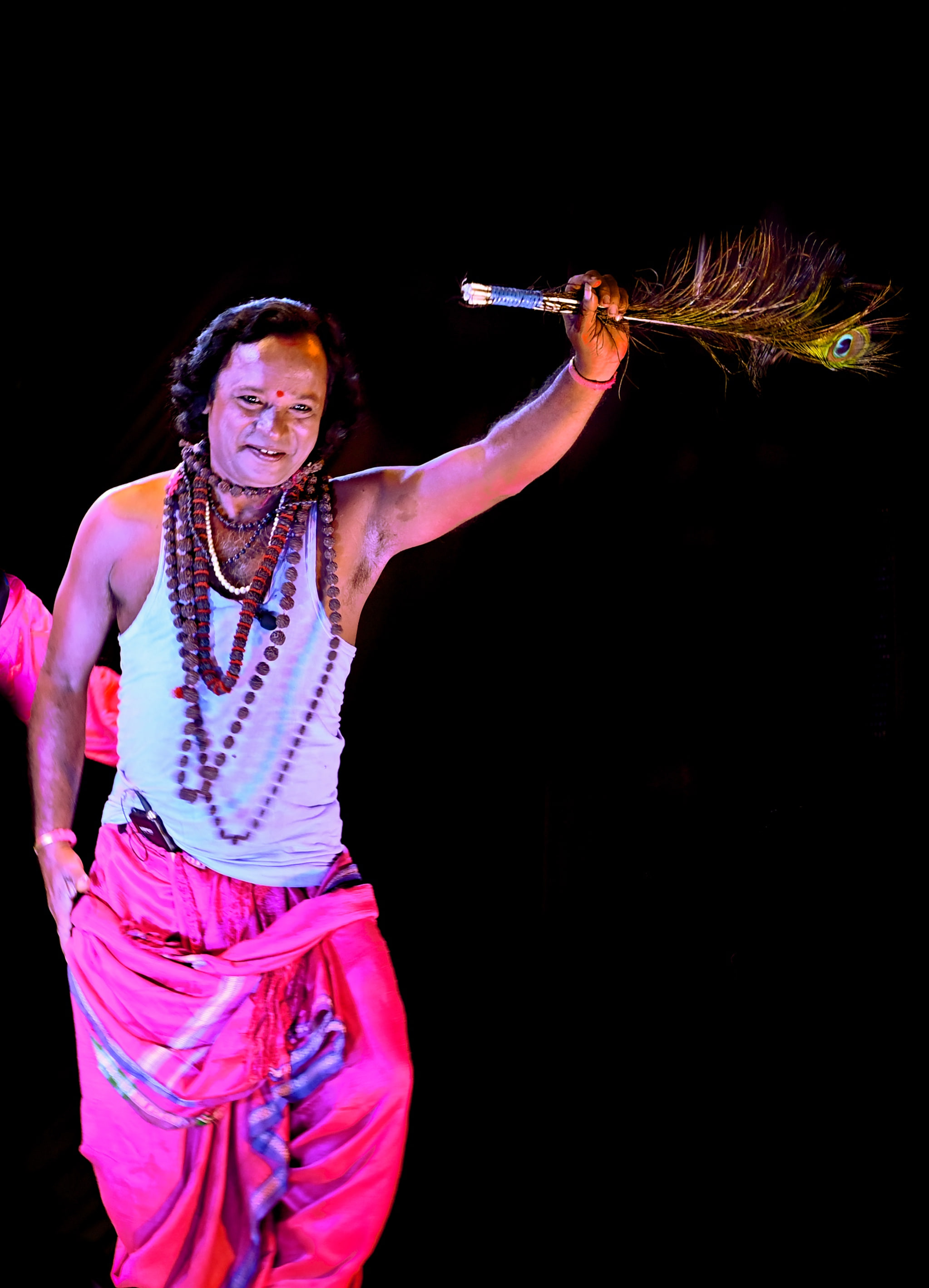
- Guru Simanchala Nahaka performs Dhanakoila or Osakothi. Photograph by Prateek Pattanaik, 5 August 2019. CC BY-SA 4.0. Full-frame photograph compressed for web delivery; responsive versions resized and re-encoded without cropping. ↩

Photograph reuse: CC BY-SA 4.0.
This story draws on published reporting and cultural research. Descriptions of particular practices remain with their named accounts; they should not be read as a uniform sequence followed throughout Ganjam.
Suggest an update. GitHub submissions are public; omit private contact details and consent documents.