
The story as told
Lakshmi and the rejected devotee
Balabhadra Ghadai retells the Lakshmi Purana associated with Balaram Das: Lakshmi honours Sriya, a devotee identified in the narrative as Chandala. Balabhadra objects to the visit, and Jagannath excludes Lakshmi. The conflict centres on caste and the goddess’s freedom to recognise devotion. This is the text’s story, not evidence that discrimination subsequently disappeared.1
A reading of its meaning
Hunger changes the argument
The Mohantys’ 2021 essay describes the brothers’ hardship after Lakshmi leaves and reads the work as a challenge to caste barriers. Food becomes central to the dispute over authority. Our interpretation is that a household’s feeding labour is made visible through its withdrawal: those who dismiss its source discover their dependence on it.2
The story as told
The meal and the recognition
In Ghadai’s retelling, the hungry brothers reach Lakshmi’s new household. Told that its mistress is Chandala, they first attempt to cook for themselves and fail. They finally accept her cooked food, recognise its familiar preparation and reunite with her. The reversal makes exclusion answerable to the experience of hunger. Ghadai himself says the story’s time of formation is not definitely known.1
A source-attributed account
The household observance
The same essay places the worship on Margasira Thursdays and identifies the mana or grain measure among its objects. Dash records khiri, khechudi, kakara and chakuli as associated foods. These are attributed examples, not a compulsory menu for every Thursday or home.23
The story as told
The measure, grain and drawn threshold
The Odia transcription describes the first Margasira Thursday through a prepared grain measure, new paddy and rice-paste designs. Areca nuts, sugarcane, radish and banana belong to its ritual arrangement. This passage records objects and preparation, not a verified household menu.4
The story as told
A separate Sudasa passage
The text then explicitly introduces Sudasa Brata: a Thursday coinciding with the bright tenth. Its ten-knotted thread and ten manda with banana, coconut and chhena follow that transition. They cannot automatically be assigned to every Manabasa Thursday; quantities and practice need edition and household checks.4
The story as told
Return on the condition of shared food
At the close, Lakshmi confronts the brothers for accepting food after condemning her as Chandala. Before returning, she demands mutual feeding across the caste hierarchy; Jagannath agrees. The passage makes shared food a condition of reconciliation within the story. It does not prove that historical discrimination ended.4
What remains to be established
What this witness cannot date
The digital page labels the work1868 without an identified imprint or scan. That label remains quarantined; the composition date and household version are unknown.4
What remains to be established
A history of text, voice and work
The next historical step is to identify dated editions and manuscripts of Lakshmi Purana and compare how they are read aloud. The author attribution alone does not date today’s menu or decorations. The collection should credit the reader, cook and person who draws the household designs, including work that a dish photograph would leave invisible.
Reading before a visit
A visitor’s starting point
Learn the meaning of the grain measure and ask a willing cook about one preparation. A shop selling chakuli does not provide access to a household’s Manabasa worship. A future tasting record needs its own date, provider and consent.
Questions worth carrying forward
- Which edition or inherited oral passage is used?
- Which offerings differ across the Thursdays?
- What does the family say about Sriya and shared food?
- Which printed or manuscript witness underlies revision57790 and its1868 header?
These are invitations for future, consented conversations. They are not reports of interviews already conducted.
Further reading
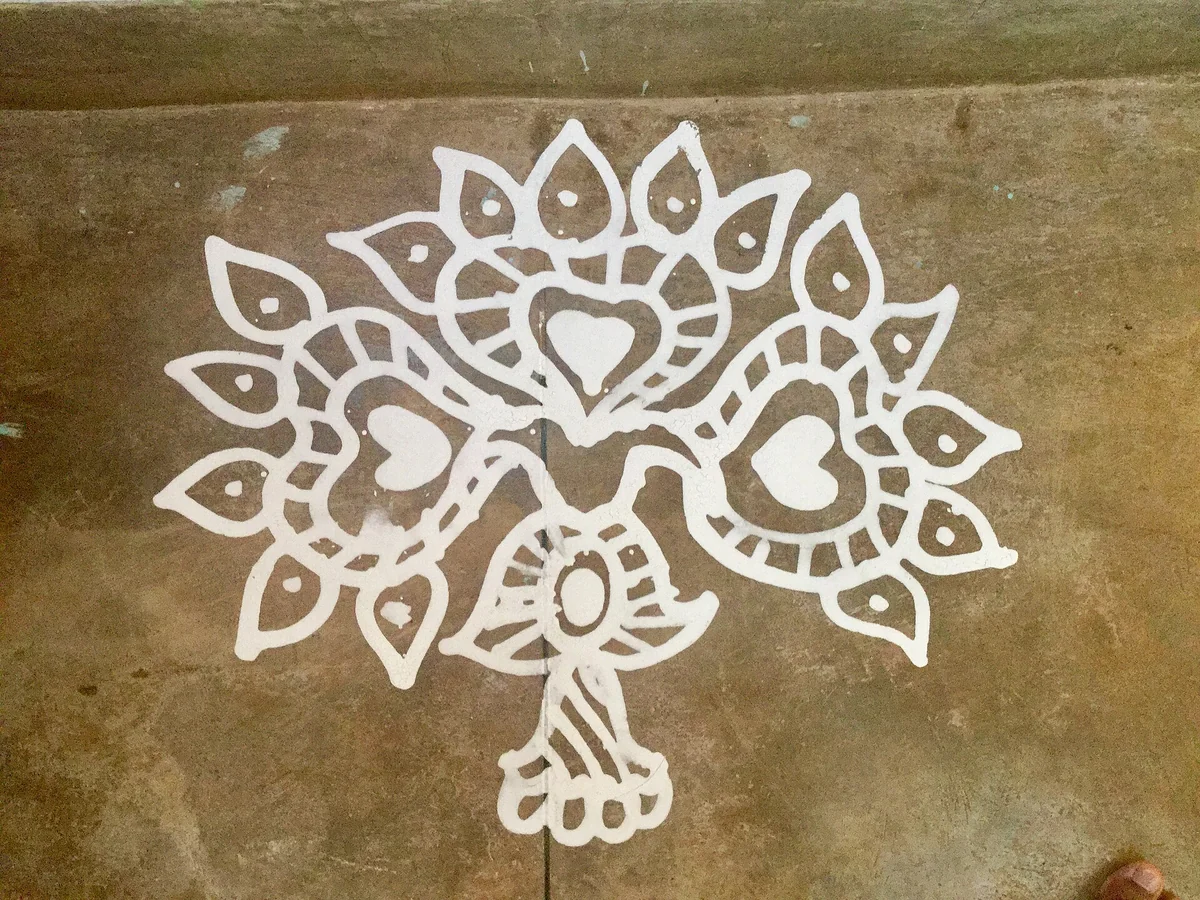
Jhoti Chita5
Footnotes & Sources
Checked 2026-10-11. Human editorial and Odia review pending. A recorded story does not establish the date an observance began.
- Cult of Goddess Mahalakshmi
Balabhadra Ghadai · 2018-06/07
Retelling and interpretation of Lakshmi Purana; article explicitly leaves time of story formation uncertain. Broad origin and current social-access claims not adopted.
Lakshmi and the rejected devotee: Cult of Goddess Mahalakshmi, printed p.102 ↩
The meal and the recognition: Printed pp.103–104 ↩
- Laxmi: The Goddess of Prosperity and Salvation
Dr. P. C. Mohanty and Swadhin Mohanty · 2021-06/07
Signed cultural/devotional essay; not a practice census or a primary manuscript edition.
Hunger changes the argument: Printed p.23, Lakshmi Purana discussion ↩
The household observance: Mohanty p.23; Dash p.17 ↩
- The Perishing Tradition of Osha, Brata and Mela in Orissa: An Overview
Pratap Kumar Dash (byline; endnote spells Das) · 2006-04
Signed cultural overview and bibliographic leads; source-specific descriptions, not a measured current survey.
The household observance: Mohanty p.23; Dash p.17 ↩
- ମାଣବସା ଲକ୍ଷ୍ମୀ ପୁରାଣ — Odia Wikisource transcription, revision57790
Attributed on page to Balaram Das; edition not identified · Publication date not established
Textual narrative and ritual instructions in this revision, not dated origins or present household practice
The measure, grain and drawn threshold: Revision57790, displayed45–56; opening ମାର୍ଗଶିର ମାସେ ↩
A separate Sudasa passage: Revision57790, displayed57–69; opening ମହାଲକ୍ଷ୍ମୀଙ୍କର ଆଉ ଏକ ବ୍ରତ ↩
Return on the condition of shared food: Revision57790, displayed463–480; especially477–479 ↩
What this witness cannot date: Revision57790, header1868 and author attribution; source edition not established ↩
- Photograph: Prateek Pattanaik, Wikimedia Commons, CC BY-SA 4.0. Full frame, resized and compressed from the official Commons preview. ↩

Read the series introduction, The Year That Feeds Us.