
Jhoti Chita and the Art of Drawing with Rice Paste
A line of Jhoti Chita begins with rice paste. Known as pithau, the white paste can be drawn with the fingers or carried by a small piece of cloth tied to a twig. Odisha’s household drawing tradition brings this simple material to walls and floors, thresholds and grain bins, and even earthen pots used at weddings.1
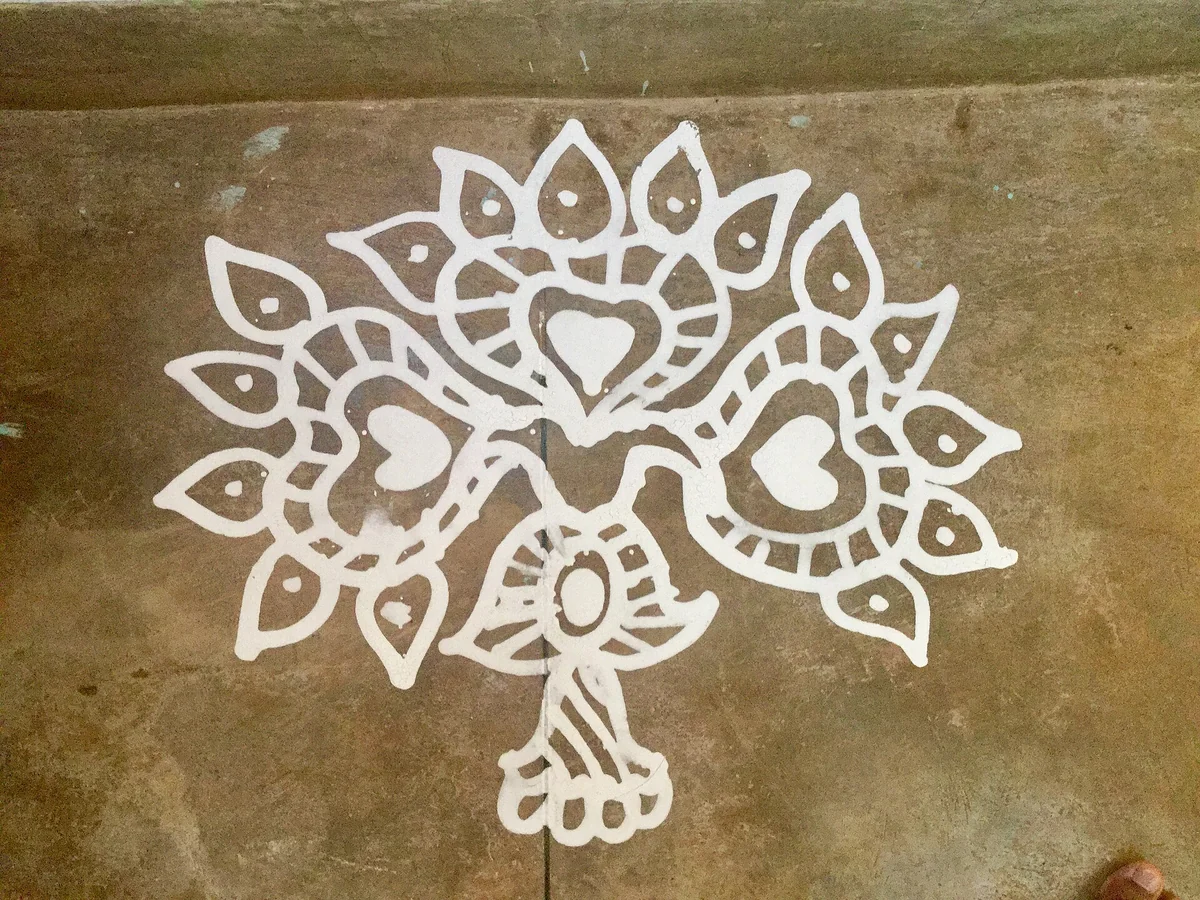
Cloth, paste and a moving hand
Chintamani Biswal and Jagannath Dash describe one way of working with dilute rice paste. A small piece of cloth is held at the middle finger; when it dries, it is dipped again. They also describe cloth tied to a stick. In either method, the cloth carries the paste while the hand guides the mark.3
This gives us something specific to look for in a demonstration. Beyond the completed motif, watch the replenishing of the cloth and the movement that follows it. The tool is modest, but it makes the drawing a sequence of actions rather than a shape that appears all at once.
Drawing on household surfaces
Odisha’s tourism account associates Jhoti with Lakshmi worship in Margasira. The listed surfaces bring the design into household movement: at entrances, beside stored grain and on objects prepared for ceremonies.1
Rice paste also helps distinguish Jhoti from muruja. The same account describes muruja as drawing with coloured powders, released between the thumb and forefinger. Both make patterns on a surface, but following the material reveals a different action of the hand.1
Learning within a family
In December 2023, a Jhoti competition at Raghurajpur brought the practice into a public gathering. Reporting on the event, Minati Singha recorded participant Rukmini Mohapatra’s account of learning through mothers, aunts and grandmothers.4
Mohapatra’s account gives the subject a named practitioner. It also suggests a useful way to approach a finished drawing: ask who taught its maker. The visible lines belong to one work, while the learning may connect several people.
Footnotes & Sources
-
Government of Odisha, “Jhoti, Chita, Muruja”, Jhoti paragraphs 1, 3–4 and Muruja paragraphs 1–2. Material, tools, surfaces and named observance; surface comparisons are the author’s reading. ↩ ↩2 ↩3
-
Photograph: Prateek Pattanaik, “Gurubara Jhoti,” Wikimedia Commons, CC BY-SA 4.0. Full frame, resized and compressed from the official Commons preview. The drawing’s maker is not separately identified. ↩
-
Chintamani Biswal and Jagannath Dash, “Socio-Cultural Context and Aesthetic Values of ‘Jhoti’,” Man in Society, vol. 27 (2020), pp. 113–120, especially printed p. 117 (PDF p. 118), for the cloth and stick methods. ↩
-
Minati Singha, “Raghurajpur women showcase special specimens of everyday art form ‘jhoti’,” The Times of India, 21 December 2023. Mohapatra’s reported account of learning; a dated event, not a survey of every household. ↩

Continue reading
Further reading
Suggest an update. GitHub submissions are public; omit private contact details and consent documents.