
The Dhinki and the Work Behind Rice
The dhinki (ଢିଙ୍କି) is a wooden, foot-operated grain pounder. Gajapati district’s account of older industries identifies its use in removing the husk from paddy, distinguishing it from pohurani, pounding by hand.1 It belongs to the work that turns a harvest into food. Understanding the implement means looking at both its mechanism and the effort of the person operating it.
How the dhinki works
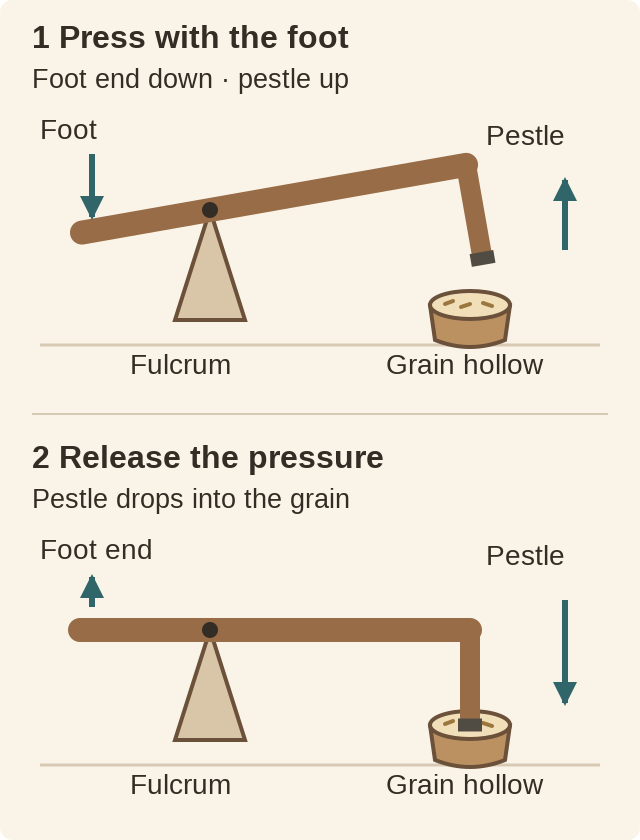
A wooden beam rests on a fulcrum. Pressing down with a foot at one end lifts the pounding end; releasing the pressure lets it fall into a hollow holding the grain. The movement repeats, turning the operator’s effort into successive blows.
Bhubaneswar Sabar and Paramatap Pradhan describe this kind of dhenki among Chuktia Bhunjia people in Odisha’s Sunabeda wildlife sanctuary. Their fieldwork took place between February and December 2023, and the study appeared in 2025. The implement they describe is wooden, preferably sal or teak, with an iron ring around its pounding tip and a wooden receptacle for grain. Women work the opposite end with their feet. Their account places it in a corner of a room, accessible for use.2
From paddy to rice
Threshing separates grains from the harvested panicle, or grain-bearing cluster. Dehusking removes paddy’s outer hull. Brown rice retains bran layers; removing these produces white rice. Pounding can remove bran as well as husk, so rice prepared with a dhinki should not automatically be called unpolished. Ray Lantin’s IRRI/FAO account, last reviewed in 1999, explains these distinctions and describes the beam pounder among rice-processing methods.3
The grain matters as much as the implement. The same broad description—pounding—does not tell us how far processing has gone. Calling a tool traditional cannot, by itself, tell us what remains on the finished rice.
The labour around the tool
The Nabakrushna Choudhury Centre for Development Studies’ Kalahandi baseline report, covering 2016–17 and published in June 2019, places the dhenki in millet processing too. It distinguishes wooden dehusking equipment from the stone chakki used for grinding. The report says women have largely borne grain-processing labour. Among reasons for manual processing, it identifies distance from processing units and the small quantities required by households. Its findings concern the surveyed millet-growing households.4
A Koraput account based on work in eight villages across Jeypore, Kundra and Boipariguda describes women’s household food preparation through sun drying, pounding by foot or hand, winnowing and cleaning.5 The dhinki’s repeated stroke is therefore only one part of the work between stored grain and a meal. Looking only at the wooden mechanism leaves much of that work out of sight.
Lantin’s 1999 international discussion describes mechanical milling bringing relief from arduous work, while also recognising lost earnings for women who pounded rice for sale.3 This older experience elsewhere gives a useful distinction: saving effort and protecting a livelihood are related concerns, but one does not automatically secure the other.
A dhinki can be valued for the knowledge embodied in its making and use without making strenuous labour a duty to the past. Preserving an example, explaining its action or remembering its place in a household need not require someone to keep using it. The people who operate it should have room to say what they value and what they would prefer to change.
Who made and repaired this dhinki? How did its operator learn to judge the grain and the timing of each stroke? What would she choose to retain, change or stop? Those answers would give the tool a history that includes both skill and choice.
Footnotes & Sources
-
Gajapati district administration, “District industries”, “Old Time Industries”; consulted 21 November 2026. The page provides a historical account, not a current inventory. ↩
-
Bhubaneswar Sabar and Paramatap Pradhan, “Material Culture of Chuktia Bhunjia Tribes of Odisha: An Anthropological Interpretation”, Man in India 105(1&2), 2025, pp. 43–64; methods p. 45, husking tools pp. 55–56 and Figure 8(a). ↩
-
Ray Lantin, Rice: Post-harvest Operations, IRRI/FAO, last reviewed 14 October 1999; pp. 4–6, 19 and 48. International technical and social context. ↩ ↩2
-
Nabakrushna Choudhury Centre for Development Studies, Baseline Survey: Kalahandi District 2016–17, Phase 1, June 2019, printed p. 19, section 5.2, “Processing Units.” ↩
-
Smita Mishra, S. S. Chaudhury and V. A. Nambi, “Agrobiodiversity Conservation and Tribal Women of Koraput, Odisha”, eTribalTribune 5(2), methods and passage before Figure 19; publication date unverified. ↩
Read the companion article: Sagada: The Work of a Bullock Cart.
Read next
Debiprasad Sahoo, “Winnowing Fan1”, CC BY-SA 3.0; resized and compressed, same licence.

Continue reading
Further reading
Suggest an update. GitHub submissions are public; omit private contact details and consent documents.