
Personal essay · Bhubaneswar
An Evening in Ekamra: Walking Through Stone, Listening to Song
I have visited many temples in Bhubaneswar, but until this evening I had never been to Parsurameswara. I joined Ekamra Walks for Bhubaneswar by Night, with Prateek guiding us around the temple and Omm Prakash and team leading an Odissi music session beside Bindu Sagar afterwards.1
We had already written about heritage walks in Project Odisha. Now I was taking part myself, looking closely at the carvings as Prateek explained them, then spending the later part of the evening listening to music with Lingaraj Temple in view.
At Parsurameswara with Prateek
The tower of Parsurameswara Temple was lit against a deep blue sky. Light picked out the projecting stonework, with shadows between the carved surfaces.
Prateek began with the structure. He described the sanctuary tower as a rekha deula, a form associated with Kalinga architecture. Beside it was the lower jagamohana, or entrance hall. He drew our attention to its rectangular form and how it differed from the pyramidal halls of many later Odishan temples.
Looking from the tower to the hall, I could follow what Prateek was explaining. Parsurameswara is generally dated to the seventh century and belongs to the early development of Odisha’s temple architecture.2
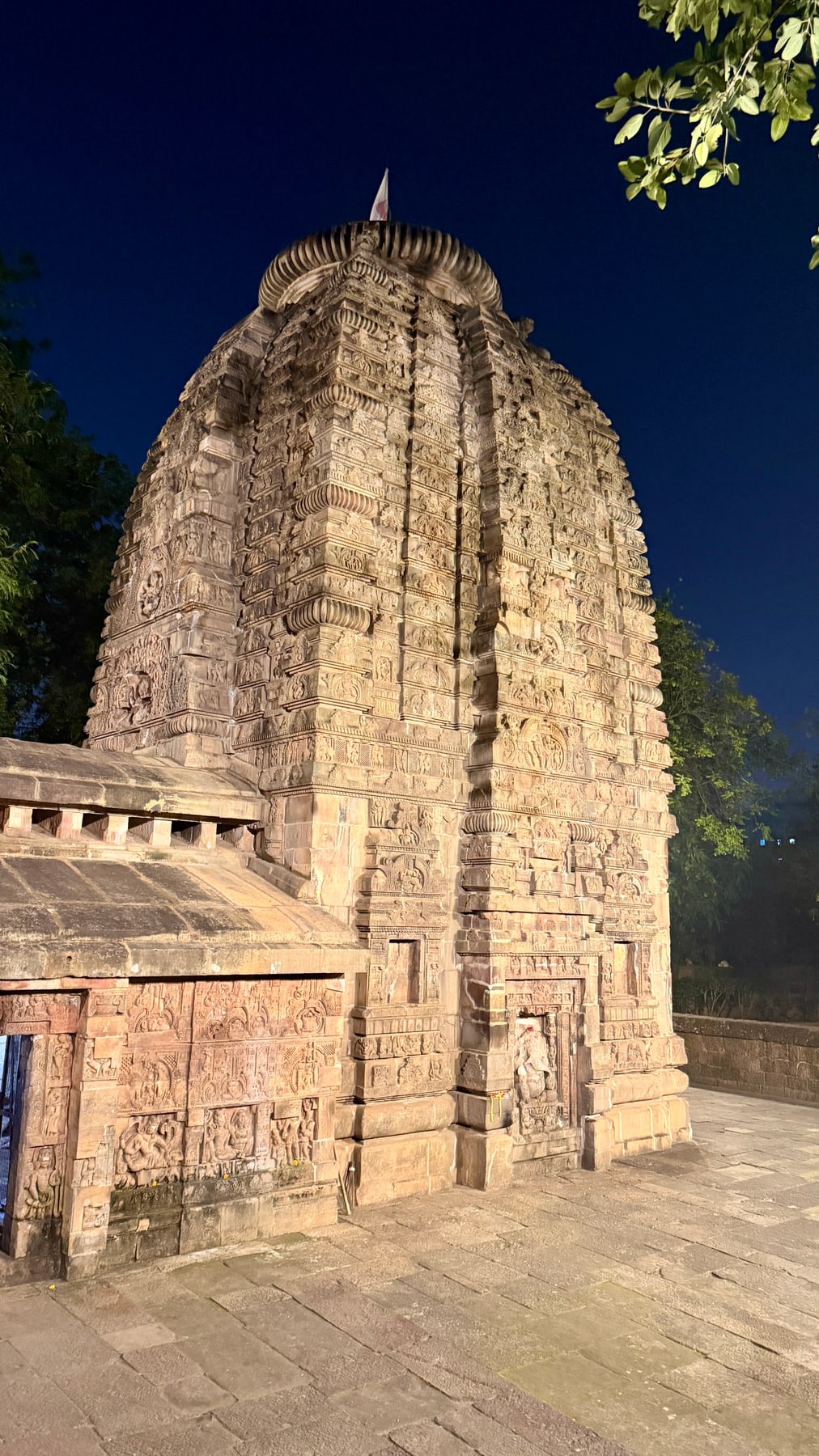
He also discussed stone construction and the use of iron clamps to secure building elements. His account brought the making of the temple into the conversation: how the stones were joined, as well as what was carved on them.
When he spoke about the Shailodbhava dynasty, he included a legend about its origins near Mahendragiri. In the version we heard, a figure emerged from stone and became the founder of a ruling line.
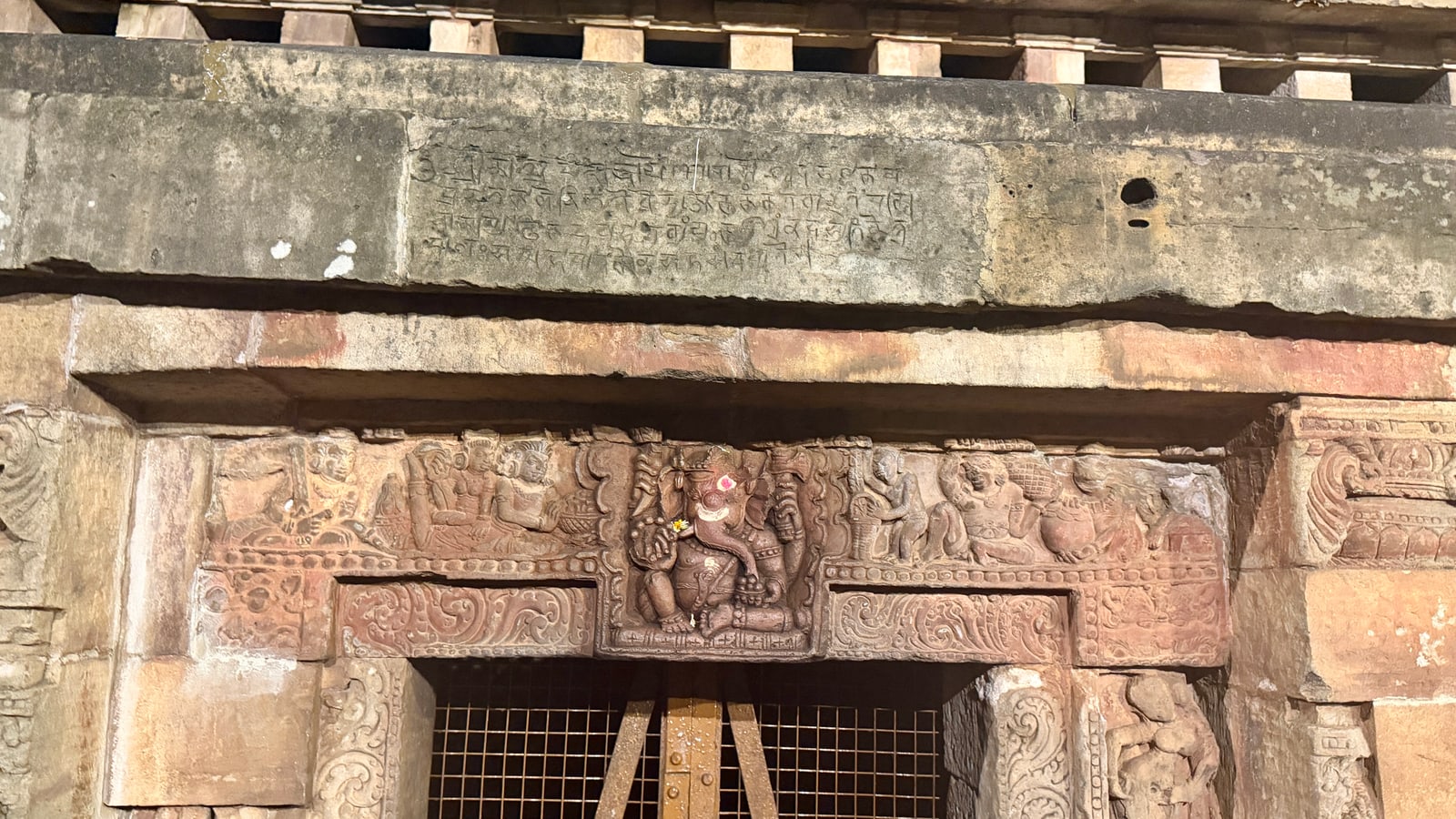
There was a great deal to see on the walls. Above one doorway sat Ganesha, surrounded by attendant figures and decorative carving. Higher up, an inscription ran across a stone beam. Faces appeared within curling frames, and small patterned screens broke up the solid stonework.
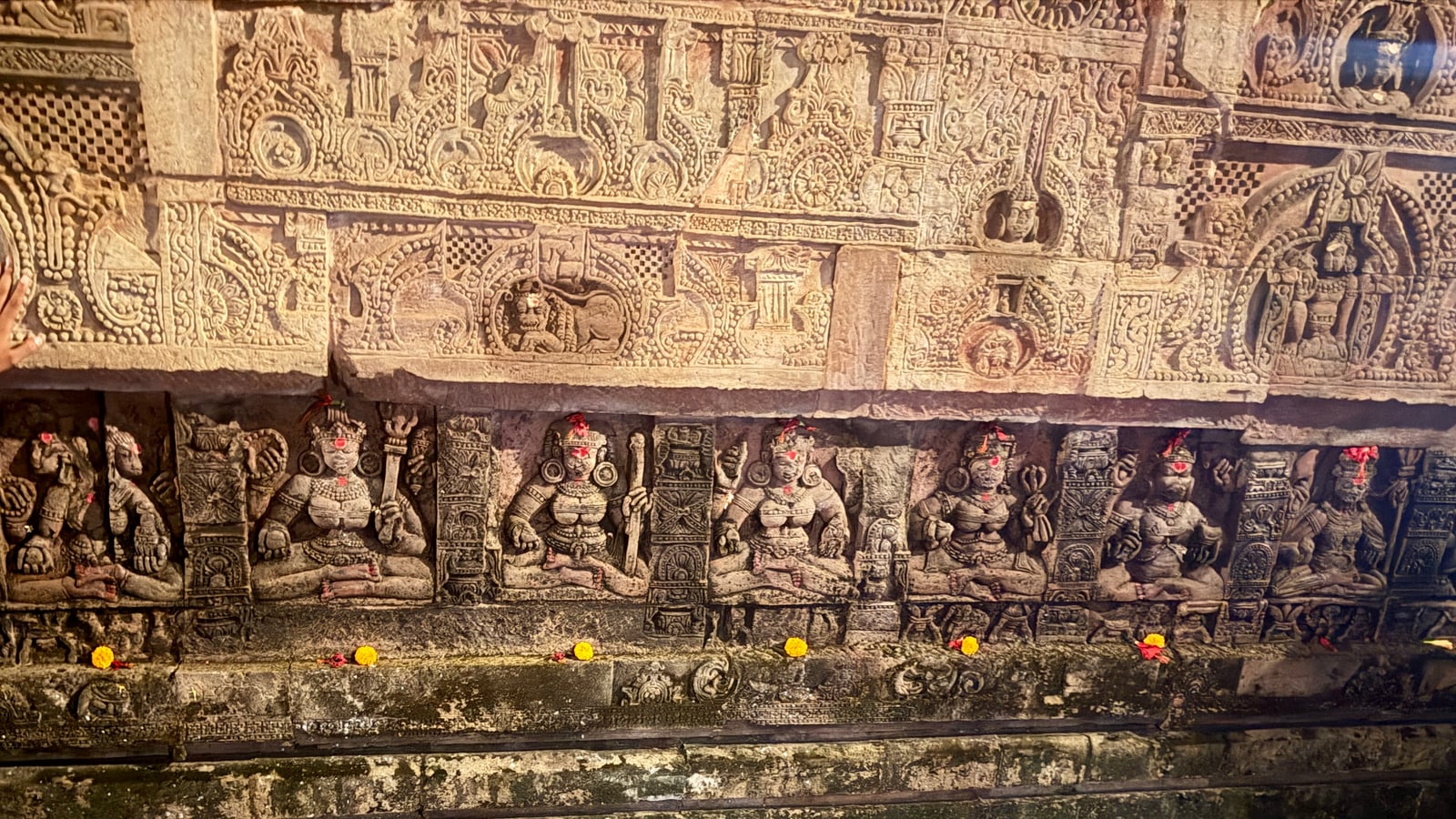
Prateek introduced the row of mother goddesses as the Saptamatrikas. He explained their associations with divine powers and their place in mythological battles. Along the panel, the seated figures have distinct ornaments and attributes. Flowers lie beneath them, and red marks of worship touch the stone.
Flowers had been placed on other sculptures too, and a priest stood at the doorway. Worship continues here. The figures Prateek was helping us understand were also sacred images receiving people’s offerings.
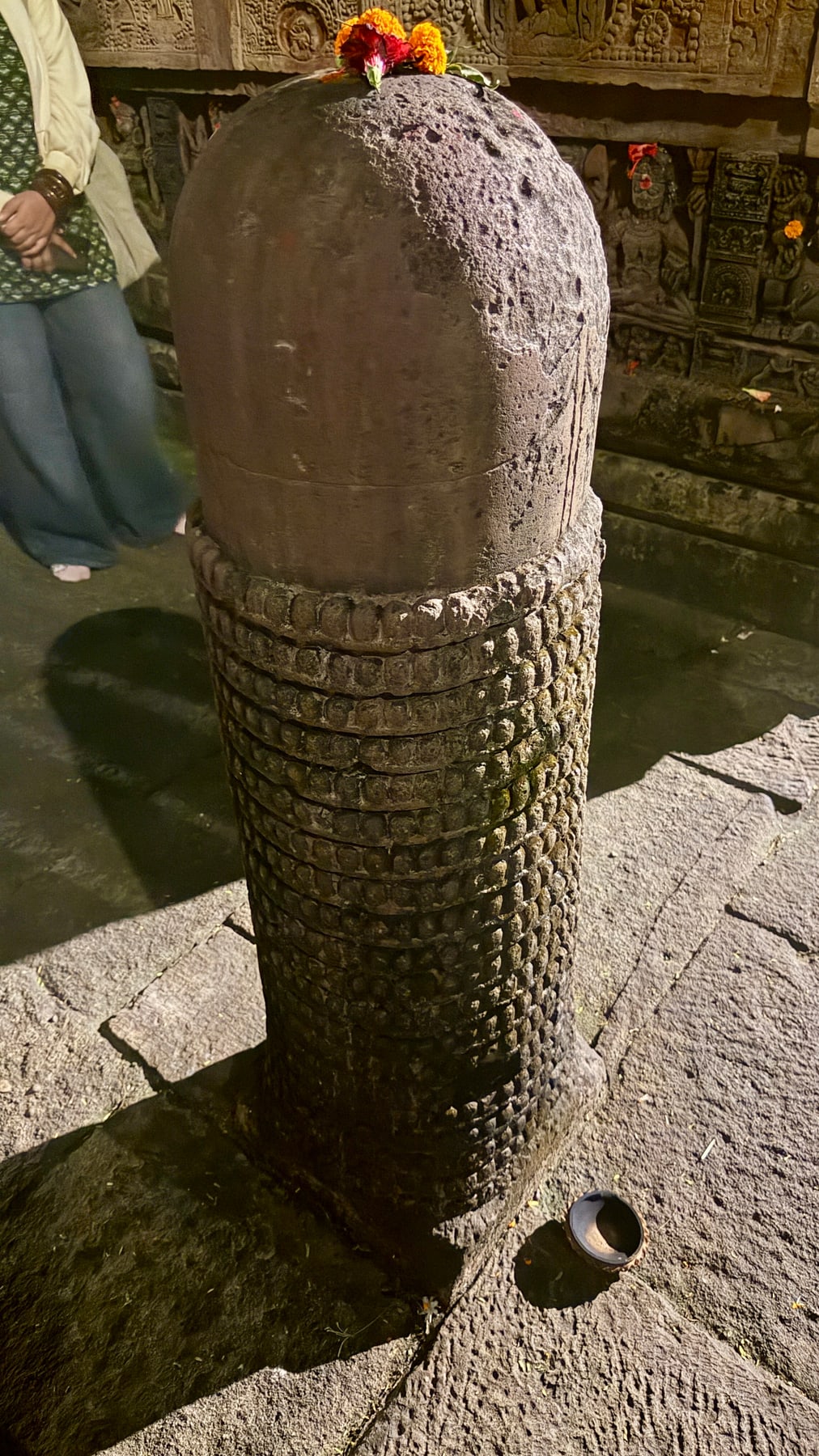
The Sahasra Linga was another object Prateek asked us to notice. He explained it as a linga bearing a thousand miniature lingas. Rows of small carved forms covered its lower surface. Flowers rested on top, with a small earthen lamp near the base.
Prateek also spoke about Lakulisa and the Pashupata tradition. There was more here than I could take in during one visit. I kept these names in my notes, along with the architectural terms and details I wanted to return to.
The stories Prateek told us
From the temple, Prateek’s account widened to Ekamra Kshetra and the great mango tree remembered in its mythology. In the story he narrated, a self-manifested linga stood beneath the tree. Parvati came to this place beloved by Shiva and took the form of a cowherd woman, Gopalini.
We heard about the two asuras, Kirti and Vasu, who encountered her. In Prateek’s telling, she asked them to carry her, then became so heavy that they were crushed beneath her weight. He connected this episode with a place remembered for the goddess’s footstep.
The story of Bindu Sagar followed. Prateek described Shiva bringing together waters from sacred rivers to quench Parvati’s thirst. He presented it as an expression of love.
He also narrated Ravana’s attempt to lift Kailash: the mountain shaking, Parvati’s alarm and Shiva pressing down with his toe, trapping Ravana beneath it. The account continued through Ravana’s suffering and devotion. Prateek pointed out a sculptural representation associated with the episode and explained that it could be difficult to see clearly, even in daylight.
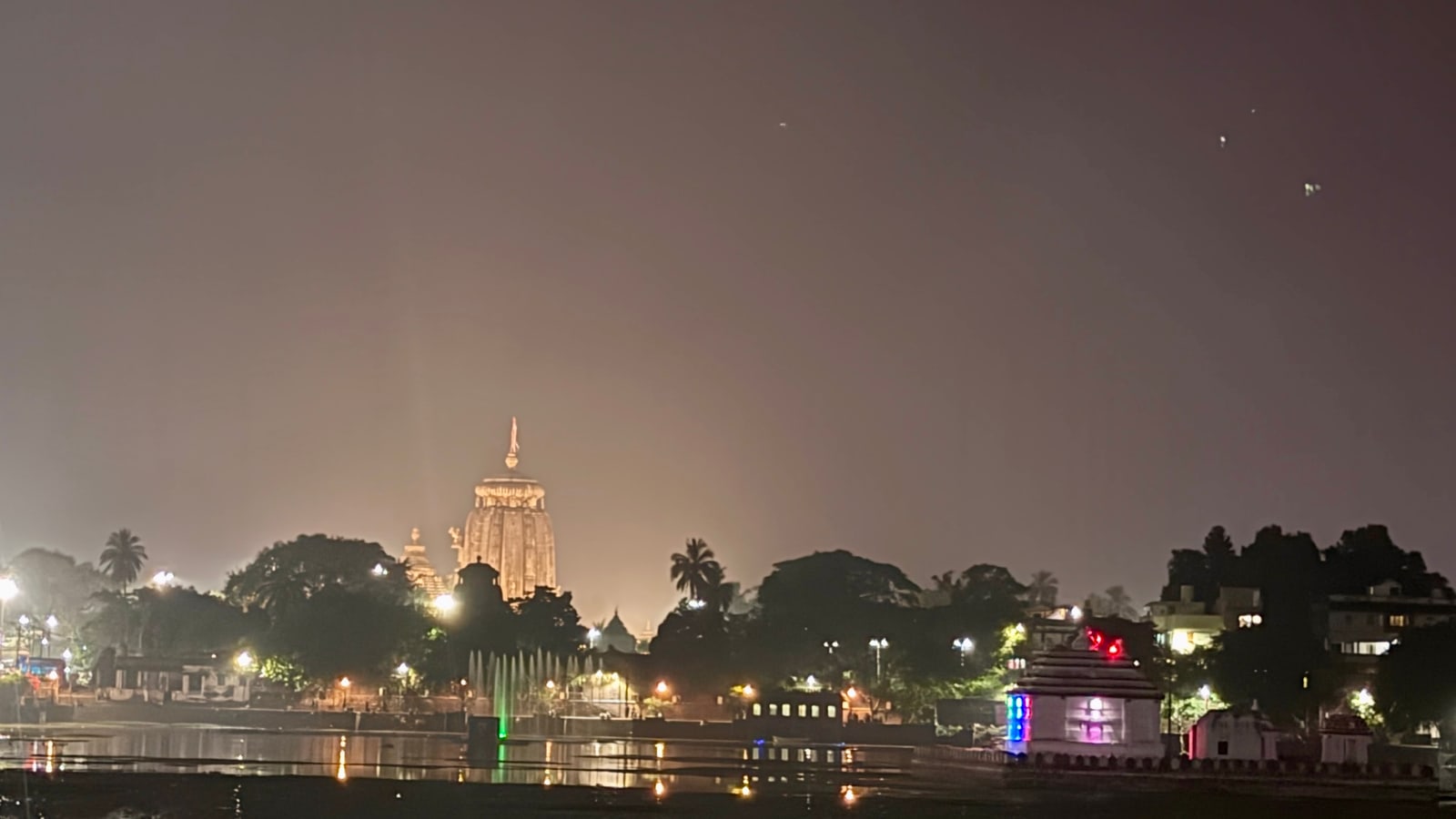
Later, beside Bindu Sagar, we could see Lingaraja’s illuminated tower beyond the trees and buildings. Reflections crossed the water, with the coloured lights of the fountains nearer the shore. After Prateek’s account of how Bindu Sagar came into being, we were here for the music.
Listening to Omm Prakash and team
Omm Prakash and his team sat together on striped mats beside the water. A large barrel-shaped drum rested before the percussionist, and notebooks and loose pages lay open in front of the performers. A musician wore a bright yellow kurta, and a woman in a patterned sari sat beside him. The city lights were visible behind them.
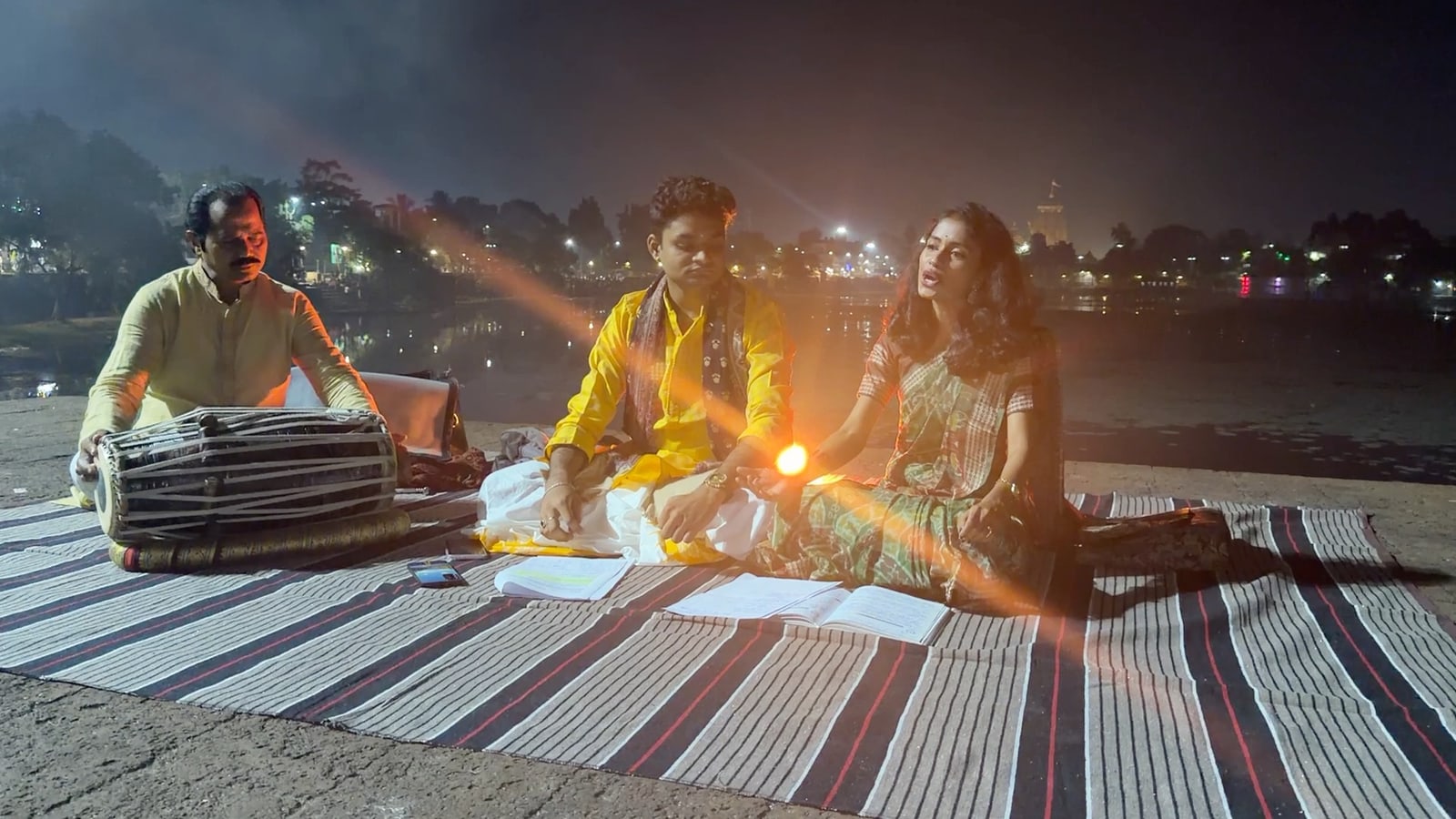
The Odissi session was an amazing experience for me. The singers were also teaching us as they performed, explaining the music, its poetry and the ideas behind it. I could listen and learn in the same sitting.
Listening to Odissi music with that spectacular view of Lingaraj Temple was simply blissful.
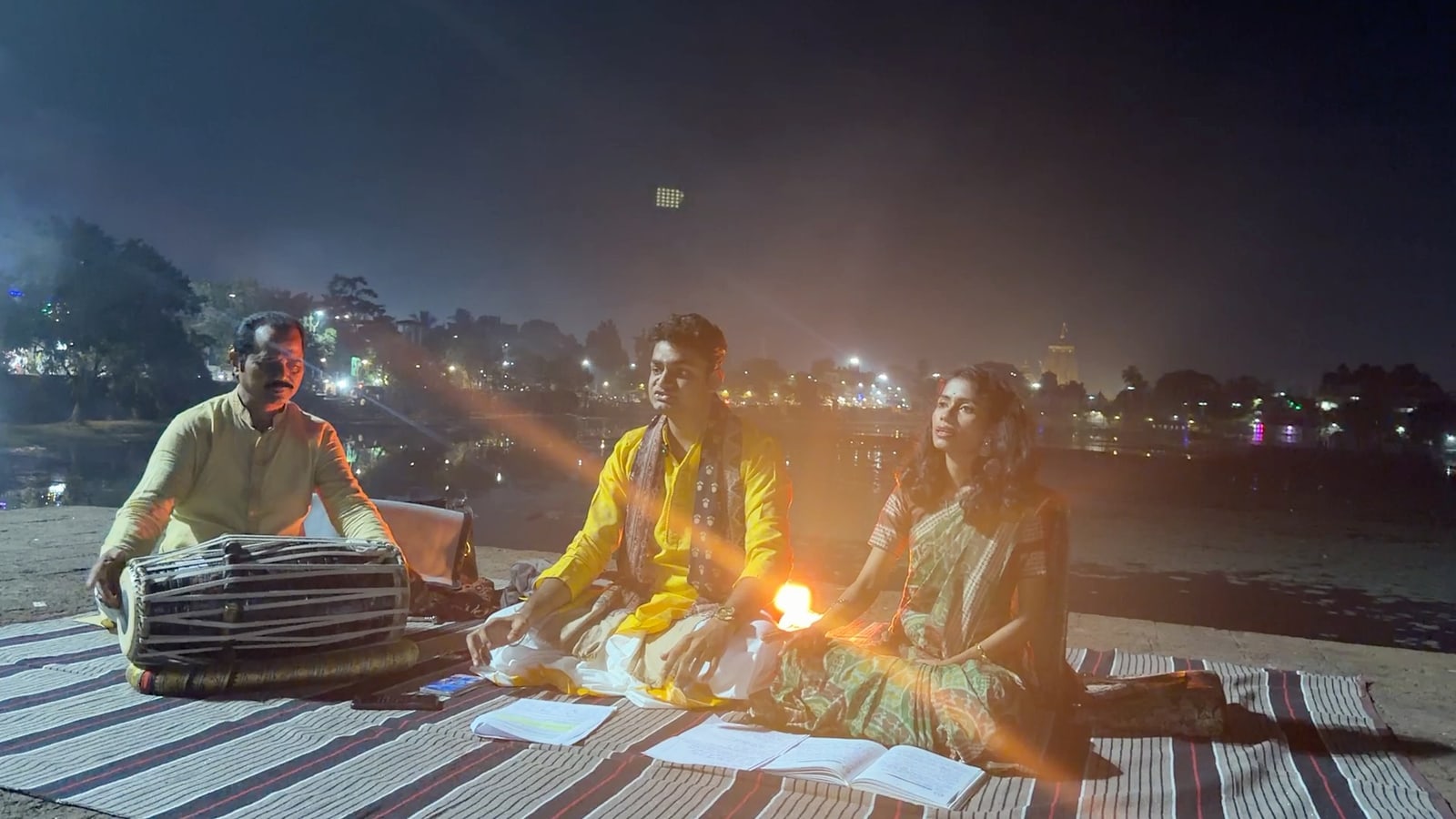
Jayadeva’s Gita Govinda was an important part of the discussion. We heard about its place in Odisha’s musical and devotional traditions. The twelfth-century Sanskrit work, centred on Radha and Krishna, has influenced music, dance and other arts across India.3 During the session, its poetry was discussed as material for singing and interpretation.
In A Week in Bhubaneswar: Conversations and New Beginnings, I wrote about the people I had been meeting and the unexpected directions those conversations were taking me. Writers, filmmakers and heritage storyteller Shakti Badjena had given me more to think about, and more reasons to explore Odisha.
Turning my teenage poem, “I Am Free to Dream,” into music had drawn me back towards poetry. I had written about that experience too. Here, the singers were explaining how poetry is sung and interpreted within the Odissi tradition. I could relate to that interest in how a written poem becomes something we listen to.
The discussion also addressed Odissi music’s classical character: its notation, rhythmic cycles and compositional structures. The speakers argued for a fuller understanding and recognition of the tradition. Guru Gopal Chandra Panda’s work came up in the account of teaching, composition and preservation.
There were philosophical questions as well. The conversation touched on an ultimate reality beyond visible form, on surrender and on the longing expressed in devotional poetry. The notes I brought back include references to poet-saints, songs addressed to the divine and the idea of devotion without worldly demands.
This is a fantastic effort by the Bhubaneswar Development Authority (BDA) and Team Ekamra Walks. Thank you to Prateek, Omm Prakash and the team for sharing what they know with us. I had finally visited Parsurameswara, and I had spent the evening listening to Odissi music beside Bindu Sagar. I’m glad I joined the walk.
Footnotes & Sources
-
Ekamra Walks, Bhubaneswar by Night, 14 November 2026. The accounts of Prateek’s explanations and the musical discussion draw on my notes from the evening. Legends are presented as narrated on the tour. ↩
-
Odisha Tourism, From Nataraja to Lakulisa of Parasurameswar Temple in Bhubaneswar, for the temple’s seventh-century setting and early Kalinga architectural context. ↩
-
Indira Gandhi National Centre for the Arts, Gita Govinda, for Jayadeva, the Sanskrit composition and its influence across artistic traditions. ↩
Continue reading
Suggest an update. GitHub submissions are public; omit private contact details and consent documents.