
History and heritage · Dhenkanal
Kapileswar at Hatuari: What Do We Actually Know?
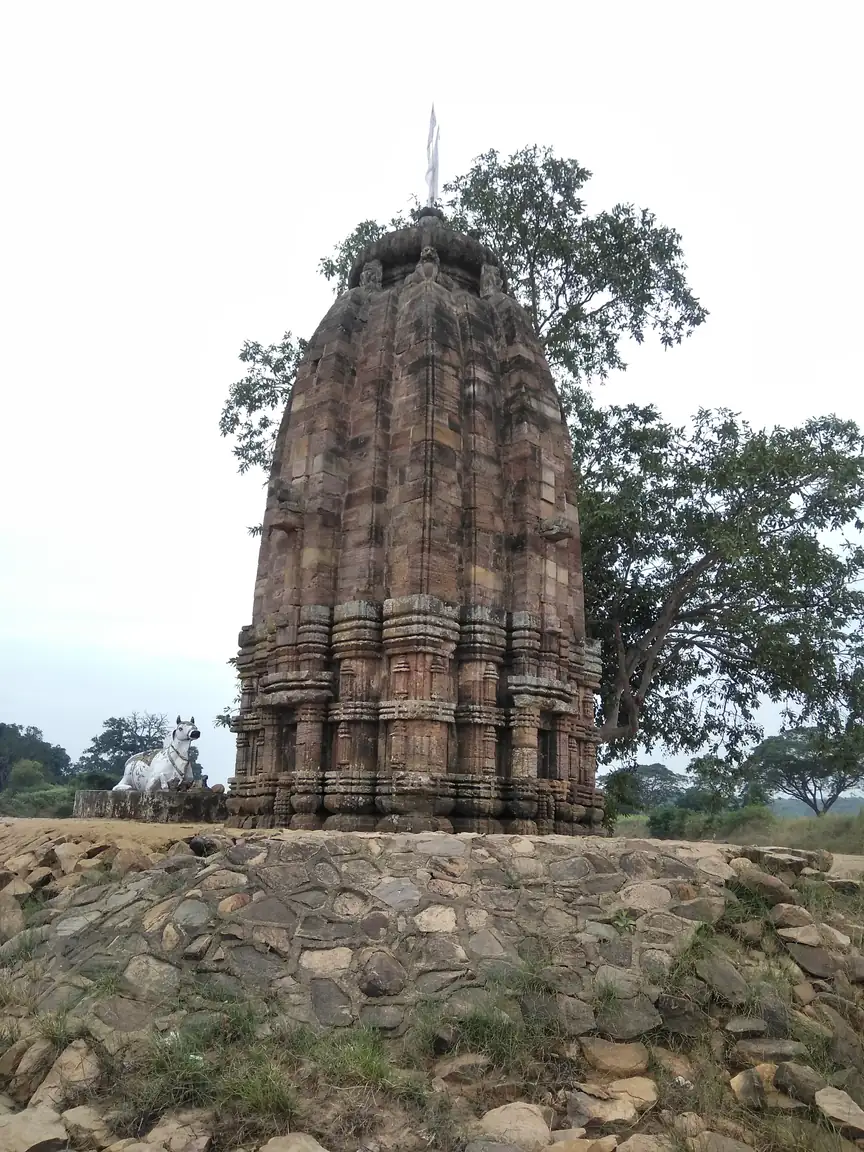
At Hatuari in Dhenkanal, a stone tower rises beside a spreading tree. In Anup525’s photograph, its curved outline and weathered masonry rise above a stone-faced embankment. This is Kapileswar Mahadev: a Shiva temple on an island in the Ramiala River, distinct from the Chandrasekhar shrine on Kapilash hill.1
Its age is less settled than its identity. Published accounts disagree, and the words used to explain their dates deserve attention. The useful question is what each source actually establishes.
What the record identifies
The National Monuments Authority’s published list names the Temple of Kapileswar Mahadev at Hatuari, Dhenkanal, among centrally protected monuments.2 An IGNCA-hosted inventory records a living Shiva temple with an east-facing rekha tower, dry ashlar masonry and “Khandolite” stone. The photograph alone cannot establish that geological identity.1
The tower’s outline and courses of dressed stone are visible in the photograph. Their presence helps us read the building, but does not by itself identify a patron or fix a century. A building type can continue across successive reigns; an architectural date needs a reasoned comparison with securely dated examples.
Two dates, different kinds of evidence
On 26 July 2020, OrissaPOST reported Tapan Kumar Satpathy’s belief that the shrine was built in the twelfth century during Ganga rule. The wording is explicitly tentative. The report does not supply an inscription, excavation or comparative architectural argument to substantiate that date.3
The inventory assigns a fourteenth-century date under Ganga rule, based on architecture. Its precise-date field is blank; its sole bibliographic entry is Cultural Heritage of Dhenkanal (2005). These records should not be counted as independent confirmations.1
The distinction matters: a reported belief and an architectural attribution are both evidence about how the temple has been understood. Neither is equivalent to a dated foundation record.
The problem on page 215
The Hatuari subsection on printed page 215 of Cultural Heritage of Dhenkanal attributes the temple, on artistic and architectural grounds, to the “Post-Ganga period” and immediately identifies that period as the fourteenth century.4
Read in its usual dynastic sense, this is an apparent chronological inconsistency. The fourteenth century runs from 1301 to 1400. The Eastern Ganga succession in Odisha continued into the fifteenth century; the Ganjam district gazetteer places Kapileswaradeva’s succession in 1435.5 A fourteenth-century temple would thus fall within Ganga rule, not after it.
The wording could reflect an error in the period label, an error in the century, or a stylistic usage that the available passage does not explain. We cannot choose among those possibilities without further evidence. Silently replacing “Post-Ganga” with “late Ganga”, or changing the date to the fifteenth century, would manufacture a certainty the source does not provide.
The full chapter has not yet been verified. Its author, complete references and any additional explanation of the dating remain unconfirmed. The available passage establishes what is printed on that page; it cannot tell us everything the chapter’s author may have argued elsewhere.
For now, the fourteenth-century date is a provisional architectural attribution, not an established construction date. The contradictory period label should travel with any discussion of that attribution, rather than disappear in retelling.
The neighbouring hill shrine
Kapilash also requires care. D. C. Sircar’s reading favouring 1246 concerns inscriptions on a detached stone kalasa, an architectural crowning element that he associated with an earlier temple. It is not a secure date for the entire building standing there today.6 Comparing two unqualified construction dates would therefore conceal uncertainties at both sites.
A documented history of conservation
There is firmer evidence for at least one intervention at Hatuari. ASI’s Indian Archaeology 2008–09—A Review records work on a stone retaining wall intended to protect the temple from floodwaters. Entry 111 begins on printed page 219 and continues onto page 220.7
That report documents conservation work at a particular time. It does not establish the temple’s founding date, prove the present effectiveness of the wall, or diagnose the condition of its foundations today. Those questions require current site records and specialist examination.
An invitation to add evidence
The next step is to locate the complete chapter containing page 215, including its opening, byline, notes and bibliography. Earlier survey photographs, measured drawings, inscription records and ASI conservation files could then help distinguish original fabric from later interventions. Local accounts should be recorded with their provenance, alongside this documentary work.
Readers who can identify the chapter, point to an earlier publication or share a properly credited site record are invited to contribute. The purpose is a better documented history of Hatuari—one that can change when stronger evidence becomes available.
Footnotes & Sources
-
IGNCA-hosted monument inventory, Kapilesvara Mahadeva Temple, Hatuari, serial OR/DKL-08, pp. 1–4. Compiled by Jaya Shankar Naik; reviewed by Sadasiba Pradhan. Dating: p. 2; architecture: p. 3; bibliography: p. 4. ↩ ↩2 ↩3
-
National Monuments Authority, list of centrally protected monuments, updated 24 April 2023, PDF p. 41, entry 2107, “Temple of Kapileswar Mahadev”, Hatuari, Dhenkanal. The listing establishes protected identity, not a building date. ↩
-
OrissaPOST, “River Ramial might eat into Kapileswar temple which dates back to Ganga dynasty”, 26 July 2020. The twelfth-century claim is attributed to Tapan Kumar Satpathy as a belief; the article does not reproduce supporting archaeological evidence. ↩
-
Cultural Heritage of Dhenkanal, printed p. 215, subsection “Kapileswar Mahadev Temple, Hatuari, near Kamakshya Nagar”; Google Books record and passage search. The year 2005 is given in the inventory’s bibliography. The full chapter, its author and complete references remain unverified; volume-level editors should not be substituted for an unidentified chapter author. ↩
-
Government of Odisha, Ganjam District Gazetteer, printed p. 44, account of the transition from the Gangas to Kapileswaradeva in 1435. This supplies dynastic context, not direct evidence about Hatuari. ↩
-
D. C. Sircar, “Kapilas Inscriptions of Narasimhadeva”, Epigraphia Indica XXXIII, printed pp. 41–43. See also Project Odisha’s Kapilash article for the distinction between the inscribed remnant and the present building. ↩
-
Archaeological Survey of India, Indian Archaeology 2008–09—A Review, entry 111, printed pp. 219–220 (PDF pp. 230–231). Original report linked through ASI’s publication directory. The Hatuari entry records retaining-wall work in progress; adjacent entries concern other monuments. ↩
Continue reading
Further reading
Suggest an update. GitHub submissions are public; omit private contact details and consent documents.