
The book · First reading edition
Mirgan Households and Kotpad Textiles
People, Colour and Livelihoods in Odisha
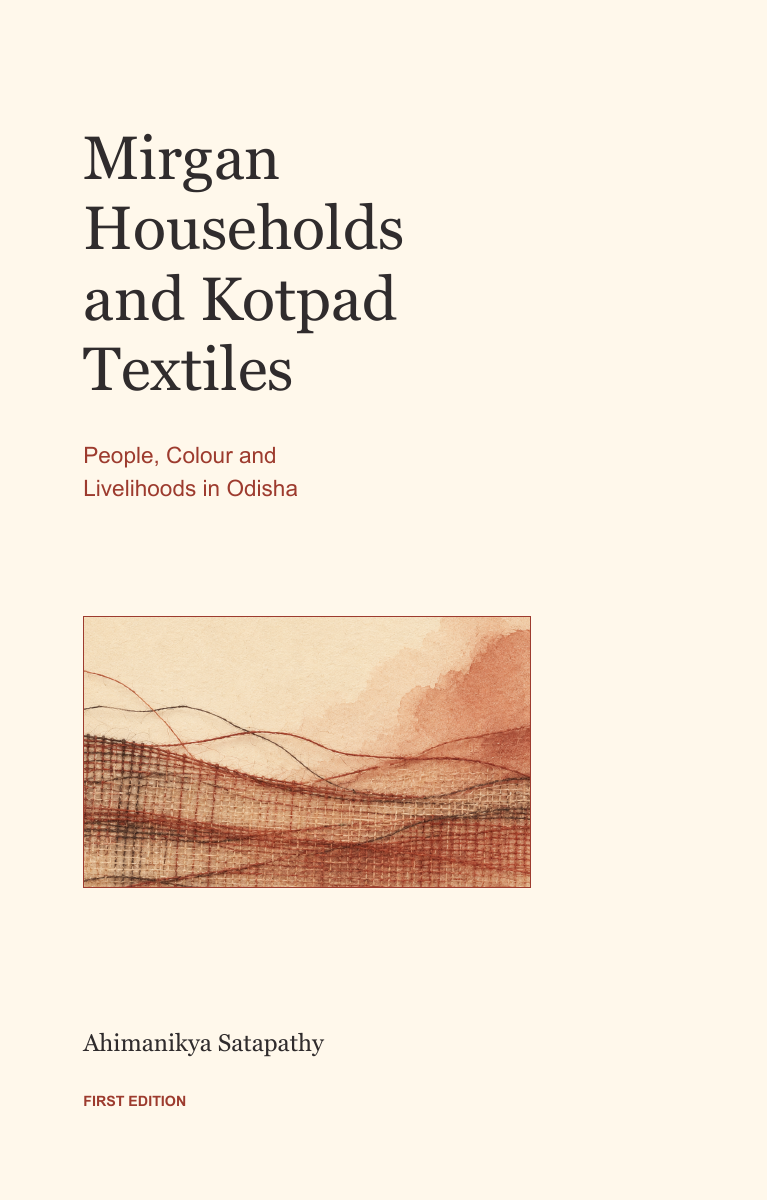
Behind a finished textile are people whose work may be only partly visible: dyers preparing colour, weavers shaping cloth, teachers passing on skills and households arranging materials and orders.
Mirgan Households and Kotpad Textiles follows these relationships across Odisha. Its nine chapters explore the judgement involved in making colour, the people sharing the proceeds of a sari, the journeys cloth takes and the demands of the working year. They also consider what support programmes can show and how skills pass between generations.
Prepared from published sources without a field visit, this first edition brings named testimony together with historical records and documented practice. It invites readers to look closely at the knowledge, choices and livelihoods behind the cloth, with references for further reading.
58 pages, including the front and back covers.
Introduction
A piece of cloth makes many kinds of work visible at once. Its colour holds the decisions of a dyer. Its structure records work at a loom. Its journey to a wearer depends on people who arrange materials, place orders, carry goods and settle payments. Yet the label attached to the finished textile may name only a place, a technique or a seller. This book follows the relationships that lie behind that label.
Kotpad provides the geographical centre of the account. Mirgan households provide its human focus. Neither term supplies a ready-made boundary. A place associated with textile expertise can serve households elsewhere; a community name in an old record cannot settle the identities of everyone working today. The opening chapters therefore begin with names, localities and historical traces before turning to colour, livelihoods and change.
The chapters connect textile history with the practical questions of a working life: preparing yarn, judging colour, arranging an order and receiving payment. Together these activities help explain how a household can keep producing and how a learner can find opportunities to practise.
Hasita Panika’s attention to root material brings practical judgement into the story of colour. Jema Panika’s concern about recognition directs attention towards work that can disappear behind admiration for a finished sari. Hari Tanti’s reported transaction distinguishes thread costs from money assigned to shared work, while Jagabandhu Panika’s account shows why payment timing matters. These published accounts, examined in the chapters that follow, retain the names and circumstances of the people who give them.
The continuity of textile knowledge depends on opportunities to exercise it. Knowing a technique does not secure materials or orders, and an order becomes available income only when payment arrives. Recognition matters too, but it cannot tell us how money or decisions are shared. These connections place the craft within the conditions of everyday work.
The first part locates people and traces the past through written records and surviving objects. The second follows the work: a transaction, the making of colour, the contributors to a textile and the routes through which it travels. The third considers water, roots, fuel and the working year, then examines what support programmes document and how learning relates to the future. The order moves from where and who to how work becomes possible.
This first edition brings together published reporting, named testimony, process documentation, museum catalogues and institutional records. It was prepared without a field visit. The method and source notes explain how the account distinguishes other people’s observations from interpretation and where the evidence remains incomplete.
Above all, this book treats practitioners as people with working lives and aspirations. Continuing a craft may involve adapting it, combining it with other work, teaching selected skills or choosing a different occupation. Admiration for textile knowledge should make those lives more intelligible. It should leave the people who hold that knowledge room to decide what they wish to carry forward.
A note on method and this edition
This edition is a desk-based synthesis prepared in November 2026. No field visit, household survey or new interview was conducted for it. Named testimony and descriptions of work come from the credited published sources. The separate research archive includes a proposed household survey; it does not record a completed survey.
The evidence falls into several groups: named-maker and journalistic accounts; craft-process documentation; historical writing and museum catalogues; administrative records; and implementer or government reports. Each serves a different purpose. A catalogue attribution is not a workshop provenance. A village population is not a count of active weavers. A training target, recorded attendance and sustained paid practice measure different things.
Publication, observation and event dates are kept separate. An undated maker page cannot securely convert a remembered age into a calendar year. A film’s production year does not automatically date its webpage. A later update to an article does not prove a new visit to a plantation or household. Historical place names and community classifications remain attributed to their sources.
References are numbered once across the book. Repeated citations to one source retain the same number. Sources concerning the same person or project are not treated as independent confirmations merely because they appear on different websites. In particular, the two Jagabandhu accounts share a subject, and the World Bank documents belong to one project reporting chain.
Some passages were available only as indexed text or earlier inspected catalogue records. The source notes identify these limits. Missing costs, sample sizes, dates and household identities have not been supplied by inference. Unreconciled programme figures and the excluded proceedings citation are discussed in the source notes.
Nine connected chapters
PART ONE · PEOPLE AND HISTORY
PART TWO · MAKING AND EARNING
PART THREE · CONTINUITY AND CHANGE
Conclusion
A finished textile can bring colour, structure and design into a single field of attention. Following it back towards its making separates what that finished surface holds together: material preparation, skilled judgement, weaving, commissioning, exchange and payment. Following it forward reveals other relationships, with wearers, collectors, designers and institutions. Kotpad cloth belongs within these movements as well as within a named locality.
Following the work changes what a finished textile asks us to notice. A price contains costs and shared effort; a household contains several contributors; a collection label preserves only part of an object’s history. These distinctions help connect appreciation of the cloth with the circumstances of its making.
Colour is central to that account. The sources describe preparation, repeated handling and judgements about readiness and shade. They also identify practitioners whose work deserves recognition in its own right. Understanding the dyer’s contribution changes the idea of authorship: the person most visible at the loom or in the market may be one among several people whose decisions shaped the textile.
Knowledge becomes usable through material conditions: a place to wash yarn, suitable space for drying, supplies that arrive when needed and time to complete successive stages. These conditions connect the working year to the terms of an order. A delayed input or an inaccessible washing place can matter alongside the price eventually paid.
Support programmes enter this same working life. Training, documentation and market introductions address different needs. Their significance becomes clearer when records show what people could do afterwards: practise a skill, complete an order, receive payment or overcome a recurring interruption. The documents examined here do not yet trace those outcomes consistently for Kotpad.
Learning brings these concerns together. Skills develop through practice, and practice takes time, materials and relationships. A younger person’s interest in textile work cannot be understood apart from the circumstances in which that work would be done. Nor should the future be reduced to a choice between an unchanged tradition and its disappearance. The family account associated with A Weave in Time shows why other work and inherited knowledge can remain part of the same life.
The extent of current practice and the distribution of earnings remain open questions. This edition provides a basis for pursuing them without turning a named household or a programme total into a portrait of the whole region.
Kotpad’s future will take shape through decisions about work, learning, resources and exchange. Careful description can recognise the knowledge involved and make its conditions more visible. The choices about what to continue, adapt or leave behind belong to the people doing the work.
Glossary
Aal
The craft name used here for the root-derived dye material. It does not, by itself, verify the botanical identity of a supplier’s plant.
Accession
A collection’s registration of an object. An accession reference does not by itself establish the object’s manufacture date.
Commission
An arrangement to make cloth to an order. The person commissioning and the people making may be different.
Elapsed time
The period between stages or between beginning and completion, including waiting and drying; distinct from hands-on labour time.
Endline
An assessment at or near a programme’s end, to be read with its sample, indicators and observation period.
Gram panchayat
A unit of local government. Its boundary is not automatically the boundary of a craft locality or production network.
Hank
Yarn arranged in loops for handling and processing.
Mai luga
Cloth described in Dhingra’s regional account as a wedding gift from the groom to the bride’s mother; not a universal designation assigned to all Kotpad cloth.
Mirgan and spelling variants
Names retained in this book and its sources, including Mirigan and Mirigáni. Shared spelling or occupation alone does not establish identity.
Pit loom
A loom arrangement with a recessed space for the weaver’s legs, documented in the process accounts.
Provenance
The documented history linking an object to its making, ownership and movement.
Settlement
In the transaction chapters, payment of an amount owed. Elsewhere the word can mean an inhabited locality.
A chronology of the records
This chronology dates selected records and reported events discussed in the chapters. It is not a continuous history of the craft.
1907 and 1909
Francis and Thurston publish records using community names discussed in Chapter 2. These are documentary anchors, not founding dates.
Late 1996
Chishti’s account dates Kalingavastra collection production with Sambalpur Bastralaya to this period; it does not independently date entry 10/42.
2014
Kavita Carneiro’s A Weave in Time is made. The accompanying family account is read in Chapter 9 as historical testimony.
2017
Choudhury’s dyer reporting is published; Dastkari process images carry this year. These are separate source dates.
2019
Thenguda planting is later reported as occurring this year. P145419 closes on 9 October. Neither event establishes a Kotpad livelihood outcome.
2021
The World Bank completion report is dated 26 July, after the project’s closure.
2023–24
The Marangoni–Creative Bee collaboration takes place according to its institutional account.
2025
The Central University of Odisha reports management training on 18–19 October; Boito appears in India Art Fair’s 2025 archive. These are different activities.
2026
The Ministry records the New Delhi showcase on 7 August. This reading edition is assembled on 10 November without a field visit.
Source notes
Geography and names
Sambad’s regional exchange account was reviewed through indexed Odia text. Census village codes retain their 2011 reference year. Batasana is a candidate administrative match, not a confirmed household address. The Samarth address is an indexed lead. No current boundary map or population estimate is asserted.
Historical records and objects
Francis and Thurston preserve historical classifications, not contemporary self-identification. MAP details retain the earlier catalogue review’s status. The book does not infer a workshop from a regional attribution. Uzramma’s filename date and the span of Rajappa’s field notes do not establish the date of the Kotpad observations. Chishti’s page references apply to the older scan consulted, not a later edition.
Transactions and contributors
Pandey’s reported sale is a household example, not an audited cost record. KFA’s price and cost ranges are not paired transactions. The YourStory interview and Boito maker page share Jagabandhu as a subject; the latter is hosted by a commercial partner. Neither provides a representative measure of net earnings or household control of money.
Process and resources
The process chapter is descriptive, not a tested recipe. Dhingra, Dastkari and Sahu describe variations that have not been combined into a universal sequence. Botanical names are source identifications. Met newsletter text and captions were consulted without new examination of the objects or practices. No ecological assessment, fuel measurement, colourfastness test or water-quality test was undertaken.
Markets and programmes
Exhibition and event records establish visibility, not item-level sales. The 2018 project passage on women’s weaving retains its earlier indexed status. World Bank results were inspected as extracted document text; annex and narrative percentages remain unreconciled, and the original evaluation data and Kotpad-specific outcome breakdown were unavailable. CUO’s announced second session is not counted as completed.
Learning and the proceedings discrepancy
PARI’s alternate site supplied the text accompanying a 2014 film; footage and a transcript were not reviewed. The Marangoni institutional project page supports the collaboration account. The linked proceedings repository was inaccessible, and two indexed records carried different identifiers for the Scott–Murden paper. That paper and its previously indexed youth-interest finding are excluded. No representative youth survey is claimed.
Footnotes & Sources
Numbers match the linked notes in the nine chapters. Each chapter places its sources beside the relevant account and provides return links.
- Sambad. Report on Mundaguda weaving and cloth demand. March 2025. Descriptive English label; indexed Odia text, not a supplied English title.
- Boito. Meet the Makers. Undated. Brand-hosted maker testimony; Jagabandhu Panika.
- W. Francis. Madras District Gazetteers: Vizagapatam. 1907. Chapter III. Wikisource transcription.
- Annapurna Devi Pandey. Artisan India: My Visit to a Small Weaving Village in Odisha Known for its Organically Dyed Fabrics and Motifs. American Kahani. October 2023. Attributed household and commissioning account.
- Census of India. Census 2011 catalogue record 41076. Settlement reference used for Batasona, Bansuli and Basuli; 2011 codes, not a current weaver register.
In Chapter 1.
- Revenue Divisional Commissioner, Southern Division. Koraput District Grampanchayat. Undated webpage. Administrative name list.
In Chapter 1.
- Ministry of Textiles. Samarth public dashboard, centre record 23133. Undated. Indexed training-centre address; direct access unavailable.
In Chapter 1.
- Nabarangpur district administration. District table hosted as 2018062379.pdf. Page 9, row 346. Descriptive document label; Mundaguda under Modeigam, Kosagumuda. Document title/date not established.
In Chapter 1.
- Government KBK portal. Kotpad block village list. Undated. Mundaguda under Bhansuli is kept distinct from the Nabarangpur locality.
In Chapter 1.
- Museum of Art & Photography. Dhoti, TXT.02336. Undated collection webpage. Cotton; Koraput; twentieth century; maker unknown. Catalogue attribution.
In Chapter 2.
- Museum of Art & Photography. Textile fragment, TXT.02607. Undated collection webpage. Catalogue range 1984–2016; maker unknown. Earlier catalogue review retained.
In Chapter 2.
- Edgar Thurston. Castes and Tribes of Southern India. Volume V. 1909. Page 65, Mirigani entry. Project Gutenberg transcription; historical classification, not dye-process documentation.
In Chapter 2.
- Uzramma. A future vision for natural dyeing in India. Hosted filename dated December 2001. PDF page 5 and bibliography; attributes Kotpad account to Jagada Rajappa’s unpublished notes, 1986–2000. Exact observation date unresolved.
- Rta Kapur Chishti. Saris of India: Tradition and Beyond. Older edition, searchable scan. Printed pages 203 and 212. Kalingavastra account and entry 10/42. Pagination is specific to the scan consulted.
In Chapter 2.
- Sareekah Agarwaal and Ruby Kashyap Sood. Product Attachment and Sustainability: Two Facets of the Same Coin. NIFT Journal of Fashion, volume 2. 2023. Pages 139–140. Ruchira Ghose’s purchaser recollection; no matched Kotpad maker or object provenance.
In Chapter 2.
- Chitrangada Choudhury. The dyers of Kotpad. Mint. Updated 24 July 2017. Reporting on women dyers, work and recognition.
- Koraput Farmers’ Association. Annual Report 2019–20. Pages 15–16 and related training account. Implementer reporting; financial ranges and targets are not matched household outcomes.
- Rekha Balakrishnan. This woman entrepreneur wants to preserve Odisha’s rich textile legacy by empowering remote weaving communities. YourStory. 14 June 2024. Founder interview and Jagabandhu Panika’s attributed payment account.
- Sudha Dhingra. Colours of Nature: Sustainable Dyeing with Aal (Morinda citrifolia). Sahapedia. Undated in the retained citation record. Process description; material and duration figures retain the source’s scope.
- Dastkari Haat Samiti. How to Dye Yarn for Kotpad Weaving. Google Arts & Culture. Images labelled 2017. Text Jaya Jaitly; photographs Chirodeep Chaudhuri; Gobardhan Panika and community credited.
- Diana Sahu. Nature’s Weavers. The New Indian Express. April 2020. Page displays 25 April update; URL carries 26 April. Jemma and Gobardhan Panika household account.
- The Metropolitan Museum of Art. Department of Textile Conservation Newsletter. Volume 3, Spring 2019. Pages 11–12. Text and captions; Yael Rosenfield credited. Publication date is not assigned as an observation date.
In Chapter 4.
- World Bank. Restructuring Paper, project P145419. 2018 record. Creating Inclusive Business Models for Marginalized Tribal Communities in Odisha, Jharkhand and Madhya Pradesh. Kotpad women’s-weaving passage retained from earlier indexed review.
- Central University of Odisha. Press release on management training with IIM Sambalpur. 19 October 2025. Sunabeda event of 18–19 October: 21 master weavers, including five women. Later session announced, not verified here.
- Sudha Dhingra. Panika Weaving Traditions of Bastar. Sahapedia. Undated in the retained citation record. Regional account of commissioning, Mai luga and inherited use.
In Chapter 6.
- Boito. Kotpad. Undated. Brand account; inspiration credit is not item-level authorship.
In Chapter 6.
- India Art Fair. Boito, supported by Devi Art Foundation. 2025 exhibitor archive. Exhibition record, not a sales ledger.
In Chapter 6.
- Ministry of Tribal Affairs / Press Information Bureau. Tribal Weaves of India event report. 7 August 2026. RISA flagship store, New Delhi; Kotpad cotton included. Descriptive source label; no supplier-level payments.
In Chapter 6.
- Annapurna Devi Pandey. Fabric of Life On the Edge: The Endangered Weavers of Kotpad and Niyamgiri in Odisha. American Kahani. Publication date unresolved. Pandemic-era resource-access account; no general current legal rule inferred.
In Chapter 7.
- Dastkari Haat Samiti. Weaving a Kotpad Sari. Google Arts & Culture. Images labelled 2017. Working spaces and seasonal interruption; distinct from the dyeing account’s seasonal window.
In Chapter 7.
- Gaatha. Kotpad Handloom Weaving, Odisha. Undated in the retained citation record. Includes seasonal account attributed to Raju Mohonto.
In Chapter 7.
- Punyaprava Pradhan. Kotpad Textile: A Tale of Natural Dyeing Art. Caleidoscope. Updated 18 August 2025. Reports Thenguda planting in 2019; no survival, harvest or delivery record.
In Chapter 7.
- World Bank. Implementation Completion and Results Report, project P145419. 26 July 2021. Results annex and evaluation sections. Project closed 9 October 2019; extracted figures remain unreconciled and are not Kotpad-specific.
In Chapter 8.
- World Bank. Restructuring Paper, project P145419. 2019. Earlier survey figures appear while endline work was commencing; same reporting chain as other P145419 documents.
In Chapter 8.
- People’s Archive of Rural India. Kotpad sarees: A weave in time. Text accompanying Kavita Carneiro’s 2014 film. Alternate webpage text consulted; film year is not the webpage publication date. Film footage not reviewed.
In Chapter 9.
- Istituto Marangoni London Research. The Kotpad Project. Undated webpage. Institutional account of the 2023–24 collaboration; accessible during assembly on 10 November 2026. Not an independent outcome evaluation.
In Chapter 9.
Further reading
Suggest an update
Share a correction or source for this book.
GitHub submissions are public. Please omit private contact details and consent documents.