
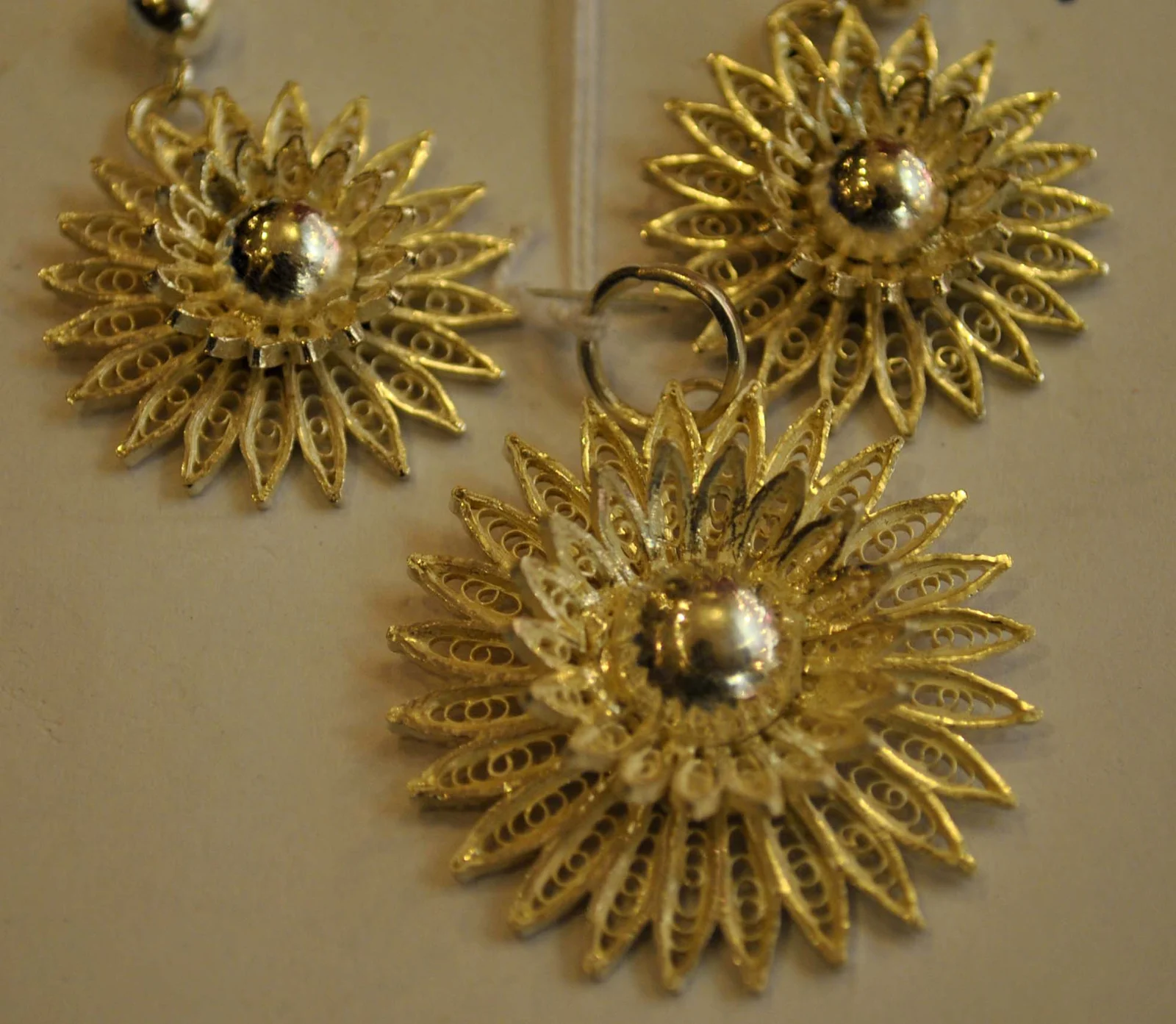
01 · Things to do
A city held in fine wire
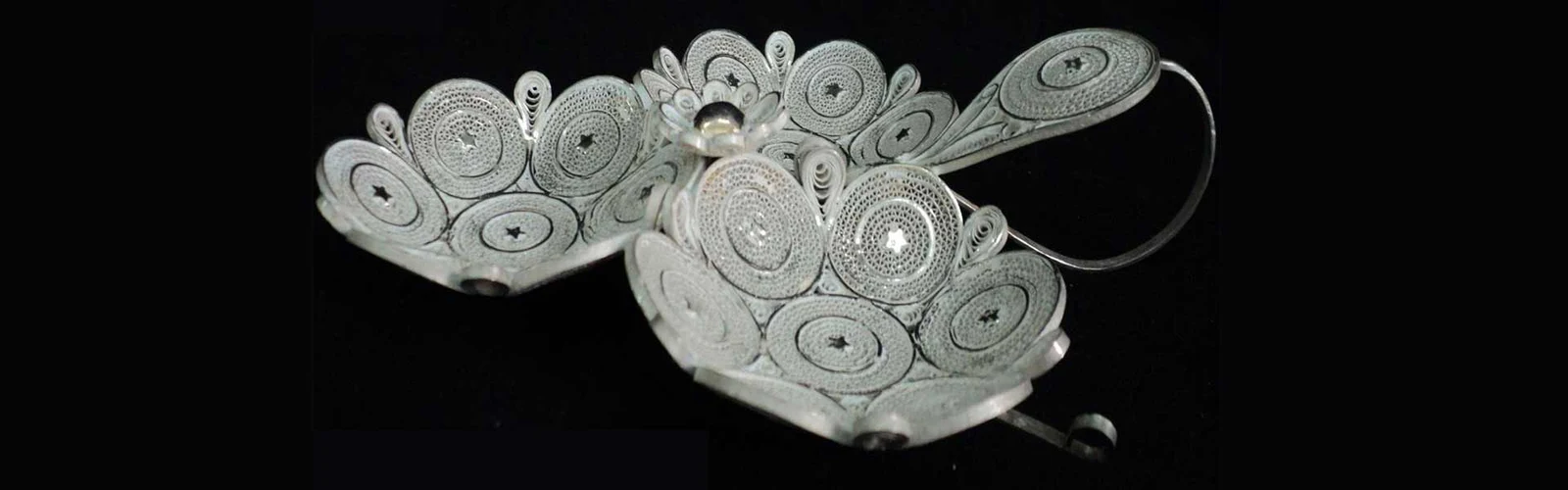
Begin with the spaces between the wires. In these decorative pieces, circles gather into flowers and small openings give the surface its lightness. Choose one curve and follow it until it meets another. Someone has made a decision at every turn.
The National Portal of India describes Cuttack’s Tarakasi as fine silver wire worked into jewellery and decorative objects. The pleasure of looking is in moving between two scales: the whole shape, then a join so small you might have missed it.
02 · Things to do
First, something to hold the pattern
A sketch gives the work its direction. In the process documented by NID Bengaluru contributors for Dsource, silver is drawn into wire; thicker wire provides the frame and finer wire fills the spaces inside it.
Fine wire is bent, rolled or twisted, fitted into the frame and joined. Larger works can bring separate components together. Filing and polishing finish the surface. Look for one meeting of two curves: what keeps that small relationship intact?
The drawing below isolates frame and infill so you can look for them in a finished piece. It is our explanatory sketch, not a traditional motif or a workshop instruction.
Find the structure
Follow the frame
Trace an outer edge with your eyes. Ask how the maker settles its shape.
Look between the lines
Notice the infill
Choose two repeated curls. What changes, and what stays alike?
Stay with one join
Ask about the finish
Which stage is hardest to correct? How should the finished piece be handled?
03 · Things to do
An invitation into a working day
Arrange a visit before arriving. Agree any demonstration fee and how much time the maker can offer. Ask separately before photographing a person, a design or the workspace. Record the maker’s preferred name with permission; a story about craft should make room for its author.
Ask who designed the piece and who worked on it. Do not assume that every stage belongs to one pair of hands. A name, a tool and an explanation can make a small purchase feel connected to a much larger story.
04 · Things to do
Take the work home thoughtfully
Ask who made the piece, its material and weight, the price and care instructions. Keep a receipt and agree delivery terms for a commission. A photograph cannot certify metal purity, and buying an object does not grant permission to reproduce its design. No named workshop or seller has been inspected by Utkal.
05 · Things to do
When the pattern fills a celebration
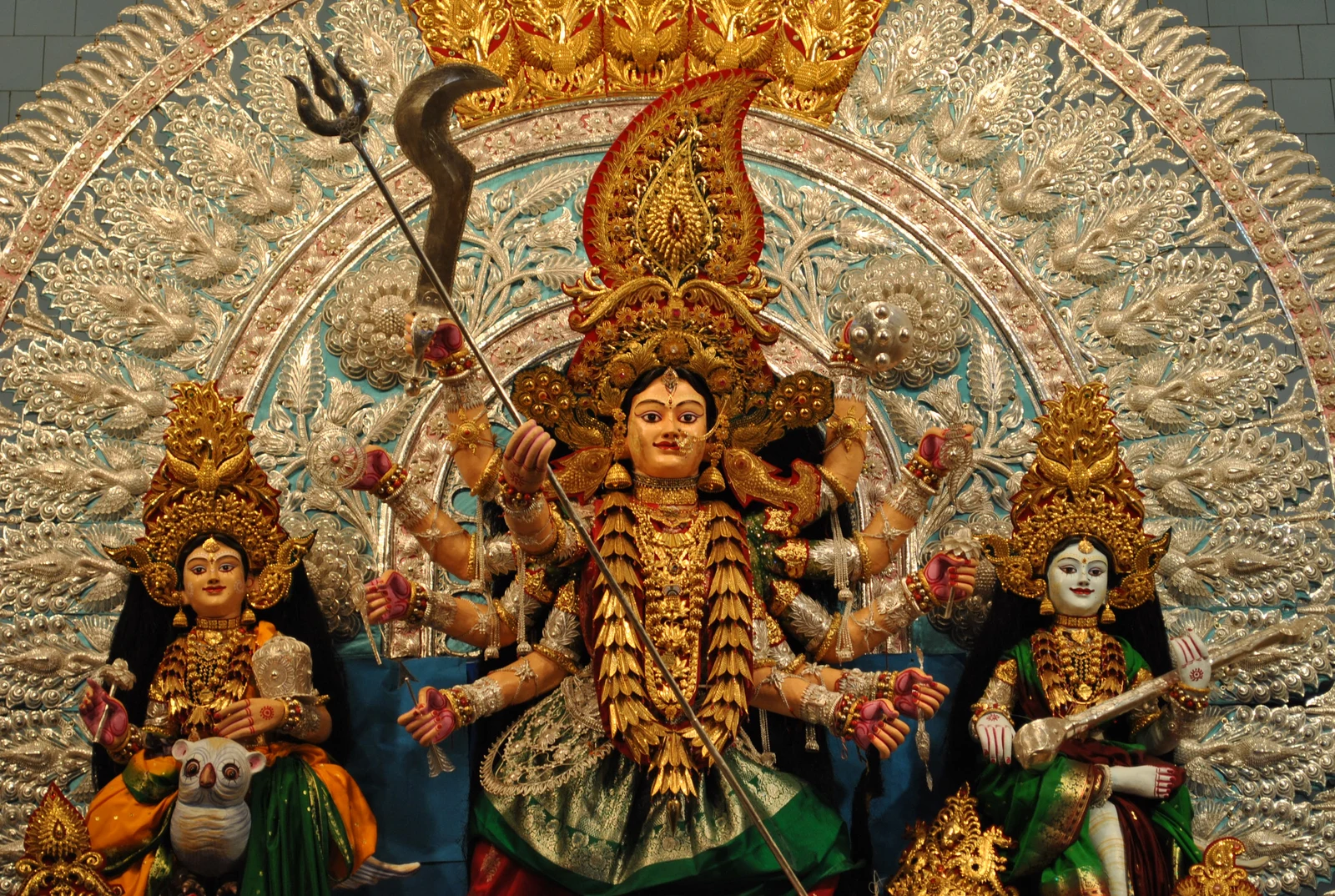
The scale changes in this 2009 photograph of Chaudhury Bazar’s Durga Puja display in Cuttack. The photographer identifies the setting as a Chandi Medha with silver filigree work. Follow the repeated forms around the figures, then think back to the small curves of the jewellery.
An object can be worn, held or encountered as part of a celebration. This photograph opens that connection; it is not a listing for this year’s festivities. If you plan a festival visit, check the dates, access and photography arrangements with local organisers.
06 · Things to do
Give the encounter its own time
Make one maker conversation the anchor of your visit. Confirm the address, an agreed time and any demonstration fee before setting off. Leave space afterwards to look again at what you have seen, rather than treating a workshop as a quick stop.
Continue into Cuttack through its food and the Barabati story. Save the ideas that appeal to you, then arrange travel and opening times for your dates. These links suggest connections, not a timed or bookable circuit.
Connect the pieces
Make room for
the whole visit.
Know the place, choose an experience and research a base. These are related ideas, not a confirmed route.
Editorial draft · Practical details need local confirmation.
Sources, photograph & research notes
Research checked 2026-10-06. Sections include original editorial planning advice. No prices, availability, verified travel times or booking service are provided.
- National Portal of India · Silver Filigree (Tarakashi Art)
Official indexed description inspected for fine silver wire, jewellery and decorative objects. No shop, material assay, appointment or current price verified.
- Dsource · Silver Filigree, Cuttack — Making Process
Prof. Bibhudutta Baral and Hariharasudan T., NID Bengaluru. Credited process text re-read 6 October 2026; sketch, wire drawing, frame, infill and finishing only. Unrelated spam links ignored. No copied process photographs, universal recipe or purity claim.
- Chaudhury Bazar Chandi Medha · photograph and creator description
Creator’s own-work description, 26 September 2009 date and CC BY-SA 3.0 licence inspected. Supports this depicted setting only; not present festival access, material assay or attribution of every decorative technique.

Pendant and earrings catalogued as Cuttack Tarakasi · ଆଶୁତୋଷ କର, 2011. Material descriptions differ in the source. by ଆଶୁତୋଷ କର · CC BY-SA 3.0. Resized and WebP-compressed. Responsive display may crop the view. Adaptations retain the stated share-alike licence. Pendant and earrings catalogued as Cuttack Tarakasi · ଆଶୁତୋଷ କର, 2011. The source descriptions differ on the metal; this image illustrates form, not verified purity.
_pendant_%26_ear_rings.jpg)
Filigree work of Cuttack · Government of Odisha, via Bhubaneswar.me and Wikimedia Commons; catalogued 2018. by Government of Odisha · CC BY 4.0. Aspect-preserving resize and WebP compression; no crop or recolouring. Reuse and adaptations retain the source licence.

Chaudhury Bazar Chandi Medha, Cuttack · ଆଶୁତୋଷ କର, 26 September 2009. by ଆଶୁତୋଷ କର · CC BY-SA 3.0. Aspect-preserving resize and WebP compression; no crop or recolouring. Reuse and adaptations retain the source licence.
Project Odisha knowledge base. Founder & Editor-in-Chief: Ahimanikya Satapathy. Drafted with AI assistance; human editorial review pending.