
Part 1 · Land, History and Belonging
Chapter 3 of 48
Ports, Boats and Ocean Crossings
Maritime archaeology and cultural memory on the Odisha coast
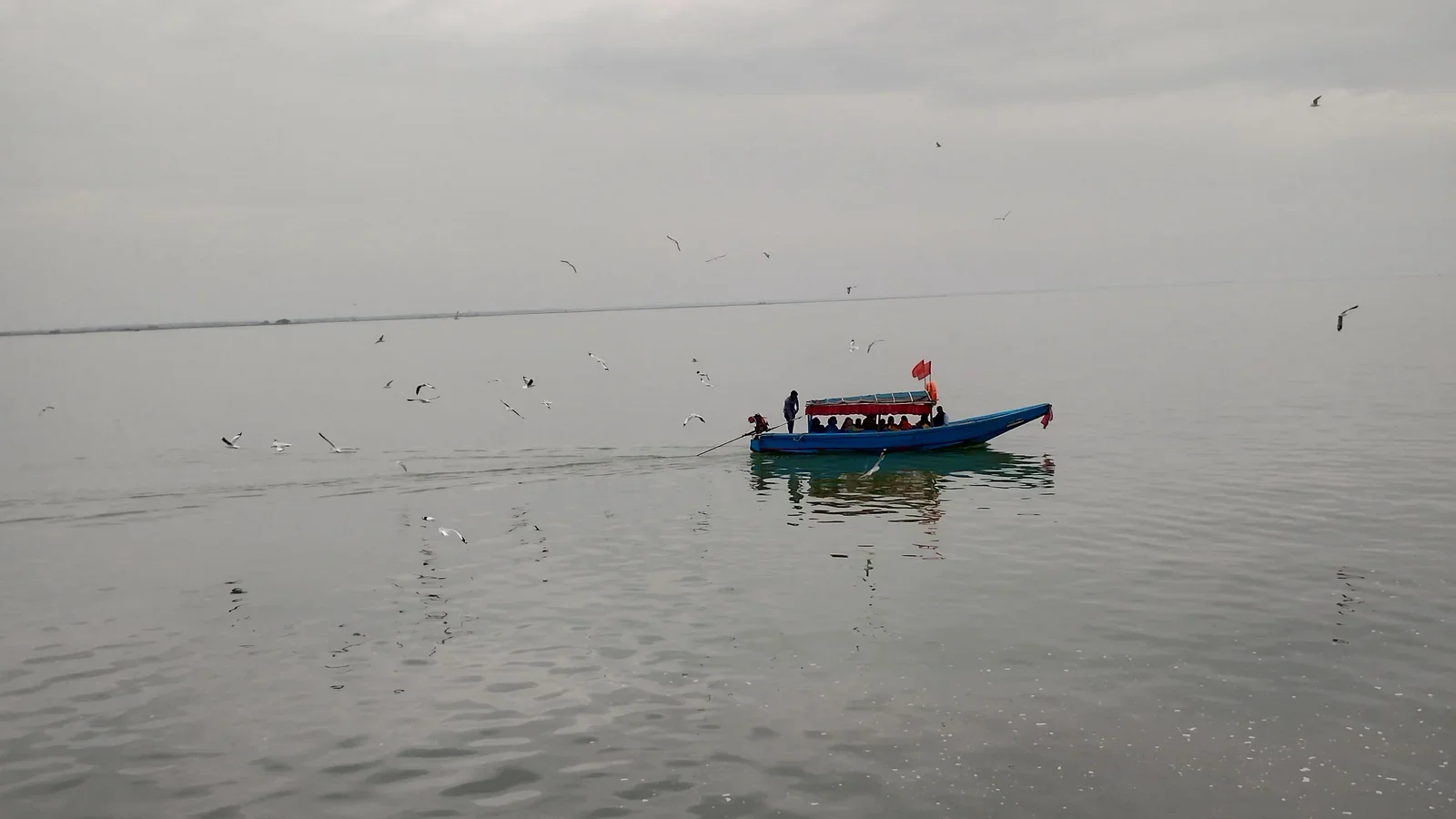
A boat and birds on Chilika Lake. A contemporary view of the water, not a reconstruction of an ancient harbour.
Hellohappy. Source · CC BY-SA 4.0.

Odisha’s maritime past comes into view at several scales. There is the small boat released in a festival, the wooden hull assembled by skilled hands, the fragment of an imported bowl and the stone once used to hold a vessel in place. Together they invite us to look outward from the coast, while keeping our attention on the work that made a crossing possible.
This chapter follows those connections through ports, boat making and seasonal sailing. It also asks how journeys become part of a community’s memory. Archaeological finds and living celebrations illuminate different parts of that story. Read together, they give the ocean a place within Odisha’s cultural history without requiring every remembered voyage to become a documented itinerary.
Where rivers meet the sea
At Khalkattapatna, near the mouth of the Kushabhadra, the surviving evidence includes pottery made locally and ceramics brought from elsewhere. Rudra Prasad Behera’s study describes porcelain and celadon, including bowls and plates, alongside other finds. These objects give the port a material presence: trade becomes something that could be handled, used, broken and left behind.1
The pottery also changes the direction in which we look. A maritime history told only through departing ships misses the arrival of goods. Imported wares make Odisha a destination within wider circuits of exchange. Their presence does not by itself identify a captain, a direct route or a single origin for every cargo. It does establish that an account confined to local production would be incomplete.1
For a reader standing before a ceramic fragment, the most useful question may be a modest one: what can this particular object tell us? Its fabric, glaze and form can be compared with other finds. Its archaeological context can help place it in time. A port history is assembled through such connections, rather than recovered as one continuous narrative.
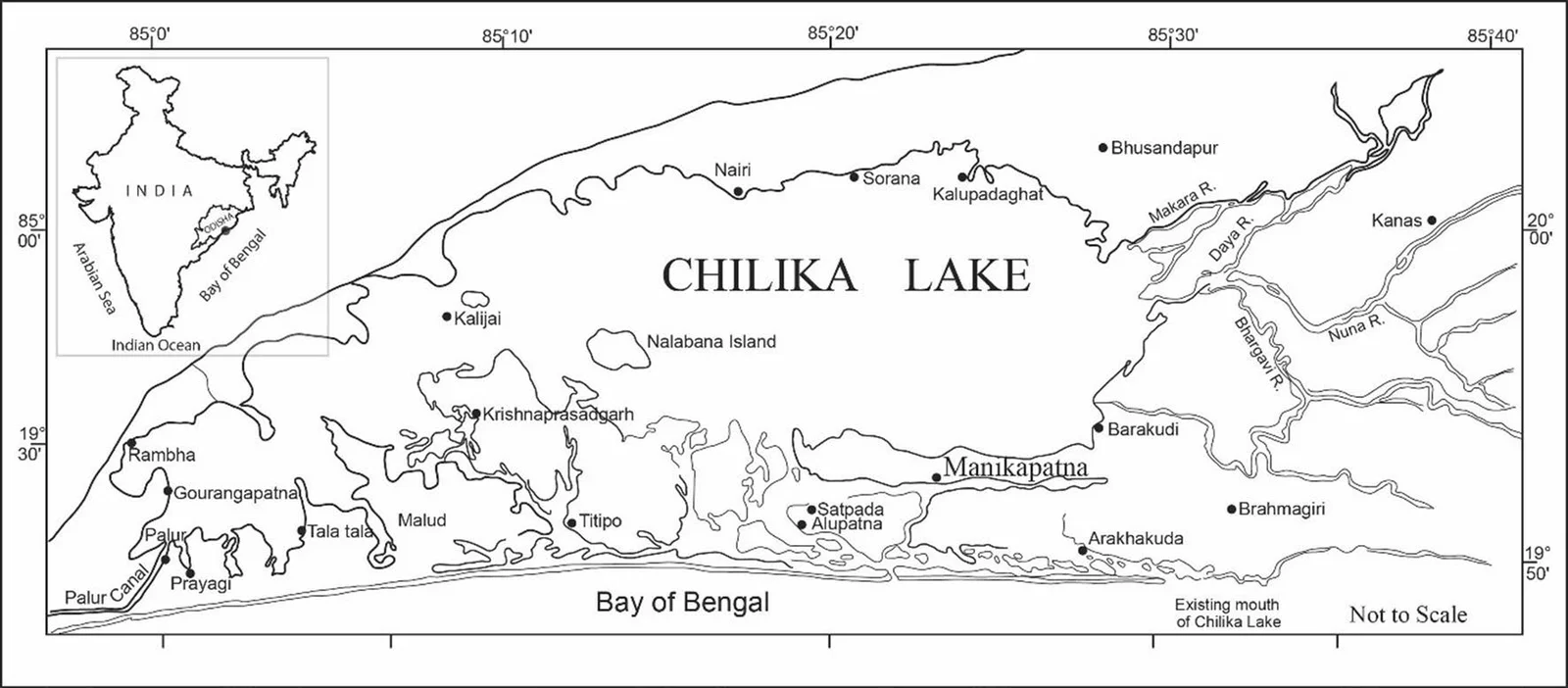
Chilika and Manikapatna in the study’s location map, figure 2. Not to scale; this is not an ancient coastline reconstruction.
A stone that travelled
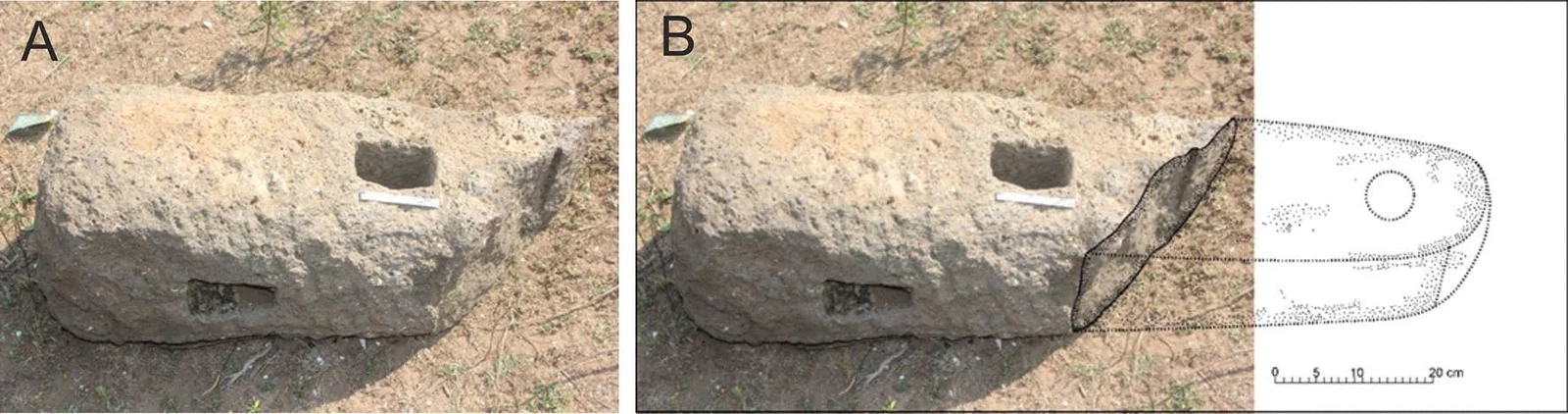
Manikapatna anchor, figure 3. A shows the surviving stone; B adds the authors’ proposed outline of its missing upper portion.
A broken stone anchor from the Manikapatna coast supplies a different kind of clue. In a 2022 study, Sila Tripati and colleagues examined its rock through petrography, chemical analysis and strontium–neodymium isotopes. Their results point most strongly to basalt from Palitana in Gujarat’s Saurashtra region, rather than a local Odisha source.2
The finding extends the view beyond the Bay of Bengal. Material found on the eastern coast can preserve a connection with western India. The researchers identify the object as an Indo-Arabian type associated with medieval maritime activity. Its missing upper portion makes the accompanying reconstruction particularly useful, provided we keep the surviving stone separate from the proposed outline.2
An anchor’s rock can outlast the vessel it served. Here, scientific comparison helps recover a material journey; it does not recover the crew’s names or a complete sailing route. That distinction leaves us with a substantial discovery: a physical object connecting distant coastal worlds, with more of its history still to be understood.
Knowledge in the hull
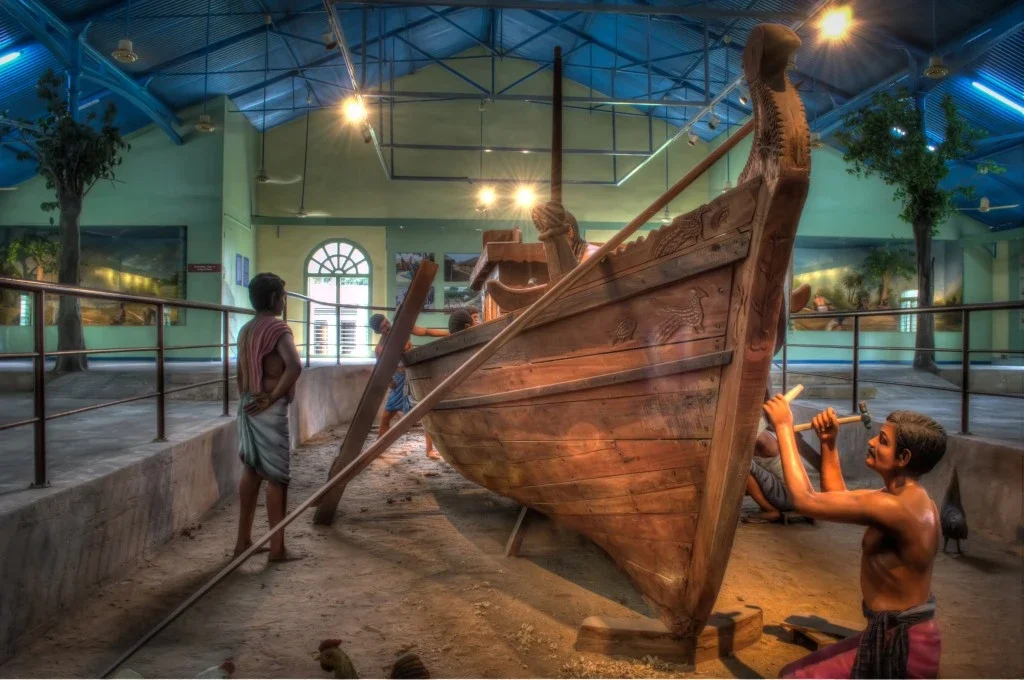
Boat-building display at the Odisha State Maritime Museum, Jobra, photographed in 2013. The figures and hull form a museum exhibit.
Gouravmoy Mohanty. Source · CC BY-SA 3.0.

The boat-building display at the Odisha State Maritime Museum in Jobra, Cuttack, offers another point of entry. The photograph shows a partly built hull and posed figures. It invites attention to assembly: the boat is something made through a succession of decisions, before it becomes a shape moving across the water.3
Swarup Bhattacharyya’s later field study of the patia describes that decision-making in detail. The owner specifies the desired length; other dimensions are worked out proportionately. Heated planks are bent with a wooden device called merry kath, and the shell is built before the internal supporting timbers are added. Such knowledge joins measurement with a practical understanding of the material.4
The study also records fisherman Arjun Behera of Pashchim Gadadharpur in West Bengal explaining the advantage of lighter arjun timber for boats brought ashore. The discussion follows craft practices across the Odisha–Bengal coastal region. It reminds us that a boat’s usefulness includes what happens when it leaves the water: handling and shelter matter alongside movement at sea.4
These observations concern later working craft. They offer a way to appreciate boat builders’ skill, without turning a photographed display or a modern patia into a replica of every vessel that once crossed the Bay. For this cultural history, the valuable continuity is a question worth pursuing: how do communities teach and adapt the knowledge on which work at the water’s edge depends?
Sailing with the seasons
A long crossing required an understanding of when movement was possible. Sila Tripati and L. N. Raut’s study of monsoon winds and historical evidence reconstructs journeys from Odisha towards Southeast Asia with the northeast monsoon and returns with the southwest monsoon. Their account treats wind and current as conditions that shaped maritime trade.5
This seasonal reading gives time a different weight. An ocean route was more than a line between two named places. Its possibilities changed through the year. A discussion of departure therefore belongs beside a discussion of waiting and return. The monsoon study offers a broad explanation of sailing opportunities, rather than a timetable for every ship or proof that all voyages followed one pattern.
Bali enters this history both as a place across the sea and as a powerful name in Odisha’s public memory. Archaeology on the Indonesian side deserves its own place in the account. I. Wayan Ardika and Peter Bellwood’s study of Sembiran identifies finds in Bali as evidence of contact with Indian traders. The available abstract supports that wider connection; it does not establish an exclusively Odishan origin for the traders or their goods.6
To write about ocean crossings is therefore to make room for more than one shore. A fuller history would ask what people in the receiving ports sought, selected and made of their encounters. Odisha’s place in that history becomes more interesting when the other coast is allowed its own perspective. A connection is a relationship, not simply the extension of one region’s story overseas.
The journeys we remember
In Boita Bandana, miniature boats carrying lamps are set afloat. The Ministry of Culture’s account of Bali Jatra describes this observance alongside the Cuttack festival’s commemoration of maritime connections with Southeast Asia, especially Bali. The contemporary fair includes crafts, performance and food, bringing remembered journeys into a shared public occasion.7
The small boat makes an immense distance imaginable. It can be prepared and released by someone who has never crossed an ocean. That is one way a cultural practice works: participation gives a historical theme a place in ordinary life. The meaning of the gesture need not depend on assigning each miniature vessel to one excavated port or one dated voyage.
For the cultural edition, these scales belong beside one another. A ceramic sherd asks for comparison; an anchor asks what its stone can reveal; a working boat asks how skill is learned. A festival asks how people choose to remember. The surviving evidence remains uneven, but the questions bring a coast of makers, traders and commemorating communities into view. The ocean becomes part of the inhabited world of Odisha, with connections still open to research.
Footnotes & Sources
- Rudra Prasad Behera, Study of Ceramics from Ancient Port Site Khalkattapatna, Odisha, India. Heritage 4 (2016), pp. 806–815. Used for site setting and imported ceramics; no single date range is assigned to the entire port here. ↩
- Sila Tripati and colleagues, Geochemical provenance of an Indo-Arabian stone anchor from Manikapatna highlights the medieval maritime trade of India. Scientific Reports 12, 13559 (2022), doi:10.1038/s41598-022-17910-9. See pp. 1–5 and discussion; figures 2 and 3 reproduced under CC BY 4.0. ↩
- Gouravmoy Mohanty, The model of a ship being buid inside Odisha State Maritime Museum. Photograph, 26 September 2013. Visual source for the museum display, not evidence of a particular ancient vessel. ↩
- Swarup Bhattacharyya, Patia a reverse clinker boat of Odisha. In Language, Literature, Culture & Integrity, vol. II, IOSR (2020), pp. 22–32, especially pp. 24–28. Editor-uploaded full text. Arjun Behera’s testimony is reported by Bhattacharyya, not an interview conducted for this chapter. ↩
- Sila Tripati and L. N. Raut, Monsoon wind and maritime trade. Current Science 90(6), 25 March 2006, pp. 864–871. Author-uploaded full text. Used as a scholarly reconstruction of seasonal sailing conditions. ↩
- I. Wayan Ardika and Peter Bellwood, Sembiran The beginnings of Indian contact with Bali. Antiquity 65(247), 1991, pp. 221–232. ANU abstract and bibliographic record consulted; the full article was not used. No exclusive Odisha provenance inferred. ↩
- Ministry of Culture, Bali Jatra Cuttack. Parliamentary reply released by the Press Information Bureau, 6 February 2025. Used for contemporary commemoration and festival practices, not as primary evidence of ancient itineraries. ↩
Each picture has a linked source and licence in its caption. The photographs are reproduced full frame and resized for print. Figures 2 and 3 are extracted intact from the open-access 2022 article and resized; their original panel labels are retained. The source licences apply to the respective images, not automatically to the chapter text. Research checked 9 November 2026.
Suggest an update
Share a correction or source for this chapter. GitHub submissions are public. Please omit private contact details and consent documents.