
Bagha Chheli and the Rules of Play
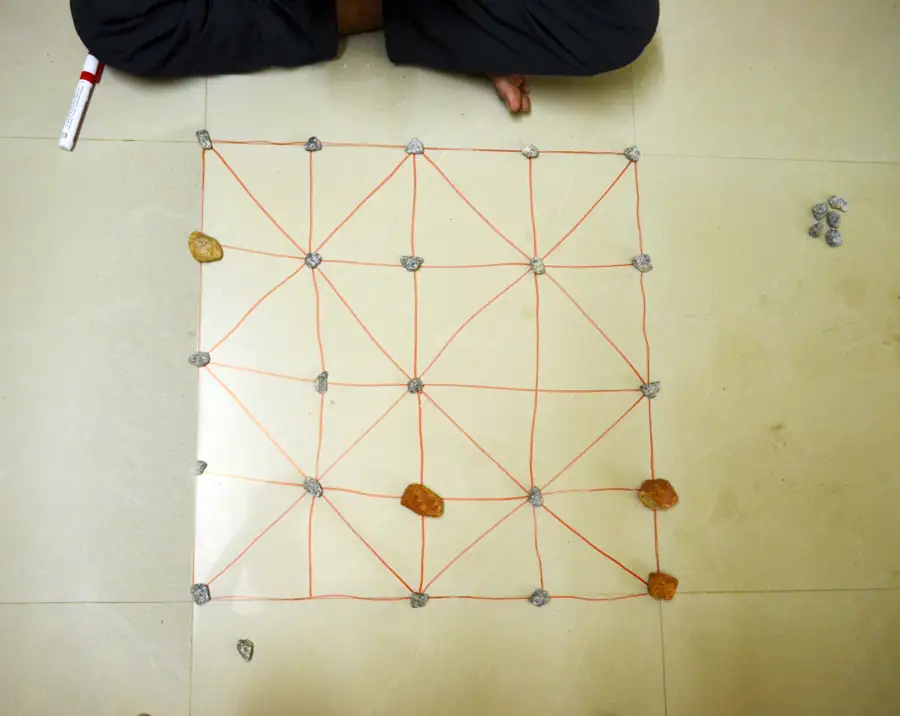
Bagha Chheli gives its two players different jobs. One controls tigers that capture; the other controls goats that try to leave the tigers unable to move.1
A gap can matter
The Ancient Indian Boardgames archive records a version with four tigers and twenty goats. Four goats begin on the board; the rest are added individually before goats may move. A tiger captures by jumping over a goat into an empty point beyond. For the goats, numbers alone do not settle the game: the task is to close the tigers’ routes.1
The pieces need not resemble animals. In her August 2020 account for Mycitylinks, Sameedha Mohanty describes larger stones for the tigers and smaller ones for the goats.2 Size makes the two sides distinguishable. A stone becomes a tiger through its place in the game and the moves allowed to it.
Agreeing on the finish
The archive’s modern Rules field gives the tigers victory after capturing every goat. Mohanty’s account instead ends their task at five captures.12 These are different winning conditions, and players should agree which one they are using before they begin. Knowing the name of a game does not by itself settle every rule.
Photographer Subhashish Panigrahi’s record places a game of Bagha Chheli in a Bengaluru home on 29 July 2014. His description identifies two players taking part.3
For anyone returning to the board, a useful opening question is simple: how did the people you played with decide when the game was won?
Footnotes & Sources
-
Ancient Indian Boardgames: Digital Documentation, “Bagha Chheli ( Odisha)”, undated, Description and Rules. The winning condition above comes from the modern Rules field. ↩ ↩2 ↩3
-
Sameedha Mohanty, “Classic Odia Games That Will Make You Nostalgic”, Mycitylinks, 13 August 2020, Bagha Cheli section. ↩ ↩2
-
Subhashish Panigrahi, “Bagha cheli”, Wikimedia Commons, photograph dated 29 July 2014. Location and occasion follow the photographer’s description. ↩

Continue reading
Further reading
Suggest an update. GitHub submissions are public; omit private contact details and consent documents.