
Ganjapa Cards Made for Play
Odisha’s Ganjapa playing cards bring painting into the hand. A pack joins the work of an artist to the needs of a game.1
Making a surface for play
In the process described by Ritu Sethi, cloth or paper is strengthened with gum made from powdered tamarind seeds. The surface is smoothed, cut into circles and painted before lacquer gives it shine and strength for repeated use.1 The last coat is part of making the card usable, as well as part of its appearance.
Reading a pack
The same account documents flower motifs on pip cards numbered from one to ten.1 These invite a different kind of attention from a single framed painting: the image belongs to a sequence within a pack.
In a January 2025 interview, Raghurajpur maker Banamali Mahapatra identifies kings, viziers and numbered cards in the Dashavatar cards under discussion.2 Those distinctions help us begin to read the pack. A figure’s place in the pack matters alongside its painted detail. Recognising that structure is a beginning; it does not, on its own, explain the rules of a game.
More than one kind of pack
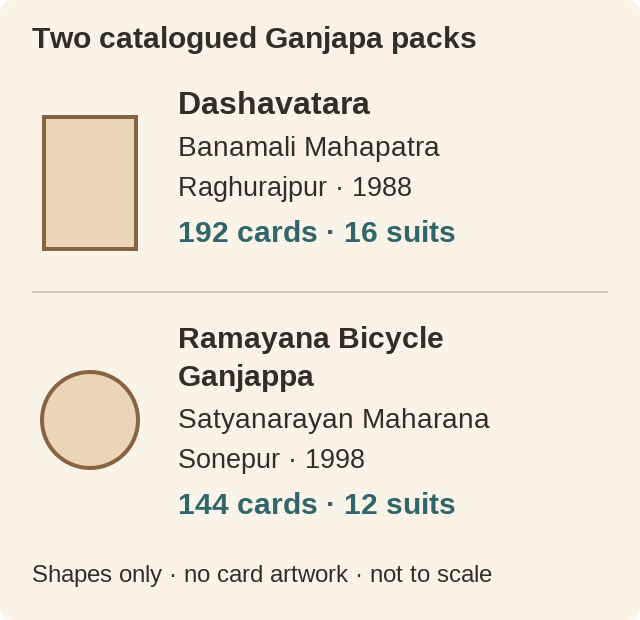
The Indira Gandhi National Centre for the Arts catalogue records a rectangular Dashavatara set by Mahapatra from 1988, with 192 cards divided into sixteen suits, or groups within the pack. Another entry, Satyanarayan Maharana’s Sonepur Ramayana Bicycle Ganjappa set of 1998, has 144 round cards in twelve suits. All twelve pradhans, or ministers, are shown riding bicycles.3
The bicycle is a particularly vivid detail: an everyday vehicle appears within a Ramayana pack. Together, these two sets also show why a circle or a single card count cannot define every Ganjapa pack. Shape, size of the pack and imagery can differ.
Learning and making to order
Mahapatra’s interview gives another view of that variety. He says he learnt designs by watching others rather than through formal teaching, and that he also makes pattachitra. Discussing square paper cards being made for an order, he explains that he works to customers’ requests; Dashavatar cards, too, can be made square.2
His account connects the painted surface to a working practice: watching others, learning designs and responding to requests. A square card can carry a Dashavatar design; a Ramayana minister can ride a bicycle. These choices belong to named makers and particular packs.
That variety is part of Ganjapa’s interest. The pictures have identities within a set, while the finished objects must stand up to handling. Painting and play meet in the same small object.
Footnotes & Sources
-
Ritu Sethi, “Ganjappa: Playing Cards of Odisha”, Craft Revival Trust/Asia InCH, hosted by Google Arts & Culture; flower-card caption and final process paragraph. Undated. ↩ ↩2 ↩3
-
Adrija Mukherjee and Souvik Mukherjee, interview with Banamali Mahapatra, Raghurajpur, 16 January 2025. Published English transcript: 00:00:29–00:01:03 and 00:02:04–00:02:47. ↩ ↩2
-
Indira Gandhi National Centre for the Arts, “Ganjifa Cards”, catalogue entries 3 and 56; accessed 21 November 2026. ↩
Another game to explore: Bagha Chheli and the Rules of Play.
Read the companion article: Jau Kandhei and the Doll Makers of Balasore.
Read the companion article: Kagaja Mukha and the Paper Masks of Raghurajpur.
Continue reading
Further reading
Suggest an update. GitHub submissions are public; omit private contact details and consent documents.