
01 · A closer look
The story on the cloth
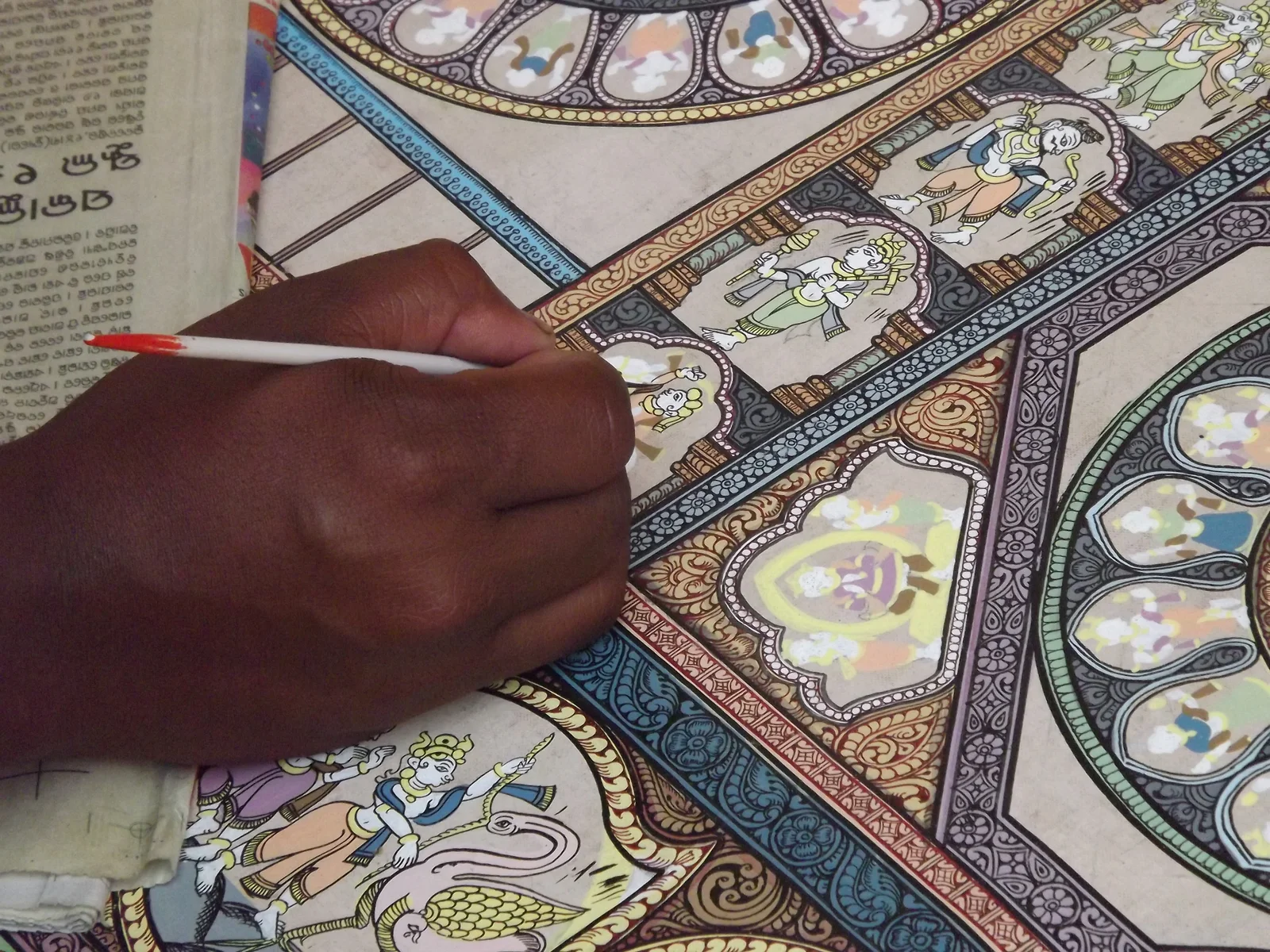
Look beside the brush in this photograph. A face takes shape inside an arch; patterned borders lead the eye from one figure to the next. Before trying to name the whole scene, choose one small detail and follow it.
Pattachitra gives a story a surface. Sucharita Sahoo’s 2014 PIB feature describes prepared cloth carrying Jagannath imagery and narrative scenes. Ask a willing artist where to begin reading one work. Which gesture connects two figures? What would you miss if you looked only at the centre?
02 · A closer look
Before the picture, the surface
The Government of Odisha describes a traditional cloth-painting process. Use these three stages as things to look for, then ask the artist how their own practice differs.
Look for the ground
Prepare the cloth
Chalk and tamarind-seed glue help make the cloth ready to take paint. Ask whether you may see an unpainted surface.
Follow an edge
Build the picture
The account places the border first, followed by brush drawing and flat colour. Notice how an edge holds the scene together.
Stay with a detail
Read the fine line
Fine dark outlines bring details into focus. Choose a small figure and ask which marks give it expression.
03 · A closer look
A craft that found another future
A December 2005 Orissa Review account recalls a difficult period for the painters and a mid-twentieth-century revival. Citing dance historian Ileana Citaristi, it connects renewed opportunities around 1953 with Halina Zealey’s involvement. Read this as a published historical account, not a complete history of the village. The makers’ work is the thread that carries it forward.
The past is an opening for a conversation, not a script for the person you meet. Ask how they learned, which work they enjoy making, and what they would like a visitor to notice.
04 · A closer look
The painter’s son who became a dancer
Guru Kelucharan Mohapatra was born in Raghurajpur. Srjan’s chronology names his father, Chintamani Mohapatra, as a chitrakara painter and records his early Gotipua training under Balabhadra Sahu. A painter’s family and a dancer’s training give this village two ways into a story.
Gotipua, described in the PIB feature as a tradition performed by boys in female attire, is part of the village’s wider cultural life. Kelucharan’s later career also involved theatre, teachers and fellow artists; no single village or person tells the whole story of Odissi.
Try comparing the attention you give to a painted hand with the attention you give to a dancer’s gesture. What changes when one position moves into the next? That is an invitation to look, rather than an explanation of what an artist intended. Arrange a performance separately; a village visit is not a performance booking.
05 · A closer look
A doorway into someone’s working day
Writing about his 2019 visit for Odisha Tourism, Biswa Prakash describes artists explaining their work and painting on surfaces beyond cloth, including coconuts and bottles. His account offers a way to begin: ask how an artist chooses a surface, and how the story changes with it. It does not promise that a workshop will be open when you arrive.
06 · A closer look
Meet a maker, with permission
Begin with a greeting and ask whether this is a good time. Let the artist explain one piece at their own pace. If you would like a demonstration, agree its length and fee before it starts. Request permission separately for photographs of people, artwork and the home.
For a dance visit, confirm the invitation with the school or organiser. Where children take part, respect schooling, supervision and permission for photographs. A warm encounter starts by leaving the host room to say what is possible.
07 · A closer look
Bring a story home
Choose a piece you want to live with, not just carry away. Ask for the maker’s preferred name, materials, price, packing and care advice, and keep a receipt. If work is commissioned, agree the design, delivery and payment terms in writing. Buying a painting does not itself give permission to reproduce the artwork. Record the story only as its teller wishes it to be shared.
08 · A closer look
Leave room for the visit
Puri makes a useful base for a separately arranged village visit. Incredible India lists Puri rail access and Bhubaneswar’s airport as arrival options. Agree the final transfer, exact meeting point and return with your host or driver; published distances are not journey times.
Incredible India suggests October to February for a visit. Treat this as seasonal guidance, then check the forecast and local arrangements for your dates. For a slower look at the work, choose an appointment that suits the maker and leave room for a pause.
Plan your main meal in Puri unless a host has agreed otherwise. Our coastal food guide introduces Mahaprasad’s devotional context and dishes such as machha besara, fish in mustard gravy. Ask about today’s menu and ingredients; these are Puri food connections, not promises of a village restaurant.
Make it your visit
Give the making its own time
Follow one small part of the work: a line, a colour or a change between stages. Ask before taking a close photograph.
Before you go
Use Puri as a possible base, then agree a meeting point, the final transfer and your return. Incredible India suggests October to February; check the forecast for your dates. A village visit does not promise an open workshop or a dance performance.
Arrival, access, food & a place to stay
Planning leads, not bookings or inspected recommendations. Confirm arrangements for your dates.
- A village visit from Puri
Puri railway station and Bhubaneswar’s airport are starting points listed by Incredible India. Agree the onward vehicle, exact meeting point and return in advance. Confirm the route for your actual starting point; this guide does not give a verified journey time.
- An invitation into a working place
Arrange the visit with the maker. Ask about the entrance, seating, toilets, demonstration fee and photography. A village visit does not include automatic access to homes, workshops or performances.
- Make lunch an arrangement
If you hope to share a meal with a host, ask in advance about availability, payment and dietary needs. Otherwise, plan your main meal in Puri; hospitality should never be assumed as part of a craft visit.
- Keep the appointment and base together
Our suggestion: research Puri as your overnight base, then arrange the village visit separately. No village homestay is inspected or recommended in this guide.
Details for this visit
From cloth to a story
The traditional process described by the Government of Odisha starts with a prepared cloth ground, then a border, brush drawing, flat colours and fine outlines. Ask which stage you are seeing and which materials this maker uses. A published tradition does not describe every contemporary piece.
A workshop is a working place
Agree the appointment, group size, demonstration time and fee with the maker. Ask before photographing people, art or a home. For a purchase, keep the maker’s preferred credit, materials, care advice and receipt; agree commission and delivery terms separately. Buying work does not itself grant reproduction permission.
Make room for dance, by arrangement
Raghurajpur is associated with Gotipua and is Kelucharan Mohapatra’s birthplace. Ask a school or organiser whether an invited visit or announced performance is available. Confirm timing, fee and photography separately; do not interrupt training or assume a show is included.
Check the path and the way back
Ask your host about the exact entrance, walking surface, steps, seating, shade and toilets. Agree pickup, waiting and return arrangements with your transport provider. Named makers, appointments, fees, accessible routes and current facilities have not been verified by Utkal.
Where to ask
Look for the Puri office in Odisha Tourism’s tourist-office directory if you need a starting point for a village visit. Agree an appointment with the maker separately. Odisha Tourism · tourist offices →
Check current arrangements
Make room for a maker’s working day
The district guide describes a craft community and Gotipua tradition; it is not a workshop or performance timetable.
- Ask whether this is a good time to visit; agree any demonstration fee before it begins.
- Arrange return transport and ask permission before photographing people, homes or artwork.
Official references checked 2026-10-01. These are planning leads; individual arrangements have not been confirmed locally.
People, connections & a memory to keep
Connect with care
Ask the artist how they would like the work and their name credited. Agree time, payment and photography before expecting a demonstration.
Leave room for
Return to Puri’s wider story when you want to place this encounter in your own coastal journey. Check transport rather than assuming a fixed circuit.
Return to Puri →Bring home a memory
Record the maker’s preferred credit and what you learned, with permission. A purchase is not permission to reproduce an artwork.
Six questions to take with you
Ask the people arranging your visit. These prompts help you prepare; they do not confirm local arrangements.
- Access
- Is the workshop I hope to visit welcoming visitors that day, and should I arrange a time first?
- Getting there and back
- How will I arrive without blocking homes or workspaces, and how will I arrange my return?
- Comfort and pace
- How long would the maker like us to stay, and what pace lets us listen without interrupting their work?
- Food and water
- Where will I plan refreshments separately so a workshop visit does not assume hospitality from a household?
- People and pictures
- Before recording a person, process or artwork, have I asked permission and how they would like to be credited?
- A change of plan
- If a maker is busy, can I return at an agreed time or choose another welcome visit without pressing them?
Save this idea, then add any useful question to your private reminders in My journey.
Add your own day notes in My journey.
City, craft and coast · Chapter 5 of 5
Keep what moved you.
Make it your journey.
A city, a hill, a temple, a shore and a village of makers. Choose what you want to return to; give those encounters their own time.
Five connected stories. Read in this order or begin wherever your curiosity takes you. Arrange travel and timings separately.
More connections to explore
Editorial draft · Practical details need local confirmation.
Sources, photograph & research notes
Research checked 2026-10-06. Sections include original editorial planning advice. No prices, availability, verified travel times or booking service are provided.
- Odisha Tourism · Raghurajpur
Official craft and dance account inspected. No household counts, sales promises, daily opening hours or universal visitor access inferred. Checked 30 September 2026 UTC.
- Orissa Review · Raghurajpur, Crafts Village Extraordinary (December 2005)
Three-page historical account inspected, including its citation of Ileana Citaristi on the mid-century revival and its descriptions of craft and dance. Historical account, not current household counts, transport directions, school availability or an independently verified oral history.
- Biswa Prakash · Raghurajpur visit, Odisha Tourism (29 April 2019)
Dated first-person account inspected for artists explaining work and adapting painted surfaces. Not a promise of access, a booking arrangement or evidence that every household behaves alike.
- Government of Odisha · Patta Chitra
Traditional cloth preparation, borders, colour and fine outlines inspected. Describes a tradition, not the materials or sequence used by every present-day maker. No pigment recipe or care guarantee inferred.
- PIB · The land of artisans: Raghurajpur (11 April 2014)
Sucharita Sahoo’s dated feature connects painted narratives, Jagannath imagery, Gotipua and Kelucharan Mohapatra. Historical context only; household counts and visitor/performance availability not adopted.
- Srjan · Guru Kelucharan Mohapatra milestones
Institutional chronology re-read 6 October 2026 for father’s craft, early Gotipua training and collaborative career. No disputed birth year adopted.
- Incredible India · Raghurajpur visitor guide
Best time to visit and How to get there read 6 October 2026. October–February suggestion and arrival gateways only. Distances, nearest-station ranking, road condition, temperature table, universal workshop access and unbooked performances excluded.
- Incredible India · Puri
Food and season passages rechecked. Supports fish in mustard gravy, prawn curry, chhena poda and October–February guidance. Does not establish restaurant availability, inspected hygiene, Konark origin or safe swimming.
- Odisha Tourism · The taste of Odisha
Food overview inspected for dalma and Mahaprasad. Religious food identity distinguished from restaurant availability; cooking miracles not adopted as fact. Checked 30 September 2026 UTC. Rechecked 30 September 2026 for this visitor candidate; no field inspection, live timetable, fare or current opening confirmation.
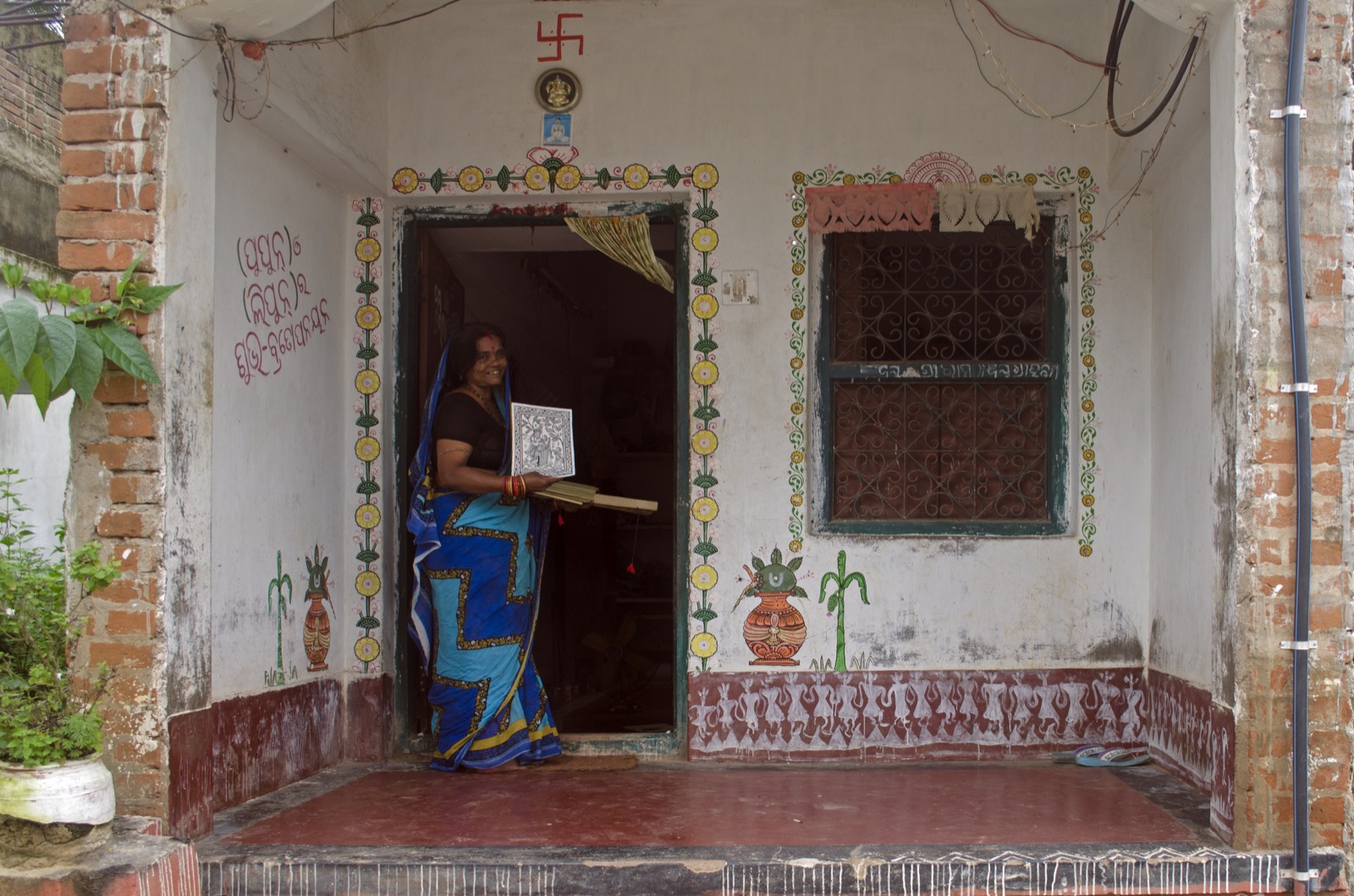
An artisan displays her work, Raghurajpur · Rangan Datta Wiki, 2018. Her name is not supplied in the source. by Rangan Datta Wiki · CC BY-SA 4.0. Resized from the original photograph for local delivery; no generated elements. Full-frame display requested. Adaptations retain CC BY-SA 4.0. An artisan displays her work, Raghurajpur · Rangan Datta Wiki, 2018. Her name is not supplied in the source.

An artist working on a Pattachitra in Raghurajpur, photographed in 2013. The source does not name the artist. by Sumit Surai · CC BY-SA 4.0. Resized and converted to WebP. No generated elements; derivative retains the stated share-alike licence.

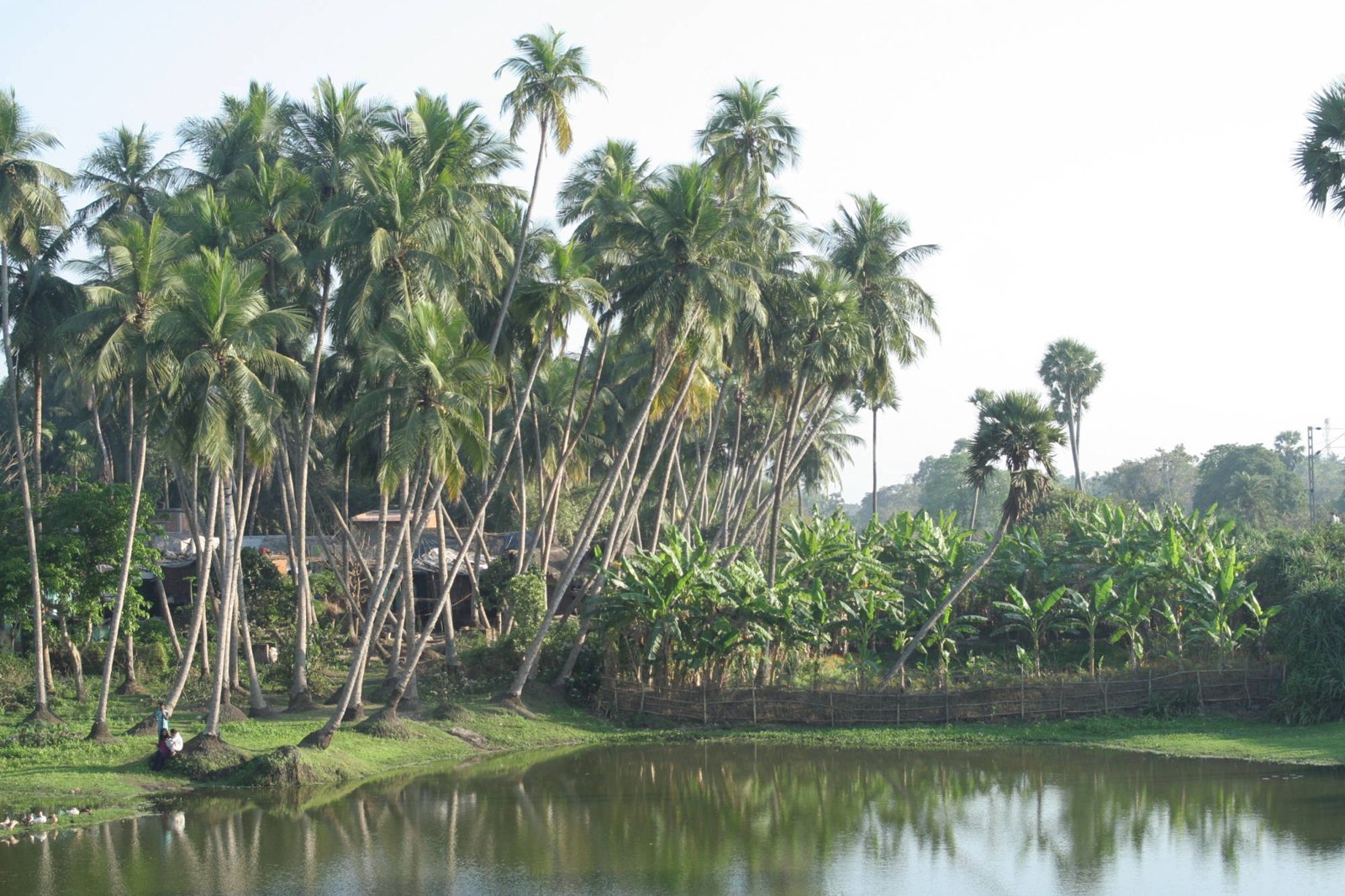
A landscape in Raghurajpur · Carla Antonini, 2008. This photograph shows the village setting, not a workshop. by Carla Antonini · CC BY-SA 3.0. Resized and JPEG-compressed for the website. Responsive display may crop the view. Adaptations retain the stated share-alike licence.

Project Odisha knowledge base. Founder & Editor-in-Chief: Ahimanikya Satapathy. Drafted with AI assistance; human editorial review pending.