
01 · Things to do
Before the horizon, a workshop
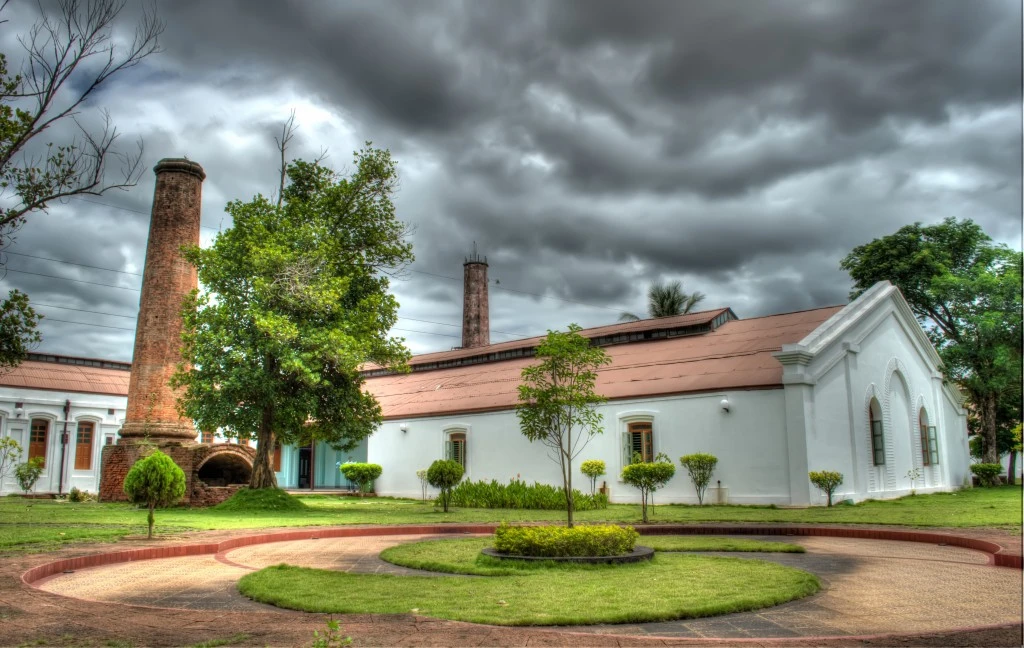
A boat draws the eye towards the horizon. Jobra brings it back to the work that makes a journey possible. The Odisha State Maritime Museum occupies the former Jobra Workshop in Cuttack.
The museum connects the workshop’s establishment with the aftermath of Odisha’s famine of 1866 and reports a foundation plaque dated 1 January 1869. Begin with that nineteenth-century setting: water, engineering and the need to make things work.
02 · Things to do
Follow the work through the room
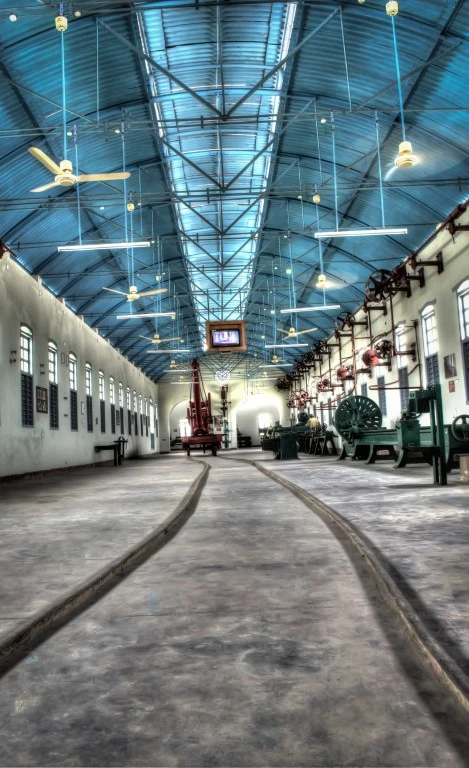
The museum describes a workshop that built boats, fabricated sluice gates and supplied canal and river works. Its account names lathes, drills and cutters, a pulley system powered first by steam and later electricity, and a rail-mounted crane for heavy materials.
Look at the photograph before reading on. Let your eye follow the rails, then rise towards the wheels overhead. In the gallery, a label can turn an unfamiliar shape into a task you understand. Ask which equipment is currently on view.
Choose one machine and try three questions: what went into it, what moved it, and what came out? There is no need to learn every name to leave with a new way of looking.
03 · Things to do
A boat is also a collection of skills
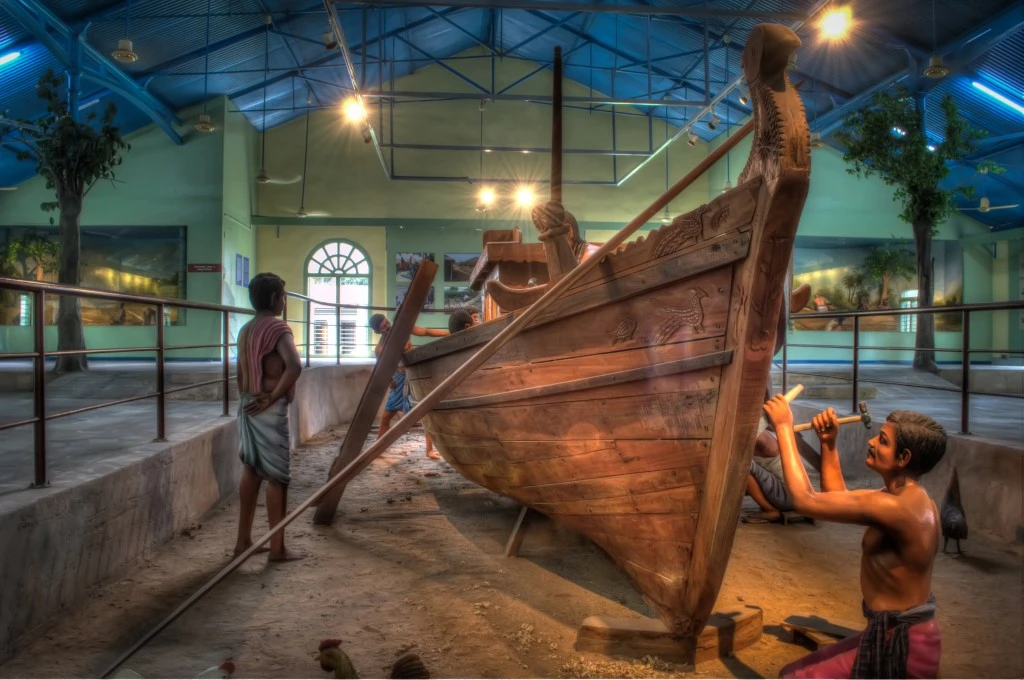
This 2013 photograph shows a museum display: a wooden hull and figures arranged around the work of building it. It invites a closer look at a boat’s shape, joints and parts. It is not a photograph of workers building a vessel.
For a playful pause, choose one part and explain what you think it does. Then read the display label or ask a guide. What changed in your answer?
The people behind the workshop deserve the same curiosity. How did someone learn the trade? What did an ordinary working day involve? Those workers’ histories remain a research gap in our account.
04 · Things to do
Let the river open a wider story
Odisha’s earlier overseas connections and Jobra’s industrial history are different chapters. Read the dates and places on each exhibit before joining them together. A model can explain an idea; an original object can preserve a particular trace of the past.
Follow whichever question stays with you: how a boat was made, how water was managed, or how an object travelled. Before leaving, choose one thing whose purpose you can explain to a friend. That small discovery is a way into a much larger history.
05 · Things to do
Plan the visit around what is open
The museum’s website lists Tuesday–Sunday, 10:00–16:30, with Monday closed; checked 6 October 2026. Confirm your date, holiday arrangements, last entry and ticket prices directly before setting out.
Ask which workshop and boat displays are accessible, whether a guide is available, and about steps, seating and toilets. Current gallery access and a step-free route have not been verified here. Follow staff directions, photography rules and display barriers.
Use “Odisha State Maritime Museum, Jobra, Cuttack” when arranging transport. Leave room for a food break and your return journey; this article does not provide a timed walking route.
06 · Things to do
Carry the question into Cuttack
From a boat’s structure to a silver filigree frame, Cuttack offers another change of scale. Pair Jobra with a Tarakasi conversation if a maker can host you, or continue through the city’s story at Barabati.
Make space for Dahibara Aloodum along the way. Ask a cook about their version, and choose a freshly prepared serving that suits you. Save Jobra to your journey, then decide which other stop deserves its own time.
Connect the pieces
Make room for
the whole visit.
Know the place, choose an experience and research a base. These are related ideas, not a confirmed route.
Editorial draft · Practical details need local confirmation.
Sources, photograph & research notes
Research checked 2026-10-06. Sections include original editorial planning advice. No prices, availability, verified travel times or booking service are provided.
- Odisha State Maritime Museum · introduction and visitor information
Institutional homepage retrieved 6 October 2026. Jobra location and posted Tuesday–Sunday 10:00–16:30 schedule, Monday closed. Posted information only; holiday closures, last entry, fees, accessibility and actual operation not confirmed. Same provenance as workshop account.
- Odisha State Maritime Museum · Jobra Workshop
Reused inspected 6 October 2026 institutional account: reported 1869 plaque, fabrication, machines, power and crane. Not an independent inspection of the plaque or a current gallery-access check.
Jobra’s museum courtyard · photographed 26 September 2013. by Gouravmoy Mohanty · CC BY-SA 3.0. WebP compression at original dimensions; no crop, upscaling or recolouring. Reuse and adaptations retain CC BY-SA 3.0. Jobra’s museum courtyard · photographed 26 September 2013.

Inside the workshop · photographed 26 September 2013; current access may differ. by Gouravmoy Mohanty · CC BY-SA 3.0. WebP compression at original dimensions; no crop, upscaling or recolouring. Reuse and adaptations retain CC BY-SA 3.0.

A boat-building display, not a working boatyard · photographed 26 September 2013. by Gouravmoy Mohanty · CC BY-SA 3.0. WebP compression at original dimensions; no crop, upscaling or recolouring. Reuse and adaptations retain CC BY-SA 3.0.

Project Odisha knowledge base. Founder & Editor-in-Chief: Ahimanikya Satapathy. Drafted with AI assistance; human editorial review pending.