
Part 3 · Languages, Literature and Oral Memory
Chapter 13 of 48
A Land of Many Languages
Names scripts and the languages of learning in Odisha
A sign at Bhubaneswar airport announces a service in Odia, Hindi and English. The same practical message appears in three forms, offering different readers a way into a shared space. It is an everyday glimpse of multilingual Odisha, though only a small part of its linguistic life.
Beyond such public writing are languages learned in families, used among neighbours, carried into classrooms and chosen for poems. Odia, Sambalpuri/Kosali, Desia, Santali, Ho, Kui, Kuvi, Sora, Juang and Koya belong in this account. Their histories cannot be reduced to one script, one administrative category or a set of neatly separated territories.
This chapter offers an orientation to that diversity. It follows names and classifications into questions of writing and learning, asking what becomes visible when we attend to speakers as well as to language labels.
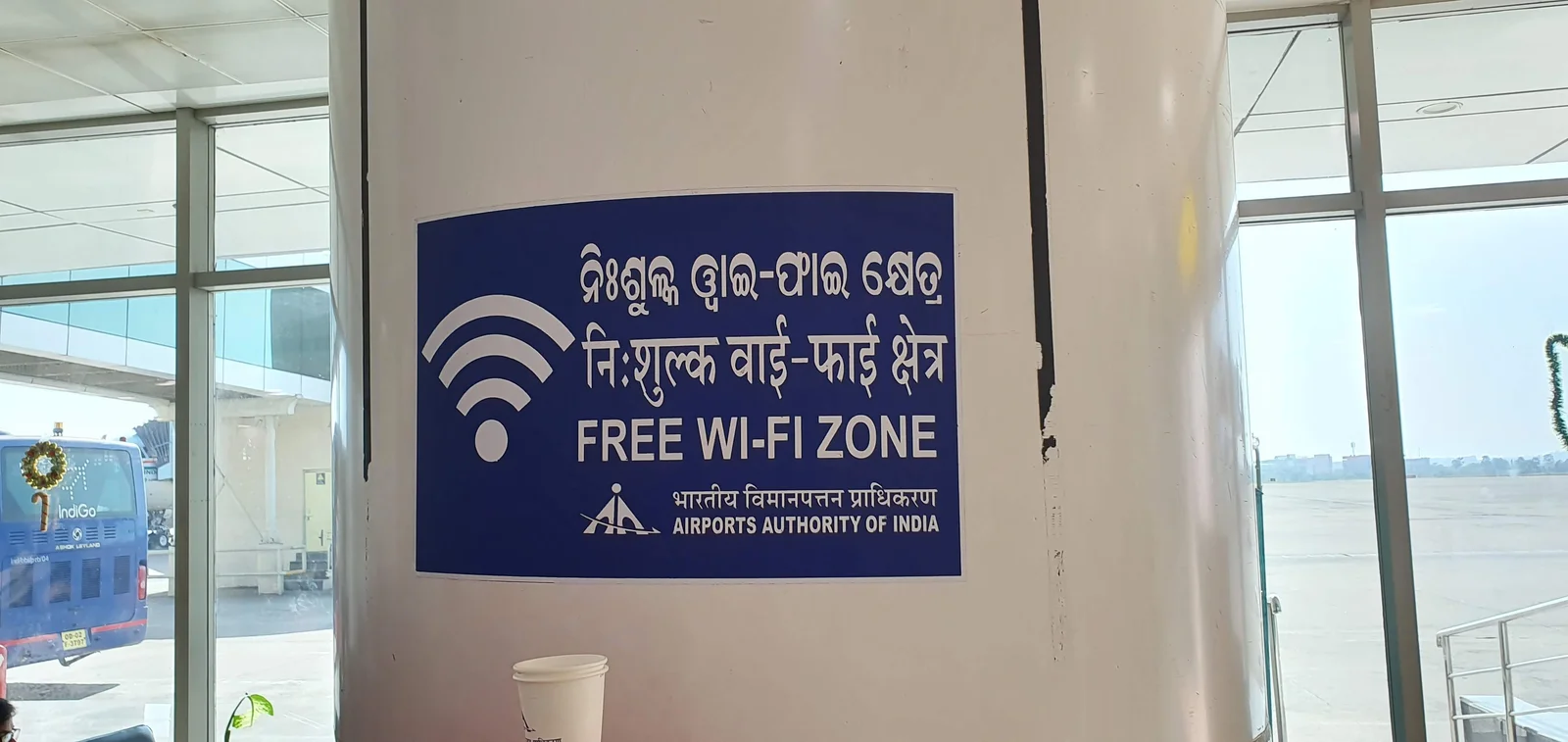
A sign for free Wi-Fi at Bhubaneswar airport in Odia, Hindi and English, photographed in December 2019.
Kalingaputra. Source · CC BY-SA 4.0.

Names on a page
The Census of India’s 2011 C-16 table for Odisha records population by mother tongue. In its published arrangement, Desia and Sambalpuri appear within the broader ODIA heading. That arrangement is important when interpreting the table: a total for the heading is not the same thing as a total for the individual entry named Odia. Nor is either a measure of everyone who can speak it.1
The census has a separate C-17 table for bilingualism and trilingualism. Reading the two together makes the difference clear. A mother-tongue return and the ability to use another language answer different questions. The figures describe a dated enumeration; they should not be silently turned into present-day estimates or counts of ethnic communities.2
A census category also does not settle what a writer should call their language. Sambalpuri and Kosali occur in public discussion with different emphases. Sahapedia’s indexed introduction to its Haldhar Nag interview identifies his writing as Kosali. That named literary usage deserves to remain visible beside the census term Sambalpuri, without making one source decide every question of identity.3
For this edition, the paired form Sambalpuri/Kosali keeps both names in view. It is an editorial aid, not a declaration that every speaker uses them interchangeably. In an interview, poem or performance record, the name preferred by the person concerned should take priority, accompanied where necessary by an explanation for readers.
Relationships beyond the state border
Languages can also be compared through their historical relationships. Odisha’s Academy of Tribal Language and Culture places Kui, Kuvi and Koya within the Dravidian family. The Central Institute of Indian Languages likewise describes Kuvi as Dravidian and locates its speakers in both Odisha and Andhra Pradesh. A state boundary is therefore only one line in a much wider language geography.45
For another set of relationships, CIIL’s Sora and Juang collections place those languages in the Munda branch of the Austroasiatic family. Unicode’s script documentation identifies Santali as Munda and Ho as North Munda. These descriptions help explain linguistic kinship; they do not imply that the languages are interchangeable or that their speakers share one undifferentiated culture.67
Kui and Kuvi need particular care because the similarity of their names can encourage confusion. The academy lists them separately, and educational catalogues also provide separate entries. A resource labelled for one should not be reassigned to the other merely because both are associated with Kandha communities.48
The Koraput landscape below supplies a regional setting for thinking about southern Odisha. It cannot tell us which language a household uses. For that, a photograph must give way to people’s accounts, recordings and carefully located research. A hill range can be shared by several linguistic histories.
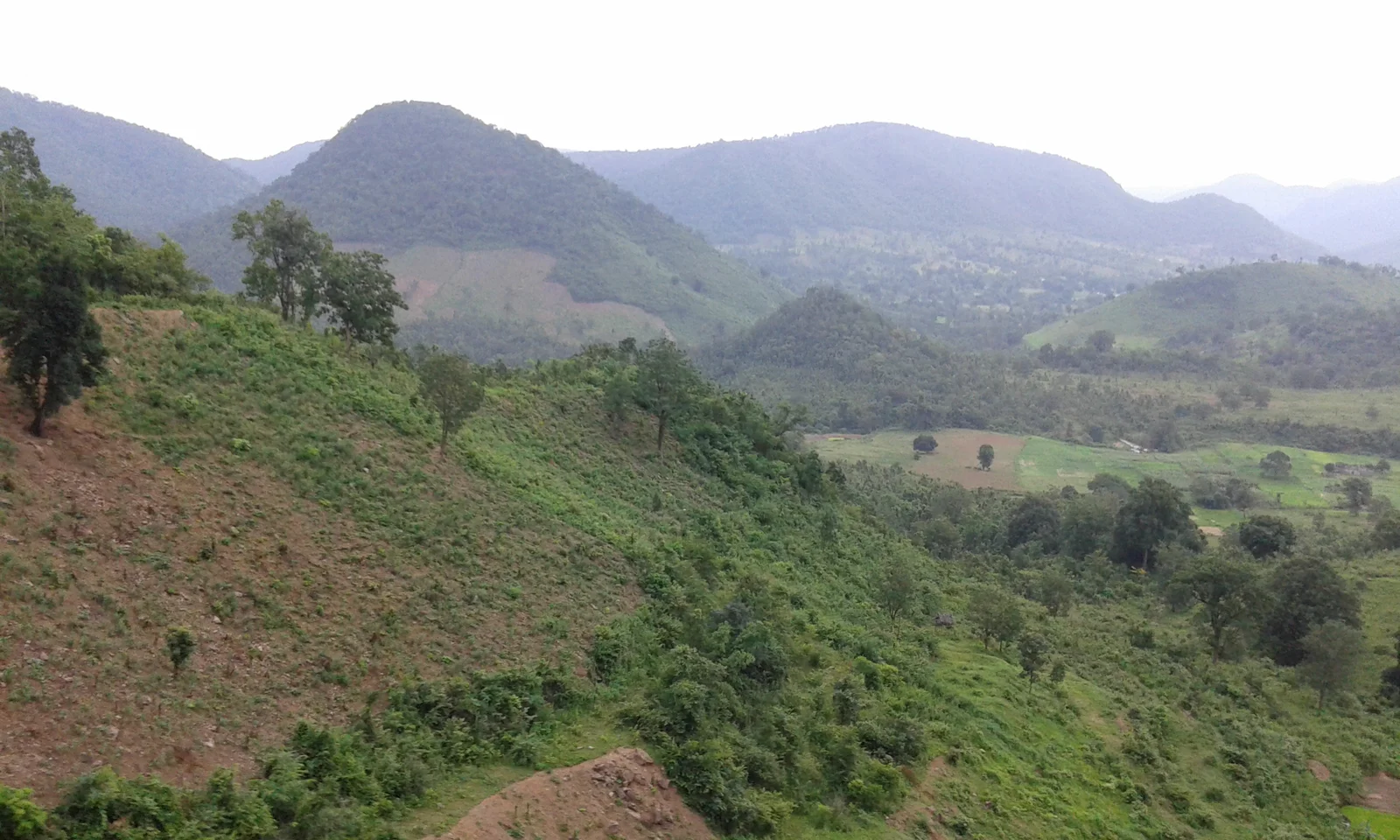
Hilly terrain in Koraput district, photographed on a journey towards Rayagada in August 2015. This regional setting is not identified as Niyamgiri.
Kkmishra1960. Source · CC BY-SA 4.0. Original photograph reproduced full frame, scaled for the page; no crop or recolouring.

A language and its writing
Raghunath Murmu’s commemorative bust honours a named maker of a writing system. Unicode identifies him as the creator of Ol Chiki for Santali. It describes an alphabet written from left to right, with independent vowel letters. It also records Santali’s use of Devanagari, Bengali, Odia and Latin scripts. One language can have more than one history of writing.7
Ho offers a related but distinct example. Warang Citi, devised by Lako Bodra, is used for Ho; it is not Ol Chiki. Unicode also notes other scripts used for Ho in different settings. Remembering the separate names matters, both for cultural attribution and for the practical task of finding a suitable book, font or learning resource.7
The relationship works in the other direction too: sharing a script does not make two languages identical. CIIL describes Kuvi as using the Odia script. A reader may recognise the written characters yet still need to learn the vocabulary and grammar. Familiar letter shapes are an opening into a text, not a guarantee of understanding.5
Writing can extend what speakers do with a language, from keeping a lesson to circulating a poem. It does not confer value on speech for the first time. A story told aloud already has a teller, an audience and a setting. An archive should retain those relationships when it adds a transcription or translation.
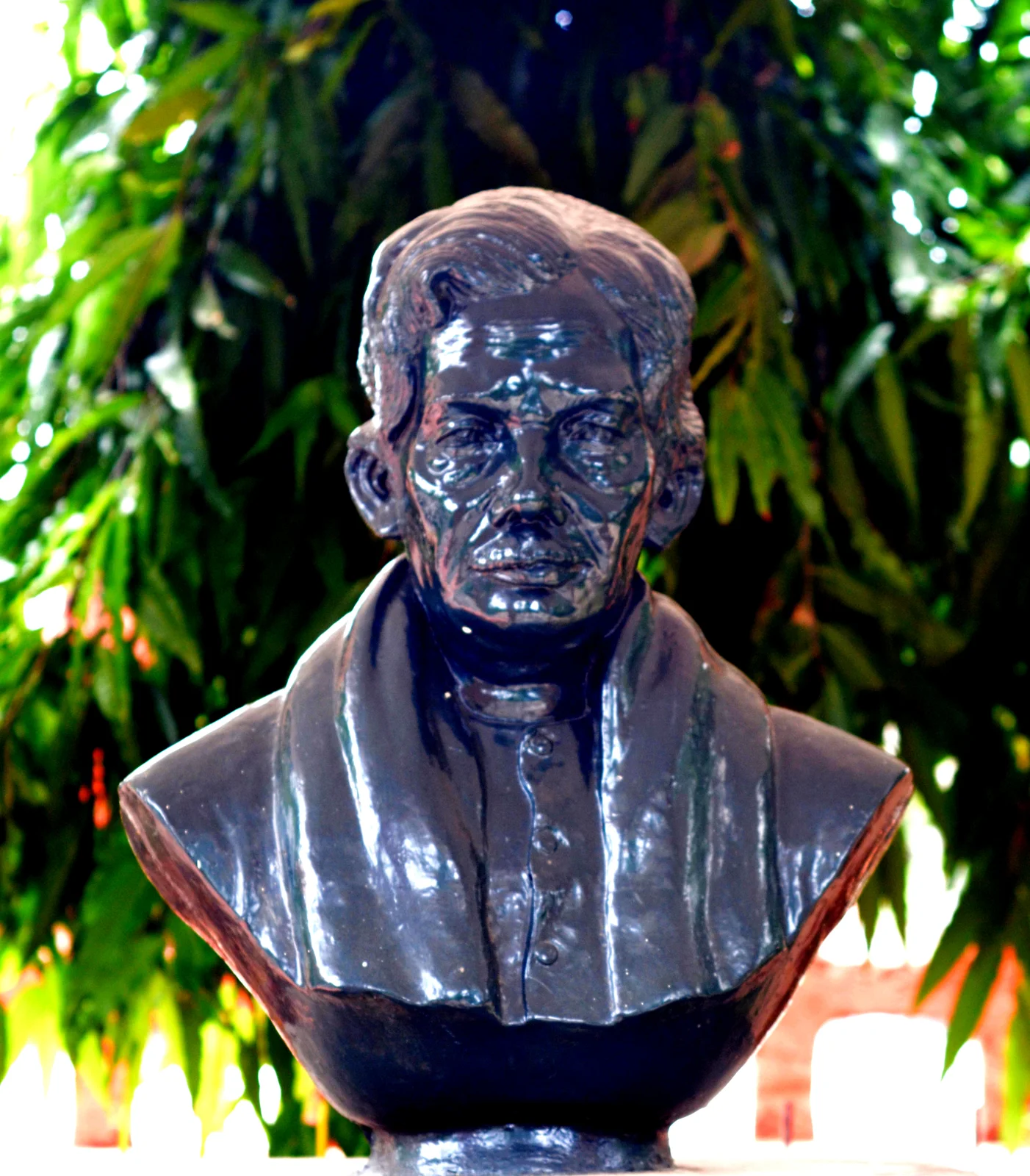
A commemorative bust of Raghunath Murmu at the Odisha Tribal Development Society office in Bhubaneswar, photographed in 2014.
Subhashish Panigrahi. Source · CC BY-SA 4.0.

When the classroom listens
A dated account from Kumbhitangari in Keonjhar brings the question of language into a child’s school day. In February 2026, UNICEF reported on Savitri Pingwa, a Ho-speaking pupil who had struggled with unfamiliar Odia classroom language. The report describes bilingual materials, familiar settings in stories and support for teachers as part of a multilingual approach.9
The same account describes words in children’s languages placed beside Odia equivalents, with Odia script retained in the materials discussed. This is one educational use of a shared script, rather than a statement about the only way Ho or Santali should be written. UNICEF reports increased participation in this school setting; its feature is not an independent evaluation of every classroom in Odisha.9
A different document records work before a book reaches learners. A June 2023 Ministry of Education release describes a workshop at the Central University of Odisha preparing materials in Kui and Desia. Participants considered listening, speaking, reading and writing, selected vocabulary and planned illustrated alphabet books. Local trials and subsequent revision were still part of the stated process.10
That sequence deserves attention. Preparing a manuscript, trying it with speakers, revising it and making it available to teachers are different achievements. The workshop report documents the first steps and plans; it does not establish later distribution or learning outcomes. Its account of community interaction also makes clear that educational material is made through people’s contributions.
The work behind a resource
SCSTRTI’s trilingual-booklet catalogue gives this labour a visible shelf. It includes separately labelled resources for Ho, Juang, Koya, Kui, Kuvi, Santali and Saora, as well as an entry labelled Bhatri-Desia. The catalogue preserves particular institutional names. It should be read as a guide to publications, not as a definitive classification of every language or variety.8
A useful reading practice follows from this. Keep the source’s title, identify its intended readers and ask which variety and script it uses. A catalogue entry confirms that a resource is listed; inspecting the book is a further step. Classroom use and a learner’s response require further evidence again. Each stage adds something that the previous one cannot supply.
For the cultural edition, this means allowing both connection and difference to remain audible. Odia’s public presence belongs beside the literary name Kosali, the educational use of Desia and the distinct histories of Santali, Ho and the southern languages. None needs to disappear so that another can be described clearly.
A land of many languages is made through people addressing one another. Its future lies partly in whether children can learn through familiar words, writers can find readers, and speakers can name their own experience. The sign, the commemorative bust and the learning booklet offer different entrances into that larger conversation.
Footnotes & Sources
- Census of India, C-16 Population by mother tongue, Odisha, 2011. Office of the Registrar General and Census Commissioner. Catalogue and row labels consulted, including Desia and Sambalpuri under ODIA. No current population figures inferred. ↩
- Census of India, C-17 Population by bilingualism and trilingualism, Odisha, 2011. Companion table distinguishing subsidiary-language reporting from mother-tongue classification. ↩
- Sahapedia, In Conversation with Padma Shri Haldhar Nag. Indexed introduction consulted for the identification of his writing as Kosali. Full interview did not load; no interview quotation or detailed argument is reproduced. ↩
- Academy of Tribal Language and Culture, The Tribes of Odisha. Language-family entries for Kui, Kuvi and Koya. The chapter does not adopt the page’s generalised social descriptions or treat its catalogue as a one-to-one map of people and languages. ↩
- Central Institute of Indian Languages, Kuvi collection. Bhasha Sanchika. Used for Dravidian affiliation, Odisha–Andhra Pradesh distribution and the stated use of Odia script. ↩
- Central Institute of Indian Languages, Sora collection. Bhasha Sanchika. Used for Munda affiliation. Companion Juang record consulted; its discussion notes differences in subgroup classification. Neither record’s population estimates nor generalised social descriptions are adopted. Additional source ↩
- Unicode Consortium, The Unicode Standard 17.0, Chapter 13. Sections 13.9 and 13.10, Warang Citi and Ol Chiki. Used for script identity and structure; historical population and literacy estimates are not reused. ↩
- SCSTRTI, Trilingual Booklets. Catalogue entries consulted, including Bhatri-Desia. Individual lessons and translations were not inspected or reproduced. ↩
- Gowri Sundararajan, What Happens When Classrooms Speak Your Language. UNICEF India, 27 February 2026. Reported account of Savitri Pingwa and Kumbhitangari school, not fieldwork conducted for this edition or an independent statewide evaluation. ↩
- Ministry of Education, National Workshop on Kui and Desia language concluded at Central University of Odisha. Press Information Bureau, 2 June 2023. Materials preparation, proposed local trials and revision are distinguished from subsequent implementation. ↩
All three photographs are reproduced full frame and resized for print, with linked credits and Creative Commons licences in their captions. The airport photographer’s Commons username is transliterated as Kalingaputra; the original Odia name is retained in the source record. The image licences apply to the photographs, not automatically to the chapter text. No invented interviews are used. Naming and classroom examples remain attributed to their sources. Research checked 10 November 2026.
Suggest an update
Share a correction or source for this chapter. GitHub submissions are public. Please omit private contact details and consent documents.