
Part 2 · Faith, Seasons and Shared Spaces
Chapter 12 of 48
The Seasonal Calendar
Fields, households and the occasions that shape an Odisha year
An Odisha year can be remembered through things held in the hand: a length of swing rope, the first rice of a crop, a little grain measure, a miniature boat lowered onto water. Each object belongs to an occasion. Together they suggest a calendar made through repeated acts, with time felt in food, work, worship and visits.
This chapter follows several of those rhythms. Raja, Nuakhai and Manabasa offer different ways of connecting a household to the agricultural year. Boita Bandana turns a seasonal gathering towards the sea. They belong within a much larger field of observances, whose meanings and dates need to be understood in particular places.
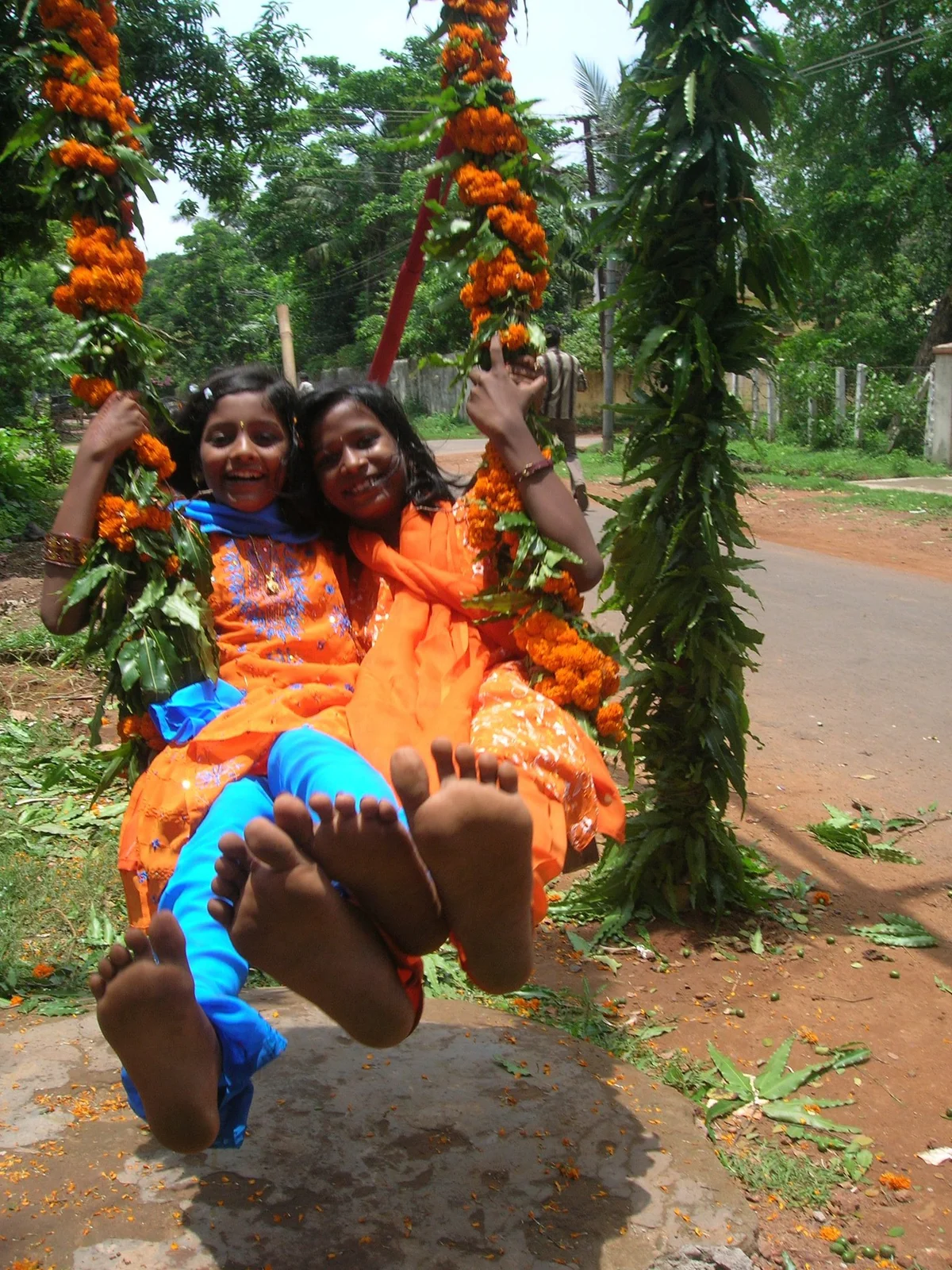
A decorated swing during Raja, photographed in 2011.
Saroj Bal. Source · CC BY-SA 3.0.

Reading the year
A printed festival list can make Odisha appear to share one uninterrupted round of celebrations. A closer view reveals overlapping calendars. Fields have their rhythms; families remember obligations; temples and public gatherings bring people together on another scale. A holiday may be widely recognised without being observed in the same way by every household.
Even the relationship between festival and date needs care. Raja is associated with Mithuna Sankranti, while the Nuakhai described in western Odisha follows a lunar date in Bhadraba. A season, a calendrical rule and a Gregorian date are different kinds of information. The broad months in this chapter orient the reader; they are not an annual schedule.12
The distinction matters when we read the landscape. A festival associated with the rains does not certify that rain has arrived in every village. An offering of first rice does not announce that every crop has been harvested. Ritual time gives agricultural experience a shared form, while actual fields remain subject to differences of place and circumstance.
Raja and the work of rest
In Pravukalyan Mohapatra’s account, Raja is especially associated with coastal Odisha. Its three principal days fall around Mithuna Sankranti in June. The earth is understood within the festival’s sacred idiom as menstruating and resting; cultivation is paused. Swings, songs, visits and the sharing of cakes make the interval visible beyond the field.1
The swing is an especially expressive object. It takes an ordinary place and gives it a temporary purpose: people gather, wait their turn and watch one another move. Poda pitha and other preparations similarly turn ingredients and kitchen labour into the taste of an occasion. Celebration acquires a texture that a date alone cannot convey.
Raja also asks for a careful account of gender. The literature describes leisure and sociability for girls and women alongside ritual restrictions. Neither side should erase the other. A cultural history can recognise the pleasure of the festival while asking who prepares the food, who receives a respite and how participants understand its rules.
First rice and shared belonging
Nuakhai places new grain at the centre of an encounter between fields, deities and kin. Indhubala Kesavan’s ethnography of a village in Bargarh district describes its observance on the fifth day of the waxing moon in Bhadraba, usually August or September. The offering uses the first ripened paddy, rather than marking the completion of the entire harvest.2
In that account, new rice is offered to deities and ancestors and distributed within the family. Greetings and visits extend the occasion beyond a single home. Unmarried sisters have important ritual roles, and gifts accompany their relations with brothers. Rice becomes a means of recognising both dependence on cultivation and obligations between people.2
This is a situated account, based on fieldwork, rather than a script for all western Odisha. Kesavan also examines the tension between sisters’ ritual importance and their structural position. Honour within a ceremony should not automatically be read as equality in everyday life. The value of the study lies partly in holding those experiences together.
Public performance adds another setting. The photograph below records Dalkhai at a Nuakhai Bhetghat gathering in Burla. It shows how an occasion can enter a stage programme; it does not show the household offering of first grain. Keeping that distinction helps us see a festival’s several forms without collapsing them into one.
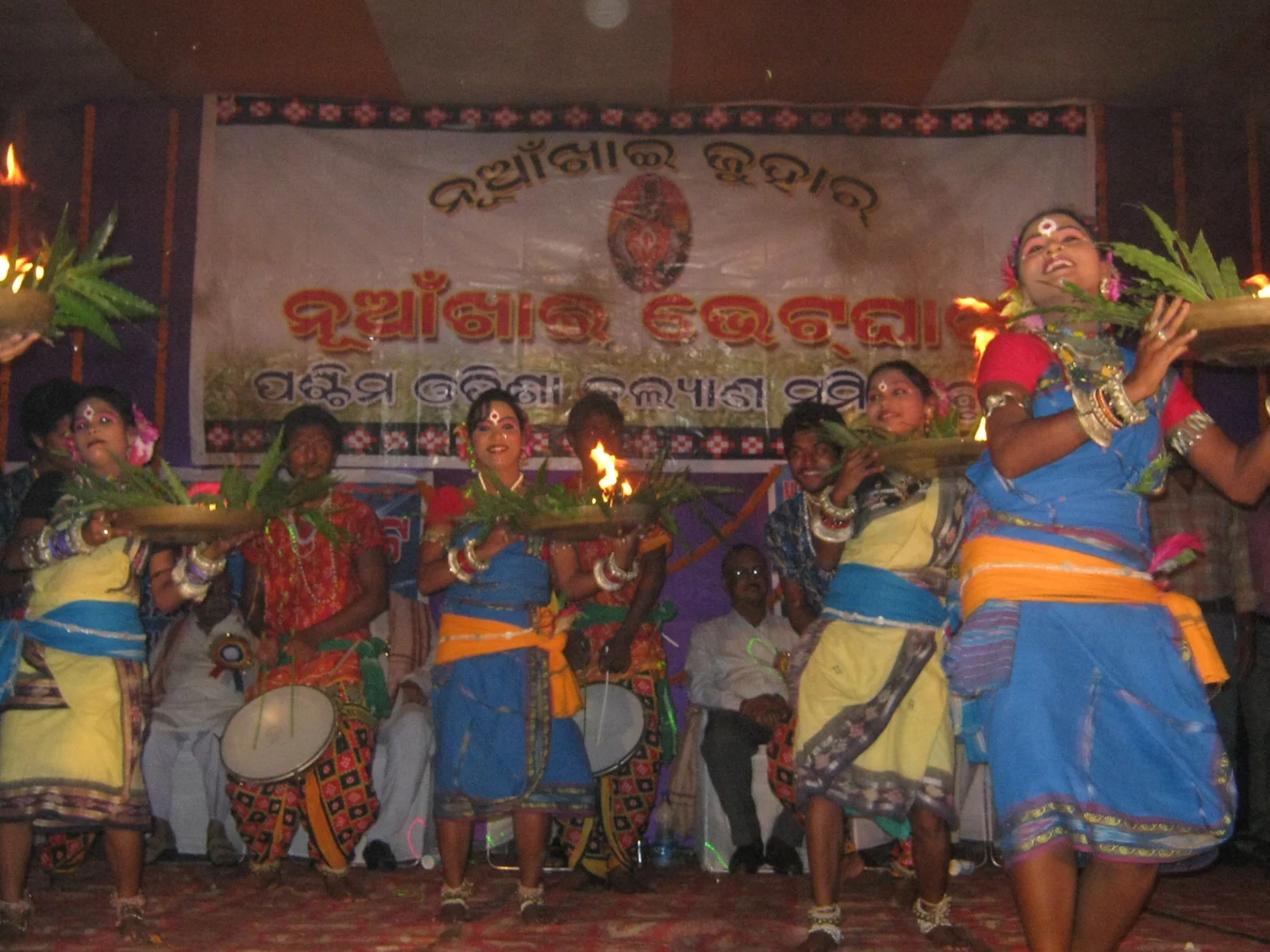
Dalkhai performed at a Nuakhai Bhetghat gathering in Burla. This is a stage performance, not the first-grain household rite.
Mamata Padhi. Source · CC BY-SA 4.0.

A Thursday inside the home
Manabasa Gurubara brings the seasonal calendar across the threshold. Observed on Thursdays in Margasira, broadly November and December, it is associated with Lakshmi, grain and household prosperity. The mana, a grain measure, gives the observance its distinctive material focus. Women’s worship and the preparation of the domestic space are central to descriptions of the practice.3
The photographed jhoti at Sergarh in Baleswar makes that preparation visible through a few white lines: feet, a floral form, an offering. The image is small in scale, but its setting matters. Here the calendar is marked on the surface of a home, rather than only through a procession or a crowded public ground.
The Lakshmi Purana, attributed to Balaram Das, gives this devotional world a powerful narrative dimension. Lakshmi’s departure from Jagannath and Balabhadra brings hardship; the story places hospitality, food and social exclusion within a moral argument. Its challenge to hierarchy deserves attention without treating a sacred narrative as evidence that discrimination disappeared.3
Osha and brata invite this kind of close reading: an observance has participants, preparations, stories and obligations as well as a name. The household is therefore an essential place for understanding the cultural year. What may be almost invisible to an outside visitor can be central to the person keeping the occasion.
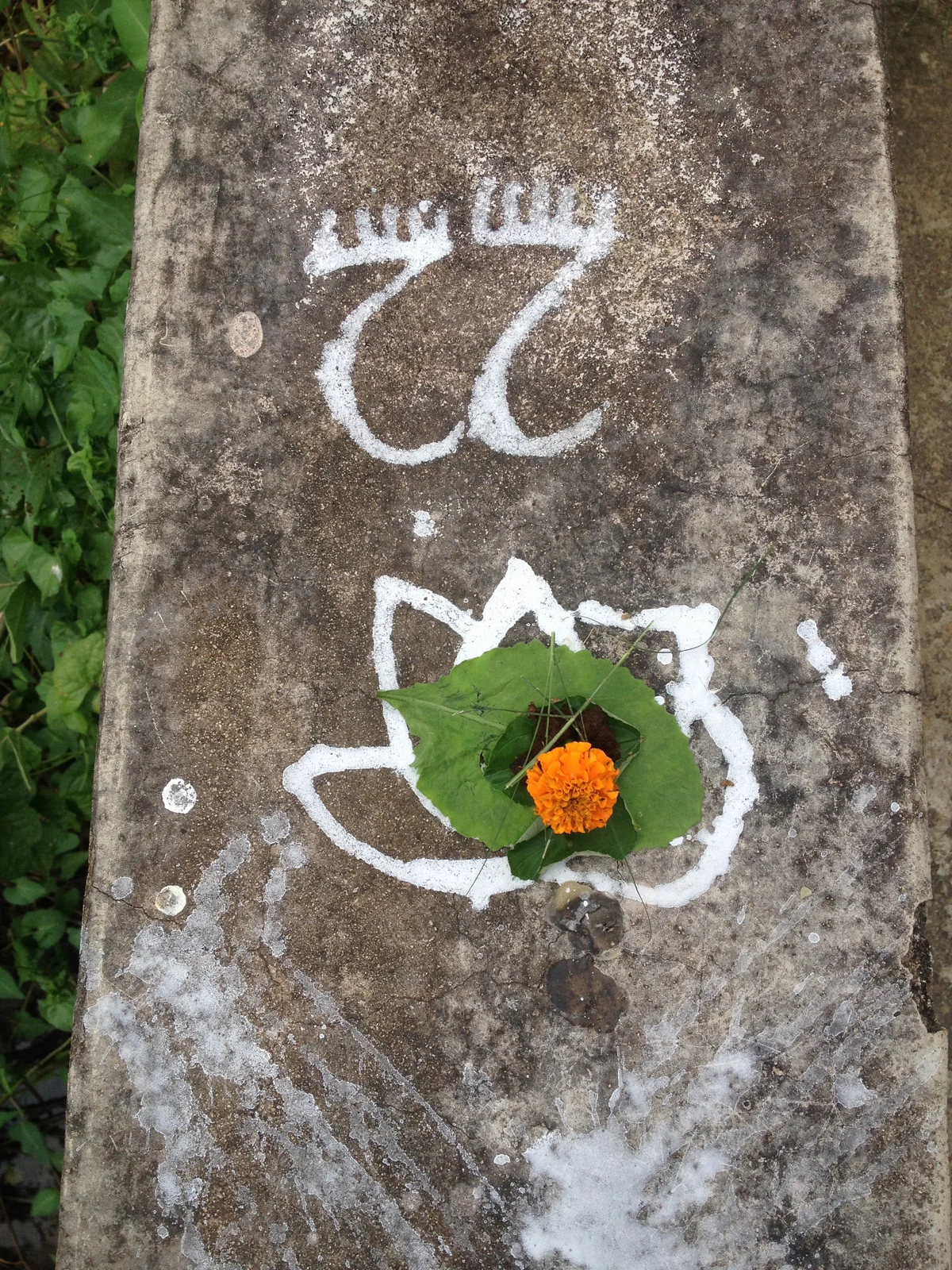
Jhoti during Manabasa Gurubara at Sergarh, Baleswar, photographed in 2013.
Subhashish Panigrahi. Source · CC BY-SA 3.0.

Small boats and a public memory
At Kartika Purnima, miniature boats give water a ceremonial role. Odisha Tourism describes Boita Bandana as recalling Odisha’s maritime voyages, while the Ministry of Culture places it alongside Cuttack’s Bali Jatra. The little vessel and the large fair work at different scales, joining an intimate gesture to a public commemoration.45
The photograph from a village pond in Baleswar keeps that smaller scale in view. Flowers, floating craft and the edge of the water make a setting that can be approached without an ocean voyage. The occasion connects participants with a remembered seafaring past; it does not, by itself, establish the route or date of a particular historical expedition.
This distinction allows memory to retain its own importance. Archaeology asks what survives from a port or a ship. A festival asks how a community gives the past a recurring place in the present. Both questions belong in the cultural edition, but they call for different kinds of evidence.
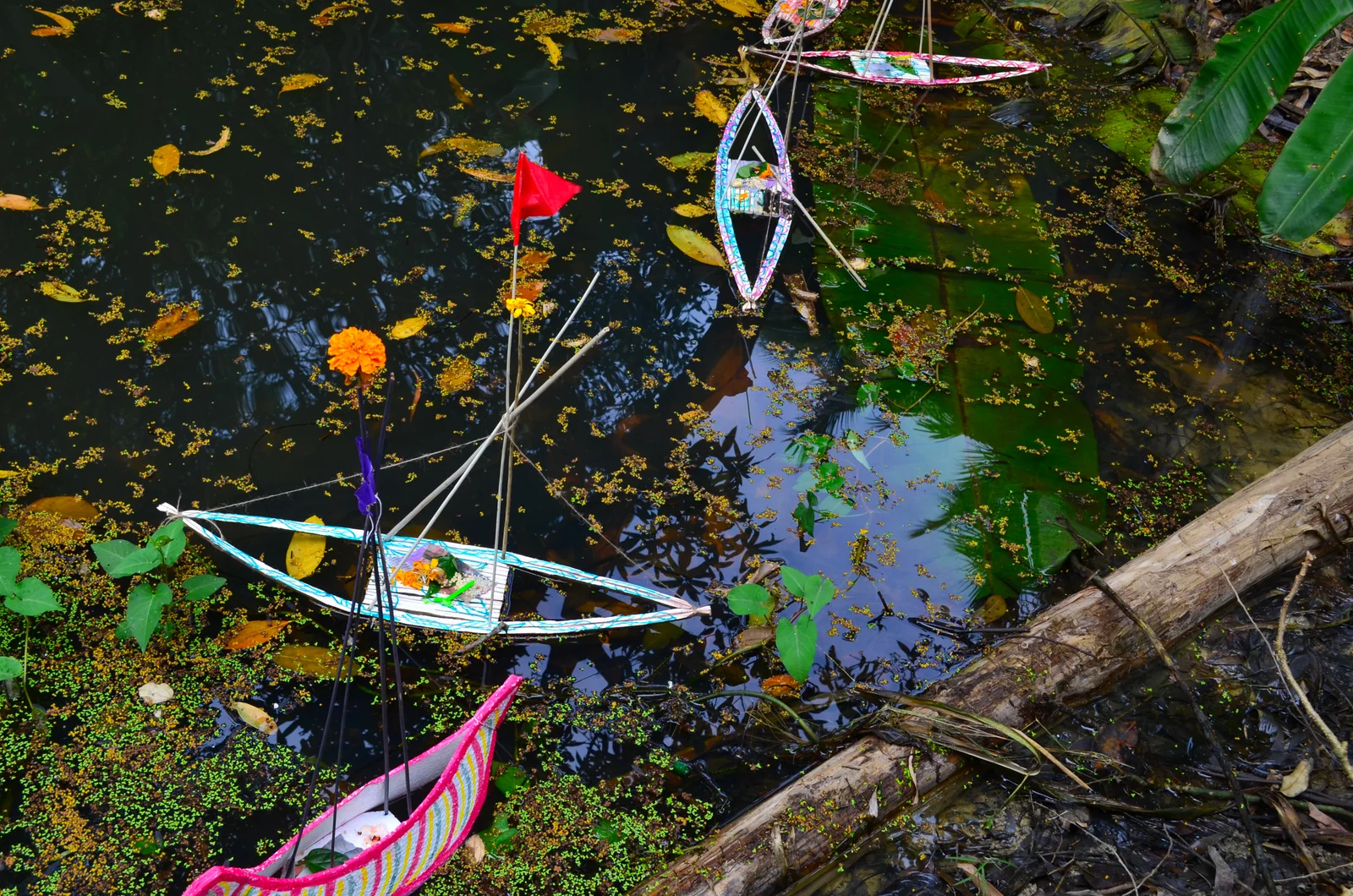
Miniature boats during Boita Bandana in a village pond, Baleswar, photographed in 2013.
Subhashish Panigrahi. Source · CC BY-SA 4.0.

A seasonal guide
These are selected points of orientation, not a complete festival inventory. Gregorian months are approximate; local calendars and organisers should be consulted for a particular year.
March–April: Sarhul. The Kendujhar district account describes sal flowers brought to a sacred grove in Munda observance. This is a community-specific example, not a calendar for all Adivasi peoples.6
June: Raja. Rest, swings and sociability gather around Mithuna Sankranti, with a particularly strong coastal association in the account used here.1
August–September: Nuakhai. First rice, offerings and kinship come together in the western Odisha field study discussed above.2
October–November: Sohrai. The Kendujhar account describes a Munda observance concerned with cattle, including feeding them and tending their shelter.6
Kartika Purnima, usually October–November: Boita Bandana. Miniature boats recall maritime journeys; Cuttack’s Bali Jatra gives the commemoration a major public setting.45
November–December: Manabasa Gurubara. Thursdays in Margasira place Lakshmi, grain and domestic preparation at the centre of the observance.3
The gaps are part of the guide’s meaning. A household’s year may also be shaped by observances explored elsewhere in this edition, including temple festivals and Muslim and Christian religious life. The examples here cannot stand for everyone. They offer a way of asking better questions: whose calendar is being described, what work sustains it, and what does returning to the occasion make possible?
Read this way, a seasonal calendar is more than a list of attractions. It is a record of relationships renewed through action. A person prepares, offers, shares, visits or remembers. Repetition gives those acts familiarity, while each new year gives them another setting in which to matter.
Footnotes & Sources
- Pravukalyan Mohapatra, Raja Sankranti: The Festival of Swings. Orissa Review, June 2006, pp. 122–123. Festival timing, regional emphasis, earth symbolism, swings, foods and restrictions. Ritual beliefs are presented as beliefs. ↩
- Indhubala Kesavan, Rice Culture and Sacred Siblingship. Full title: Rice Culture and Sacred Siblingship: Nua Khai and Bhai Jiuntia Celebrations in Western Odisha, India. Paideuma 70/71 (2024/25), pp. 15–40, especially 27–29. Based on fieldwork in Bargarh district; the village name used in the study is a pseudonym. ↩
- P. C. Mohanty and Swadhin Mohanty, Laxmi: The Goddess of Prosperity and Salvation. Odisha Review, June–July 2021, pp. 21–25, especially p. 23. Used for Manabasa, the grain measure and the Lakshmi narrative, not as proof that caste exclusion ended. ↩
- Odisha Tourism, Mahanadi Boita Race. Official visitor account, consulted 10 November 2026. Used for Boita Bandana at Kartika Purnima and its commemorative meaning, not for current event dates. ↩
- Ministry of Culture, Bali Jatra Cuttack. Parliamentary reply, 6 February 2025. Contemporary account of the fair, Boita Bandana and maritime commemoration. ↩
- Kendujhar district, Culture and Heritage. Official district account, consulted 10 November 2026. Sarhul and Sohrai descriptions are retained as locally situated Munda examples. ↩
Each photograph has a linked source and licence in its caption. All four are reproduced full frame and resized for print. The respective Creative Commons licences apply to the photographs, not automatically to this chapter’s text. Wikimedia Commons descriptions supply the photograph locations and credits. This is a selected cultural guide, not an annual festival-date schedule. Research checked 10 November 2026.
Suggest an update
Share a correction or source for this chapter. GitHub submissions are public. Please omit private contact details and consent documents.