
Part 3 · Languages, Literature and Oral Memory
Chapter 14 of 48
Odia in Manuscript, Print and Public Life
Copying reading and the making of a literary public
A manuscript leaf, a newspaper’s subscription notice and a school anthology all put words before a reader. Yet each depends on a different arrangement of work. Someone copies a text; someone pays for printing; someone decides which book belongs in a classroom. The history of written Odia is also a history of these decisions.
This chapter follows that history from the continued use of palm-leaf manuscripts into the presses, newspapers and literary arguments of the nineteenth century. Its focus is how writing circulated and acquired public authority. The making of palm-leaf art receives fuller treatment later in this edition; here, the material page helps us ask who could produce, encounter and judge a text.
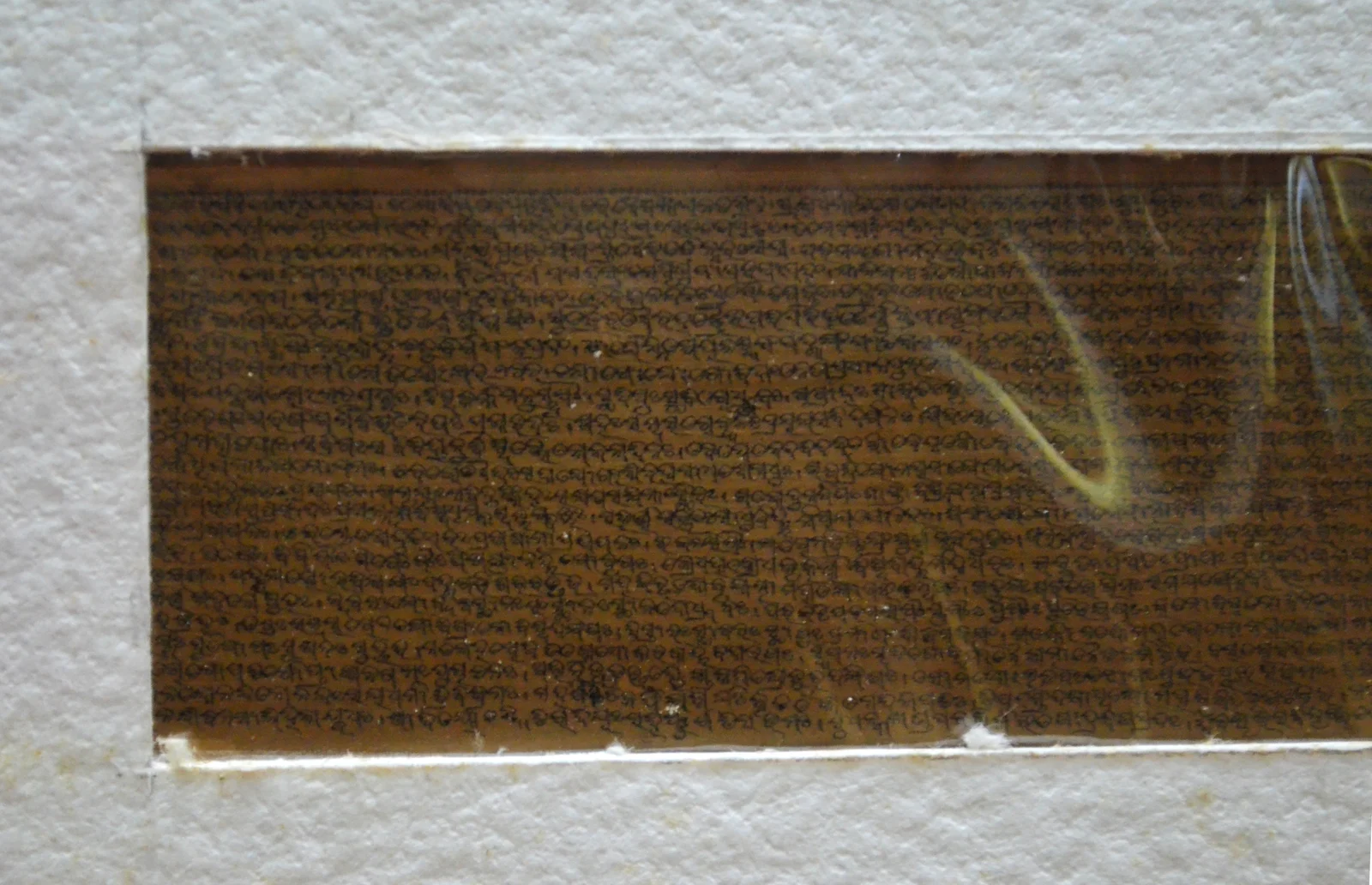
Palm-leaf manuscript photographed at the Odisha State Museum. The source does not establish its title, copyist or copying date.
Subhashish Panigrahi. Source · CC BY-SA 3.0.

The leaf and the listening reader
In her history of language and regional politics, Pritipuspa Mishra describes palm-leaf manuscripts as an important part of Odisha’s textual life even after printing had begun. Copying depended on patronage and the labour of scribes. An author’s composition and a scribe’s surviving copy were different acts, sometimes separated by a considerable interval.1
That distinction changes how we look at a museum display. The age of a literary work cannot simply be assigned to every manuscript bearing its title. A photograph may record a leaf clearly while leaving the copyist, copying date and history of ownership unknown. The opening picture is therefore identified as a manuscript photographed at the Odisha State Museum, without supplying a title or date that its source does not establish.
Mishra also describes Bhagabata Ghara or Bhagabata Tungi as places where manuscripts were housed and readings of Jagannath Das’s Bhagabata were heard. A written text could reach listeners as well as people able to read it themselves. The social life of a book extended beyond the person holding it, through a voice and a gathering.1
This makes a simple progression from manuscript to print misleading. New presses entered a world with existing ways of copying, reciting and sharing literature. Their arrival changed the means of reproduction, but it did not make those earlier relationships disappear on a single date.
More than one language on a leaf
Odia script and Odia language also need to be distinguished. CIIL’s catalogue describes a palm-leaf Gita Govinda in Odia script. The National Museum’s account identifies Jayadeva’s Gita Govinda as a Sanskrit work and dates its own illustrated palm-leaf example to the eighteenth century. The composition, writing system and physical manuscript each have a history.23
The photograph below shows a different Gita Govinda display, at the Odisha State Museum in 2013. The source identifies the work, but does not establish the copying date. It should not be called Jayadeva’s autograph or assigned the National Museum object’s date. Keeping objects separate is essential when an image travels beyond its original caption.
For a reader, this is a useful pause before the history of printing. A script connects texts that need not be in the same language. A familiar title can survive in many copies. The cultural world around Odia writing includes these crossings, while the task of identifying a particular manuscript still requires its own evidence.
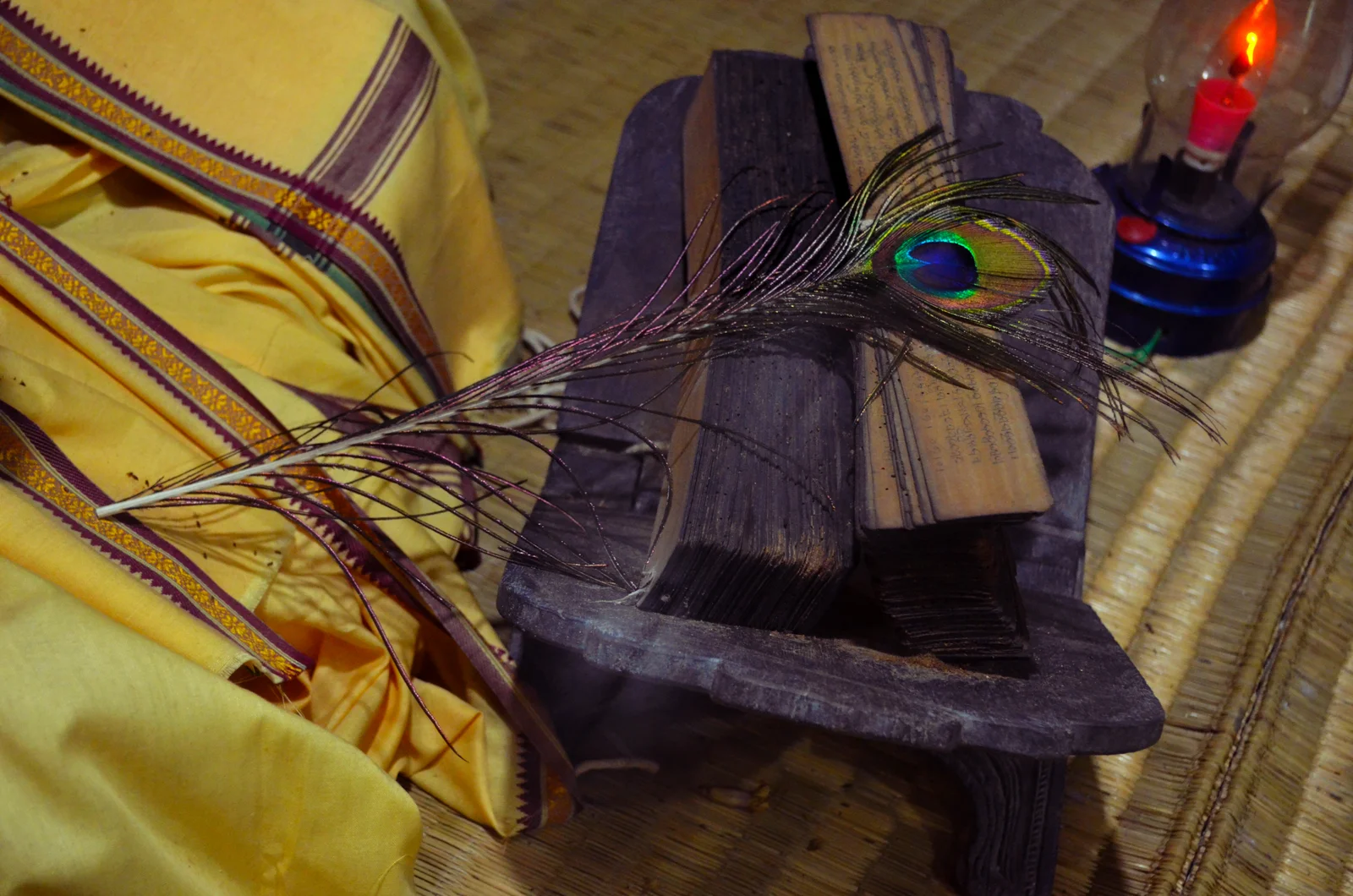
Gita Govinda display at the Odisha State Museum, photographed in 2013. The date of this manuscript copy is not established here.
Subhashish Panigrahi. Source · CC BY-SA 3.0.

The press and the schoolbook
Mishra dates the establishment of the Cuttack Mission Press to 1838. Before that, Odia publications including a Bible translation and a grammar had been printed at Serampore and brought to Odisha. The press in Cuttack served missionary purposes and also produced dictionaries and educational material. Its place in print history should retain that religious and institutional setting.1
Later presses depended on other forms of support. Mishra describes the Cuttack Printing Company’s funding through shareholders and patrons, while its routine business included government forms and schoolbooks. Her account of its third annual report records 12,500 schoolbooks among 18,200 books printed. Those are production figures reported by the historian, not evidence that every copy reached a separate reader.1
Textbooks made repeat demand possible. They also made choices about language consequential: which vocabulary to teach, which poems to select, and whose account of the world children would encounter. Printing was not only a new way to preserve old works. It provided employment, required investment and made particular kinds of writing commercially useful.
The classroom was already a site of political argument. Mishra traces proposals in 1864–65 to replace Odia with Bengali as the language of instruction in Odisha division schools. Officials invoked shortages of suitable Odia books and qualified teachers. Opposition challenged the proposed change and connected the production of books with the standing of the language itself.4
This was not a conflict in which every person’s position followed their mother tongue. Mishra notes Bengali as well as Odia participation in the Utkal Bhasha Uddhipani Sabha formed in 1867. The history is best understood through particular institutions, arguments and participants, rather than inherited antagonism between today’s language communities.4
A newspaper makes its offer
Utkal Dipika began publication in 1866, during the devastating famine remembered as Na’anka. Odia Bibhaba’s collection introduction identifies Gourishankar Ray as its founder and editor and describes the newspaper’s role in bringing public concerns before government. Alongside news and argument, it carried essays, poetry, reviews and notices of other publications.5
The reproduced page offers a closer encounter with the business of circulation. In the archived reprint of the 1866 volume, printed page 9 sets out prices and conditions for the newspaper, postal provision, advertising and printing work. It addresses people as possible subscribers and customers. These are offers on a page; the notice alone cannot tell us how many accepted them.6
This modest distinction is important. A newspaper could imagine a dispersed readership and provide a means of reaching it. Demonstrating actual circulation would require further records. The terms nevertheless show the practical arrangements behind public discussion: payment, delivery, available space and work for the press.
The image is taken from a later reprint digitised by Srujanika, rather than photographed directly from an original 1866 sheet. That transmission history stays with the illustration. The page can be studied as evidence of the reproduced terms without being mistaken for an untouched original issue.
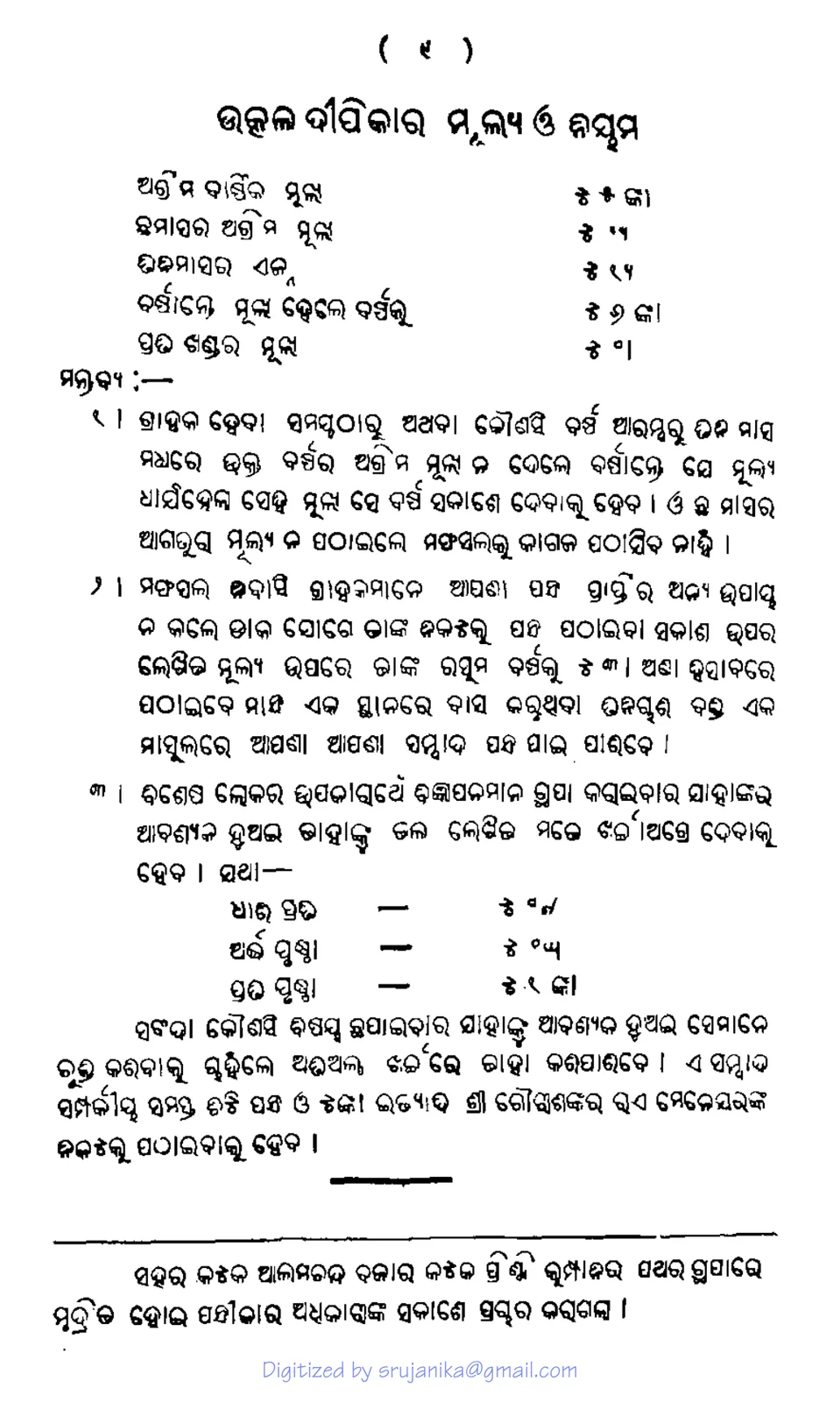
Prices and conditions in the reprint of Utkal Dipika, volume 1 (1866), printed p. 9; PDF p. 46. Later reprint and digitisation, not an original sheet.
Utkal Dipika via Srujanika and Odia Bibhaba. Source · Historical document source.
Who decides what belongs in a book
The growth of print also opened disagreement about literary value. In Mishra’s account of the 1890s, arguments about Upendra Bhanja’s poetry spread through newspapers and journals. One question was whether older poetry was suitable for schoolchildren; another was whether its place in the literary inheritance should depend on that suitability. Those questions did not always lead to the same answer.1
A school selection could therefore become a judgment about the past. Defending an earlier poet did not necessarily mean wanting every work taught in a classroom. Equally, demanding new writing could involve a particular idea of what readers ought to become. The history of print includes argument over the purposes of reading, as well as the multiplication of pages.
Utkal Sahitya, launched in 1897 under Biswanath Kar, provided another setting for this expanding literary life. Odia Bibhaba describes a monthly whose contents ranged across culture, politics, economics and science, alongside travel writing, biography, fiction and poetry. Its publication history brings several kinds of knowledge into the same reading space.7
The widening ambition of print should not be confused with universal access. Mishra emphasises the limited urban and educated constituency of the early public sphere. Editors could speak in the name of a much larger public than the group actually producing or reading their journals. Questions about class, gender and participation belong beside the achievements of the press.1
Today, digitised collections let us return to some of these pages. Their gaps and condition remain part of the evidence: an archive’s index helps locate a text, but does not guarantee that every issue survives. The reader’s task is to keep the date, edition and source attached. In doing so, we can follow written Odia through its changing public life while still noticing the people and work that made a page available.
Footnotes & Sources
- Pritipuspa Mishra, Vernacular Publics. Chapter 2 of Language and the Making of Modern India, Cambridge University Press, 2020. Printed pp. 80–88 and 92–94: manuscripts, oral reading, presses, schoolbooks and literary debate. Selected passages inspected in the retained full-book PDF; original press accounts were not independently obtained. ↩
- Central Institute of Indian Languages, Gita Gobinda catalogue record. Catalogue description identifies a palm-leaf text in Odia script. Used only for that distinction; no claim about the photographed copy follows from this record. ↩
- National Museum, Manuscripts collection. Collection entry for Gita Govinda of Jayadeva, accession 57.46, eighteenth century. Indexed institutional description consulted; its date is not transferred to the Odisha State Museum photograph. ↩
- Pritipuspa Mishra, How the Vernacular Became Regional. Language and the Making of Modern India, 2020, printed pp. 48 and 52–54. School-language proposals, institutional response and economic arguments. Modern historian’s interpretation, not a transcription of original orders. ↩
- Odia Bibhaba, Utkal Dipika collection. Collection introduction and index: 1866 launch, editor, famine context and range of contents. Name spellings follow the source. ↩
- Utkal Dipika, volume 1, 1866, reprint. Srujanika digitisation linked by Odia Bibhaba. Printed p. 9, PDF p. 46, inspected visually. Broad description of the terms only; no exact rates, circulation totals or claim of completed transactions supplied. ↩
- Odia Bibhaba, Utkal Sahitya collection. Collection introduction and index: 1897 launch, Biswanath Kar and range of genres. The archive notes missing issues; this chapter does not claim a complete run or reconstruct an uninspected article. ↩
Two museum photographs are reproduced full frame and resized under CC BY-SA 3.0, with linked photographer credits. The documentary illustration reproduces the historical 1866 terms page through a later reprint digitised by Srujanika; its digitisation credit remains visible. It is included for discussion and review, with no Creative Commons licence asserted for the reprint or scan. Research checked 10 November 2026.
Suggest an update
Share a correction or source for this chapter. GitHub submissions are public. Please omit private contact details and consent documents.