
Part 8 · Modern Media and Cultural Futures
Chapter 45 of 48
Archives, Libraries and the Digital Page
Keeping words available, making room for readers
A book may survive without being available. Someone remembers its title; a library catalogue records it; a copy rests in a cupboard. Yet the person who wants to read it cannot reach its pages. Between survival and use lies a chain of work: keeping, describing, copying, checking and helping another reader find a way in.
In Odisha, that work connects manuscripts and printed volumes with reading rooms, volunteer collections and digital libraries. The screen adds another doorway. What passes through it depends on earlier acts of care—and on the people who continue to make a preserved page intelligible.
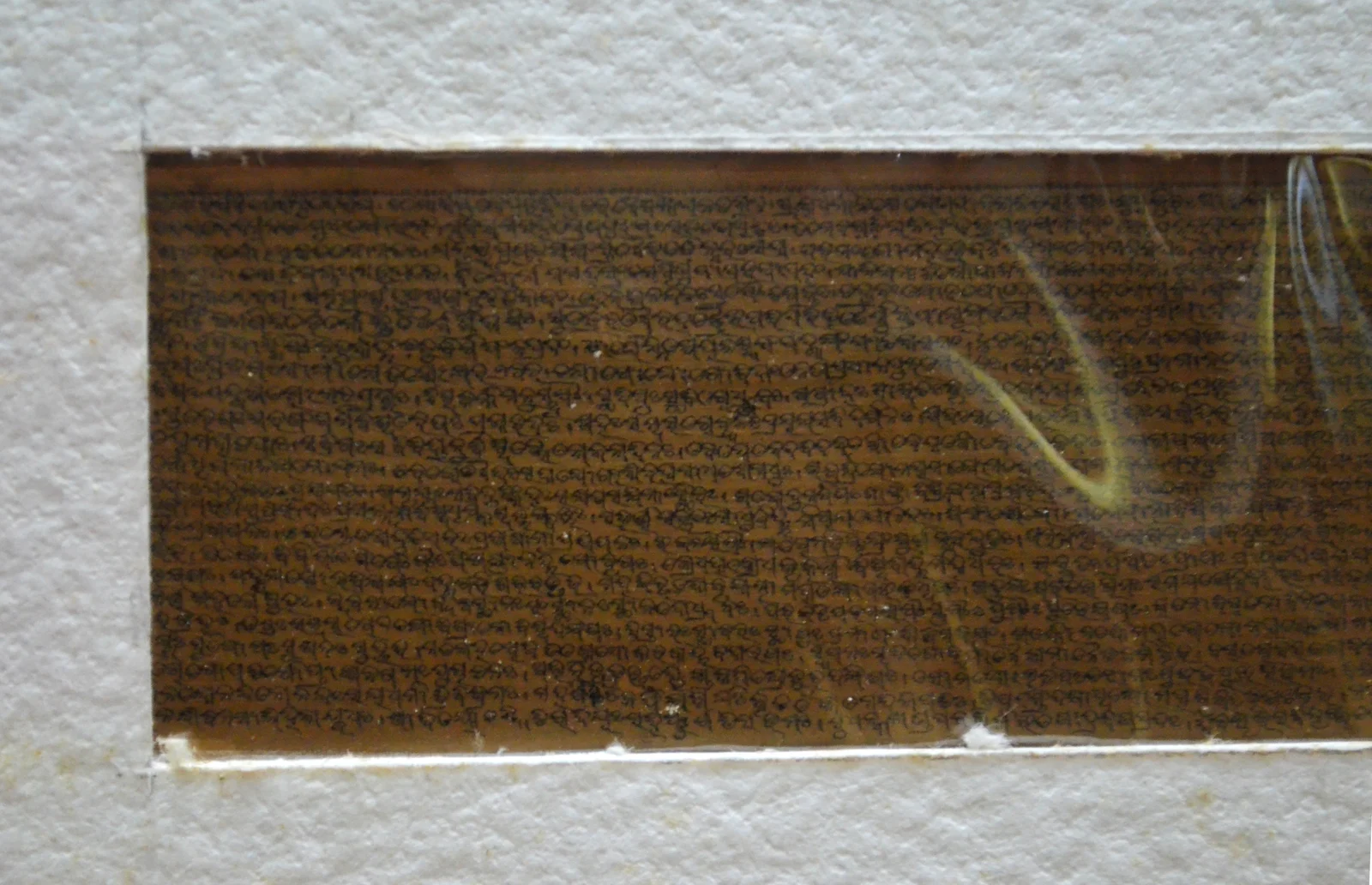
Palm-leaf manuscript photographed at the Odisha State Museum. The source does not establish its title, copyist or copying date.
Subhashish Panigrahi. Source · CC BY-SA 3.0.

The work before the website
Odia Bibhaba offers a particularly revealing history of this labour. Its account describes Srujanika as a volunteer collective rooted in science and education. Project Rebati, begun in 2004, joined work on Odia computing with the preservation of printed material. The digital Purnachandra Odia Bhasakosha appeared in 2006, followed by collections of dictionaries, periodicals and individual writers’ works.1
The equipment belongs to the story. Srujanika describes developing a camera-based copying system and using open-source software. Before a reader could download a volume, someone had to arrange the pages, obtain usable images and process them. Earlier distribution on discs and flash drives also reminds us that the digital archive did not begin with a browser window.1
This history has changes of responsibility as well as achievements. In a post dated 23 May 2021, Srujanika announced that its digitisation work had ended and described work beginning under SOA University’s PPRACHIN programme, using its equipment and experience. It said website management would continue for the time being. That dated statement records a transition; it does not establish the present staffing arrangement or imply that the collection disappeared.2
An archive therefore needs more than a successful launch. Someone must answer a query, repair a broken route to a volume and explain what a collection contains. The visible page rests on less visible continuity. A useful question is not simply how much has been scanned, but whether a reader can identify the edition, follow its sequence and return to the same passage later.
What a collection can—and cannot—show
A periodical preserves a conversation differently from a collected volume. A poem appears beside an essay; an editorial shares an issue with advertisements or correspondence. Their proximity is part of the evidence. Reading only a detached passage can conceal the company it kept and the audience to which it first spoke.
Odia Bibhaba’s Utkal Sahitya collection identifies the magazine’s beginning in 1897 under Biswanath Kar and describes writing on religion, philosophy, culture, politics and science. Its range invites a reader to follow connections across subjects rather than regard literary history as a shelf of isolated masterpieces.3
But a catalogue entry is a promise of a route, not proof that every issue survives. The responsible reader checks the volume and issue dates, the available pages and any indication of gaps. An absent search result cannot settle whether a word was never printed: the relevant issue may be missing, or the page may be present only as an image.
A scanned page and a searchable text also offer different kinds of help. The image retains visible layout, marks and damaged edges. A transcription makes words easier to search, quote or enlarge, but introduces decisions about letters, spacing and uncertain readings. Keeping the image close to the transcription lets readers examine those decisions.
The same care applies to editions. A scan of a later reprint is evidence of that reprint; it should not silently become a photograph of an original newspaper sheet. Author, title, edition, date and page number are modest details with a large purpose. They allow another person to retrace a reading and disagree with it on shared ground.
Readers who help make the text
Digital preservation also creates occasions for people to learn together. A Centre for Internet and Society report documents an Odia Wikisource workshop in New Delhi in December 2014. Its photograph places the digital page in an ordinary social setting: people around tables, working in a room lined with books.4
The image is a useful reminder that a readable text is made through attention. Comparing a transcription with a page asks for patience, language knowledge and a willingness to leave uncertainty visible. A corrected letter may look like a tiny contribution. Across a book, such acts determine whether another reader can trust what appears on screen. Participation has value when the source remains available for checking.
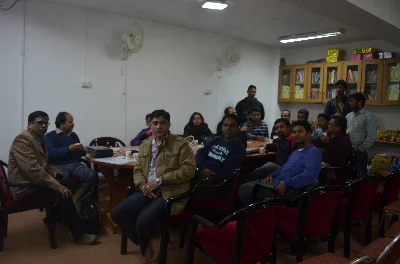
Participants at an Odia Wikisource workshop in New Delhi, documented by CIS in December 2014. Reproduced at modest size from the source image.
Subhashish Panigrahi. Source · CC BY-SA 4.0.
A place to read, a way to return
The library remains a physical invitation as well as a collection. Bakul Foundation’s account of its Library Movement describes donated books, individual contributions and volunteer work. It presents its Bhubaneswar library as free to readers and describes storytelling, author interactions and creative workshops. Its work with Odia picture books also connects access to the making of material that children can enjoy.5
These activities answer a question that digitisation alone cannot resolve: who feels able to begin? A child may need someone to read aloud. An unfamiliar catalogue may need explanation. A person using a phone may struggle with a large file or a page whose letters cannot be enlarged clearly. Availability becomes meaningful through the conditions in which reading happens.
For a small collection, a practical beginning is a clear record of what is held, where it came from and what can be consulted. A digital copy should carry its source and any known gaps. Backups, dependable filenames and a named person responsible for the collection help keep that record usable. These are suggestions for care, not a claim that every collection already follows them.
Access and reuse also need separate descriptions. A page that can be read or downloaded does not, by that fact alone, explain permission to republish it. The work, its edition, a photograph and a recorded performance may carry different notices. Readers need the applicable terms beside the material, with uncertainty acknowledged rather than replaced by a blanket claim.
An archive is most generous when it makes return possible: return to a source, to an overlooked writer, to an unfinished question. The digital page extends that possibility. Libraries and the people who sustain them give it a welcoming place in everyday life.
Footnotes & Sources
- Odia Bibhaba · About. Institutional account of Project Rebati, the 2006 Bhasakosha, equipment and distribution. No present collection total is adopted. ↩
- Srujanika · Blog, 23 May 2021. Dated transition statement retained on the Srujanika site. Used as historical evidence, not a current staffing report. ↩
- Odia Bibhaba · Utkal Sahitya. Collection introduction: 1897, Biswanath Kar and subject range. No complete-run claim is made. ↩
- Subhashish Panigrahi · Odia Wikisource workshop. CIS, December 2014. Previously checked report and credited photograph retained in the edition’s Chapter 41 research; live page unavailable during this check. ↩
- Bakul Foundation · Education. Organisation’s account of its Library Movement, activities and Odia picture books. No current reach totals or independent outcome claims. ↩
Both photographs are by Subhashish Panigrahi. The manuscript photograph is CC BY-SA 3.0; the workshop photograph is CC BY-SA 4.0. Source and licence links appear in their captions. Images are resized, with no intentional crop or content alteration. These licences apply to the credited photographs; they do not establish a blanket licence for archival texts discussed in this chapter.
Suggest an update
Share a correction or source for this chapter. GitHub submissions are public. Please omit private contact details and consent documents.