
Part 8 · Modern Media and Cultural Futures
Chapter 44 of 48
Odia Cinema and the Worlds It Makes
Literature households and the work behind the screen
A film makes a world through people, places, voices and the time it asks us to spend with them. A family meal can reveal an argument without naming it. A familiar landscape can become the setting for someone else’s hopes. Watching in Odia also brings the sound of the language into that encounter.
This chapter follows a few routes through that larger world: the first Odia talkie, the movement of literature to the screen, household stories, and the labour of making and preserving films. These examples offer different ways of looking at Odisha. They also invite us to notice the people behind the images, whose work continues beyond a film’s release.
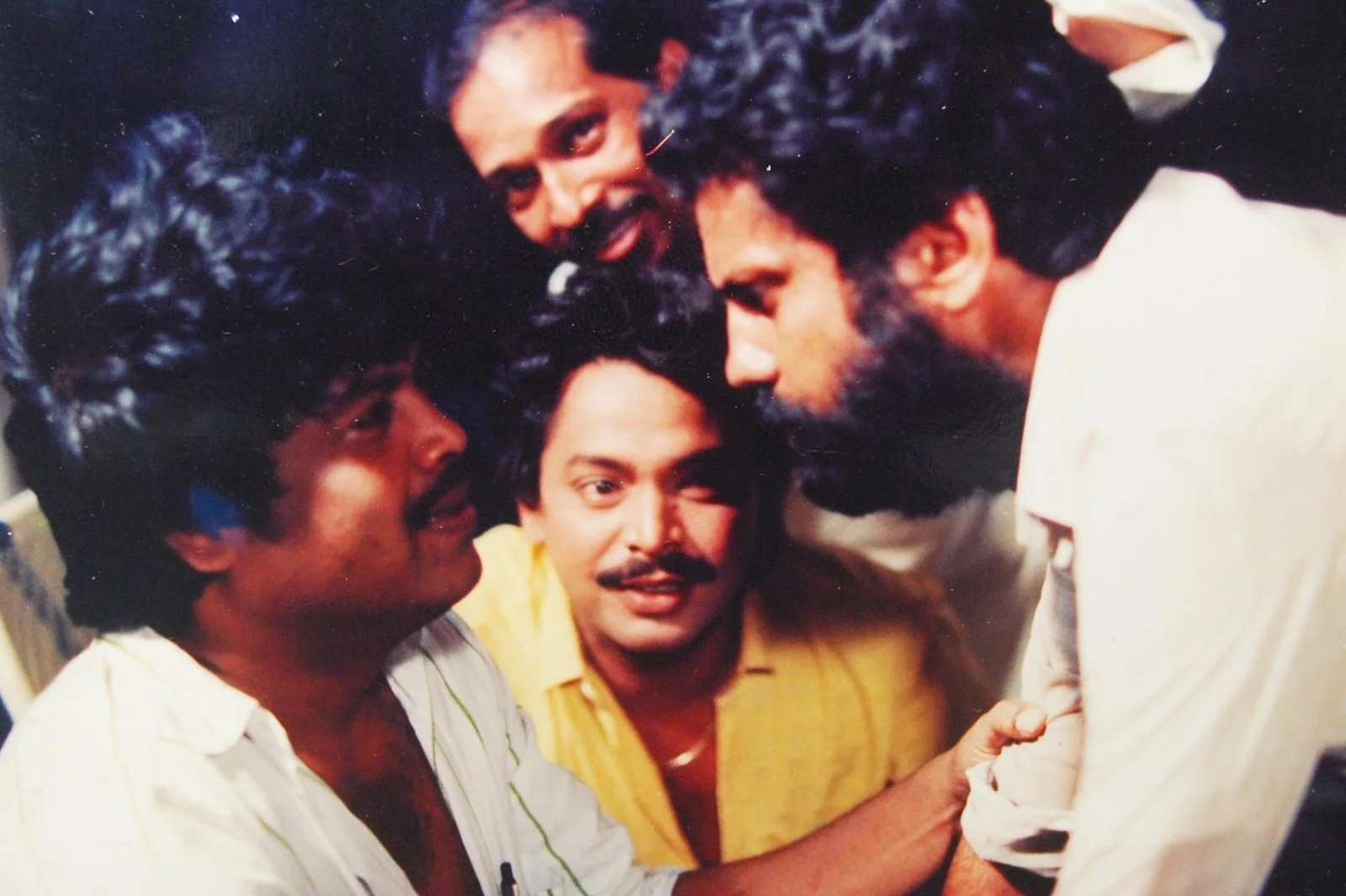
Pranab Das with actors Bijay Mohanty and Mihir Das, identified and dated 1989 by the source. Photographer and film unrecorded.
Director Pranab Das collection, via Wikimedia Commons. Source · CC BY-SA 4.0.

Stories finding a screen
Kapilas Bhuyan’s historical account for the Press Information Bureau identifies Mohan Sundar Deb Goswami’s Sita Bibah as the first Odia talkie. It distinguishes an earlier Calcutta showing from the formal release at Laxmitalkie Cinema in Puri on 28 April 1936. Bhuyan records fourteen songs sung by the actors.1 Story, performance and music were already closely connected at this beginning.
The choice of a familiar story gave cinema a relationship with audiences who could know its characters before entering the hall. Yet a film still had to organise that familiarity through recorded performances and a sequence of images. The encounter belonged to a new setting, even when its material had a longer life.
Literature provided further routes. Mrinal Sen’s filmography credits Kalindi Charan Panigrahi with the story of Matira Manisha, his 1966 Odia film. Its synopsis describes two brothers whose attitudes towards inherited land diverge.2 The source places family obligations beside changes in agrarian life, allowing a household dispute to open onto a wider social world.
Adaptation involves decisions about what can be seen and heard. A novelist can explain a thought directly; a filmmaker might place two people in a room, let one remain silent, or return to an object that has acquired meaning. These possibilities make the relationship between book and film worth exploring without expecting them to work identically.
An adaptation can also lead a viewer back to its author. Keeping the source work visible in credits, introductions and discussions gives that journey a starting point. The film need not exhaust the book’s possibilities. It can become one reading of a work that other readers, performers and filmmakers may approach differently.
The household as a larger world
Nirad Mohapatra’s Maya Miriga follows an extended middle-class family in a small town. The Il Cinema Ritrovato programme describes its gradual disintegration and draws attention to the restrained performances and Bhaskar Chandavarkar’s music. It also reproduces the director’s reflections on affection, responsibility and the desire for personal freedom within the joint family.3
This is a useful way to approach the title of this chapter. A film’s world need not be geographically large. The expectations shared inside a household can carry questions about education, status and independence. We can ask who has room to choose, whose work supports others, and how a decision that seems promising to one person may unsettle someone else.
Another father-and-son story appears in Anupam Patnaik’s Pratikshya. The 2022 IFFI account identifies Gourahari Das’s short story as its inspiration. Its central character, Sanjay, seeks a government job while the family faces debt and his father’s serious illness. The possibility of employment through compassionate appointment brings a troubling pressure into their relationship.4
The premise turns an economic hope into an intimate conflict. It asks what happens when the wish for security becomes entangled with the fate of someone loved. Such a story can be rooted in a recognisable social setting while leaving viewers to consider feelings that are difficult to acknowledge.
These films should retain their differences. Their households, styles and moments of production are not interchangeable portraits of every Odia family. Together, however, they show how cinema can make ordinary relationships worthy of sustained attention. A pause, an exchange or a decision may reveal something that a broad description of social change leaves out.
Parbati Ghose and the work of adaptation
The Gour–Parbati archive dates Chha Mana Atha Guntha to 1986 and identifies Fakir Mohan Senapati’s novel as its source. It credits Parbati Ghose as producer and director, as the performer playing Saria, and as Shrabani, the name used for screenplay and dialogue.5 Several kinds of creative responsibility met in her work on this film.
The same record names Ashok Swain for camera, Nagen Barik for sound, and Asim Basu and Sarat Sahoo for art. It describes filming in Olosingh and acknowledges the villagers and Kalyani Patnaik’s hospitality.5 These details widen the picture of authorship. A screen world also depends on technical skill, places to work and people willing to help a production take shape.
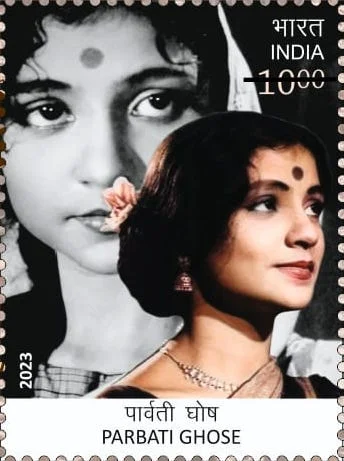
Parbati Ghose on a commemorative stamp issued on 30 March 2023. Shown at modest size from the available scan.
India Post, Government of India. Source · GODL–India.

Keeping a film available to be seen
A completed film has another life to negotiate: reaching viewers and remaining available after its initial release. At IFFI in 2022, Anupam Patnaik spoke about the difficulty of sustaining an industry with limited theatre access.4 His account is a filmmaker’s assessment at that moment, rather than a current inventory of cinema halls. It nevertheless connects the making of stories with the practical question of where people can see them.
Preservation presents a different challenge. Film Heritage Foundation describes locating deteriorated reels of Maya Miriga’s original camera negative in 2021. Repair, scanning and restoration used that material together with a surviving 35 mm print held by NFDC–NFAI. The foundation credits laboratories, restoration specialists and the director’s family in a process lasting almost three years.6
The 2024 Il Cinema Ritrovato programme placed the restored film before a festival audience.3 Recognition and survival are separate achievements: a celebrated film can still depend on fragile materials and sustained effort to remain viewable. The restoration makes this dependence visible without diminishing the original filmmakers’ work.
For a viewer, careful identification is part of that renewed encounter. A restored version, a trailer and a short online extract offer different experiences. Recording the source and version helps a discussion stay close to the work actually seen. Credits also let us follow the contributions of actors, writers, composers and technicians into other films.
Odia cinema’s worlds are made by these connections as well as by what appears within the frame. Books find performers; households become stories; crews turn locations into scenes; preservation brings older work to another audience. The pleasure of watching can lead us further into each of those relationships, and towards films we have yet to discover.
Footnotes & Sources
- Kapilas Bhuyan, 75 Years of Odiya Film Making. PIB/IFFI, 22 November 2010. Sita Bibah release chronology and songs; historical retrospective. ↩
- Mrinal Sen filmography, Matira Manisha. 1966 film credits and synopsis. Literary source, direction and the two brothers’ relationship to land. ↩
- Il Cinema Ritrovato, Maya Miriga. 2024 restored-film programme. Credits, family setting and director’s reflections; not a claim of current screening availability. ↩
- PIB, Pratikshya at IFFI 53. 23 November 2022. Literary inspiration, synopsis and director’s remarks on exhibition. No current theatre total inferred. ↩
- Gour–Parbati archive, Chha Mana Atha Guntha. 1986 film entry. Parbati Ghose’s roles, crew credits, Olosingh filming and local assistance. ↩
- Film Heritage Foundation, restoring Maya Miriga. First-party account of locating materials and undertaking restoration; credits distinguish the participating organisations. ↩
Crew photograph: Director Pranab Das collection, uploaded by Sunny Roy to Wikimedia Commons under CC BY-SA 4.0; the photographer is unrecorded. The source dates the scene to 1989; digital-file metadata records a later date. Parbati Ghose stamp: India Post, Government of India, GODL–India. Source and licence links appear in captions. Existing local copies are reproduced full-frame, with resizing and compression and no generated additions. Adaptations of the crew image retain CC BY-SA 4.0.
Suggest an update
Share a correction or source for this chapter. GitHub submissions are public. Please omit private contact details and consent documents.