
Part 8 · Modern Media and Cultural Futures
Chapter 46 of 48
Languages on New Screens
Ho Santali and Odia in digital everyday life
A message reaches a phone, but its letters appear as empty boxes. A book is visible online, but its words cannot be searched. A keyboard displays familiar letters, yet the person using it still needs help composing a sentence. These are different difficulties, and solving one does not automatically solve the others.
For Ho, Santali and Odia, digital participation involves writing systems, usable tools and people willing to teach and contribute. The question reaches beyond whether a language appears on screen. It concerns who can write, correct, read and circulate knowledge there—and whose choices shape the result.
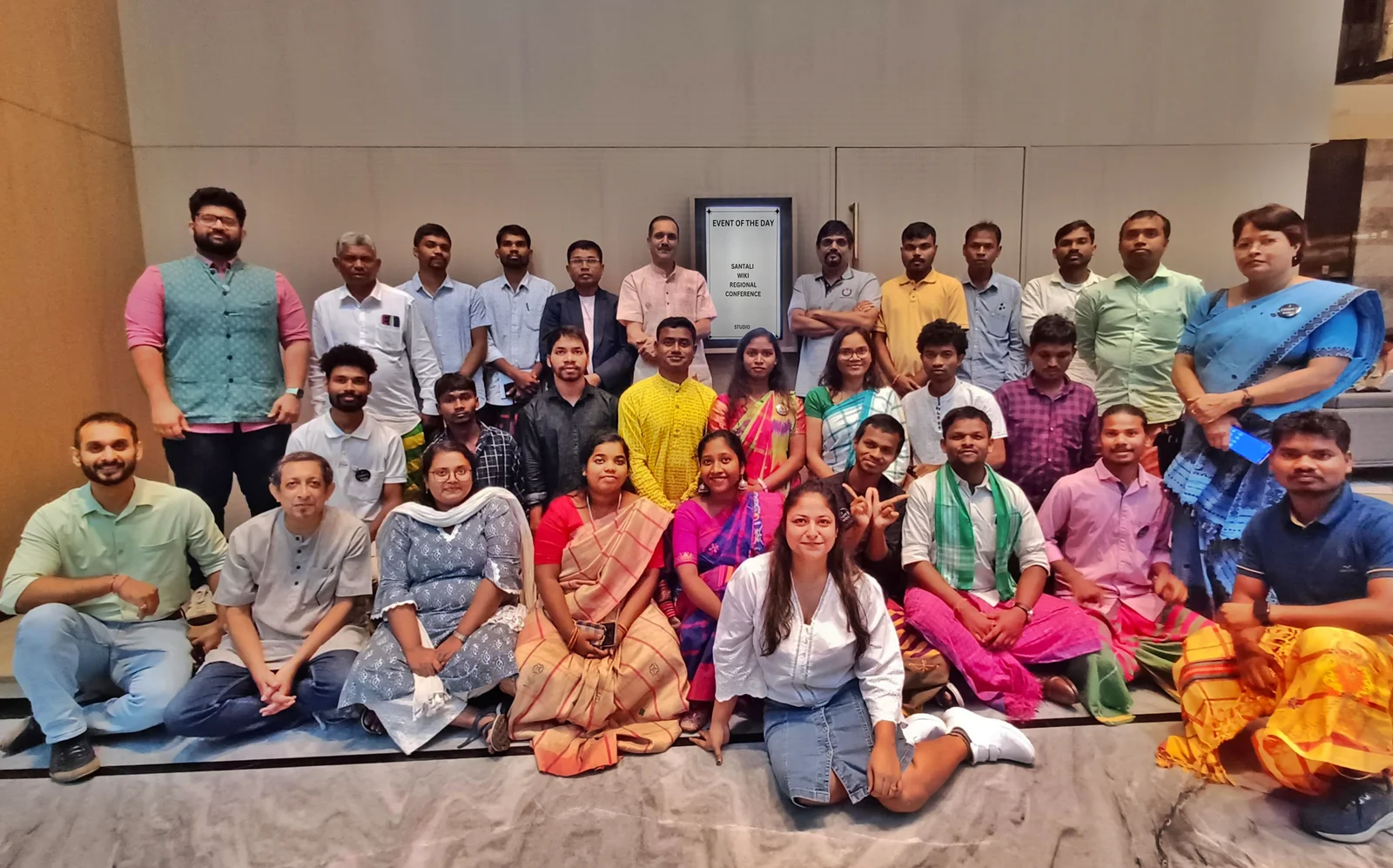
Participants at the Santali Wiki Regional Conference, September 2024, as identified in the accompanying Wikimedia community report.
A language is more than its lettering
Ho and Santali have histories that cross the boundaries of Odisha. Their digital lives cannot be understood through a single state or a single writing practice. The Unicode Standard identifies Warang Citi as a script devised by Lako Bodra for Ho. It also records Ho writing in Odia, Devanagari and Latin letters. For Santali, it identifies Ol Chiki with Raghunath Murmu and notes other scripts used to write the language.1
These distinctions matter when someone prepares a learning resource or a digital collection. A speaker may understand a story while being unfamiliar with the script in which it is presented. Choosing a script is therefore also a choice about readers, teaching and the paths through which a text will circulate. It should begin with the people expected to use it.
Unicode supplies a shared system for representing characters in digital text. It does not assign one script exclusively to one language. Its own explanation stresses that several languages may share a script, while a language may be written in more than one.2 Encoding makes exchange possible; it does not determine what a community should write or settle differences in usage.
For Ho digital work, the practical questions follow from this distinction. Which writing practice do intended readers know? Can they enter the letters on the devices they use? Who will check a lesson, a local name or an explanation? A successful demonstration on one computer cannot answer all three. The value of a resource becomes clearer when a reader can use it independently, and when a knowledgeable contributor can correct it without surrendering control of the language to an outside editor.
Letters that can travel
The tools involved have separate jobs. Character encoding represents the text; a font supplies the visible forms of its letters; an input method lets a person enter them. These parts must work together. A page can contain correctly encoded text while the device lacks a suitable font. Equally, text that looks right in an older font may need conversion before it can travel reliably into another system.23
O Foundation’s Santali resource page makes these differences concrete. It brings together Ol Chiki fonts, input methods and a converter for text typed with older fonts. It credits individual makers, including Pooja Saxena for the Guru Gomke typeface and Jnanaranjan Sahu for the listed Unicode converter. Such credits reveal a field of design and maintenance behind what may look like a simple act of typing.3
The page also names Sarjom Baha as a phonetic input method for Wikimedia projects. A keyboard arrangement can help someone begin, but familiarity still takes practice. The useful test is a real task: entering a name, composing a question or correcting a paragraph. Instructions should meet people at that level rather than assuming that installing a tool completes the work.
In a multilingual household or classroom, movement between scripts may be ordinary. A person can read one language, speak another and use a third for study or employment. Digital design should leave room for those combinations. Clear language labels, readable text and an easy way to change input methods can support them. These are practical design aims, not evidence that all devices or platforms already serve every reader equally well.
People who make a digital public
In an interview published by Wikimedia’s Diff in February 2025, Santali contributor Ramjit Tudu describes building contacts among editors and receiving support from the Odia community. The account places workshops and collaboration alongside the Santali Wikipedia launch in 2018. It also describes outreach to writers and universities, and the importance of social media for a geographically dispersed community.4
This is a history of relationships as well as pages. An experienced contributor helps another person make a first edit; a writer introduces a source; a discussion resolves an uncertainty. The Odia workshop photograph below records another such learning setting. It does not measure the reach of either language online, but it makes visible the people whose effort a website can easily hide.5
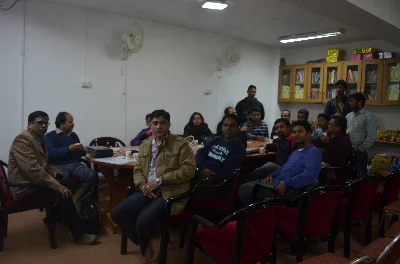
Participants at an Odia Wikisource workshop in New Delhi, documented by CIS in December 2014. Reproduced at modest size from the source image.
Subhashish Panigrahi. Source · CC BY-SA 4.0.
From a page image to a usable text
Odia Wikisource offers a different view of digital participation. A 2014 account by Subhashish Panigrahi describes volunteers retyping books or using optical character recognition, usually shortened to OCR, to turn scanned images into editable text. It also discusses converting writing from older font systems. These are related forms of work, but they begin with different materials.6
A scan is a picture of a page. OCR attempts to recognise the printed characters in that picture. Conversion, by contrast, can begin with text already stored digitally in an older encoding. Neither operation removes the need to check the result. A damaged letter, an unfamiliar name or an unusual spelling may require a reader who understands both the source and its context.
Correction is consequently part of authorship’s supporting world. A useful edition keeps a route back to the page it follows and makes uncertain readings visible. It should also distinguish a faithful transcription from a modernised spelling or a translation. Each can help readers, but each makes a different promise.
Access involves more than letters. A long download may be difficult on a limited connection. Someone may prefer listening, need larger type or rely on another person to explain an unfamiliar interface. Recording a voice adds possibilities, while also requiring agreement about attribution, circulation and future use. Community participation should include decisions about what remains unrecorded or outside public circulation.
New screens offer room for everyday correspondence, learning and literary experiment. Their strongest promise is the possibility of sustained use: people writing to one another, finding material worth reading and helping newcomers take part. The tools matter because they can support those acts. The direction belongs to the people whose languages give the screen its meaning.
Footnotes & Sources
- Unicode 17.0 · Warang Citi and Ol Chiki. Sections 13.9–13.10. Script identities and writing practices; no population, literacy or current publication totals adopted. ↩
- Unicode Consortium · Basic questions. Character encoding and the distinction between scripts and languages. Device support is not inferred from encoding alone. ↩
- O Foundation · Santali language resources. Subhashish Panigrahi and Ramjit Tudu. Fonts, converter and input-method descriptions and credits, checked 18 November 2026; tools not independently tested. ↩
- Nikos Likomitros · Interview with Ramjit Tudu. Diff, 14 February 2025. Contributor account of community formation, Odia collaboration and outreach; source and credit for conference photograph. ↩
- Subhashish Panigrahi · Odia Wikisource workshop. CIS, December 2014. Report and licensed photograph retained in the edition’s Chapter 41 research. ↩
- Subhashish Panigrahi · Odia Wikisource launch account. Diff, 21 October 2014. Retyping, OCR and legacy-font conversion; contemporary launch account, not a current capability survey. ↩
The Santali conference photograph is credited to Nayan j Nath under CC0 1.0 in its source report. The Odia workshop photograph is by Subhashish Panigrahi, CC BY-SA 4.0. Both are resized without intentional cropping or content alteration. Source and licence links accompany the captions. Photographs document particular events, not the full range of speakers or digital contributors.
Suggest an update
Share a correction or source for this chapter. GitHub submissions are public. Please omit private contact details and consent documents.