
Part 7 · Everyday Lives and Social Change
Chapter 38 of 48
Birth, Marriage, Mourning and Remembrance
Kinship ritual and the work of memory
A name spoken over a child, a wedding promise, a voice remembering someone who has died: life’s changes become occasions for other people to gather. They can bring joy and reassurance, but also separation, obligation and disagreement. A cultural history of Odisha must leave room for all of these experiences.
There is no single Odia sequence of rites. This chapter follows a few documented settings: family ceremonies described in the Nayagarh gazetteer, children’s tonsuring at Tara Tarini, an Odia marriage lament, and Sora practices of mourning and remembrance. Together they open questions about belonging, care and the ways a person remains part of other lives.
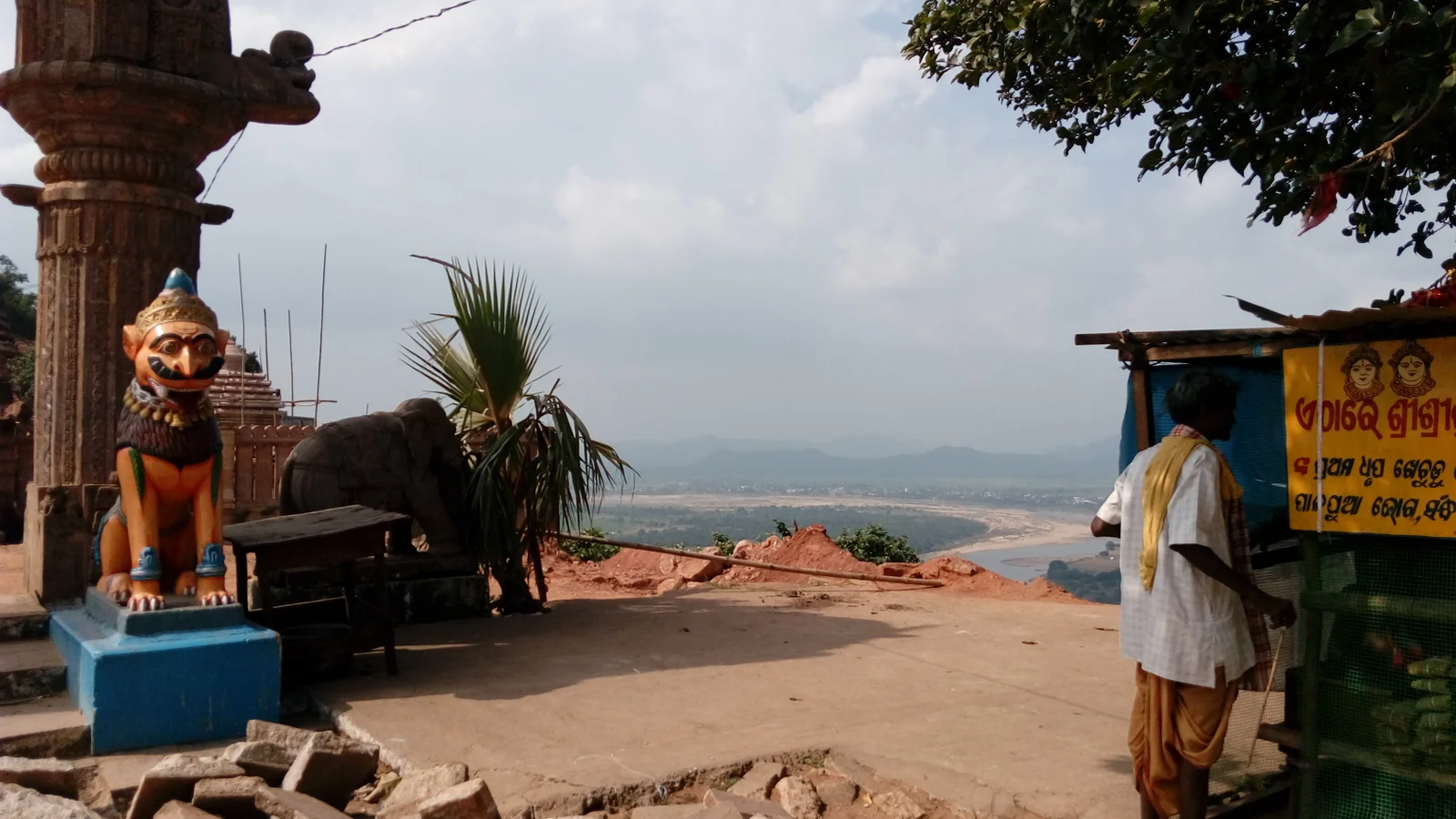
Tara Tarini precinct and the river landscape below, 28 October 2016.
Buddy.forever.985. Source · CC BY-SA 4.0. Full-frame reproduction; size and file format adjusted only.

Welcoming a child
The Nayagarh district gazetteer describes worship of Sasthi Devi on the sixth day after birth in its account of Hindu family rites. It identifies ekoisa, on the twenty-first day, with naming and Satyanarayan Puja.1 These are recorded customs in a district account, rather than a timetable followed by every household.
A naming ceremony draws attention to something both intimate and public. The infant is already being cared for; now a name can be spoken, remembered and used by others. The occasion gives relatives a way to acknowledge a new relationship. Looking at it in this way shifts attention from a list of ritual steps to the people who give those steps meaning.
Family observance can also meet the calendar of a shrine. Reporting from Tara Tarini in April 2024, The New Indian Express described parents accompanying children for mundan, or tonsuring, during Chaitra Yatra. The report attributed its account of the arrangements to temple officials.2 The photograph on the opening page shows the precinct and its landscape, not a tonsuring ceremony.
The journey to a shrine makes a household milestone part of a shared place. Yet a crowd cannot tell us each family’s reasons for being there. To understand a particular visit would require listening to the people making it: what they hoped for, who accompanied them, and how they understood the offering.
Birth customs should also be read with attention to the mother’s experience. Descriptions of ritual can foreground a child’s entry into family life while leaving the work of care almost invisible. A fuller family history would ask who provided meals, rest and company, and whose recollection of the occasion has been preserved.
Marriage and the making of relationships
Marriage joins personal decisions to public recognition. The Nayagarh gazetteer places different religious forms side by side: Hindu rites including panigrahan, Muslim marriage with consent and meher, and Christian marriage with vows and rings in church.1 Its compressed account does not capture every denomination, community or household, but it makes a single ceremonial model inadequate.
A useful account of a wedding would therefore begin with people and place. Who is marrying, in which community, and at what moment? Which actions do the participants regard as essential? Which have been adapted? Such questions allow a particular celebration to retain its character without being made to represent the whole state.
The ceremonial centre is only part of the story. An invitation, a meal or an exchange of words can matter because of the relationship it acknowledges. To describe these details well, we need more than a photograph of decorated clothing. We need the explanations of those who chose, prepared and used the objects.
We should also ask whose work makes a celebration possible. Cooking, receiving guests and arranging a gathering deserve a place in its record alongside the most visible rites. These are questions for future interviews and family archives; they should not be answered by assigning fixed roles to women, men or particular communities.
Marriage can be a moment of departure as well as celebration. The recorded kandana on the following page brings a lamenting voice into this account. It invites attention to emotional expression alongside ceremonial description. The sound of a person performing a repertoire is evidence of a different kind from a district handbook’s summary of rites.
A marriage lament, a remembered voice
Shantilata Dwibedi’s recital of an Odia marriage kandana was recorded by Sangram Keshari Senapati on 3 December 2023.3 The image below is a preview still from that recording. It shows a named performer sharing a repertoire, rather than a bride at an observed wedding.
A recording preserves voice, pacing and expression alongside words. Here the distinction between recital and ceremony matters: a performance can carry knowledge of a form beyond the occasion with which it is associated. It can be listened to again, discussed and placed beside other tellings.
This chapter does not supply an unverified translation of the lament. A fuller edition could pair a checked Odia transcription with a translation and the performer’s explanation. That would let readers attend to her particular words, rather than assuming that every marriage lament expresses the same experience.
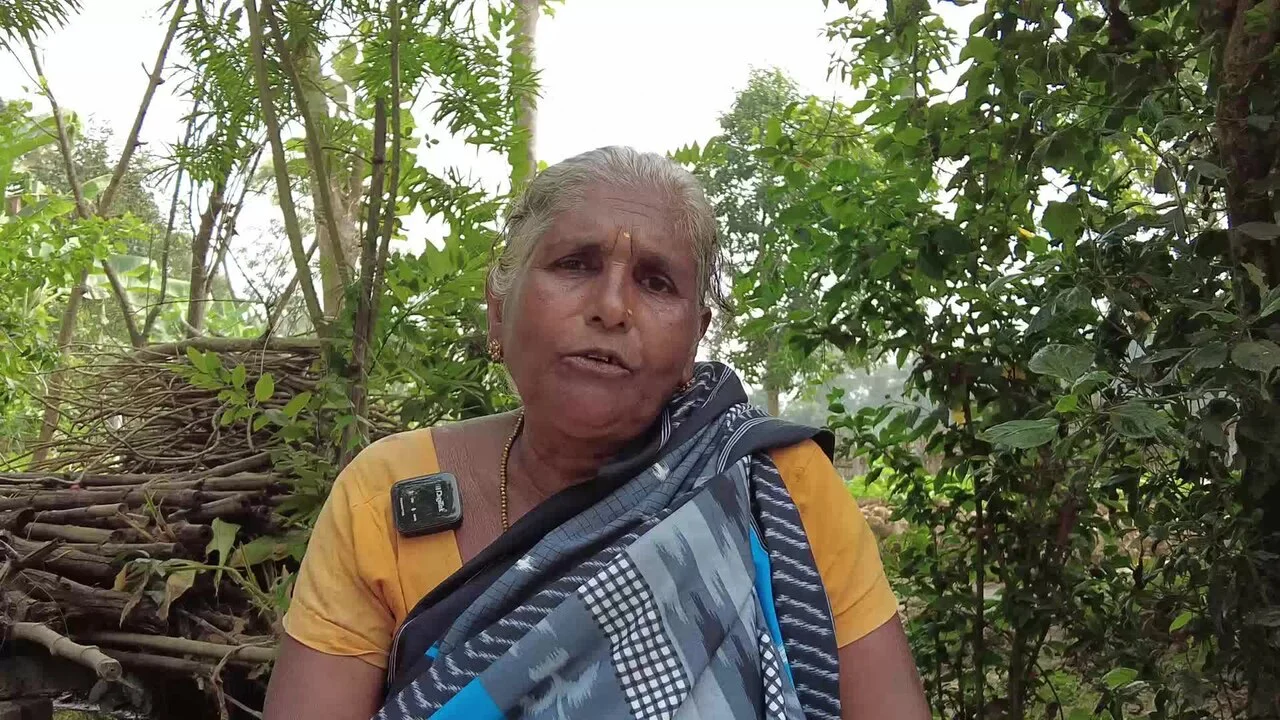
Shantilata Dwibedi reciting an Odia marriage kandana. Preview still from the recording dated 3 December 2023.
Sangram Keshari Senapati. Source · CC BY-SA 4.0.
Mourning, place and continuing memory
The Nayagarh gazetteer records annual sraddha in its account of Hindu remembrance.1 Other sources reveal quite different ways of sustaining relationships after death. These practices need their own names and settings, rather than being gathered into one supposedly shared belief about ancestors.
Anthropologist Piers Vitebsky recalls fieldwork among Sora communities in Odisha beginning in the 1970s. He describes mourners addressing the dead through trance mediums, with argument, tears and laughter all part of the encounter.4 This is an account of a ritual world as participants understood it, not a claim that every Sora household shares those practices.
Stefano Beggiora’s 2016 conference abstract describes a Lanjia Saora funeral procession in Rayagada that links sacred places in and around a village. He contrasts this ritual setting with presentations at Bhubaneswar’s Adivasi Mela.5 The distinction asks us to notice what a procession means to its participants, beyond the movements an audience can see.
Vitebsky also describes later generations adopting Christian or Hindu religious practices. Some younger Sora, he writes, have sought his earlier photographs, recordings and field notes as heritage documentation.4 Remembering a tradition need not mean practising it unchanged. An archive can become a resource for people whose present beliefs differ from those of their grandparents.
These examples leave a question for anyone assembling cultural history: who should interpret a family’s most intimate occasions? A careful record keeps names, dates and circumstances, and makes room for participants to explain what matters. Birth, marriage and mourning belong to lived relationships. Their public documentation is most valuable when it preserves that human particularity.
Footnotes & Sources
- Nayagarh District Gazetteer · Customs and Practices. Printed pp. 70–72: birth, marriage and mortuary customs. Text checked in the StudyLib mirror; the official file did not load. A descriptive district account, not a universal rule. ↩
- The New Indian Express · Chaitra Yatra concludes at Tara Tarini. 24 April 2024. Reporting on children’s mundan and arrangements attributed to temple officials. ↩
- Shantilata Dwibedi · Odia marriage kandana. Recording by Sangram Keshari Senapati, 3 December 2023. Recital and image provenance; no transcript or translation supplied here. ↩
- Piers Vitebsky · This Spiritual Tradition Could Be the Most Poetic Bereavement Therapy Ever Documented. Scientific American, 1 January 2023. First-person retrospective on Sora fieldwork, religious change and archival return. No clinical claim adopted. ↩
- Stefano Beggiora · Death rites and dance performance among the Saoras of Odisha. ECSAS, Warsaw, 27–30 July 2016. Published conference abstract: Lanjia Saora funeral procession in Rayagada and comparison with festival performance. ↩
Both images are reused from this edition’s research collection under CC BY-SA 4.0, full-frame and resized without content alteration. Captions link to creators, source records and licences. The Tara Tarini photograph dates to 28 October 2016; the recital still to 3 December 2023. No private ceremony is represented by a staged substitute. Sources checked 14 November 2026.
Suggest an update
Share a correction or source for this chapter. GitHub submissions are public. Please omit private contact details and consent documents.