
Part 7 · Everyday Lives and Social Change
Chapter 39 of 48
Women as Makers and Keepers of Culture
Authorship skill and cultural authority
Women make Odisha’s cultural life through particular acts of skill and imagination: writing a novel, preparing a painting surface, teaching movement, telling a story. Recognising that work requires names, but also attention to the labour that does not acquire a public signature.
This chapter brings Pratibha Ray’s writing and Sanjukta Panigrahi’s performance alongside recorded storytelling, craft production and Sora ritual knowledge. These are different kinds of expertise, with different routes to recognition. Keeping culture can involve questioning an inherited story, changing its form or deciding how to pass it on. It should not be treated as a duty that women are simply born to fulfil.
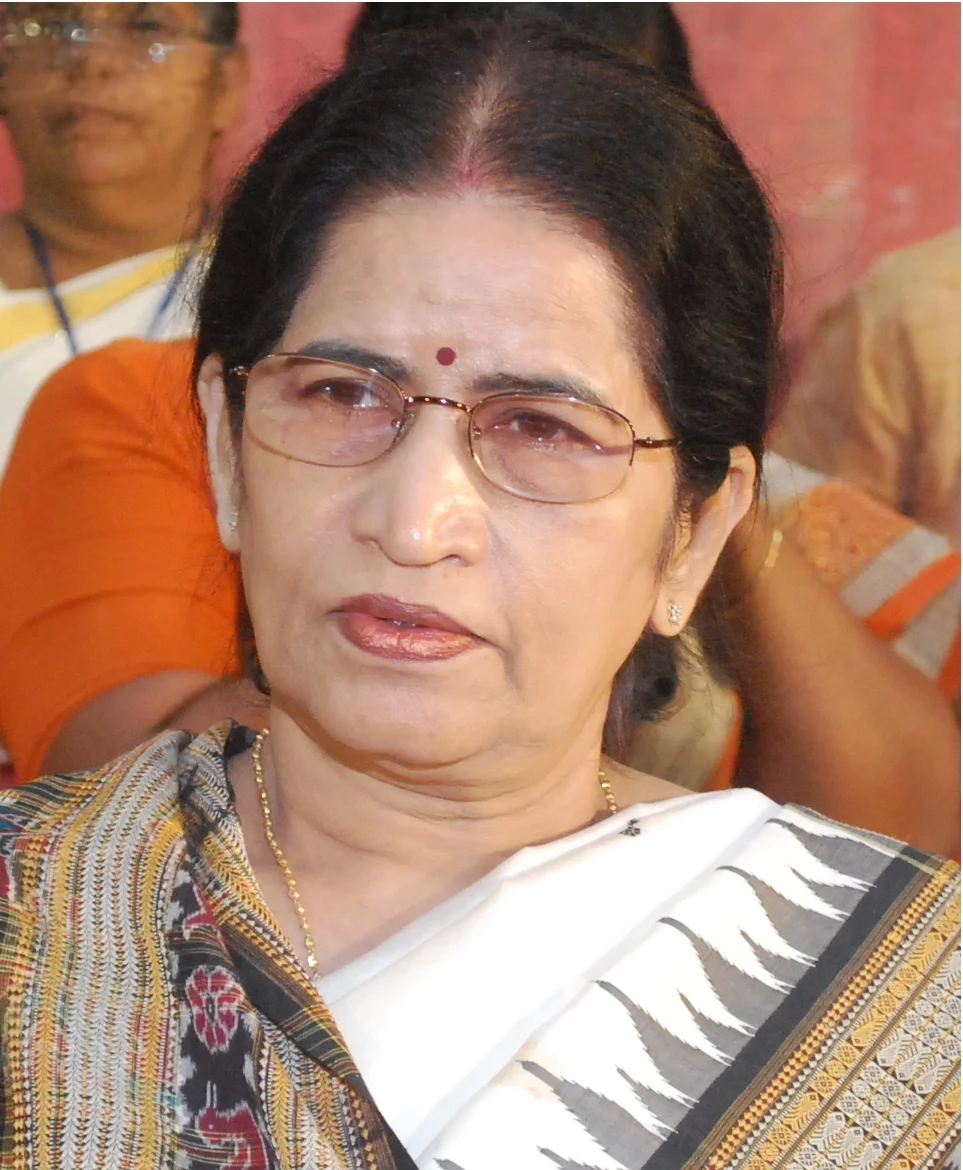
Pratibha Ray photographed in Kollam on 15 May 2010.
Kannan Shanmugam. Source · CC BY-SA 3.0.

Writing from a different centre
Pratibha Ray’s Yajnaseni places Draupadi’s consciousness at the centre of an inherited epic world. The English excerpt on Ray’s website follows her reflections during the Himalayan ascent: attachment, desire and the meaning of a life come under scrutiny as her husbands continue ahead.1 The passage gives a woman inside the epic the authority to judge what she has endured.
This is one way of making culture through interpretation. A familiar story can remain recognisable while its emotional centre moves. Draupadi’s questions ask the reader to pause where a narrative of heroic progress might hurry onward. Ray’s novel belongs to the continuing life of the Mahabharata through that act of reconsideration.
Women’s literary work also becomes visible through the company in which it is read. Spark of Light, edited by Valerie Henitiuk and Supriya Kar and published by Athabasca University Press in 2016, gathers short stories by women writers of Odisha in English translation. Its contents include Reba Ray, Binapani Mohanty, Pratibha Ray and Sarojini Sahoo.2
The publisher describes a range of styles and concerns, including class, poverty, violence and family.2 Such a collection allows disagreement and difference to remain visible. A woman writer may attend to domestic life, but she may also examine the wider arrangements that determine whose work, suffering or ambition receives attention.
Editing and translation are part of this cultural work. They shape which texts travel and how new readers encounter them. Crediting an author alone leaves that chain incomplete. The anthology gives readers a route back to particular stories and contributors, while its open-access edition makes the collection available beyond a single library shelf.
The labour within the finished object
A painting begins before the first visible figure. Mamata Tripathy’s 1998 study of Raghurajpur describes patta production as household work. In the division of tasks she records, women commonly prepared tamarind glue and chalk solution and polished the painting surface, while men applied the materials to the cloth.3 These details belong to her historical study, not to an unchanging rule about who can do each task.
The preparation is consequential. A surface must be suitable for the painter’s line; its finish is part of the completed object’s material history. Calling this work mere assistance would conceal the knowledge it requires. A label that names only the person who draws the figures may tell only part of the story of how a painting was made.
Tripathy also describes household members contributing under the guidance of a senior man.3 Participation and authority are therefore separate questions. Who knows how to make an object? Who directs its production? Whose name appears when it is exhibited or sold? A careful account of women’s craft work needs to ask all three.
The economic setting matters too. Mission Shakti’s description of its ORMAS partnership names women’s producer groups and self-help groups, with support envisaged for packaging, branding, training, buyer connections and working capital.4 These are programme aims rather than proof of any individual maker’s income. They nevertheless acknowledge that reaching a market requires resources beyond production skill.
Recognition becomes more useful when it follows work closely: identifying contributions, recording teaching and asking how earnings are shared. Praise for a beautiful object does not answer those questions. The maker’s account of her own decisions and working conditions belongs beside the object in a fuller cultural history.
A storyteller with a name
Musamoni Panigrahi’s storytelling in Baleswari Odia was recorded by Subhashish Panigrahi on 20 January 2014.5 The source describes a tale about a newly widowed woman who must convey family information while constrained from speaking her husband’s name. Verbal ingenuity becomes a way through a social restriction.
The recording identifies the teller as well as the tale. Her expression and timing are part of what a listener encounters; a plot summary cannot preserve them. The still below records a moment in that performance, rather than illustrating the story’s fictional widow.
A named storyteller complicates the loose description of knowledge as simply inherited. A story reaches listeners through someone’s choice of words and manner of telling. Preserving that contribution gives future listeners an individual voice to return to, and a place from which to ask about other versions.
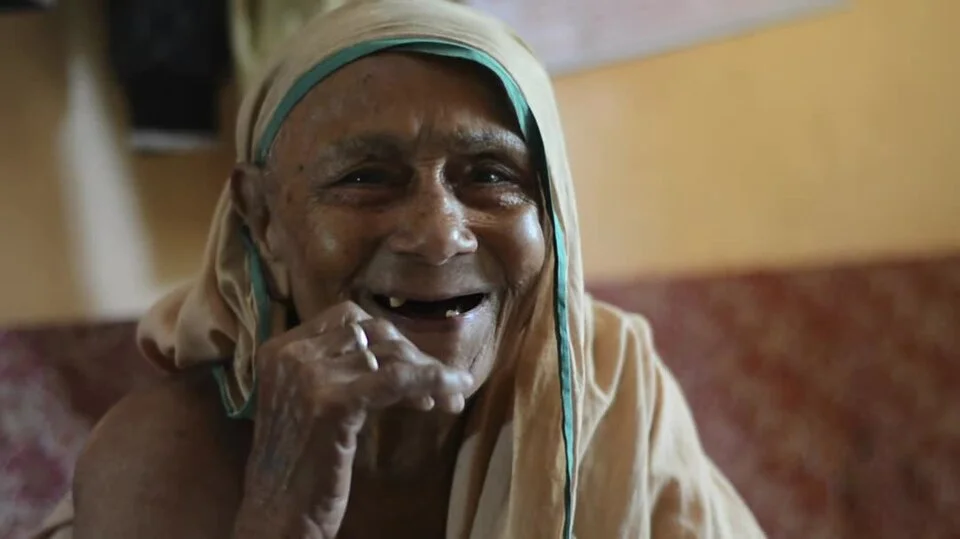
Musamoni Panigrahi telling a story in Baleswari Odia. Preview still from the recording dated 20 January 2014.
Subhashish Panigrahi. Source · CC BY-SA 3.0.
Performance knowledge and the right to change
The Sangeet Natak Akademi’s citation for Sanjukta Panigrahi recognises a dancer who was also a teacher and choreographer. It records her training at Kalakshetra and in Odissi under Kelucharan Mohapatra, and performances in India and abroad.6 Her work included presenting a repertoire, shaping it and helping others learn it.
Teaching makes the body’s knowledge available to another person. Choreography requires choices about how movement and expression unfold. Naming these activities gives a fuller account of artistic authority than a list of appearances or honours alone. It also reminds us to look for the rehearsal and instruction behind the public performance.
Ritual expertise belongs to a different setting. Recalling fieldwork among Sora communities in Odisha, Piers Vitebsky describes Ononti and the training of her designated successors, Taranti and Lokami. He notes women’s prominence as trance mediums in the communities he knew.7 His account concerns particular people and religious practices, rather than a role shared by all Adivasi women.
Vitebsky also records religious change across generations and interest among younger Sora in earlier field notes, photographs and recordings.7 Cultural continuity can take several forms. Someone may value a grandmother’s knowledge while choosing a different religious life. Documentation should allow that choice to remain visible.
The women encountered here do not occupy a single cultural role. Their work involves authorship, trained judgement, material preparation and the interpretation of relationships. Recognising them as makers means attending to what they create and decide. Recognising them as keepers means valuing the work of transmission without asking them to hold every tradition still.
Footnotes & Sources
- Pratibha Ray · Jajnaseni. English excerpt on the author’s website. Himalayan ascent and Draupadi’s reflections; translator not identified on the page. Literary interpretation, not biographical testimony. ↩
- Spark of Light · Short Stories by Women Writers of Odisha. Edited by Valerie Henitiuk and Supriya Kar, AU Press, 2016. Publisher description and contents; open-access edition linked there. ↩
- Mamata Tripathy · Folk Art at the Crossroads of Tradition and Modernity. JASO 29(3), 1998, pp.197–211, especially pp.201–202. Retained source PDF checked for household organisation and surface preparation. ↩
- Department of Mission Shakti · ORMAS partnership. Programme description of women’s groups and marketing support. Objectives distinguished from measured livelihood outcomes. ↩
- Musamoni Panigrahi · Storytelling in Baleswari Odia. Recording by Subhashish Panigrahi, 20 January 2014. Source description used for the tale’s synopsis; no new transcription or interview. ↩
- Sangeet Natak Akademi · Sanjukta and Raghunath Panigrahi. Institutional award citation: training, performance, teaching and choreography. The citation honours dance and music jointly. ↩
- Piers Vitebsky · This Spiritual Tradition Could Be the Most Poetic Bereavement Therapy Ever Documented. Scientific American, 1 January 2023. Fieldwork retrospective: Ononti, successors and religious change. No clinical claim adopted. ↩
Both images are reused from this edition’s research collection under CC BY-SA 3.0, full-frame and resized without content alteration. The portrait and the storytelling preview still carry linked creator, source and licence credits. Sources checked 14 November 2026.
Suggest an update
Share a correction or source for this chapter. GitHub submissions are public. Please omit private contact details and consent documents.