
Part 2 · Faith, Seasons and Shared Spaces
Chapter 9 of 48
Buddhist and Jain Histories
Religious life through places and objects
A doorway cut into a hillside and a small name impressed in clay offer very different entrances to Odisha’s past. The first can be seen from a distance; the second may fit in a hand. Both preserve traces of religious communities: where people stayed, what they honoured, and how they named the institutions to which they belonged.
This chapter follows Jain caves at Udayagiri and Khandagiri near Bhubaneswar, then the Buddhist remains of Ratnagiri, Lalitgiri and Udayagiri farther north. The two Udayagiris are distinct places. Keeping their identities clear is the beginning of a larger task: allowing different histories to emerge from particular sites and objects.19
The surviving evidence includes royal inscriptions, residential spaces, images, relic containers and travellers’ accounts. Read together, these sources reveal religious landscapes repeatedly built, used and altered. They also leave gaps. A carefully preserved uncertainty can tell us more than an attractive story that joins every ruin into one institution.
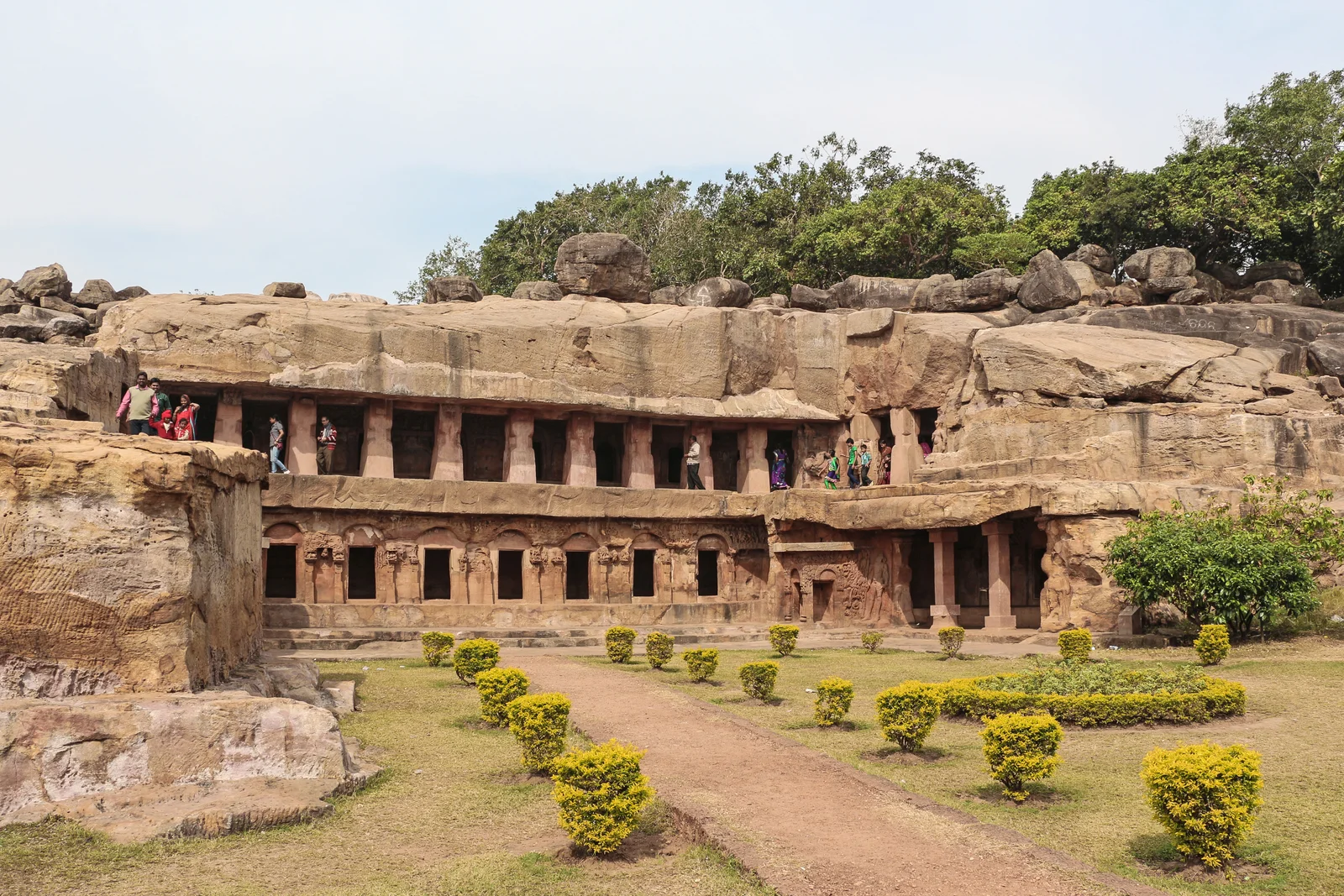
Rani Gumpha near Bhubaneswar, 8 December 2013.
Bernard Gagnon. Source · CC BY-SA 3.0.

Rooms cut into the hill
The Jain caves of Udayagiri and Khandagiri bring architecture close to the shape of the rock. In its historical account, the National Monuments Authority associates their early cutting with Kharavela and his successors around the first century BCE. It also records work continuing into the Somavamsi period, many centuries later. The hills hold an accumulated history rather than a single building campaign.1
Rani Gumpha makes that architectural ambition especially visible. Its two storeys open towards a court, with a rhythm of columns, entrances and carved surfaces. The National Monuments Authority singles it out among the larger caves and describes the flowers, creepers and animal motifs decorating the cave façades. Scale varies across the complex: a monumental frontage and an individual cell ask for different kinds of looking.
In Bernard Gagnon’s photograph, the horizontal openings remain part of a rough, uneven hill. The court gives space from which to take in the whole arrangement; the smaller entrances draw attention back to the rooms. Stone has been removed to create a place that people could enter and inhabit. The landscape itself has become architecture.
Royal memory and later images
At Hathigumpha, Kharavela’s inscription adds a royal voice to the site. Sahapedia’s account by Adrija Ghosh describes its seventeen lines and the expeditions and recovery of Jain images that it records.2 Such an inscription preserves a ruler’s presentation of his actions. It deserves to be read as a historical text with a speaker and a purpose, alongside the physical setting in which it was placed.
The same guide points to another period of Jain image-making at Khandagiri. It assigns additions in Navamuni and Barabhuji caves to the eleventh century, describing Tirthankaras and their attendant Sasana Devis. Tirthankaras are the liberated teachers central to Jain tradition; the accompanying goddesses are part of the caves’ religious imagery. These later carvings extend the story well beyond Kharavela’s reign.
Ghosh also describes Hindu worship of Chakreswari at Barabhuji. This is a useful, specifically attributed example of a sacred image receiving attention across religious boundaries. It invites a history of particular objects and their changing reception. The guide’s account does not establish that every cave followed the same course, or that the original meanings of its images disappeared.
Ratnagiri in brick and clay
At Ratnagiri, excavation allows us to move from an impressive ruin towards a named community. The Archaeological Survey of India’s report for 1958–59 describes work under Debala Mitra that exposed two neighbouring monasteries. Monastery 1 included a large court, a shrine and twenty-four cells. The report also records major rebuilding: older rooms were filled, new floors raised, and parts of the complex adapted while other spaces remained in use.3
Clay sealings supplied the name Ratnagiri Mahavihara and referred to its community of monks. Their lettering connects a physical site to the way an institution represented itself. The count of rooms tells us about the excavated plan; it cannot by itself become a count of students.
The same season’s report records five plaques bearing dharanis, sacred Buddhist formulas, inside another stupa. Religious writing was placed within a structure as part of its devotional life. Together, the sealings and plaques give clay more than one role: it could identify a community or carry a sacred text. The stupas in Satyabrata Nanda’s photograph belong to this wider setting of buildings, deposits and images.
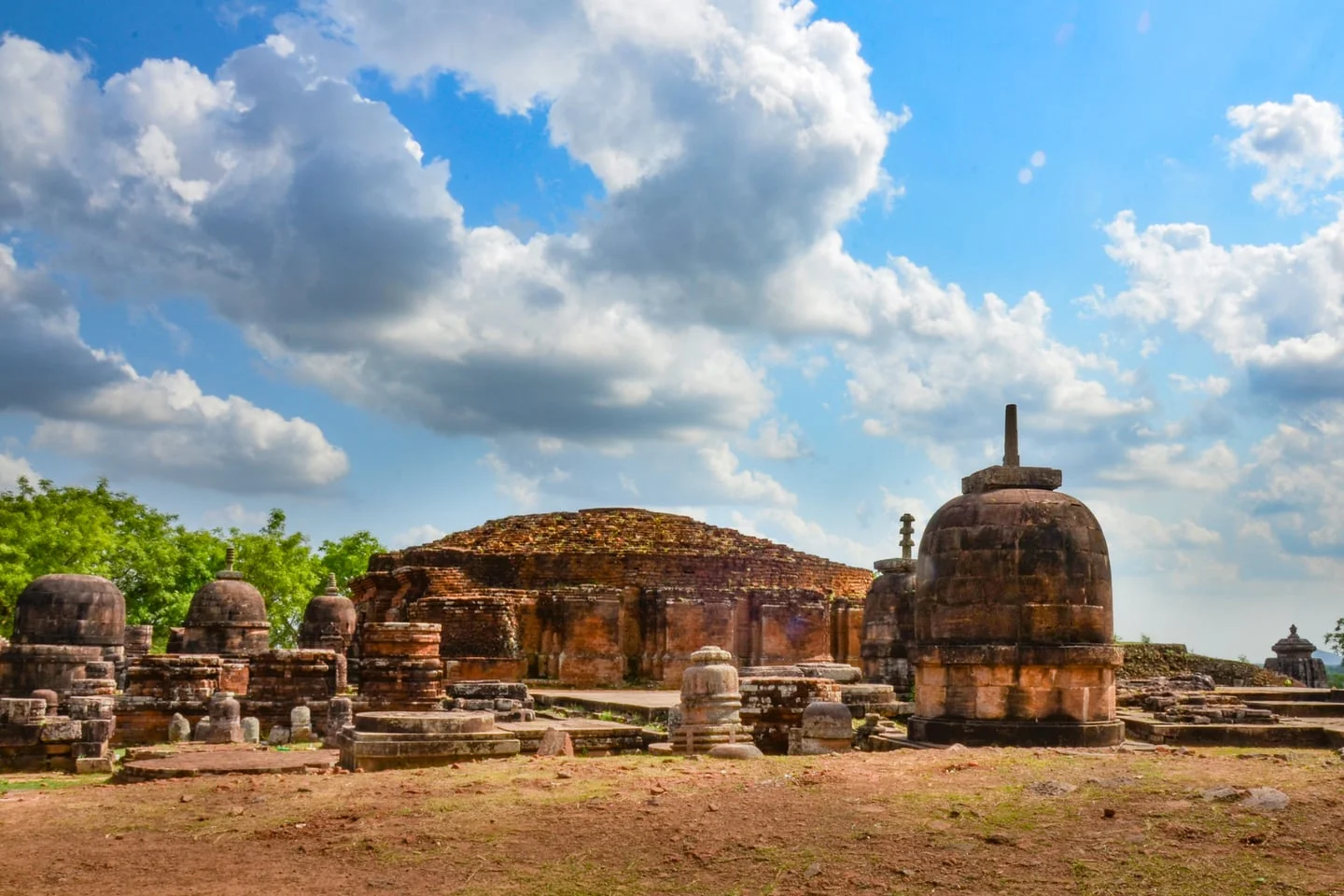
Stupas at Ratnagiri, 26 April 2015.
Satyabrata Nanda. Source · CC BY-SA 4.0.

What Lalitgiri kept within
Lalitgiri’s most intimate evidence lay inside its hilltop stupa. Excavations in December 1985 and January 1986 recovered three outer khondalite containers. Two held nested containers of steatite, silver and gold, with bone fragments inside the innermost vessels. The published report distinguishes a gold-wrapped fragment in one set from an unwrapped charred fragment in another; the third outer container lacked the complete inner set.4
The care given to these tiny remains is palpable in the sequence of materials. Each container enclosed another, protecting what the community had chosen to preserve. Their religious significance is clear, but the identity of the individuals is unresolved: the report states that the two relic-bearing sets have no inscriptions and presents attribution to the Buddha or disciples as speculation.
Elsewhere at Lalitgiri, the evidence becomes more explicit. Snigdha Tripathy’s study of the monastic sealings reads the name Chandraditya Vihara. The difference is instructive: one object preserves a name, while another preserves remains without naming their owner. Both deserve their full importance. Neither needs an invented certainty to make it compelling.
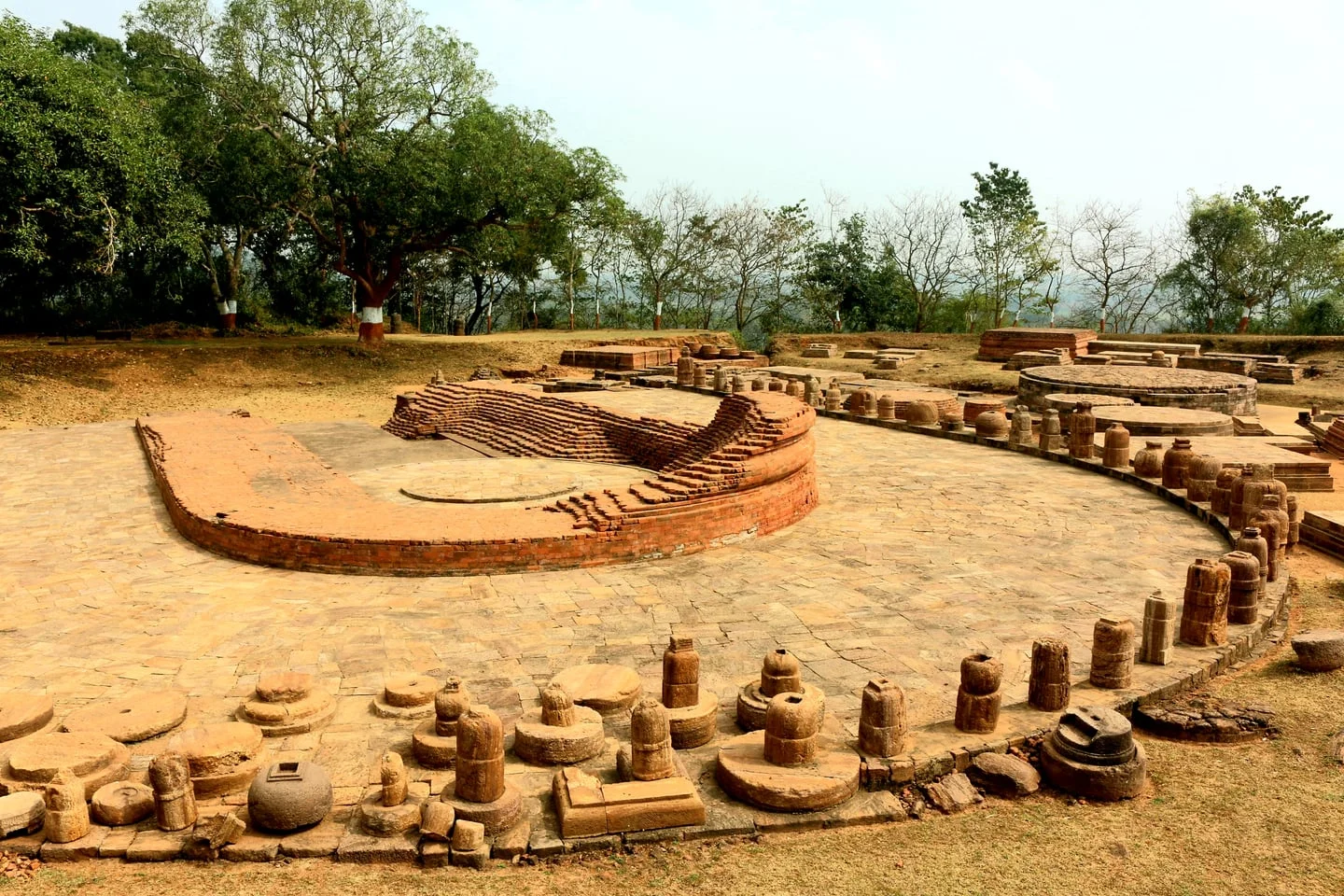
Exposed brick remains and small stupas at Lalitgiri, 15 September 2020.
Rupeshsarkar. Source · CC BY-SA 4.0.

The other Udayagiri
The Buddhist Udayagiri in Jajpur has its own institutional identities. Bimal Bandyopadhyay’s excavation report distinguishes the earlier excavated complex, identified through seals as Madhavapura Mahavihara, from Udayagiri-2, where work in 1997–2000 recovered evidence for Simhaprastha Mahavihara. The inscription readings were contributed by Snigdha Tripathy.5
The second excavation revealed a monastic complex, shrines and a water reservoir. These details bring the practical needs of residence into the archaeological picture. A monastery required places for worship and arrangements that supported people living together. The surviving walls and paved spaces can be approached with both functions in mind.
A sealing can recover a name that a large building no longer announces. Udayagiri names the place we visit; Madhavapura and Simhaprastha name communities identified through the archaeological record. Preserving that distinction gives the landscape a more precise history.
The photograph presents the Buddhist complex as it appeared in 2005. It is a view of exposed remains in a wooded setting, not a reconstruction of the complete monastery or its vanished upper parts.
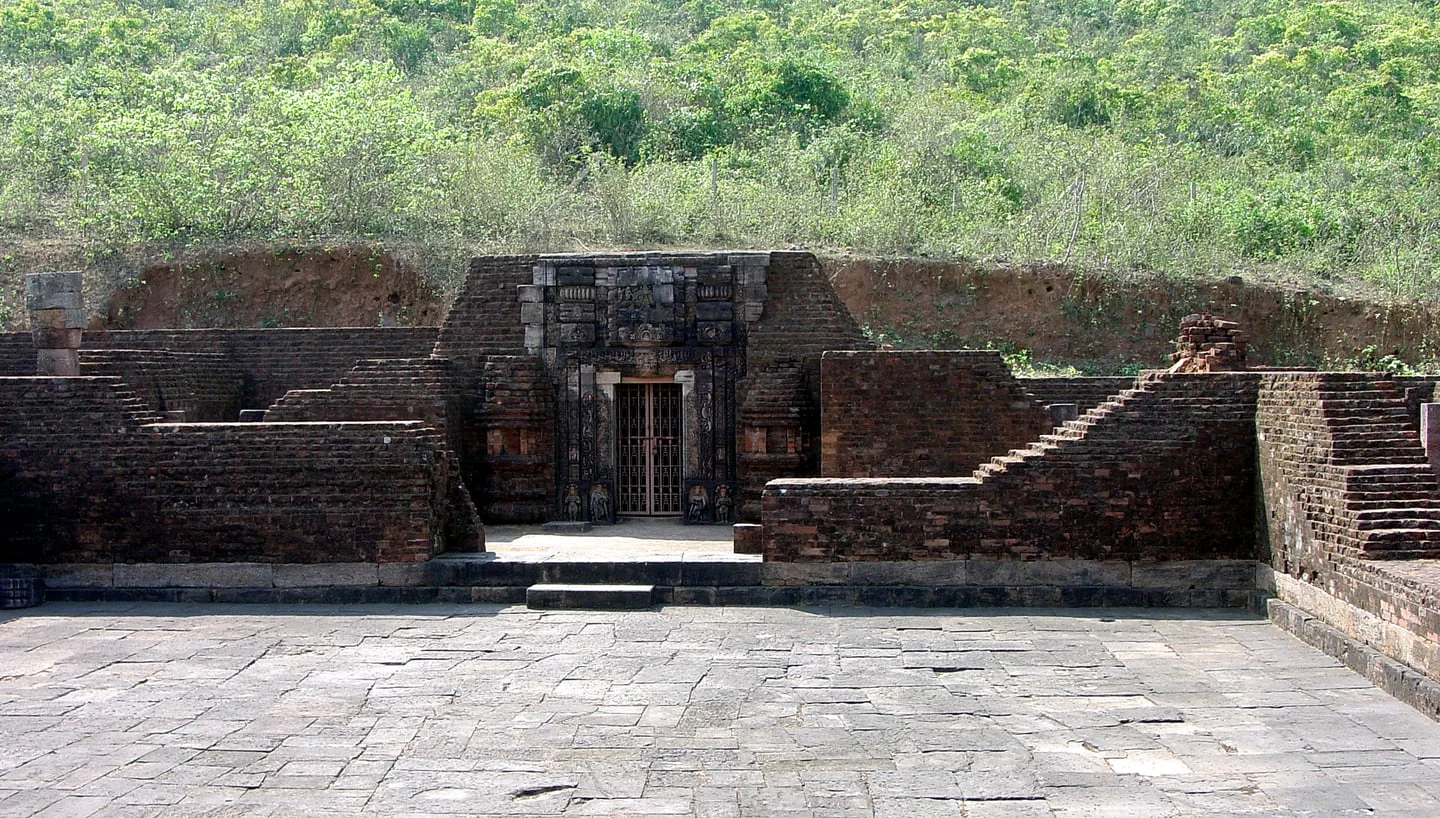
The Buddhist Udayagiri complex in Jajpur, 2005.
G41rn8. Source · CC BY-SA 4.0.

A traveller and a difficult identification
In the seventh century, Xuanzang described the country of Uda as a place of learning with more than a hundred monasteries and over ten thousand monks. Li Rongxi’s English translation then introduces Pushpagiri Monastery among the mountains. The large numbers belong to Uda as a whole; they are not an enrolment figure for Pushpagiri.6
The account combines observations of religious life with reports of marvellous happenings at stupas. Its descriptions of shining light and offerings belong to the devotional world that the traveller recorded. They should remain visible as religious testimony, with a different evidential status from a measured wall or a legible sealing.
Identifying Pushpagiri with a particular excavated site requires further argument. Bandyopadhyay’s 2007 report discusses the proposed identification at Langudi and records scholarly reservations.5 That dated discussion should not be made into a claim that the question can never be resolved. It does, however, caution against treating Ratnagiri, Lalitgiri and Udayagiri as the campuses of one proven ancient university simply because they form a modern visitor circuit.
The work of keeping histories legible
Modern care is part of the story now visible at these places. At Lalitgiri, the site museum was created to protect and display excavated antiquities, including the nested caskets. The Ministry of Culture’s 2018 announcement described six galleries of sculpture and architectural fragments; the Prime Minister’s Office subsequently confirmed the museum’s inauguration on 24 December.78 Display brings the small object back into conversation with the landscape from which it came.
India’s 2025 Tentative List submission groups Lalitgiri, Udayagiri and Ratnagiri as Buddhist heritage sites. Their place on that list is a step in a heritage process, not World Heritage inscription.9 The modern grouping makes it easier to consider their relationships while leaving each site’s excavated identity intact.
Jain caves and Buddhist monasteries also need to remain distinct in a cultural edition. Their histories meet through a shared region and through the work of people who record, conserve and interpret them. A cave entrance, a damaged image and an impressed name each carry something different. Looking closely enough to preserve those differences is how a broad history gains human scale.
Footnotes & Sources
- Udaygiri and Khandagiri Caves. National Monuments Authority, draft heritage document (2021), sections 3.0 and 3.2–3.3, English printed pp. 23–25 (PDF pp. 26–28). Used for location, architectural features and historical phases, not current regulations. ↩
- My City My Heritage Bhubaneswar. Adrija Ghosh, “Udaygiri and Khandagiri Caves”, pp. 20–21, Sahapedia and InterGlobe Foundation. Used for the inscription’s reported themes and later Jain images and worship. Its founding-date label is not adopted. ↩
- Indian Archaeology 1958–59 A Review. Archaeological Survey of India, pp. 33–36. Contemporary excavation report: Ratnagiri’s monasteries, rebuilding, sealings and dharani deposits. Historical district name “Cuttack” is retained in the source; Ratnagiri is now in Jajpur. ↩
- Excavations at Lalitagiri 1985–1991. Jeeban Kumar Patnaik, ASI Memoirs 112 (2016), pp. 44, 51 and 245. Excavation directed by G. C. Chauley; sealings chapter by Snigdha Tripathy. Linked copy is a third-party scan of the ASI publication. ↩
- Excavations at Udayagiri 2 1997–2000. Bimal Bandyopadhyay, ASI Memoirs 100 (2007), foreword, preface and pp. 1, 7, 12–17. Monastic identities, excavated features and discussion of Langudi. Inscription readings credited to Snigdha Tripathy. ↩
- The Great Tang Dynasty Record of the Western Regions. Xuanzang, translated by Li Rongxi (BDK, 1996), Fascicle X, pp. 269–270. Uda and Pushpagiri; numerical estimates and miraculous accounts are presented as the traveller’s testimony. ↩
- Archaeological Museum at Lalitgiri. Ministry of Culture announcement, 20 December 2018. Museum purpose, six galleries and planned display of the relic caskets. The announcement precedes the opening. ↩
- Lalitgiri Museum inauguration. Prime Minister’s Office, 24 December 2018, release 1557152. Confirms the completed inauguration. No present opening hours or display availability are inferred. ↩
- Serial Nomination of Buddhist Triangle Sites of Odisha. India’s Tentative List submission, 22 December 2025, reference 6926. Used for the three-site grouping and present district locations; not proof of a single ancient university or of World Heritage inscription. ↩
The four photographs carry linked creator, source and Creative Commons licence credits beside each image. All retain their full frames; size and file format were adjusted for layout. Dates identify the pictured views rather than current site conditions. Sources checked 9 November 2026.
Suggest an update
Share a correction or source for this chapter. GitHub submissions are public. Please omit private contact details and consent documents.