
Part 2 · Faith, Seasons and Shared Spaces
Chapter 8 of 48
Temples, Goddesses and Local Shrines
Sacred places in the life of Odisha
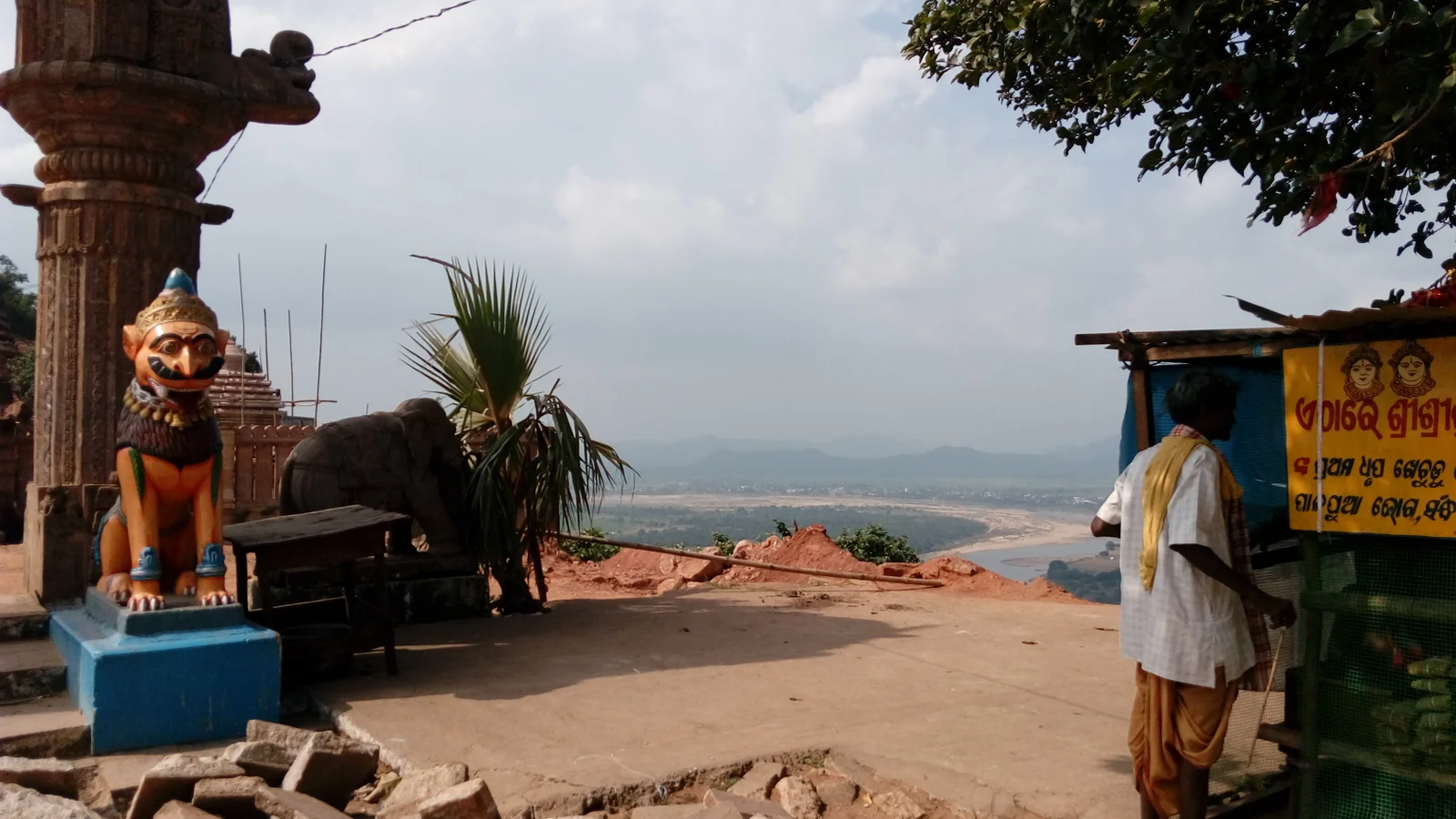
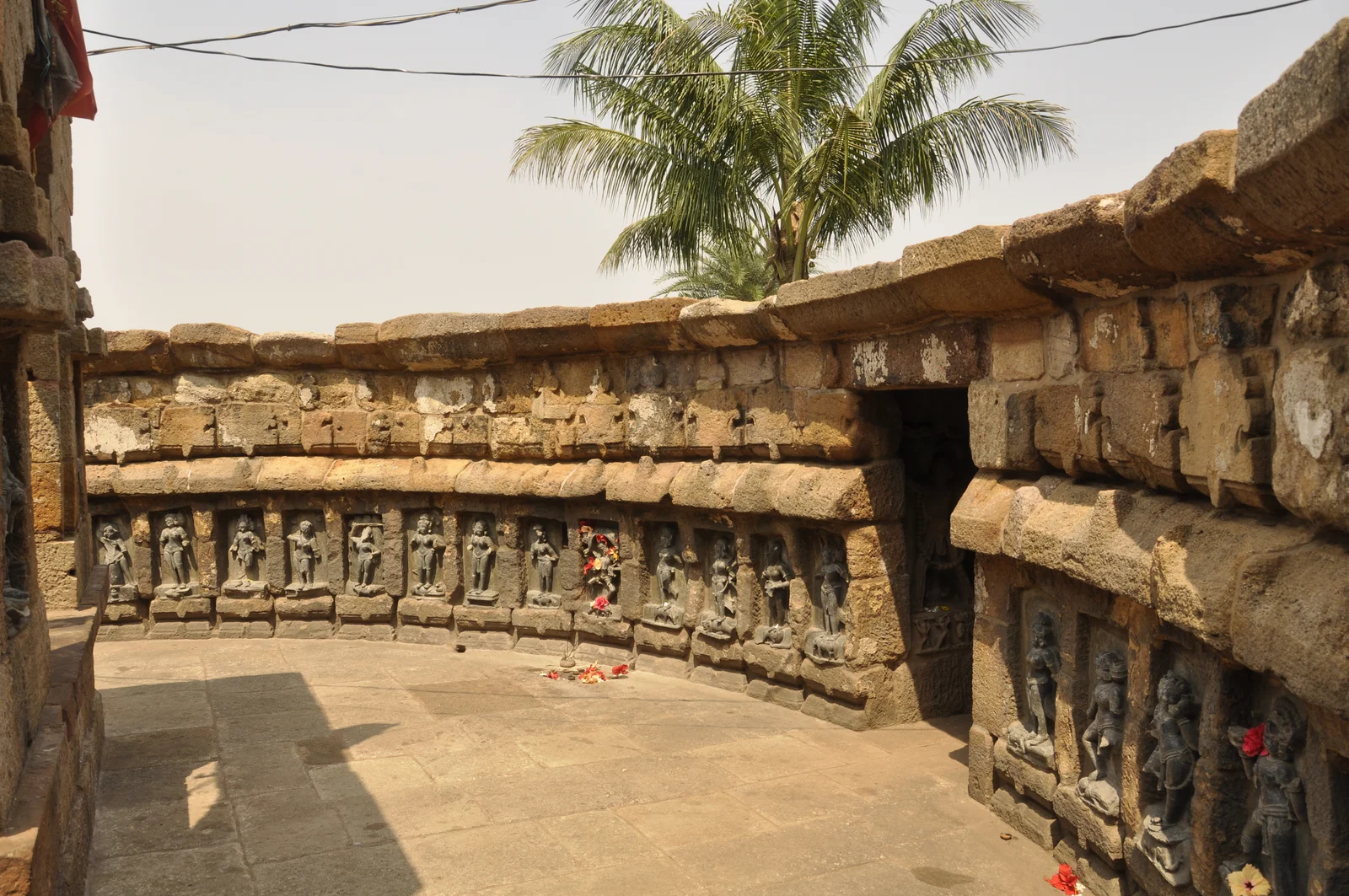
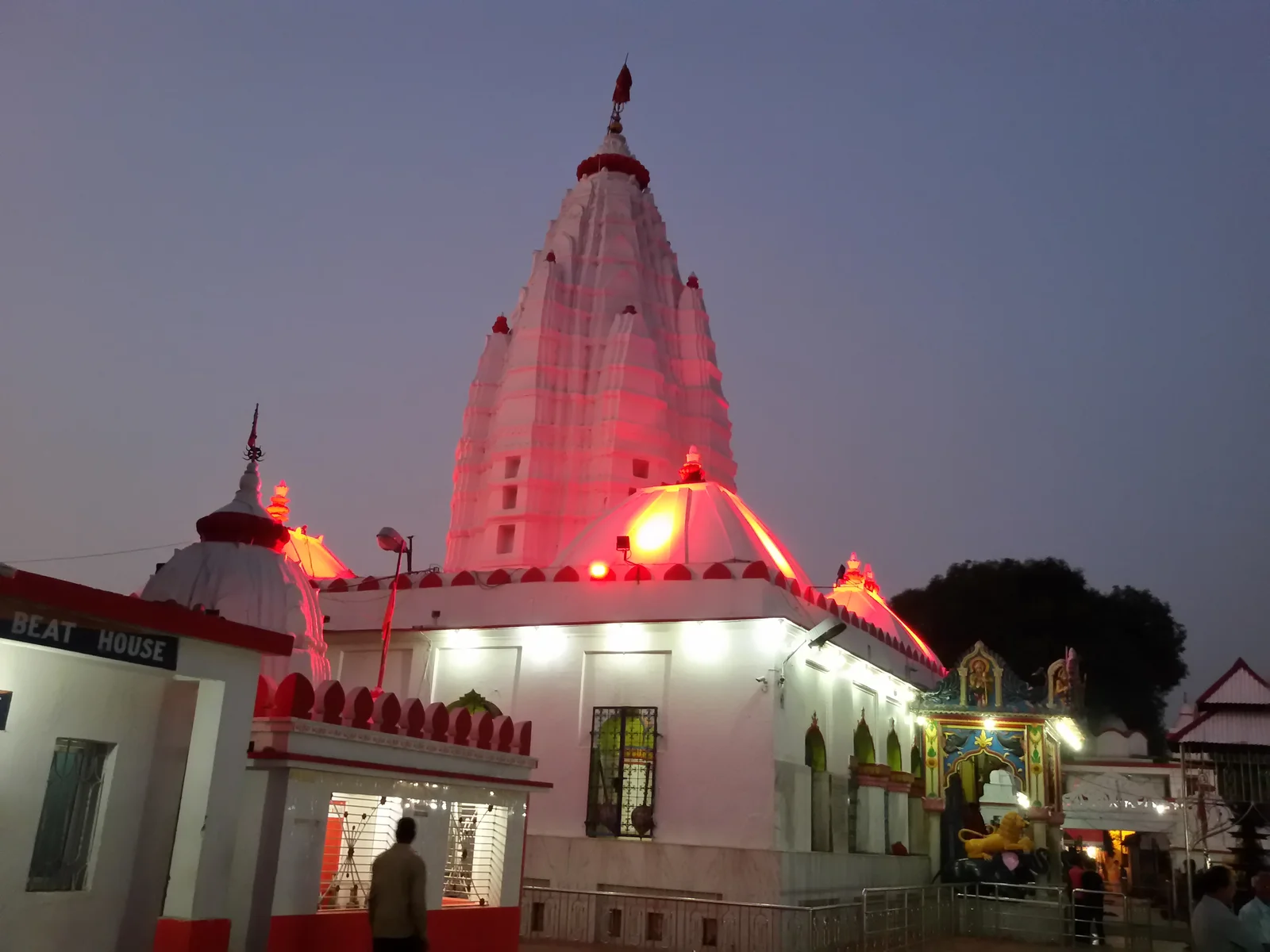
At Hirapur, a ring of sculpted goddesses faces an enclosure open to the sky. At Tara Tarini, the view extends from a hilltop towards the Rushikulya. In a photograph of Samaleswari, electric light washes a temple tower pink against the evening. These are three different ways of encountering a sacred place: through its arrangement of images, its surrounding landscape, and the changing life around its walls.
Odisha’s temples reward attention to all three. A building can be read through stone, proportion and carving; a place of worship also asks us to follow water, offerings, stories and journeys. Alongside the famous sanctuaries are temporary centres of devotion, assembled for a season or carried through a street. Moving between them gives us a fuller cultural geography, one in which the smallest gathering deserves as careful a description as the tallest tower.
Tara Tarini precinct and the river landscape below, 28 October 2016.
Buddy.forever.985. Source · CC BY-SA 4.0.

Water and worship in Ekamra
In old Bhubaneswar, Lingaraj stands at the centre of a sacred geography extending beyond its enclosure. India’s 2014 submission for the UNESCO Tentative List describes Ekamra through temples, small shrines, tanks and prescribed ritual routes. It places Lingaraj at the religious centre and Bindusagar at the focus of the old town. The submission draws on sacred texts to explain these relationships; its account is a cultural map as well as a description of buildings.1
This changes the scale at which we look. A tank is part of the sacred setting, and a route between shrines belongs to the history of a temple town. The smaller structures beside water or along a wayside become legible as parts of a larger place. Their importance cannot be measured simply by comparing heights.
Ekamra also offers a useful discipline for looking: begin with the celebrated monument, then turn towards its neighbours. What connects the shrines? Where does water gather? Which paths make the separate buildings into a place that can be traversed? Such questions keep architectural appreciation close to the ground.
A remembered offering at Remuna
At Remuna, the name Khirachora Gopinath carries a devotional story. The fourth chapter of the Chaitanya Charitamrita’s Madhya-lila tells of Madhavendra Puri travelling towards Jagannath Puri for sandalwood. At Remuna, Gopinath sets aside a pot of sweet milk for him. The narrative explains the deity’s name through this act: Gopinath becomes the one who steals the milk offering for a devotee.2
The story belongs to Vaishnava devotional literature. Its miracle is part of the text’s religious meaning, rather than an event that an architectural survey can establish. Read on those terms, it brings a different kind of evidence into view: affection between deity and devotee, a remembered food, and a journey connecting Remuna, Puri and Govardhana.
A temple’s cultural life can therefore reside in a name as much as a façade. To hear the name explained is to encounter a particular understanding of generosity and devotion. Remuna invites us to read an offering as a story-bearing object, while keeping the text’s account distinct from claims about today’s kitchen or ritual schedule.
A circle at Hirapur
Hirapur’s Chausathi Yogini sanctuary changes the architectural encounter again. The heritage inventory hosted by the Indira Gandhi National Centre for the Arts describes a circular, open-air temple, with Yogini images and a central mandapa associated with Bhairava figures. It distinguishes the sandstone structure from the black-chlorite images inside. Goddess and Shaiva imagery meet within the same small enclosure.3
The inventory assigns the building to the early tenth century on architectural and sculptural grounds. This is a stylistic assessment, not a foundation date supplied by an inscription. It also records renovation, conservation and weathering. The sanctuary we see has passed through care and damage; its material history continues after the moment of construction.
In the photograph, the curved wall gathers the figures into a company. Differences of posture remain visible within the repeated niches. Above them are sky, palm fronds and wires: the old sculptures inhabit a present-day setting. Looking closely lets us appreciate the arrangement without pretending that a photograph reveals the full history of the rites once practised here.
Yogini figures along Hirapur’s open-air circular enclosure, 11 April 2015.
Devasish Nandy. Source · CC BY-SA 4.0.

Samaleswari and the western horizon
Samaleswari shifts the chapter’s centre towards western Odisha. The Sambalpur district account identifies her as the city’s presiding deity and describes her importance across western Odisha and neighbouring Chhattisgarh. It locates the sanctuary beside the Mahanadi and records several names of worship, including Jagatjanani and Adishakti.4
This regional reach matters. A cultural map centred only on the coastal temple cities would leave a major devotional centre at its edge. Following Samaleswari instead allows Sambalpur to become the point from which a wider sacred region is understood. The river and the city belong in that picture alongside the sanctuary.
Aditya Mahar’s 2015 photograph records an evening view: a white tower, coloured illumination, railings and people near the entrance. It is a dated glimpse of a working place of worship. The ordinary fittings deserve to remain in the frame. They remind us that a temple is encountered through movement and maintenance as well as through the silhouette that represents it in a guidebook.
Samaleswari Temple, Sambalpur, at dusk, 14 February 2015.
Aditya Mahar. Source · CC BY-SA 4.0.

Tara Tarini above the river
In southern Odisha, Tara and Tarini are worshipped together at a hilltop sanctuary overlooking the Rushikulya. The Ganjam district description identifies them as sister goddesses and marks the Tuesdays of Chaitra as especially significant occasions of worship.5 The hill, river and recurring month give this sacred place both a setting and a rhythm.
The opening photograph looks out from the temple precinct towards the river below. It is a useful counterpoint to a frontal architectural view. Here the surrounding country enters the image, while carved and painted forms occupy the foreground. We see something of what makes an ascent memorable: a change of level and a widening horizon.
The district’s festival account also describes devotees fulfilling vows at the Chaitra gathering.6 This gives the journey a personal dimension. A place on a map can become the destination of a promise, with a return visit carrying meaning that no photograph can fully show.
When the shrine enters the street
Budhi Thakurani’s yatra offers another relationship between deity and place. Ganjam’s cultural account describes the goddess being taken to a temporary temple during the festival and visiting different streets in procession. It also records decorated festival spaces and displays with religious and contemporary themes.6
A temporary shrine changes what we might otherwise understand by permanence. The festival’s importance does not depend on its setting remaining in place throughout the year. For its duration, a route and a gathering space become central to the encounter with the goddess. The devotional landscape is made through movement as well as through construction.
This is why local shrines need to be studied with their streets and calendars. A photograph taken on an ordinary day and a photograph taken during a yatra may describe very different arrangements of the same neighbourhood. Both belong to its history.
Under the shade of a tree
J. C. Mahanti’s Fading Festivals of Odisha describes Chaitra Mangala worship on Tuesdays of the lunar month. In his account, worshippers, mostly married women, gather beneath a tree and prepare an image of Mangala on sand or earth, decorating it with cloth and flowers. Seasonal fruit and pana are offered around midday, accompanied by conch, bells and ululation.7
The description brings materials and actions into focus: a shaded place, a prepared image, offerings and a gathering. It gives us a particular account of practice, rather than a rule for every household or locality. Its value lies partly in the scale of attention it permits. We can recognise religious making without first looking for a monumental building.
The women who assemble the worship are central to this scene. A history concerned only with royal patrons and surviving stone would struggle to make their work visible. Cloth, fruit and prepared earth ask for another kind of record, attentive to those who arrange, remember and repeat the observance.
Learning to see the smaller place
These encounters suggest a way of reading Odisha’s sacred landscapes without flattening their differences. A devotional narrative at Remuna, a sculptural inventory at Hirapur and a description of seasonal worship each answer different questions. Together they make room for buildings, remembered journeys and acts of preparation.
The next time a temple tower draws the eye, there is reason to look around it too: towards the tank, the approach, the neighbouring shrine and the place where people gather. There is also reason to ask who can explain what happens there, and to listen for differences between their accounts. Local knowledge gains depth when it is attached to particular people and places.
An adequate cultural portrait must hold the monumental and the intimate in the same field of view. Stone survives unevenly; so do stories and practices. Giving each its proper source and scale is one way to keep a small shrine from disappearing behind a famous skyline.
Footnotes & Sources
- Ekamra Kshetra — The Temple City, Bhubaneswar. India’s Tentative List submission, 15 April 2014, Description. Used for the relationship of shrines, tanks and ritual routes; a Tentative List entry is not World Heritage inscription. ↩
- Chaitanya Charitamrita, Madhya-lila, chapter 4. Krishnadasa Kaviraja; English translation and commentary by A. C. Bhaktivedanta Swami Prabhupada, Bhaktivedanta Book Trust. Chapter summary and Remuna narrative. Cited as devotional literature. ↩
- Chausathi Yogini Temple, Hirapura. Heritage inventory OR/KDA/13, hosted by IGNCA, pp. 1–4. Building form, materials, stylistic dating and conservation observations. Survey date is not stated. ↩
- Samaleswari Temple. Sambalpur district administration, opening description. Used for the deity’s regional associations and Mahanadi setting; not for the page’s travel information. ↩
- Tara Tarini — The manifestations of Adi Shakti. Ganjam district administration. Hilltop setting, sister goddesses, Rushikulya and Chaitra Tuesdays. ↩
- Culture and Heritage. Ganjam district administration, Tara Tarini Mela and Thakurani Yatra sections. Votive worship, temporary temple and processions. Describes customary practice, not a year-specific programme. ↩
- Fading Festivals of Odisha. J. C. Mahanti, “Chaita Mangalbara osha”, printed p. 62 (PDF p. 78). A named author’s practice account; local variations and present prevalence are not established here. ↩
All three photographs are reproduced under CC BY-SA 4.0, with linked creator, source and licence credits beside each image. Images retain their full frames and original colours; only size and file format were adjusted for layout. Photograph dates describe the pictured views, not current site conditions. Sources accessed 9 November 2026.
Suggest an update
Share a correction or source for this chapter. GitHub submissions are public. Please omit private contact details and consent documents.