
Part 2 · Faith, Seasons and Shared Spaces
Chapter 10 of 48
Mahima Dharma and the Poetry of Bhima Bhoi
The formless divine and the suffering world
What does a prayer ask for? Relief, forgiveness, perhaps a place beyond suffering. In Bhima Bhoi’s poetry, the request becomes more difficult: how can the speaker accept deliverance while others remain in pain? The question brings the intimate voice of devotion into contact with the widest imaginable community of living beings.
The nineteenth-century poet gave Mahima Dharma an enduring literary voice. Its founder, Mahima Gosain, and its poet should be distinguished, even as their histories meet. The movement’s commitment to a formless divine and its challenge to inherited religious authority open another route through Odisha’s sacred landscape.1 At Joranda, that landscape includes the buildings pictured below. At Khaliapali, it includes a place of poetic memory. Between them lies a history carried by words, communities and competing understandings of faith.
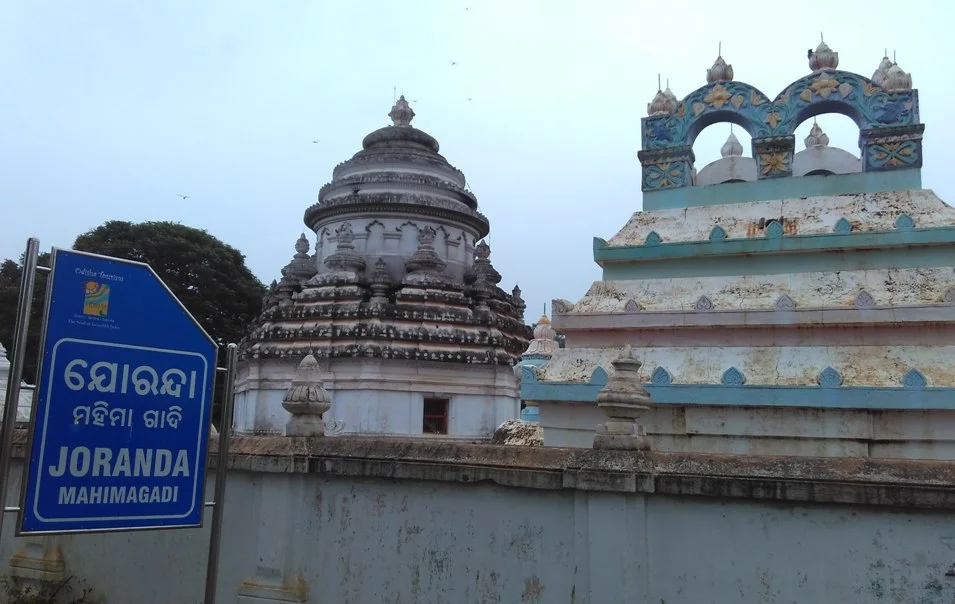
Mahima Gadi at Joranda, photographed on 7 September 2016.
SUDEEP PRAMANIK. Source · CC BY-SA 4.0.

A divine beyond the image
Mahima Dharma’s language asks the worshipper to think beyond a deity contained in a visible image. Alekha names the indescribable; nirakara, the formless. Sunya belongs to this vocabulary too. In his study of Bhima Bhoi, Sitakant Mahapatra places these expressions within a longer Odia religious and literary conversation about ultimate reality.2 Their presence does not, by itself, establish that Mahima Dharma and Buddhism are the same tradition.
The challenge for poetry is immediate. How can language approach what it calls indescribable? A poem must still address someone, ask something and make feeling audible. Bhima Bhoi’s prayer offers a way into that difficulty: an appeal to the guru, a confession of weakness, a demand that suffering be heard. Reading him, we encounter a relation of dependence and urgency rather than a detached list of divine attributes.
Formlessness also does not mean that believers live without gathering places. The Dhenkanal district administration identifies Joranda as a religious headquarters, with Mahima Gosain’s samadhi and the Sunya, Dhuni and Gadi mandiras. It records the annual gathering at Magha’s full moon.3 These places locate a shared religious life. The photograph cannot explain their practices by itself, but it makes one important point visible: a faith directed towards the formless has a material history of buildings, care and assembly.
The prayer that widens
The twenty-seventh boli of Stuti Chintamani offers a concentrated encounter with Bhima Bhoi’s poetic method. In the English selection printed by Mahapatra, the speaker imagines the weight of wrongdoing gathered into a basket and placed at the guru’s feet. The plea then expands from the burden of one person to the distress of devotees and, finally, to the suffering of the living world.2
That movement matters. The basket gives an abstract moral burden the weight and familiarity of something carried. The widening address prevents the poem from resting in private relief. Its culminating willingness to endure condemnation for the sake of others makes compassion costly. In this reading, the poem asks whether salvation can be satisfying when it leaves everyone else behind. The force comes from the change in the scale of concern, from a troubled self to lives beyond it.
Khaliapali and the work of community
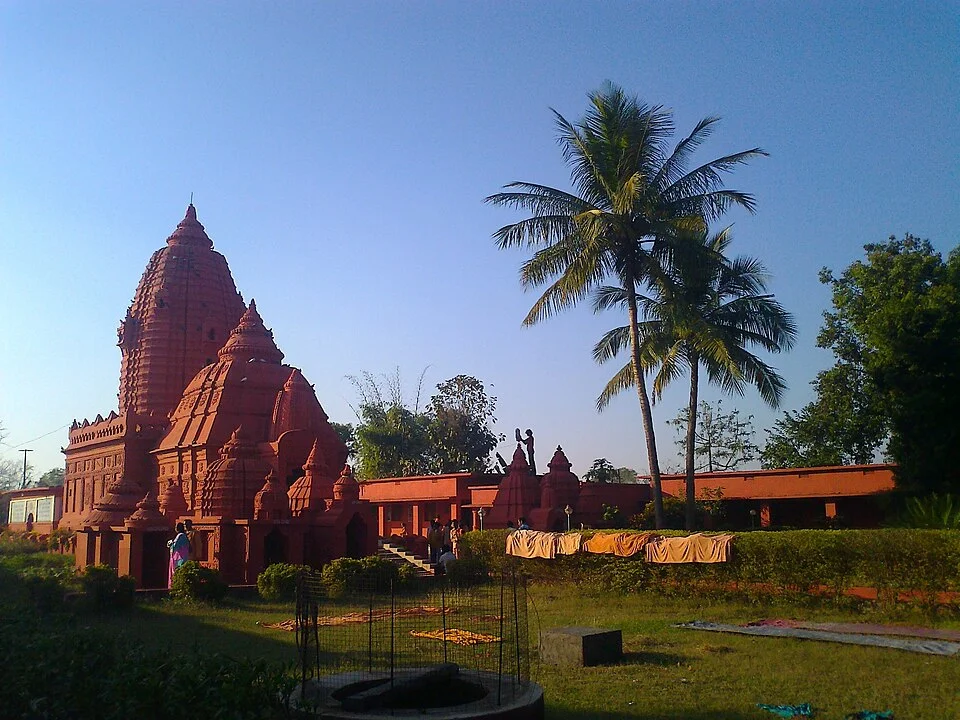
Bhima Bhoi memorial at Khaliapali, photographed on 5 February 2012.

Khaliapali belongs to the poet’s later religious life. Mahapatra dates the ashram’s emergence as a centre of his activity to 1877 and identifies Ma Annapurna as supervising it.2 Remembering her changes the emphasis of the story. A community cannot be sustained by the fame of a single voice alone; it also requires people who hold its daily life together.
The memorial photograph is from 2012. It records a later commemorative landscape, not the appearance of the ashram during Bhima Bhoi’s lifetime. Its towers and grounds offer a setting in which to think about remembrance: what a community chooses to build, preserve and associate with a poet. Joranda and Khaliapali should therefore remain distinct points on our map, connected by faith but carrying different associations.
Weakness as a poetic resource
Compassion is only one register of this writing. In an extract from the thirty-first prayer, reproduced by Nishamani Kar in Odisha Review, the speaker seeks refuge while acknowledging depleted strength and patience. The translation is credited to Saubhagya Kumar Mishra.4 Here, the voice does not claim mastery of spiritual practice. It asks for help because its resources are failing.
Read alongside the twenty-seventh boli, this admission gives the poems an arresting tension. The person who feels unable to secure his own spiritual footing can still care about the fate of the world. Smallness does not cancel ethical imagination. Nor does anguish disappear when the prayer turns outward. The reader hears vulnerability and an extraordinary reach of concern occupying the same voice.
These observations concern the selected English passages, not a new translation or a line-by-line study of the complete Odia text. Translation gives access, but also shapes cadence, emphasis and the relation between ordinary and sacred language. Keeping the translator visible is part of reading responsibly. A familiar saying detached from its prayer can retain its moral beauty while losing the sequence of images and appeals that gave it force.
Equality and differing authorities
Historian Ishita Banerjee-Dubey places Mahima Dharma among religious movements that worked against caste hierarchy through their practices. She also warns against treating challenges from lower-caste poets and saints as merely a response to the silence of elite intellectuals.5 This perspective allows us to recognise religious thought as an arena of social argument in its own right.
Yet a movement’s egalitarian promise does not make all its communities identical. Johannes Beltz, drawing on fieldwork in western Odisha in 2000–2001 and documentary sources, examines differing claims to Bhima Bhoi. In the Joranda controversy he discusses, Kaupinadhari and Balkaladhari positions assigned different degrees of authority to the poet’s writings.1 These are historically situated observations, not a description of every believer today. They remind us that a poem can become a source of institutional argument as well as devotion.
A life remembered in many ways
Bhima Bhoi’s biography requires care. Mahapatra begins by acknowledging uncertainty about his birth and the history of his sight. Beltz treats stories about him as evidence of how a saint is remembered, rather than accepting every episode as a recoverable event.12 A responsible account can respect devotional memory without turning it into an exact chronology.
This matters for the way we picture the poet. An invented face would offer an easy sense of recognition while concealing how little it could establish. The photographs in this chapter instead show places of religious and commemorative life. They leave room for the reader to meet Bhima Bhoi through the work, without mistaking a modern visual reconstruction for a historical record.
The voice beyond its first listeners
On 2 March 2024, addressing a Mahima gathering in Sambalpur, President Droupadi Murmu presented Bhima Bhoi’s writings as a resource for social equality and human welfare, and called for wider translation.6 This is a documented moment of public reception: a religious poet being addressed to readers far beyond his immediate community.
Such recognition creates an opportunity to return to the poems. Their value is not exhausted by the idea that they convey a good message. They make a reader experience changes of scale: the weight of personal wrongdoing, the need for shelter, the suffering of others, the possibility of concern without limit. The person praying remains vulnerable throughout.
In an edition devoted to Odisha’s cultural worlds, Bhima Bhoi asks us to attend to what words can do within those worlds. Buildings make a tradition visible; communities sustain its practices; a poem can unsettle the boundaries of the self. The question with which we began remains open at the end: what should one ask for, once the suffering of others has entered the prayer?
Footnotes & Sources
- Johannes Beltz, “Bhima Bhoi: The Making of a Modern Saint”. In Antony Copley, ed., Hinduism in Public and Private (Oxford University Press, 2003), pp. 230–253; especially pp. 230–232 on sources and fieldwork, and pp. 244–245 on differing institutional claims. Fieldwork dates are 2000–2001. ↩
- Sitakant Mahapatra, Bhima Bhoi. Sahitya Akademi, Makers of Indian Literature; first published 1983. Printed pp. 1–3 discuss uncertain biography; pp. 12–13 discuss Joranda, Khaliapali and Ma Annapurna; pp. 17–20 discuss religious vocabulary; pp. 74–75 present extracts from the twenty-seventh boli. The close reading here uses the English selection on p. 75 and is the chapter author’s interpretation. ↩
- Dhenkanal district administration, “Places of Interest”. Joranda entry: religious centre, Mahima Gosain’s samadhi, named mandiras and the Magha full-moon fair. Consulted 10 November 2026; not a year-specific event schedule. ↩
- Nishamani Kar, “The Saint-Poets of Odisha”. Odisha Review, July 2014, printed pp. 68–72, especially p. 71 and reference 3 on p. 72. The excerpt from Stuti Cintamani 31 is credited to Saubhagya Kumar Mishra, Modern Indian Literature: An Anthology, vol. I (Sahitya Akademi, 1992), pp. 908–909. Consulted through Kar’s essay, not that anthology. The website filename differs from the printed page range. Used for the poem extract, not the essay’s disputed biographical or religious-origin claims. ↩
- “Caste in 19th Century India: In Conversation with Ishita Banerjee-Dubey”. Interview by Rajarshi Chunder, 2017, Sahapedia. See the response on lower-caste movements and religious challenges to hierarchy. Consulted 10 November 2026. ↩
- President of India, “President of India Addresses a Meeting of Mahima Cult”. Official release, 2 March 2024, reporting the Sambalpur address. Used as evidence of public reception and the appeal for translation, not to resolve disputed biography. ↩
Both photographs are reproduced full-frame and resized for layout; no content has been added or removed. Creator, original file page and licence are linked in each caption. The Joranda photograph remains under CC BY-SA 4.0; the Khaliapali photograph is dedicated under CC0 1.0. These licences concern the images, not the chapter text. The supplied web images suit this review PDF; higher-resolution originals would improve a future print edition. No generated imagery is used.
Suggest an update
Share a correction or source for this chapter. GitHub submissions are public. Please omit private contact details and consent documents.