
Part 7 · Everyday Lives and Social Change
Chapter 40 of 48
Caste, Labour and Access to Cultural Life
Making learning belonging and recognition
A cultural tradition can depend on someone’s labour without giving that person equal authority or recognition. To understand Odisha’s cultural life, we must ask who makes and serves, who can learn, and who is allowed to enter, speak or decide.
This chapter follows those questions through craft production, temple access, devotional arguments and Dalit writing. These settings cannot be reduced to one history. Together, however, they show why celebrating cultural achievement also requires attention to its social conditions. Caste hierarchy has been challenged within Odisha’s literary and religious worlds, while struggles over participation have continued. The makers and critics of culture belong within the same account.
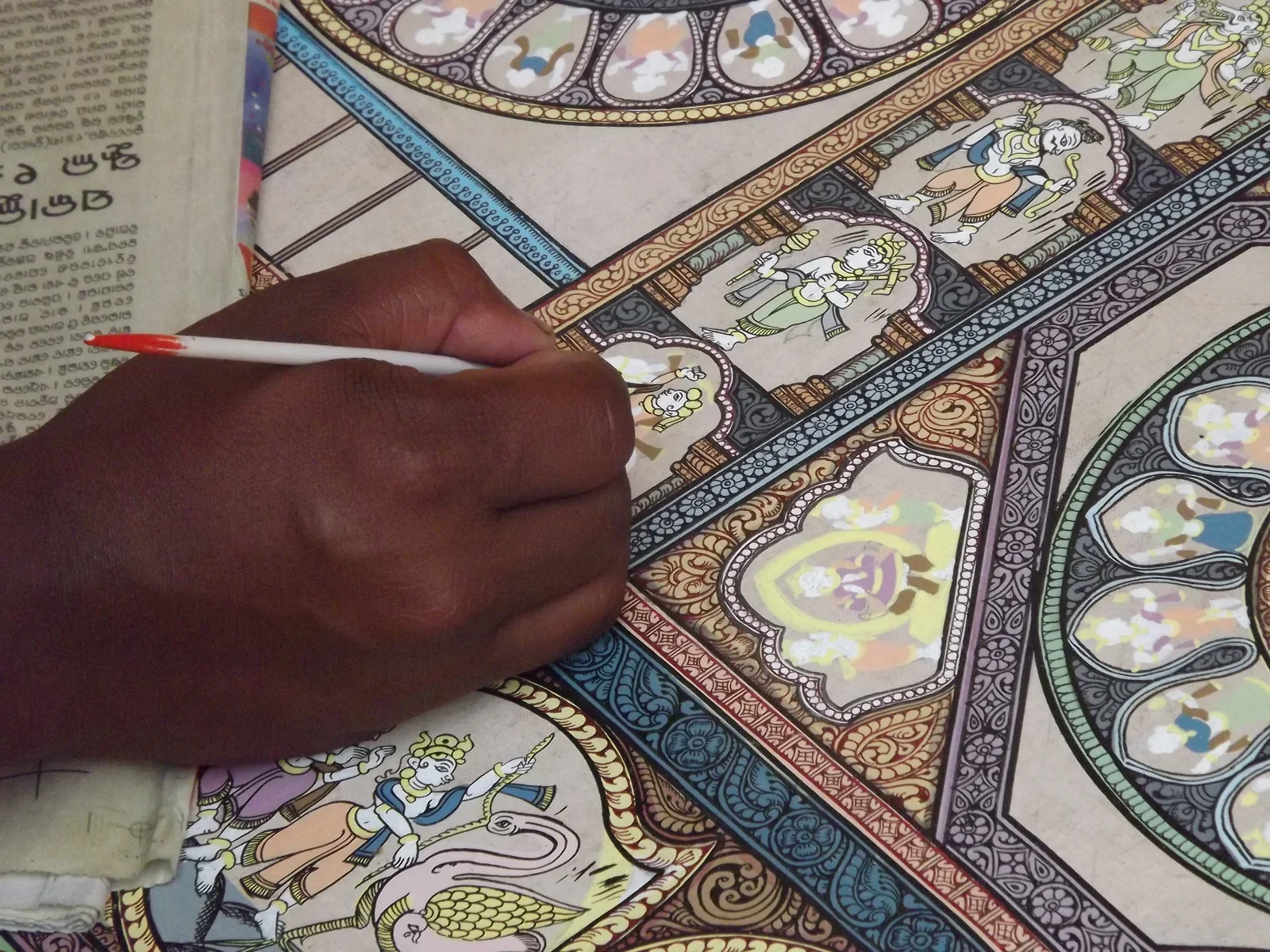
Painting in Raghurajpur, 21 March 2013. The source does not name the artist; no caste identity is inferred from the photograph.
Sumit Surai. Source · CC BY-SA 4.0.

Skill inheritance and the opportunity to learn
In her 1998 study of Raghurajpur, Mamata Tripathy describes patta painting as a household craft, with materials prepared and work shared among family members. She also records painters from communities beyond the Chitrakaras entering production as markets changed.1 Her account shows a relationship between occupation and community that was being remade, rather than a permanent correspondence between birth and skill.
The distinction matters when a visitor hears a craft described as hereditary. A family can carry a valuable history of teaching, remembered designs and practical knowledge. That history deserves recognition. It does not establish that artistic ability belongs naturally to a caste, or that someone from another background cannot learn.
Tripathy describes training and workshops as opportunities for exchanging ideas. She also records competition and the involvement of middlemen, sometimes to artisans’ disadvantage.1 An expanding market could bring new participants while producing new pressures. Her study belongs to a particular historical setting; it cannot establish the earnings or opportunities of today’s households.
To follow these relationships further, an account of a workshop would need to distinguish ownership, teaching, preparation, painting and sales. A person’s visible task does not reveal who owns the materials, sets the price or receives payment. The photograph opening this chapter records skilled painting, but supplies none of that information about the individual shown.
Cultural credit can begin with precise description. Who prepared the surface? Who taught the design? Whose labour made the finished work possible? These questions help recognise collaboration while leaving room to examine unequal control. They also keep an account of inherited expertise from becoming an endorsement of inherited social rank.
A doorway is also a social boundary
Article 17 of the Constitution of India abolishes untouchability and forbids its practice in any form.2 This establishes a public principle against which exclusion must be judged. A cultural description should not turn discrimination into an unquestioned custom merely because it occurs around a revered institution.
An answer in the Lok Sabha on 6 September 2011 provides a specific Odisha record. Drawing on information from the state government, it reported two temple-entry incidents during the preceding five years: at the Jagannath temple in Keredagada, Kendrapara district, and the Kali temple at Nuapada village in Puri district. It stated that Scheduled Caste people had been barred and that cases had been registered.3
The answer also said that such incident data were not maintained centrally. Its two reported cases are therefore neither a complete count of exclusion nor evidence about those temples’ present arrangements. The record establishes that access was contested at named places and that the state acknowledged the disputes.
Entering a cultural space is only one dimension of participation. Learning its repertoire, receiving a performing role, sharing a meal and helping govern an institution raise further questions. Service may be highly skilled and essential without carrying the same authority as deciding how that service is organised.
These distinctions help us read claims of cultural unity carefully. A story about equality, a legal principle and a person’s experience of welcome are different kinds of evidence. Each matters. Placing them beside one another lets us ask where an ideal has become practice, where it has been resisted and whose testimony is needed to understand the difference.
Devotion as a language of challenge
Balaram Das’s Lakshmi Purana makes food and hospitality part of an argument about hierarchy. P. C. Mohanty and Swadhin Mohanty’s account describes Jagannath and Balabhadra enduring hardship after Lakshmi leaves them, and reads the narrative as an appeal against caste discrimination.4 That moral argument should not be mistaken for proof that exclusion disappeared.
Bhima Bhoi’s legacy offers another public language of equality. At a meeting in Sambalpur on 2 March 2024, President Droupadi Murmu highlighted social equality in his work and called for wider translation of his writings.5 This is evidence of how his legacy is invoked in public life today.
The memorial at Khaliapali gives remembrance a physical setting. Such places invite a further question: how can honouring a poet keep the challenge of his ideas audible, alongside the ceremonies through which he is remembered?
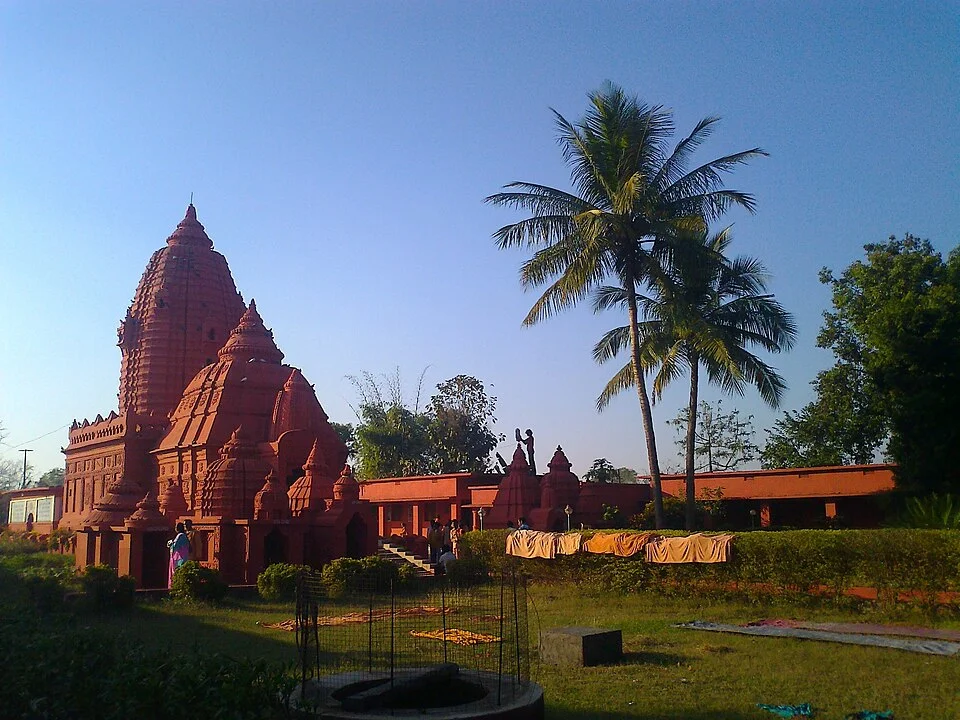
Bhima Bhoi memorial at Khaliapali, photographed on 5 February 2012.

Speaking as a maker of the record
Dalit writing changes the position from which cultural life is described. In a 2019 interview with Jaydeep Sarangi, Basudev Sunani recalls his early concern with poverty and his later engagement with caste discrimination and Ambedkar’s thought. He describes this development as part of his own thinking and creative work.6
Sunani identifies poverty, migration, starvation and protest as concerns of his first poetry collection, published in 1995. He also discusses a substantial work on Dalit cultural history based on years of fieldwork, and his editing of Odia Dalit literature.6 His account brings poetry, historical research and the work of assembling other voices into the same creative life.
He questions the limited attention paid to marginalised people in much contemporary writing.6 The criticism asks more of literary culture than sympathetic representation. It asks who is writing, whose experience shapes the terms of discussion and which works reach readers. A poet can be an interpreter of society as well as someone whose experience is interpreted by others.
This interview is one writer’s position, not a statement for every Dalit author. Its importance lies partly in that specificity. Naming a speaker and locating an argument gives readers something they can examine and respond to, rather than an anonymous category presented as having a single voice.
A fuller cultural record would place such voices alongside accounts by makers, performers, teachers and people who have challenged exclusion. It would ask about remuneration and access to training as carefully as it asks about artistic form. Odisha’s cultural achievements become more intelligible when the people who sustain them can also question their conditions, claim credit for their work and participate in deciding what comes next.
Footnotes & Sources
- Mamata Tripathy · Folk Art at the Crossroads of Tradition and Modernity. JASO 29(3), 1998, pp.197–211; especially pp.201–202 and 209–210. Retained PDF checked for household work, training, new entrants and markets. ↩
- Government of India · The Constitution of India. Article 17, abolition of untouchability. Constitutional principle; no case-specific legal advice or outcome inferred. ↩
- Lok Sabha · Temple Entry. Unstarred question 5515, answered 6 September 2011, parts (a)–(b). Named Odisha incidents, registration of cases and absence of centrally maintained data; no current status inferred. ↩
- P. C. Mohanty and Swadhin Mohanty · Laxmi The Goddess of Prosperity and Salvation. Odisha Review, June–July 2021, pp.21–25, especially p.23. Narrative and interpretation only; its claim that caste barriers ended is not adopted as social history. ↩
- President of India · Address to a meeting of Mahima Cult. Official release, 2 March 2024. Sambalpur address on Bhima Bhoi, equality and translation; evidence of public reception. ↩
- Jaydeep Sarangi · An Interview with Basudev Sunani. Writers in Conversation 6(2), August 2019, especially PDF p.4. doi:10.22356/wic.v6i2.50. Published first-person testimony; paraphrased, not a new interview. ↩
The Raghurajpur photograph is reused under CC BY-SA 4.0; the Khaliapali photograph under CC0 1.0. Both come from this edition’s research collection, reproduced full-frame and resized without further content alteration. Captions link to source records and licences. Neither image documents the temple-entry incidents discussed here. Sources checked 14 November 2026.
Suggest an update
Share a correction or source for this chapter. GitHub submissions are public. Please omit private contact details and consent documents.