
Part 7 · Everyday Lives and Social Change
Chapter 41 of 48
Places to Learn Together
Shared reading libraries and voluntary learning
A place to learn together needs more than a collection of books. It needs someone to welcome a newcomer, a reason to return and time in which a question can be asked. Reading aloud, browsing a shelf and learning to type Odia each create different relationships between people and knowledge.
This chapter follows Bhagabata Tungis, Bakul’s library work and a volunteer digitisation workshop. Their purposes and histories differ, but each makes learning a shared activity. The important continuity is the work of gathering people around something worth understanding. The future of such places depends on who can participate, who sustains them and how their activities respond to the people who use them.
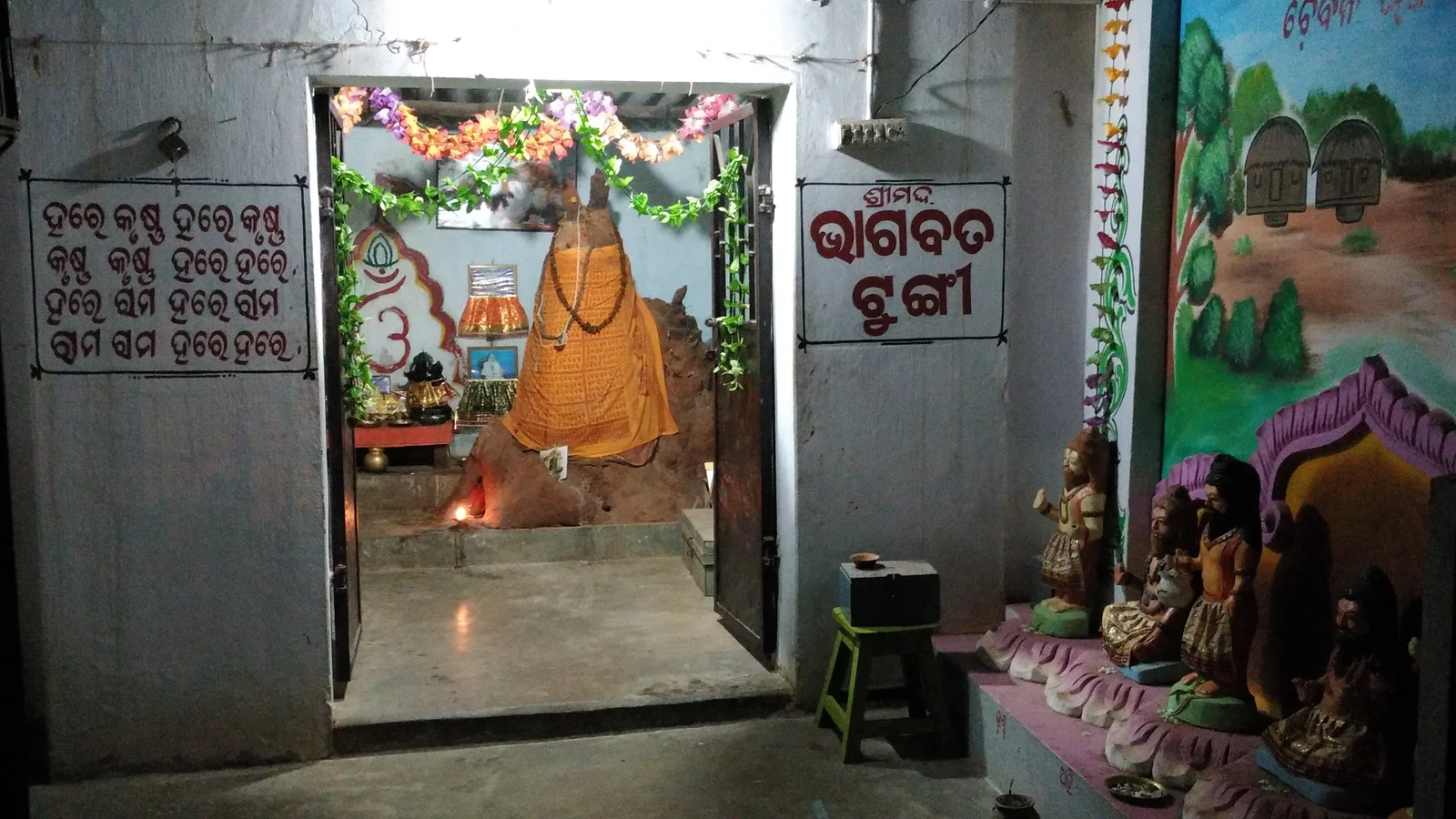
Bhagabata Tungi in the Shani temple precinct at Niladri Vihar, Bhubaneswar, 1 January 2016. Location identified in the photographer’s description.
Hellohappy. Source · CC BY-SA 4.0.

The book heard in a shared room
Historian Pritipuspa Mishra describes Bhagabata Gharas or Tungis as places where palm-leaf manuscripts were housed and communal readings took place. In her account of nineteenth-century Odia literary culture, these spaces also served as village libraries and sites for panchayats.1 A text had a social life beyond its owner or the person able to read it independently.
Reading aloud changes the scale of access. A single copy can reach several listeners; explanation and discussion can accompany the words. The gathering becomes part of the text’s circulation. This helps us understand why the history of books cannot be written entirely through printing presses, sales or individual literacy.
The photograph on the opening page shows a Bhagabata Tungi in a Bhubaneswar temple precinct in 2016. Its devotional objects and painted lettering locate it within a religious setting. It does not show a reading session, and cannot tell us how often people gathered or who participated. A photograph of a room is an opening into its history, rather than a complete account of its use.
A shared institution should also be understood through its local arrangements. Who kept the manuscripts safe, opened the room and led the reading? Who could interrupt with a question? Were people of different ages and social backgrounds equally welcome? Those questions require testimony about particular places, rather than an assumption that every gathering worked in the same way.
The Tungi offers a history of learning through listening and meeting. Its relevance today need not depend on calling it an early version of every modern institution. Its devotional purpose, collections and local relationships deserve to remain visible in their own terms.
A library made through participation
Bakul Foundation describes its Bhubaneswar library as growing from an online appeal for books, individual donations and voluntary effort. Its education page presents the Satyanagar space as a free library with storytelling, author interactions and creative workshops.2 The account shows how a collection can become a setting for repeated encounters.
The organisation also reports mobile-library activity and work with schools. Under its BLISS initiative, it distinguishes helping children learn to read from encouraging those already able to read, placing enjoyment at the centre of both.2 These are related tasks, but they call for different kinds of attention from a volunteer.
A child who struggles with a page may need patient help with words. Another may need the freedom to abandon an uninteresting book and find a better one. A shared reading space can accommodate both. Its value is partly the room it gives readers to develop preferences, rather than measuring every encounter as a completed lesson.
Bakul’s account also describes workshops that produced Odia picture-book manuscripts, including three developed in Ganjam villages and published with children credited as authors.2 Here the library’s educational work leads towards making books. A participant can contribute something for another person to read.
Book donations begin a process that still needs daily care. Collections must be arranged, damaged copies repaired and activities prepared. Volunteers need guidance and reliable ways to share responsibility. These practical matters help explain why a successful appeal and a lasting library are different achievements. Bakul’s published account documents its approach; the experience of any particular reader would need to be heard directly.
Learning to build a digital collection
A Centre for Internet and Society report from December 2014 describes an Odia Wikisource workshop in New Delhi, organised with community volunteers and The Intellects. Pankajmala Sarangi and Sitikantha Kheti shared their experience, while Subhashish Panigrahi demonstrated Odia input and book digitisation.3
The report records a handbook explaining the project and keyboard layout, and plans for further workshops and digitisation sessions. It also describes Sarangi’s involvement in proofreading the Odia Bhagabata.3 A text associated with collective listening could become the focus of another shared task: checking and preparing it for readers online.
The meeting illustrates how a digital collection depends on people learning together. A keyboard layout becomes more usable when someone can demonstrate it and answer a question. The group photograph records that gathering; it does not by itself establish the later completion or accuracy of the texts discussed.
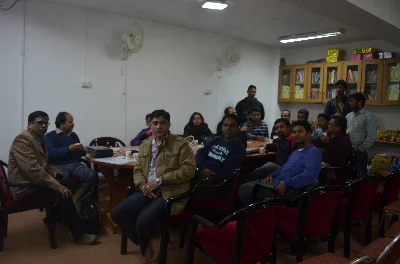
Participants at an Odia Wikisource workshop in New Delhi, documented by CIS in December 2014. Reproduced at modest size from the source image.
Subhashish Panigrahi. Source · CC BY-SA 4.0.
What makes renewal meaningful
In October 2025, PTI reported the Odisha government’s stated intention to revive Bhagabata Tungis across the state.4 An announcement expresses a commitment; it does not establish that every proposed space is functioning. Assessing renewal requires attention to activities, people and continued use as well as buildings.
The IFLA–UNESCO Public Library Manifesto of 2022 offers a useful principle for public libraries: equality of access and services responsive to local needs. It recognises lifelong learning and participation in cultural life as part of their purpose.5 This is an international statement of aims, not a report on implementation in Odisha.
For a future community learning project, we propose beginning with the people who might use it. Children, older residents, people with disabilities and speakers of different languages may need different materials and arrangements. Asking when they can attend and what they want to learn would give the programme a firmer basis than choosing activities on their behalf.
A modest programme could combine a dependable reading hour with practical help, a book discussion or a session led by a local maker. This is a proposal for adaptation, not a claim that all Tungis or libraries already offer these activities. A devotional gathering and a general public library may share resources while retaining distinct purposes.
The measure of a learning place is also the confidence it gives someone to return. A child choosing a book, an adult practising a new skill and a volunteer learning to teach all contribute to its life. Keeping such a place open means sustaining the relationships that let people become participants, and eventually help others take part.
Footnotes & Sources
- Pritipuspa Mishra · Vernacular Publics. Language and the Making of Modern India, Cambridge University Press, 2020, pp.82–83. Retained book PDF checked for manuscripts, Tungis and communal reading. ↩
- Bakul Foundation · Education. Library Movement, Bakul Books and BLISS sections. Organisation’s account; no current reach totals or independent outcome evaluation claimed. ↩
- Subhashish Panigrahi · Odia Wikisource workshop at New Delhi. Centre for Internet and Society, report dated December 2014. Participants, training, handbook and image credit. Its dating of the Bhagabata is not adopted. ↩
- PTI · Odisha govt to revive Bhagabata Tungis in every village. 5 October 2025, ThePrint. Indexed report of the announcement; the article page did not load. Treated as stated intention, not completed delivery. ↩
- IFLA–UNESCO · Public Library Manifesto 2022. Equality of access, lifelong learning and cultural participation. General principles; final-page programme suggestions are this chapter’s proposals. ↩
Both photographs are reproduced under CC BY-SA 4.0, full-frame and resized without content alteration. Creator, source and licence links appear in the captions. The workshop photograph is retained at modest size because the source image is 400 × 264 pixels. Sources checked 14 November 2026.
Suggest an update
Share a correction or source for this chapter. GitHub submissions are public. Please omit private contact details and consent documents.