
Part 7 · Everyday Lives and Social Change
Chapter 42 of 48
Changing Towns and Rural Lives
Work mobility and the choices that shape a place
Change in Odisha can be read through the distance between a home and a workplace, a school and a seasonal journey, or a workshop and its buyers. Town and countryside meet in these relationships. A village does not stand outside modern life, and a growing city carries older places and attachments within it.
This chapter follows the planned capital at Bhubaneswar, the schooling of children in migrant families, craft livelihoods at Raghurajpur and a farmer’s account from Koraput. Together these examples show why cultural continuity depends on practical conditions: space to gather, time to learn, reliable work and a voice in decisions about the future.
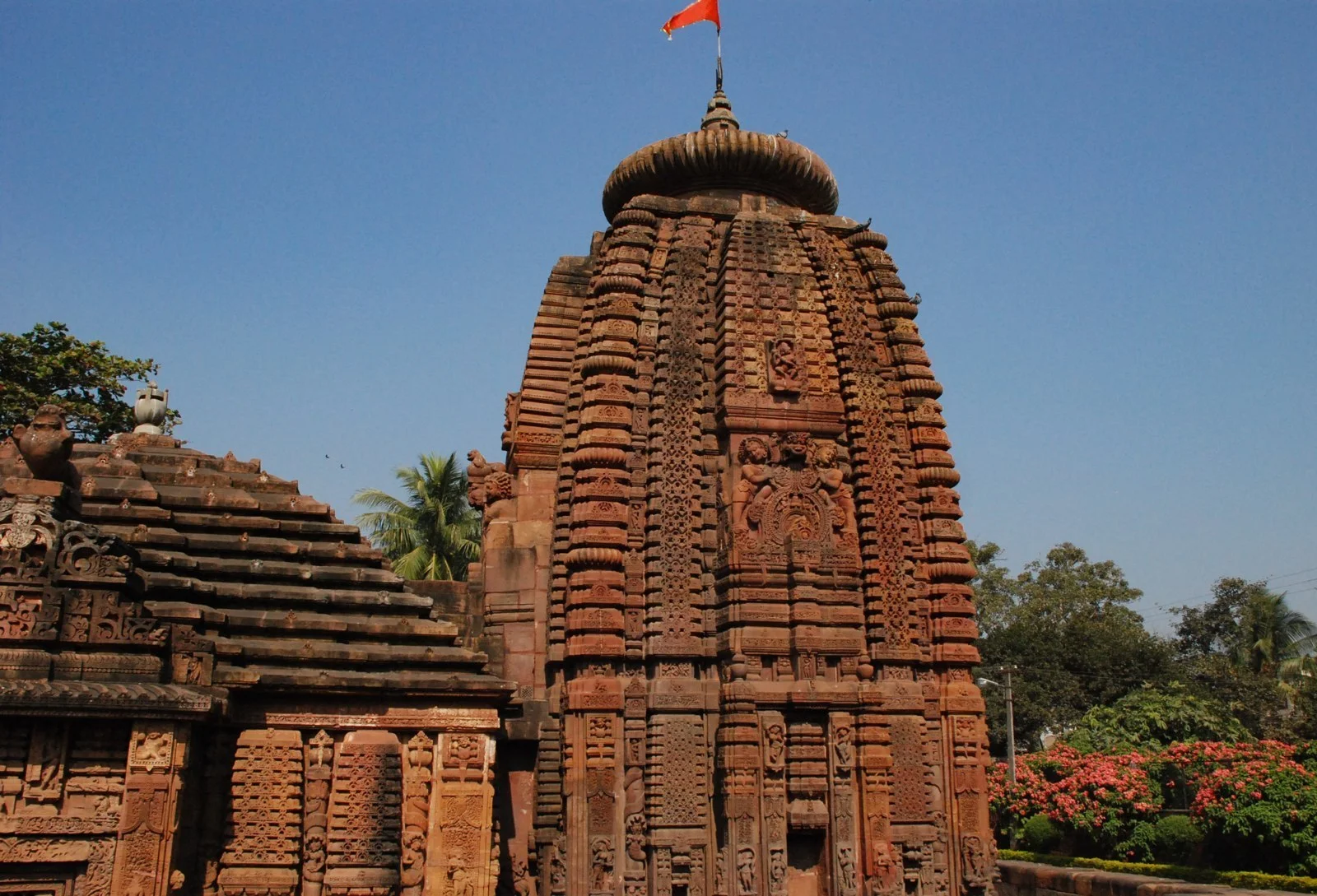
Mukteswar temple, Bhubaneswar, photographed in 2007. A monument within a larger inhabited landscape.
Bikashrd. Source · CC BY-SA 4.0. Resized and JPEG-compressed for the website. Responsive display may crop the view. Adaptations retain the stated share-alike licence.

A capital grows beside an older town
Bhubaneswar’s City Development Plan traces the new capital to planning begun in 1948 under Otto Koenigsberger. It describes neighbourhood units, an administrative centre and markets. Government departments moved from Cuttack after the Secretariat building was completed in 1956; offices and institutions helped draw further residential and commercial development.1 The capital’s growth joined a political decision to many smaller decisions about where people would work and live.
The same planning history records the incorporation of neighbouring revenue villages as the urban area expanded. This matters because a city can grow around a place without all its residents having moved. A familiar locality becomes part of a larger administrative and economic landscape. Its name may survive even as the relationships around it change.
The older temple town offers another scale of belonging. India’s 2014 Tentative List submission for Ekamra Kshetra describes a landscape of temples, tanks and ritual connections.2 The submission is a proposal for recognition, not proof of World Heritage inscription. Its account nevertheless helps us see why a monument cannot be understood entirely apart from the spaces around it.
The opening photograph of Mukteswar records one part of that older landscape. It cannot show the experience of every resident or the effects of subsequent development. To understand a changing neighbourhood, we would also need accounts of everyday routes: where people shop, meet neighbours, find work and take children to school.
These different scales belong in the same history. A capital can be described through plans and institutions, but its cultural life also depends on the places residents can continue to use. The question is how change is experienced, and whose experience is included in the record.
A working season and a school year
The Odisha School Education Programme Authority describes seasonal migration from western Odisha after the kharif season and Nuakhai, often in October or November. Its account includes parents travelling with children for work at brick kilns outside the state. The agency also records seasonal hostels at places of origin from 2006–07, intended to help children remain in school.3 These are descriptions of an educational response, not evidence that every child received support.
Here the agricultural year, the festival calendar and the school year overlap. For a family, the timing of work can determine whether a child travels or remains behind. Cultural participation is therefore connected to wages and care: being present for a gathering or a lesson requires arrangements that make presence possible.
A hostel changes the organisation of family life as well as access to a classroom. Assessing it properly would mean listening to children, parents and carers about safety, companionship and contact during separation. An official objective tells us what an institution is meant to achieve; it does not substitute for those experiences.
Migration itself needs to be described precisely. The Census of India’s 1991 migration table for Odisha distinguishes employment, business, education, marriage, movement with family and other reasons.4 These categories remind us that leaving home is not one kind of event. They should not be used as current statistics or as explanations of a particular person’s decision.
A young person leaving for study and a family travelling for seasonal labour may both keep connections with a village, but their opportunities differ. A cultural history should make room for those differences. It should also ask about people who remain: who cares for relatives, tends a home and keeps shared activities going while others are away?
A workshop connected to wider markets
In a 2014 account of Raghurajpur, Sucharita Sahoo described craft production in homes, support for training and marketing through organisations, and artisans taking work to fairs within and beyond Odisha.5 The village was already connected to buyers elsewhere. Its rural setting did not make its artistic life economically self-contained.
The photograph below, made in 2018, shows an artisan displaying her work at a painted doorway. Her name is not recorded in the source. The image brings a maker into view, but tells us neither her earnings nor her wishes for the next generation. A fuller account would let her explain how she learned, how work reaches buyers and what makes continuing worthwhile.
For younger makers, continuity must leave room for choice. Training can keep a skill available; a sustainable livelihood can make practising it possible. Neither requires us to imagine that every child should inherit the same occupation.
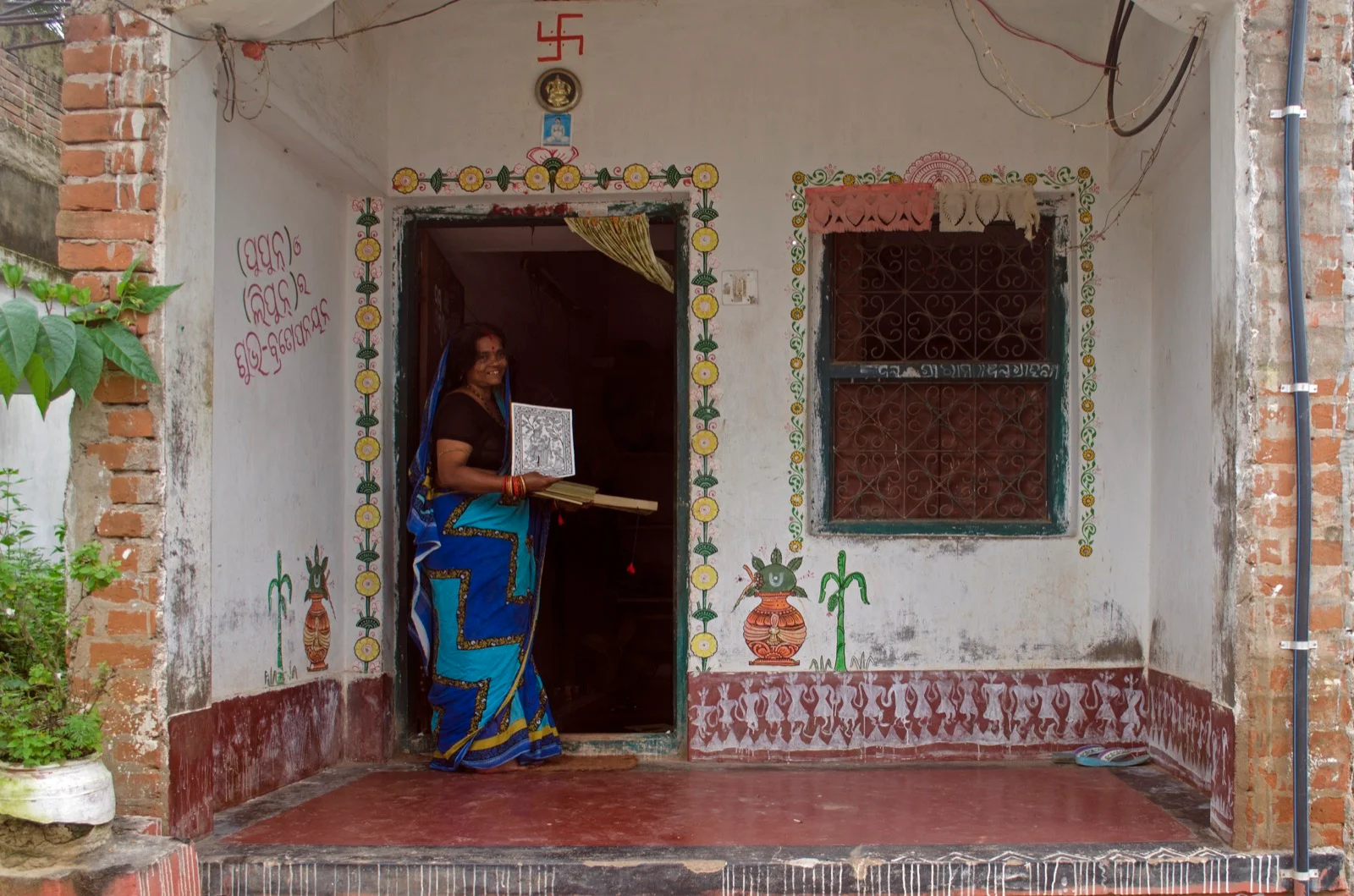
An artisan displays her work in Raghurajpur, 2018. The source does not record her name.
Rangan Datta Wiki. Source · CC BY-SA 4.0. Resized from the original photograph for local delivery; no generated elements. Full-frame display requested. Adaptations retain CC BY-SA 4.0.

Having a say in what changes
In May 2025, Associated Press reported Sunita Muduli’s account from Putpondi village in Koraput. A Paraja farmer, she described late rains and reduced production. The report also documented women mapping local resources and the changes they wanted to see, with support from a rural development organisation.6 Their work made local knowledge part of a discussion about the future.
This example places a resident’s explanation beside the plans and institutional accounts encountered earlier. The authority to describe change should include people whose daily work gives them knowledge of a place. Their priorities may be expressed through a field, a water source or a route used repeatedly, rather than through a famous landmark.
Generational change deserves the same attention. Instead of deciding in advance that young people have abandoned a tradition, we can ask what learning it requires and what choices are available. Instead of assuming that staying preserves a way of life, we can ask whether those who stay can influence the conditions in which they live.
A useful local record could bring together a dated map, photographs and conversations with residents of different ages and occupations. People should be able to decide how their names, images and accounts are used. Recording both agreement and disagreement would help future readers understand why a change was welcomed by some and resisted by others.
The future of cultural life is shaped in ordinary decisions about work, education and shared space. Remembering a place well means attending to these decisions as carefully as to its buildings and celebrations. It also means allowing its residents to imagine lives that differ from those of earlier generations.
Footnotes & Sources
- Bhubaneswar City Development Plan. Sections 2.4 and 3.1.2, historical growth and planning. A historical planning account, not a current land-use assessment. ↩
- Permanent Delegation of India to UNESCO, Ekamra Kshetra. Tentative List submission, 15 April 2014, description. Submission is distinguished from World Heritage inscription. ↩
- Odisha School Education Programme Authority, Interventions. Section on seasonal hostels for children of migrant families. Programme history and stated aims; no present coverage or outcome claim. ↩
- Census of India, D-3 migration table, Orissa, 1991. Table metadata and reason-for-migration categories. No numerical estimate is reproduced. ↩
- Sucharita Sahoo, The land of artisans: Raghurajpur. Press Information Bureau, 11 April 2014. Craft production, organisational support and fairs; not a present earnings survey. ↩
- Sibi Arasu, Indigenous women and their dream maps. Associated Press, 15 May 2025. Reported experience of Sunita Muduli in Putpondi and women’s resource mapping in Koraput. ↩
Photographs by Bikashrd and Rangan Datta Wiki are reproduced under CC BY-SA 4.0, with source and licence links in their captions. Existing local copies were resized and compressed; full frames are retained and no generated elements are added. Any adaptations of these images retain the same licence. Photographs document the dates stated, not present conditions.
Suggest an update
Share a correction or source for this chapter. GitHub submissions are public. Please omit private contact details and consent documents.