
Part 8 · Modern Media and Cultural Futures
Chapter 43 of 48
Radio, Recordings and Television
Voices performances and audiences across media
A voice can reach a listener who has never seen the singer or the stage. A recording can return that voice to another day. Television adds a face, a setting and a choice of what the camera allows us to see. Each medium changes the relationship between a performance and its audience.
In Odisha, these relationships connect writers, musicians, dancers and the people who prepare programmes for transmission. This chapter follows AIR Cuttack, recorded songs and literary readings, and the growth of Odia television. Their histories overlap: a performer can work across several media, while a familiar story acquires a different shape in each.
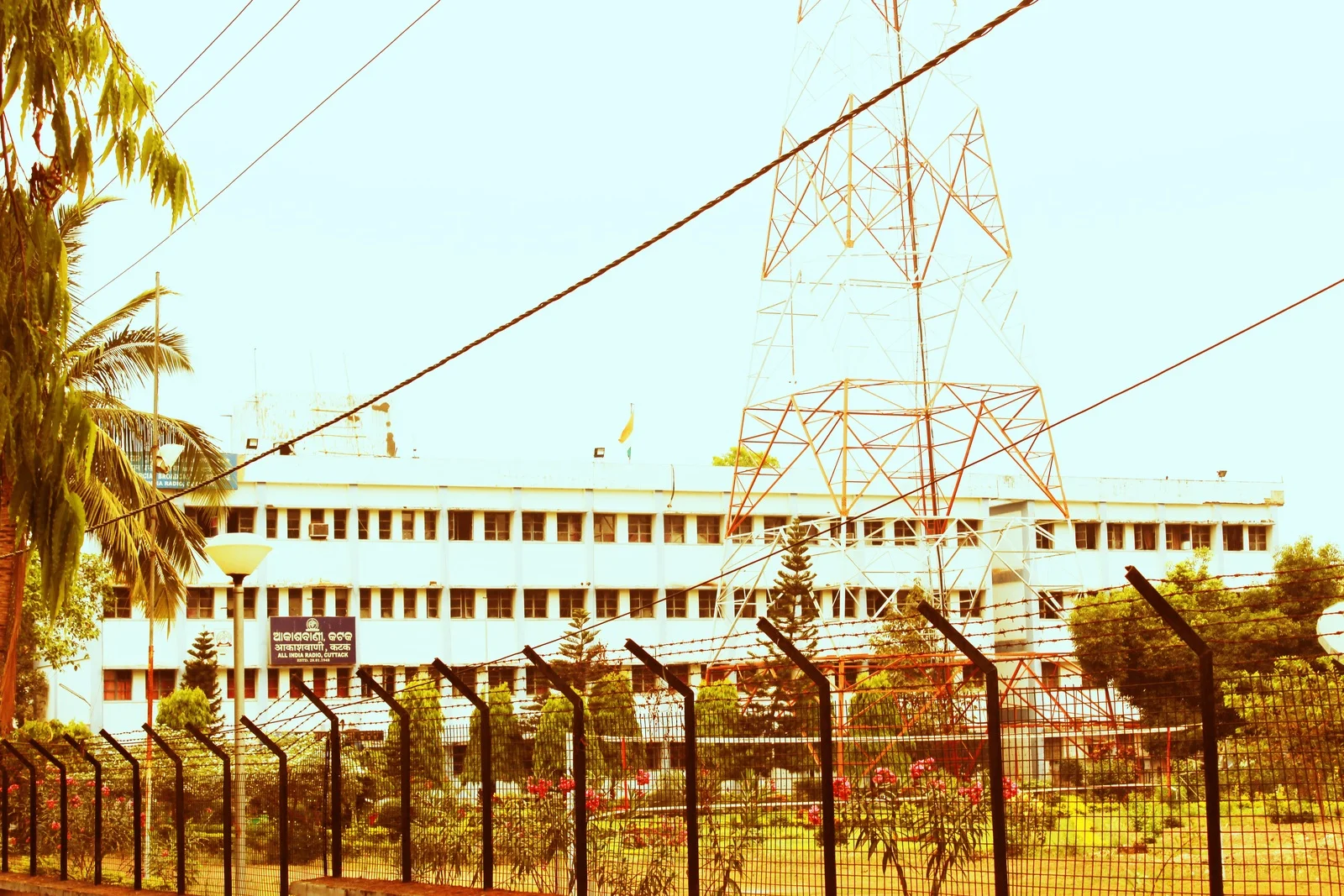
Akashvani Cuttack, photographed on 27 March 2013. The station building is shown decades after broadcasting began.
Kamalakanta777. Source · CC BY-SA 3.0.

The studio and the imagined stage
Jose Jacob’s account of an engineer-guided visit dates AIR Cuttack’s inauguration to 28 January 1948. It describes an initial temporary studio at Madhapur House and a transmitter at Killa Fort. During his 2008 visit, Jacob observed specialised spaces for talk, drama, music and playback, with computers used alongside reel-to-reel tapes.1 His account makes the practical work of broadcasting visible as well as its beginnings.
For a radio dramatist, the absence of a visible stage is a creative condition. A change of voice can announce an arrival; a pause can suggest hesitation. Music and other sounds can help a listener imagine distance or a change of scene. The script must give performers and listeners enough to build that world together.
Gopal Chhotray’s work belongs within this exchange between writing and performance. The Library of Congress describes his long association with AIR Cuttack and credits him with helping revive Gitinatya, or plays in verse.2 His career shows how a literary form could continue through new opportunities to write for voices.
Dancer Kumkum Mohanty recalls another kind of collaboration. For Kumar Utsav Samiti programmes in Cuttack, students from different dance institutions worked with AIR artists. Bhubaneswar Mishra composed music and AIR staff played instruments including violin, flute and harmonium. In her account, AIR recorded and broadcast the music, while the dances themselves were not filmed.3
That distinction matters. A surviving soundtrack can preserve the musical part of an event without preserving its movement, costumes or audience. Mohanty’s recollection helps restore the relationships around the sound. It also reminds us to describe an archive according to what it actually holds, rather than treating one surviving part as the whole performance.
What a recording carries
In a 2018 interview, lyricist Devdas Chhotray contrasted the studio with the stage. A singer before an audience can repeat or emphasise a phrase in response to listeners; a radio recording has a different immediate setting. He remembered his first recorded ghazal being composed and sung by Akshaya Mohanty for AIR Cuttack, and said such songs were classified as adhunika, or modern songs.4
The programme category mattered because it placed an experiment within an existing listening world. A song could draw on a form associated with another language while finding its own words and manner in Odia. The recording preserved one version of that encounter, not every way the singer might later perform it.
Devdas also described making the album Nua Luha Puruna Luha with Susmita Das and Omprakash Mohanty.4 Here the album offered another setting for collaboration and for returning to a musical approach. Broadcast schedules and recordings were connected parts of creative work, with different ways of reaching listeners.
A recording also allows us to return to spoken literature. The Library of Congress catalogue links Gopal Chhotray’s readings from Pheria, Parakalama and Sei phula.2 These are author readings, not a collection of original AIR drama broadcasts. Their value lies partly in the opportunity to hear how a writer gives pace and emphasis to words on a page.
A disc, a tape and a digital file are different carriers of recorded sound. To understand any particular item, we need its credits and history: who wrote and performed it, when it was recorded, and whether it is complete. A label, sleeve or catalogue entry can preserve information that listening alone cannot supply. Keeping those details with the sound helps later listeners distinguish a new rendition from an older recording.
Odia stories on television
Mrinal Chatterjee’s history places Odisha within the Satellite Instructional Television Experiment of 1975–76, with programmes produced at Cuttack for districts including Dhenkanal, Sambalpur and Phulbani. He traces the move of production to the Bhubaneswar studio complex in 1992.5 Educational television and later entertainment belonged to different stages of this development.
Prasar Bharati dates its Odia satellite service to 2 October 1993 as DD-5, its renaming as DD-6 to August 1994, and round-the-clock broadcasting to April 2001. Its programme catalogue includes Katha Sarita and Gopala Rahasya.6 Stories could now be shaped through actors, framing and editing as well as through voice.
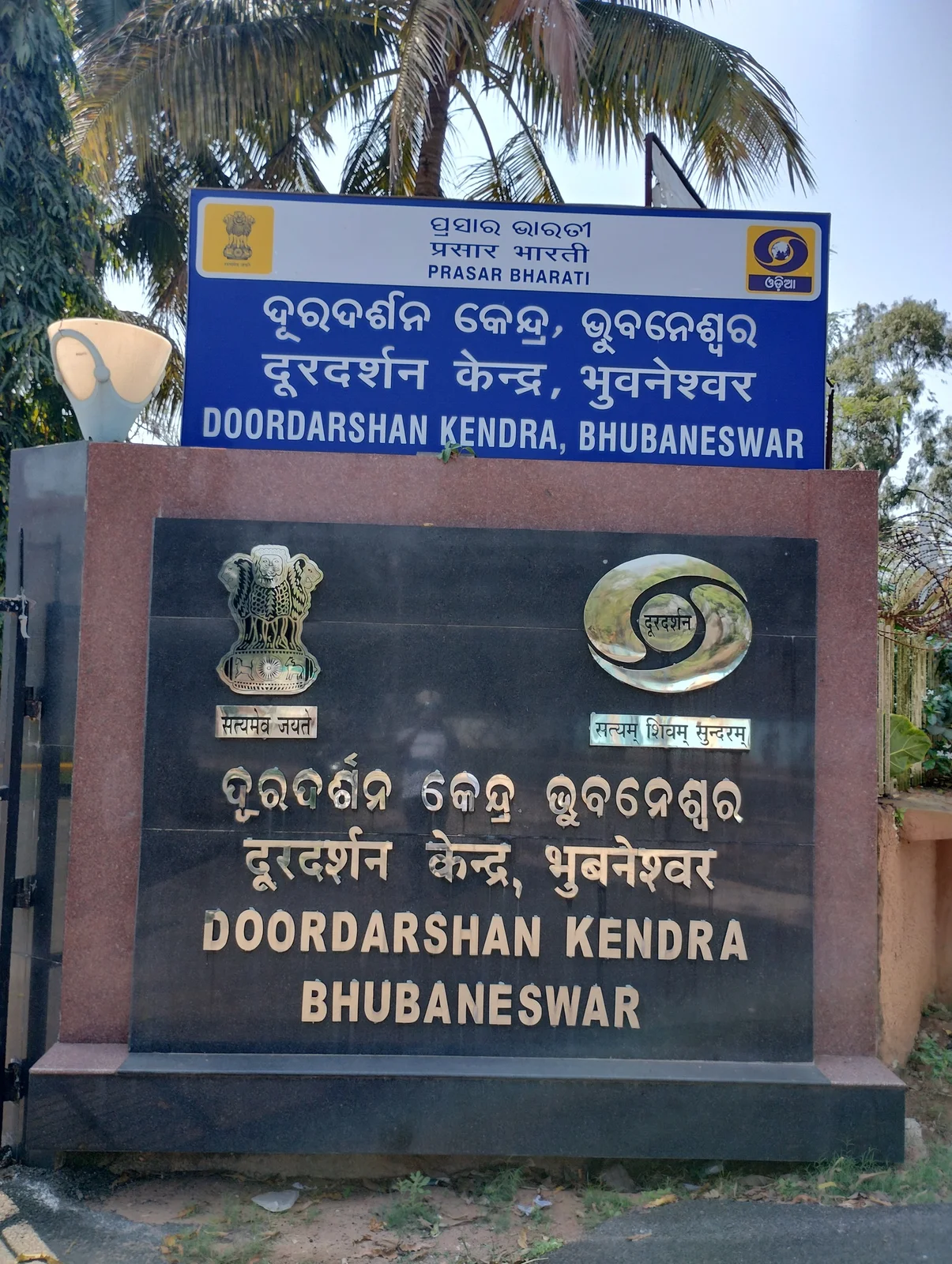
Doordarshan Kendra Bhubaneswar, photographed in February 2022.
Hellohappy. Source · CC BY-SA 4.0.

The work behind a shared screen
Television’s expansion brought more settings in which Odia programmes could be made. Chatterjee records OTV’s beginnings in Bhubaneswar and Cuttack in 1997, and the subsequent growth of private broadcasting.5 A channel’s arrival created another schedule, but the programmes still depended on people assembling stories, images and sound for viewers.
Fakira Mohan Nahak’s recollection of ETV’s Rath Yatra coverage on 12 July 2002 describes teams working in Puri and Hyderabad. He names field leadership, engineering and panel production among the coordinated roles.7 The account turns a live broadcast into a history of work: what reaches the screen depends on decisions and connections that the viewer may never see.
A televised festival is also a particular view of a larger event. The camera can bring a distant detail close, while commentary gives it an explanation. Viewers elsewhere can follow the procession without being in Puri. Yet the screen cannot reproduce every sound, movement or personal reason for attending. These are different ways of participating, each worth understanding.
For programmes encountered again online, the original broadcast date and the upload date should remain distinct. An excerpt may preserve a memorable scene while leaving out the rest of a serial or performance. Identifying the episode, contributors and source makes it easier to appreciate the work and harder to mistake a fragment for a complete record.
The history of these media therefore includes more than familiar voices and faces. It includes writers, accompanists, engineers, editors and the listeners and viewers who remember programmes. Preserving credits alongside recordings gives those contributions a better chance of remaining visible. It lets future audiences encounter the work with some understanding of the people and circumstances that made it possible.
Footnotes & Sources
- Jose Jacob, A visit to AIR Cuttack and others. Visit account, February–March 2008, pp. 1–2. Historical studio and equipment observations, not current facilities. ↩
- Library of Congress, Gopal Chhotray. South Asian Literary Recordings Project. Biography and catalogue of author readings; audio playback not tested. ↩
- Kumkum Mohanty in conversation with Madhur Gupta. Sahapedia, interview conducted in 2018. Kumar Utsav recollection; soundtrack distinguished from filmed dance. ↩
- Devdas Chhotray in conversation with Shyamanuja Das. Sahapedia, September 2018 interview, Parts II–III. Studio and stage, adhunika classification and album collaboration. ↩
- Mrinal Chatterjee, Television in Odisha. Odisha State Open University hosted history, pp. 1–4. SITE, production centres and private broadcasting; historical district names retained. ↩
- Prasar Bharati, DD Oriya. Institutional history and programme catalogue. Service launch distinguished from renaming; programme playback not tested. ↩
- Fakira Mohan Nahak, Live Broadcast, Rath Yatra and ETV. OdishaPlus, 24 February 2022. Participant recollection of the 2002 broadcast and its production teams. ↩
AIR Cuttack: Kamalakanta777, CC BY-SA 3.0. Doordarshan Kendra Bhubaneswar: Hellohappy, CC BY-SA 4.0. Source and licence links appear in the captions. Existing resized and compressed copies are reproduced full-frame, without generated additions. Any adaptations retain their respective share-alike licences. The photographs show the dates stated, not the institutions at their founding.
Suggest an update
Share a correction or source for this chapter. GitHub submissions are public. Please omit private contact details and consent documents.