
Part 4 · Music, Dance and Theatre
Chapter 22 of 48
Chhau, Dalkhai, Ghumura and Dhemsa
Movement and music across Odisha
Four names take us into different worlds of performance. Mayurbhanj Chhau, Dalkhai, Ghumura and Dhemsa bring particular places, occasions and ways of moving into view. Seeing them together helps us recognise the range of Odisha’s dance cultures, provided we keep those differences in focus.
Chhau belongs to a wider eastern Indian tradition. UNESCO’s 2010 inscription identifies Seraikella, Purulia and Mayurbhanj styles; Seraikella and Purulia use masks, while Mayurbhanj does not. Its account connects Chhau with Chaitra Parva and describes a movement vocabulary drawing on martial practice, animal gaits and everyday work. Stories from the epics share this repertoire with folklore and abstract themes.1
In the photograph below, two unmasked dancers are airborne together. Their extended arms and folded legs make a striking arrangement, but the landing and the movement that follows also belong to the dance. A still image invites us to notice bodily coordination; it cannot tell us which episode is being performed.
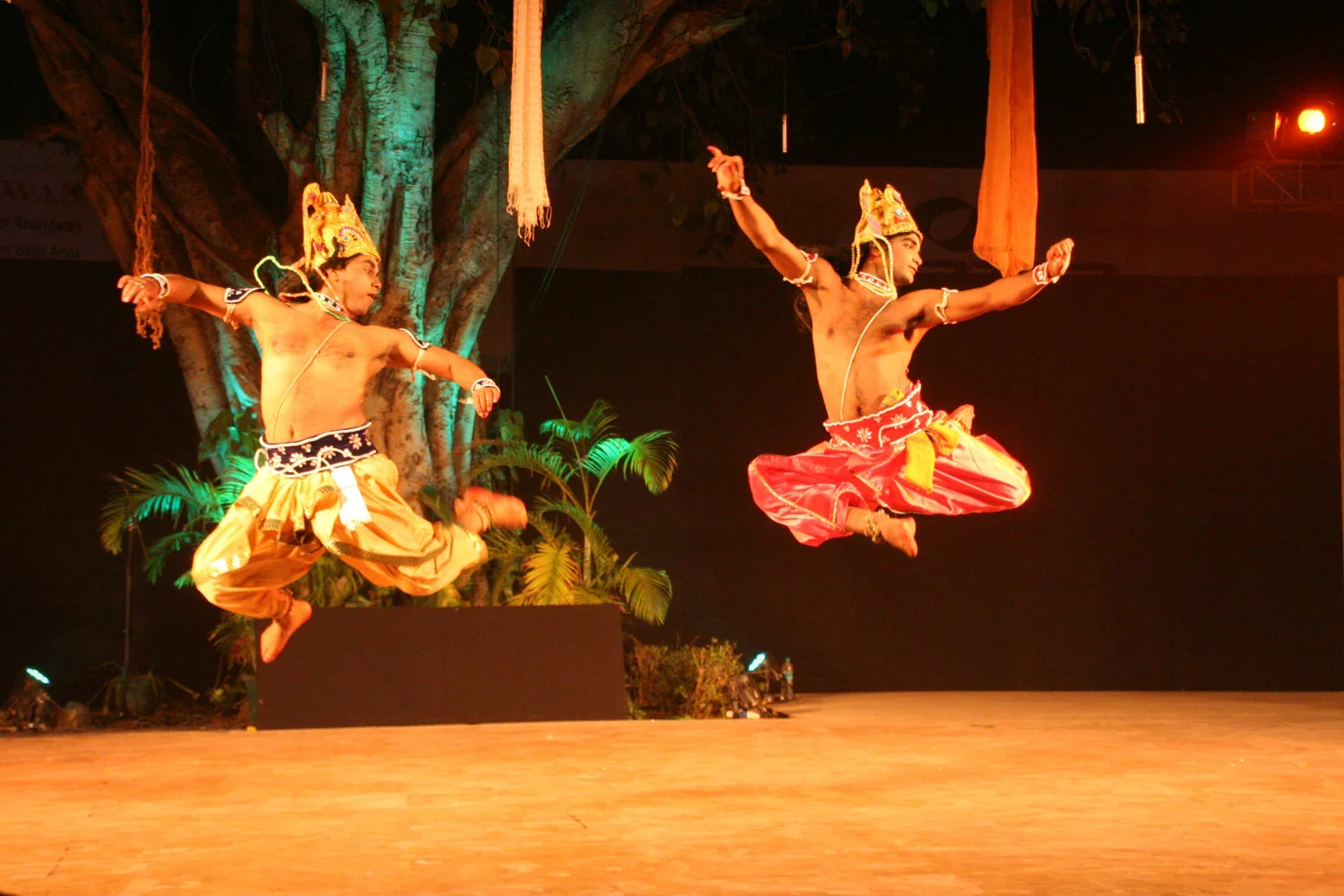
Mayurbhanj Chhau performers, 2016. The source does not name the dancers or the item.

Dalkhai and the gathering of voices
Sambalpur’s district account places Dalkhai at Dussehra, Bhaijuntia and other festive occasions. It describes young women from communities including Binjhal, Soura and Mirdha singing Dalkhai songs in a line or semicircle. The description gives us a starting point in an occasion and a social gathering, rather than a dance detached from its singers.2
The Odisha Reference Annual adds detail about accompaniment: dhol, nisan, tamki and wind instruments. In its account, the dhol player moves with the dancers while other musicians remain seated. This arrangement makes the drummer’s movement part of the performance, as well as providing a beat for it. It is a documented description, not a rule for every troupe.3
The Burla photograph records a stage presentation associated with Nuakhai Bhetghat. Performers hold decorated trays, while drums and musicians are visible behind them. The image’s title identifies the item with Bhaijiuntia and Dalkhai; the photograph alone does not establish a ritual sequence.
A listener can begin with the song. Follow how a phrase ends and how movement continues into the next phrase. Then watch the spacing between performers. The pleasure of a group dance can lie in these shared adjustments as much as in a single dancer’s skill. Different presentations deserve their own descriptions and credits.
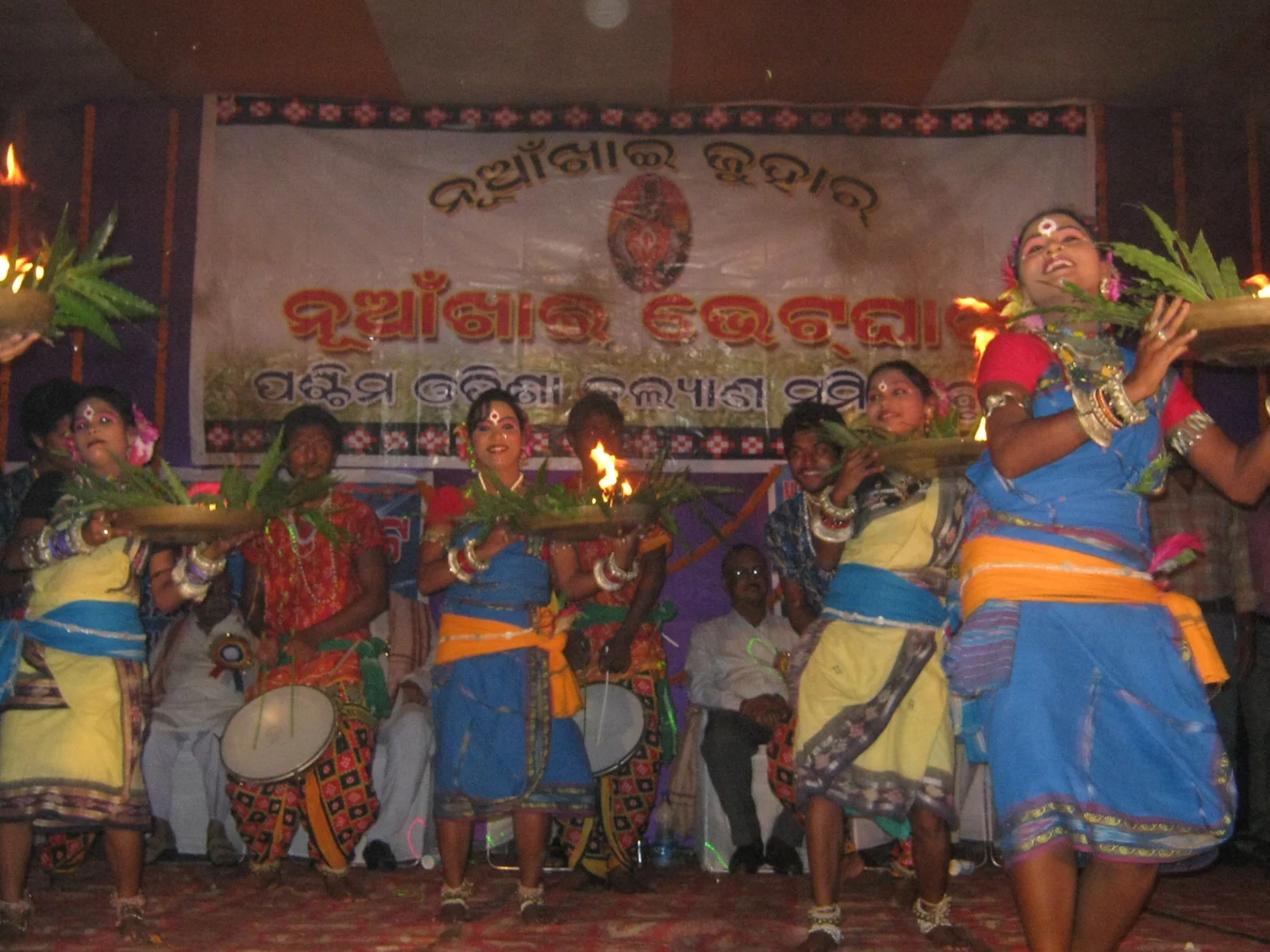
Bhaijiuntia and Dalkhai presentation at Nuakhai Bhetghat, Burla, 5 October 2013, as identified in the image record.
Mamata Padhi. Source · CC BY-SA 4.0.

Ghumura and the moving drum
Ghumura has a strong association with Kalahandi. The district’s cultural inventory records troupes performing at Nuakhai, Dussehra and other festivals. Its indicative troupe size of eighteen to twenty artists describes an ensemble practice; it should not be read as a compulsory number for every performance.4
The Odisha Reference Annual names Ghumura, Nishan, Taal, Turi and Madal among its instruments. It also remarks on the forceful sound and the impression of a war dance. This is useful evidence for how Ghumura has been described, but it does not by itself establish an ancient battlefield origin.3
The government photograph shows a group at an Odisha tribal sports meet. Rounded drums hang in front of several performers; some crouch close to the ground while others raise their arms. Here the instrument remains visibly attached to the moving body. A performance can make the relationship between playing, carrying and balancing an instrument part of what an audience sees.
That relationship offers a useful way to watch Ghumura. Notice where the hands return, how the body changes level, and how one formation gives way to another. A photograph cannot supply the missing rhythm. Recordings and live performances let us hear the ensemble that the image can only suggest.
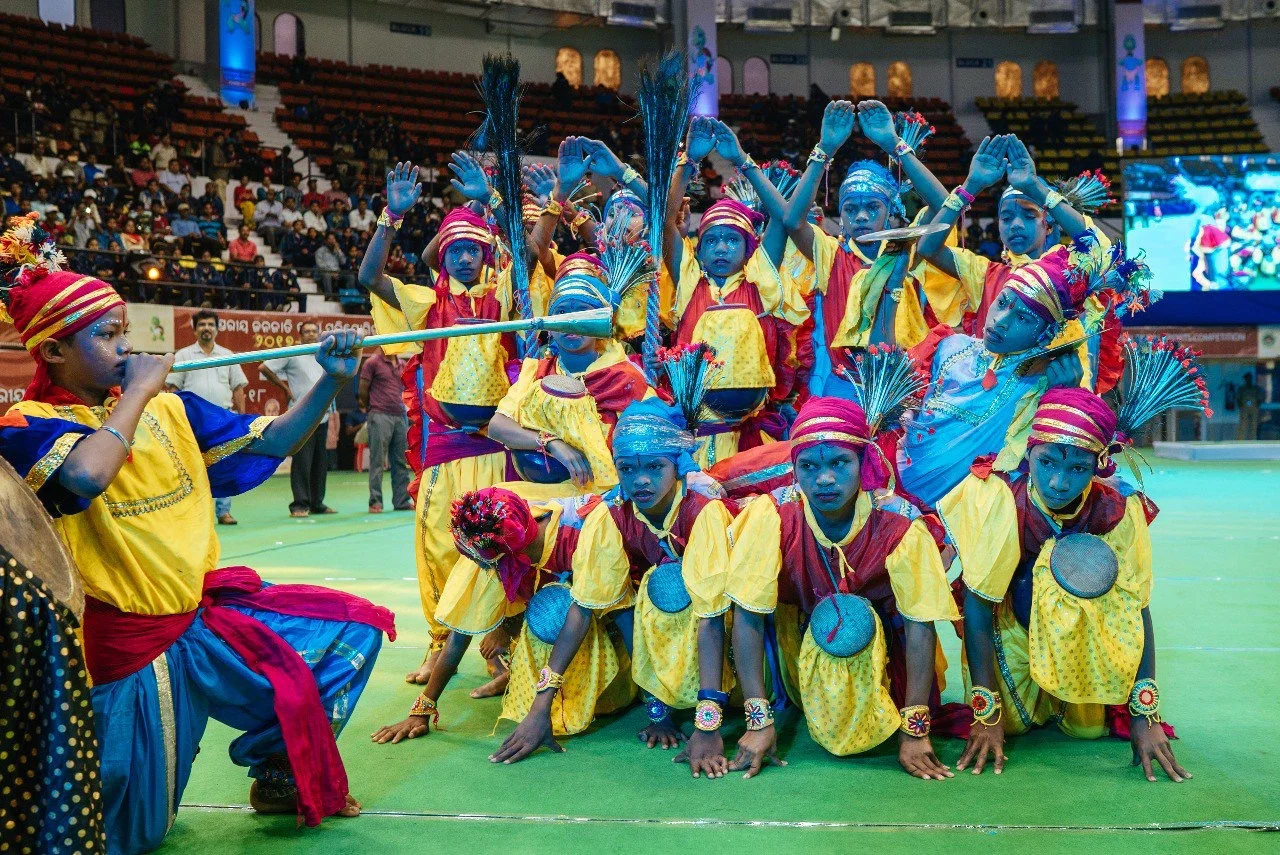
Ghumura at an Odisha tribal sports meet; image record dated 4 July 2018. Individual performers are not named.

Dhemsa and the linked line
Koraput Odyssey, published by the District Council of Culture in 2016, describes Dhemsa through dancers joining at waists or shoulders and forming winding chains. It names Paraja, Gadaba, Bhumia, Bhotra and Kondh communities among its practitioners, and associates the dance with festivals as well as recreation. This account locates Dhemsa in relationships between people, music and occasions.5
A linked formation makes each person’s timing matter to the next. To look along such a line is to follow small transfers of weight and direction. Apparent repetition can hold considerable variation: a change in pace, the depth of a bend or the way a curve travels through the group. These are ways of attending to a performance, rather than a claim that every community dances identically.
The photograph shows an Odisha contingent presenting Dhemsa at a national tribal festival in 2022. Stage lights and the frontal arrangement make the setting visible. It records one public presentation; it should not stand in for every village gathering or identify unnamed dancers with a particular community.
The Tribal Atlas of Odisha notes that many dances are shared across communities and that patterns can vary within a community from place to place. That observation is especially valuable when reading broad labels. A dance name opens an inquiry into local practice; it does not finish it.6
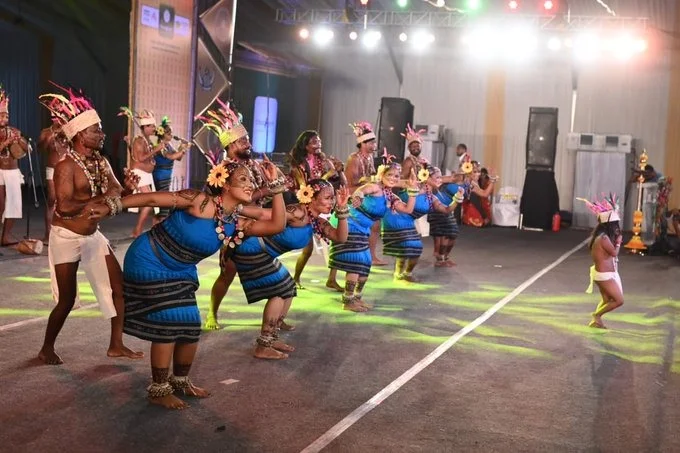
Odisha contingent performing Dhemsa at a national tribal festival, 2022. Individual performers are not named.

Watching without losing the place
Placed beside one another, these performances invite several kinds of attention. In Mayurbhanj Chhau, the unmasked body can shape a character or an imagined action. Dalkhai directs us towards the relationship between song, musicians and a group. The Ghumura image brings the carried instrument into view. Dhemsa asks us to follow connections along a line. These are useful entry points, not exhaustive definitions.
A district name is also an entry point. Balangir’s cultural inventory includes both Dalkhai and Ghumura among many forms of dance and music. The listing reminds us that the associations used in a short chapter do not draw exclusive boundaries around performance. Artists, songs and occasions need more precise descriptions than a single label can supply.7
A festival stage offers a particular encounter with this knowledge. Its duration, lighting and arrangement of audience and performers shape what can be seen. A village occasion may involve relationships and purposes that remain outside the frame of a programme photograph. Neither image nor programme should be asked to document what it does not show.
For a fuller record, begin with the troupe’s own name for the item. Keep the place, date and occasion alongside it, and credit dancers, singers, instrumentalists and teachers where those details are available. Ask which language is being sung and what the chosen song means. Such details make comparison more illuminating and give future readers a route back to the people who performed.
The four photographs here leave room for that further listening. Each catches an arrangement of bodies at one moment. The dancers’ knowledge continues through the next step, the next musical phrase and the practice that makes another performance possible.
Footnotes & Sources
- UNESCO, Chhau Dance. 2010 inscription. Regional styles, masks, Chaitra Parva, movement vocabulary and repertoire. The entry describes the tradition at inscription, not every present-day troupe. ↩
- Sambalpur district, Culture and Heritage. “Dalkhai Dance” section. Communities, occasions, song and formations; an introductory district account. ↩
- Odisha Reference Annual 2011. Printed pp. 79 and 83: Ghumura and Dalkhai. Instrument lists and ensemble descriptions; the martial comparison is not treated as proof of origin. ↩
- Kalahandi district, Culture and Heritage. “Art Forms of Kalahandi District,” entry 01. Ghumura troupe size and festival occasions. ↩
- Satyanarayan Pattnaik, Koraput Odyssey. District Council of Culture, Koraput, 2016, printed p. 40, “Dhemsa Dance.” Formation and community associations; broad claims about universal participation are not adopted. ↩
- SCSTRTI, Tribal Atlas of Odisha. 2018, printed p. 32, discussion of tribal dances. Shared practices and variation across communities and places. ↩
- Balangir district, Culture and Heritage. “Folk dance Folk Music” section lists Dalkhai and Ghumura among the district’s performance forms. Web sources checked 10 November 2026. ↩
The four photographs retain their individual licences, linked in each caption. All are reproduced full frame and scaled; format conversion adds no visual content. The Chhau image reuses the edition’s existing delivery file. The Dalkhai photograph is CC BY-SA 4.0; adaptations must retain that or a compatible licence. The two government images have documented Wikimedia Commons permission. No image is presented as fieldwork by the author.
Suggest an update
Share a correction or source for this chapter. GitHub submissions are public. Please omit private contact details and consent documents.