
Part 4 · Music, Dance and Theatre
Chapter 21 of 48
Odissi, Gotipua and Expressive Performance
Learning to see movement, character and feeling
A dance photograph holds one instant. Performance asks us to follow what comes before and after it: a transfer of weight, a turn towards another person, a pause that changes the meaning of a gesture. The memorable pose is one part of a larger act of communication.
Odissi and Gotipua invite this patient attention in different ways. Their histories meet through teachers and performers, yet each deserves to be encountered on its own terms. This chapter follows a named route of learning, looks beyond Gotipua’s acrobatic reputation, and considers how abhinaya makes a dramatic situation visible.
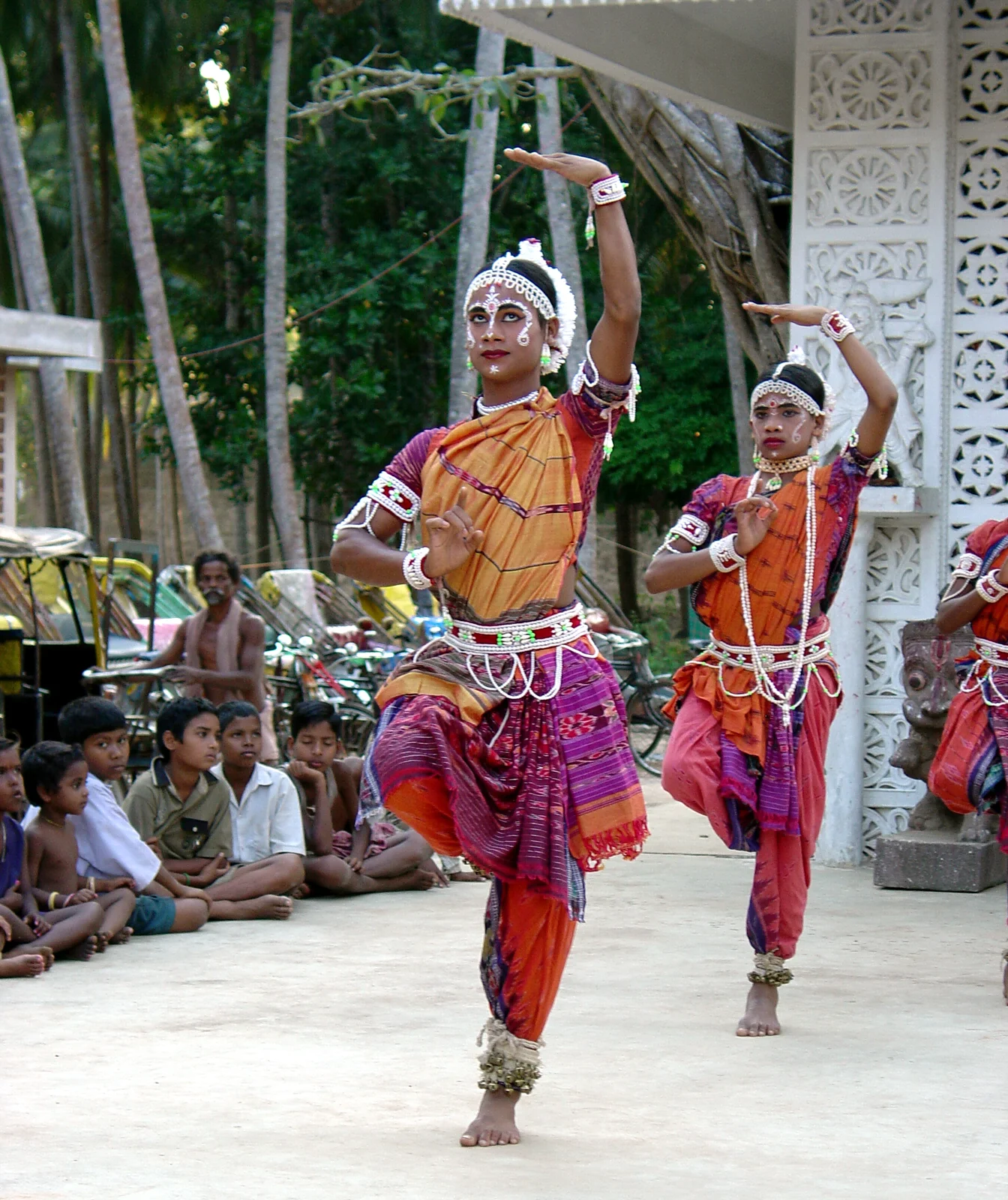
Gotipua performers at Raghurajpur, 2005. Individual dancers are not named in the image record.
G41rn8. Source · CC BY-SA 4.0.

Histories carried by people
Srjan’s institutional account connects Odissi with Mahari temple dancers and Gotipua performers, and identifies Pankaj Charan Das, Debaprasad Das and Kelucharan Mohapatra among the major figures in its twentieth-century renewal. Such an account points towards several histories of practice. It should not be reduced to a single unchanged dance passing intact from temple sculpture to the modern stage.1
A more specific route appears in Srjan’s chronology of Kelucharan Mohapatra. It records Gotipua training under Balabhadra Sahu from 1929, entry into Mohansundar Dev Goswami’s ras leela troupe in 1932, and subsequent work in theatre. In 1947, it places Kelucharan and Laxmipriya together in a Dashavatara sequence directed by Pankaj Charan Das for Sadhava Jhia.2
This sequence brings teachers, a woman performer, theatrical productions and musical experience into the frame. It describes a career made through different working environments. The institution’s dates are attributed evidence; they are not a complete history of every Odissi lineage.
The same chronology records Kelucharan teaching at Kala Vikash Kendra from 1953. Learning moves from one setting into another, carrying remembered skills while creating new opportunities for students and audiences. The relationship between Gotipua and Odissi becomes more intelligible when we follow these people and institutions, rather than treating one form as merely an unfinished version of the other.2
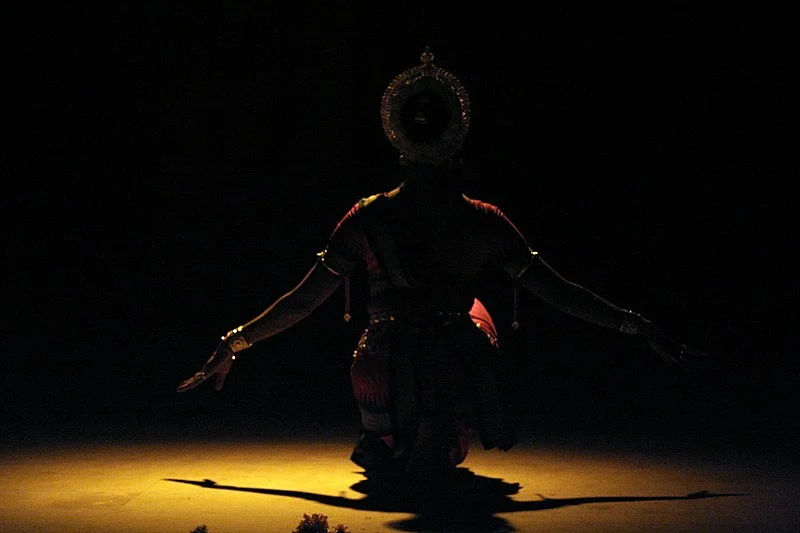
Sujata Mohapatra performing Odissi, 2007. The low stage lighting silhouettes the dancer; the item is not identified.

Gotipua beyond the difficult balance
The NCPA’s announcement for a March 2025 programme describes Gotipua as performed by boys in female attire and identifies bandha, its acrobatic postures, as part of guru-led training. It names Guru Bijay Kumar Sahoo and Nakshyatra Gurukul Trust, while distinguishing the form’s technique, costume and presentation from Odissi. A programme is evidence of a proposed appearance and its framing, not a review of the event.3
The opening photograph offers another view: performers in Raghurajpur hold related positions before an audience seated close by. This particular image does not show an acrobatic formation. It makes room for attention to stance, arms, costume and the relationship between dancers. A tradition’s most spectacular moment need not become its only public image.
An audience can look at transitions as carefully as balances. How does a group arrive at a position? Where does attention move next? What can be heard as the dancers change direction? These are viewing questions, not instructions for attempting a posture. The training belongs with knowledgeable teachers and the people learning it.
Young performers also have lives beyond the performance. Respect for their learning includes respecting rehearsal time, supervision and agreed arrangements for photographs. A visitor’s request for another pose should not become the measure of a successful encounter.
The most useful comparison with Odissi is therefore attentive rather than competitive. Ask how a particular group learns, which songs accompany it and what the teacher calls each part. The answers can reveal connections while allowing local terminology and practice to remain distinct.
When waiting becomes an action
Abhinaya concerns dramatic communication. As introductory distinctions, bhava refers to represented states or feelings, while rasa concerns the aesthetic experience made available through their presentation. Chapter VI of the Natyashastra connects rasa with a combination of circumstances, expressions and accompanying states. This is more than matching one facial expression to one emotion.5
Chapter XXIV offers a concrete example: a heroine awaiting her beloved listens for a time signal, approaches the doorway and looks along his path. When he fails to appear, her response changes. Expectation becomes a sequence of actions directed towards someone absent. This is a historical theatrical description, not a prescribed sequence for every Odissi choreography.6
A doorway matters because someone might enter; a path matters because an arrival remains possible. The dramatic situation gives an action its weight. A performer can invite an audience to imagine such a space without furnishing a literal room.
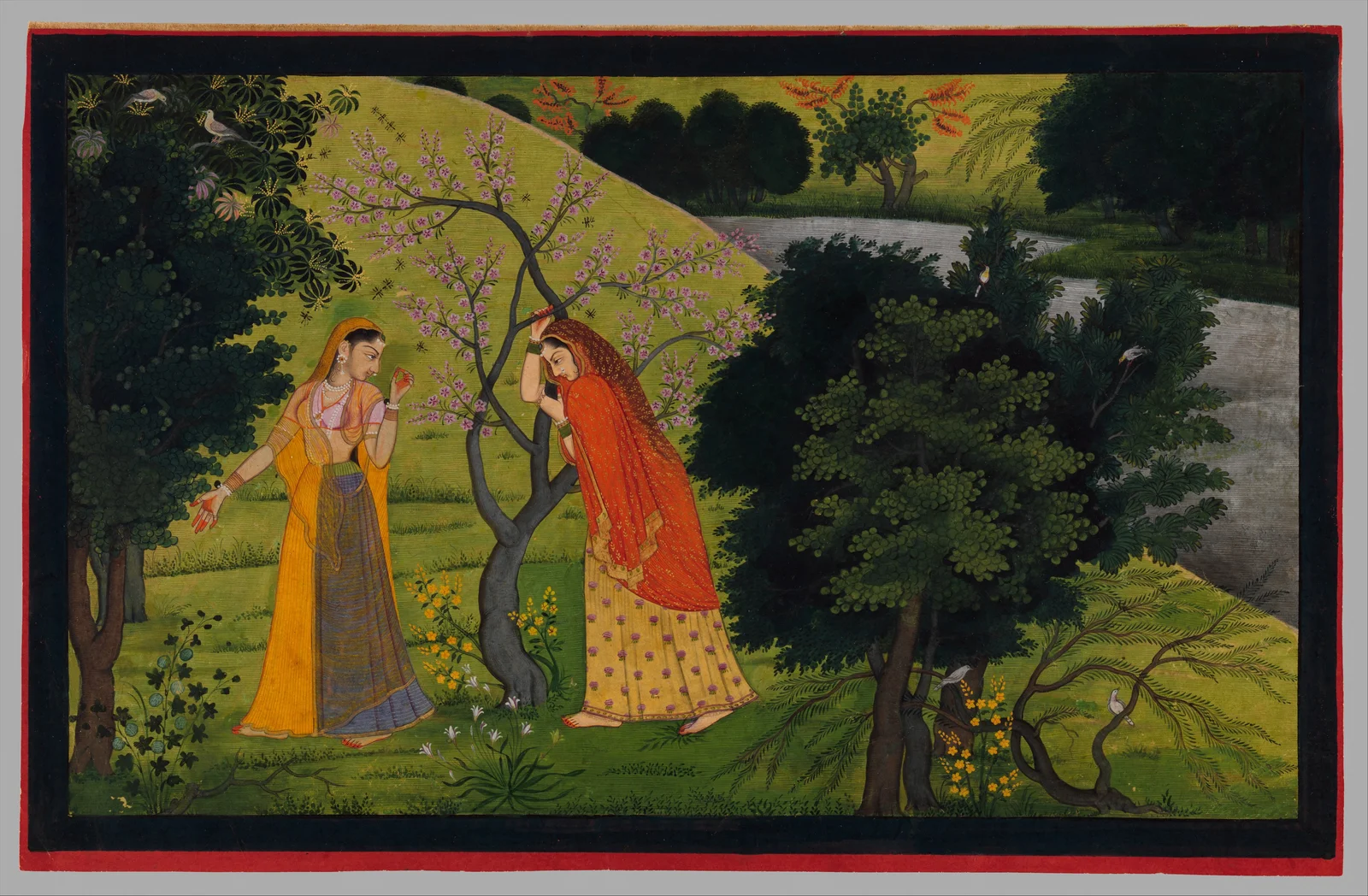
Radha with Her Confidant, Pining for Krishna, c.1775–80. Pahari painting; Met, 2020.383, gift of Steven Kossak, The Kronos Collections. A related literary image, not a depiction of Odissi or the Natyashastra passage.
The Metropolitan Museum of Art. Source · Public domain.
A lyric, a pattern, an audience
Srjan’s repertoire account distinguishes Batu and Pallavi as pure-dance items from lyric-centred abhinaya. Pallavi elaborates a raga through music, rhythm and movement; abhinaya gives scope to a song’s situation through glance, gesture, bodily movement and facial expression. Its cited repertoire includes Jayadeva’s Gita Govinda and Odia poets such as Baladeva Rath, Gopal Krishna Pattnaik and Banamali Das.4
This distinction changes what a viewer might follow. A patterned passage can hold attention through its development without narrating a specific episode. When a lyric becomes central, questions of speaker and address become especially helpful. “Pure dance” does not mean an absence of feeling, and expressive dance does not set rhythm aside.
IGNCA’s Gita Govinda project reads Radha and Krishna’s union, separation and reunion on both human and divine levels. That interpretation leaves room to attend to the chosen passage, instead of deciding in advance that it must be either love poetry or devotion. A programme note and a credited translation can help locate the scene without exhausting its possibilities.7
The nayika, or heroine, is a dramatic figure within such interpretation. Her waiting is not a diagnosis of the dancer’s private feelings, and a photographed gesture cannot establish an entire character. What has happened in the poem, whom the speaker addresses and how the performance develops all matter.
Listen as well as watch. The singer’s phrase and the percussionist’s timing belong to the encounter, even when the dancer occupies the centre of attention. Keep poet, composer, musicians and choreographer in the credits when that information is available. A second viewing after reading the lyric may reveal a relationship that escaped notice the first time.
What we learn to see is not simply a larger vocabulary of poses. It is how a performer makes a situation unfold, how a group shares time, and how an audience’s attention can deepen. The photograph is a beginning; the work lives in the movement between moments.
Footnotes & Sources
- Srjan, Odissi Dance. Institutional account of Mahari, Gotipua and twentieth-century teachers. Used for named connections; claims of earliest origin or an unchanged lineage are not adopted. ↩
- Srjan, Milestones in Guru Kelucharan Mohapatra’s Life. Entries for 1929, 1932, 1947 and 1953. Attributed career chronology: teachers, theatre, Laxmipriya, Pankaj Charan Das and Kala Vikash Kendra. ↩
- NCPA, Gotipua programme announcement, 15 March 2025. NCPA@thePark, Powai; Guru Bijay Kumar Sahoo and Nakshyatra Gurukul Trust. Training, bandha and distinctions from Odissi. Announcement only; origin narrative not treated as a settled founding date. ↩
- Srjan, Odissi Repertoire. Batu, Pallavi and Abhinaya sections. Institution-specific descriptions and named poets; not a required sequence for every recital. ↩
- Natyashastra, chapter VI: Sentiments. Manomohan Ghosh’s English translation, hosted by Wisdomlib. “Sentiments explained,” with verses 32–36. Introductory bhava/rasa distinctions, not a survey of later aesthetic theory. ↩
- Natyashastra, chapter XXIV: Harmonious Representation. Ghosh translation, verses 243–248: a heroine in expectancy. Paraphrased historical acting description; not modern choreography or a reconstruction. ↩
- IGNCA, Gita Govinda multimedia project. Project description and 27 May 2015 release account. Human and divine readings of union, separation and reunion; no performance recording analysed here. ↩
- The Metropolitan Museum of Art, Radha with Her Confidant. Object 2020.383, c.1775–80. Pahari painting related to Gita Govinda; public-domain image reused from the edition’s verified asset. Neither an Odisha dance document nor the exact scene in the cited treatise. ↩
Two documentary photographs, with their individual Creative Commons licenses linked in captions, and one public-domain museum painting. Full frames retained and resized; no generated imagery or invented performance identifications. This desk-researched review chapter does not claim fieldwork or specialist practitioner review. Prepared 10 November 2026.
Suggest an update
Share a correction or source for this chapter. GitHub submissions are public. Please omit private contact details and consent documents.