
Part 4 · Music, Dance and Theatre
Chapter 23 of 48
Pala, Daskathia and the Singing Story
Poetry in conversation with its listeners
A story told aloud has more than one route to its listeners. A singer can pause over a verse, explain an unfamiliar word, change character or invite an answering voice. Pala and Daskathia make these exchanges central to the experience of literature. Each joins narrative with music, but their arrangements of performers and rhythm differ.
The Nalconagar photograph brings the gathering into view. Performers stand near seated listeners beneath a decorated canopy. A drum and a fly-whisk are visible within the small performance space. The image cannot supply the song, but it shows something a printed poem does not: the people among whom its meaning is being made.
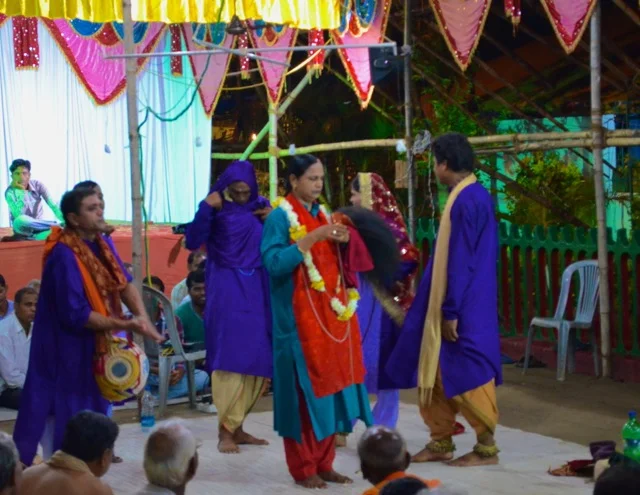
Pala at Nalconagar, Angul district, 2013. Individual performers are not named in the source.
Subhashish Panigrahi. Source · CC BY-SA 3.0.

The voice and the answer
Kalahandi’s cultural inventory describes Pala through the Gayak, Bayak and Palias, with mrudanga, gini and chamar among its instruments and objects. The Gayak leads the narrative; accompaniment and answering voices make it an ensemble undertaking. The district account places this practice around Bhawanipatna, Dharamgarh and M. Rampur. Its six-person description is a local example, not a fixed cast for every performance.1
Umesh Patra distinguishes seated Baithaki Pala, standing Thia Pala and competitive Badi Pala. The last brings teams into a contest of wit. These names point to different expectations: a seated recitation and a dramatic exchange before an audience do not ask their performers to do quite the same work.2
Patra’s Harischandra example shows how little scenery a story may need. A chamara, or fly-whisk, becomes the king’s crown when it is handed over. Elsewhere the object can suggest a bow or trident. A familiar object acquires a temporary meaning through action; listeners follow the change without requiring a new prop. This example belongs to Patra’s account, rather than to the photographs reproduced here.2
The answering performer can also change what a verse seems to mean. Sitakant Mahapatra describes the Palia offering a pun or a deliberately contrary reading after the Gayaka’s explanation. Such a reply opens a space for satire. In his account, pompous learning, corrupt officials and selfish rulers can all become subjects of laughter.3
Mahapatra gives a pointed example involving Gopabandhu Das’s poetry. An ideal of bodily sacrifice for the country is turned into a parody of leaders sacrificing other people to their own interests. The force comes from recognition: an audience that knows the earlier poem can hear what has been altered. We can describe the device without treating the parody as Gopabandhu’s own words.3
Learning to listen to Pala therefore includes noticing changes in register. The story may remain the same while an explanation, a joke or a gesture moves it into another relationship with the audience. An interruption can be where the argument becomes clearest.
Two performers and wooden rhythm
In his 2012 account of Daskathia, Basista Kumar Behera describes two performers: a Gayak or Gahana, who leads, and a Palia, who repeats the concluding stanza and contributes questions, proverbs and humour. Wooden sticks played with the hands provide a distinctive rhythmic element. The reply gives the principal singer a pause and offers the audience another way into the telling.4
Kalahandi’s inventory likewise records a pair performing historical and Puranic narratives at Bhawanipatna. Read beside its neighbouring Pala entry, this gives a useful practical distinction between the two forms. Shared stories do not make their distribution of voices and accompaniment identical.1
The Puri photograph shows two performers with hand-held pieces of wood, standing at microphones during the 2022 Ratha Jatra programme. Their names are not supplied by the image record. The microphones belong to this documented setting; they do not establish what an earlier performance would have sounded like.
Behera connects Daskathia with Ganjam and recounts a devotional explanation involving Hanuman’s service to Rama. Such an account belongs to the meanings attached to the practice. His proposed origin chronology requires separate historical evidence and is not used here as a founding date.4
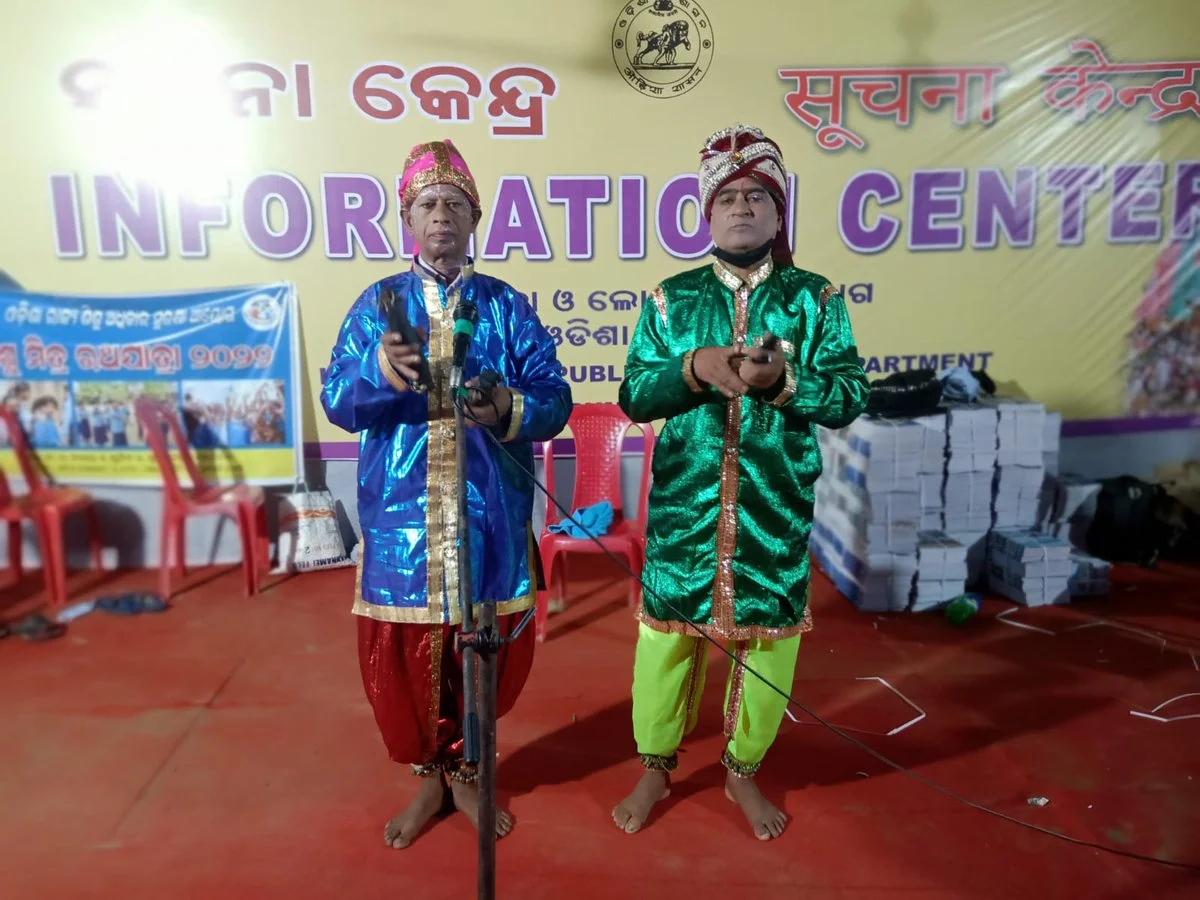
Daskathia at the Gundicha Mandira stage, Puri, during Ratha Jatra, 7 July 2022. Performers are unnamed in the image record.

Artists who read and interpret
The Sangeet Natak Akademi’s 2009 award citation for Jagannath Behera describes a reader of literary classics in Odia, Bengali, Hindi, Sanskrit and English, despite formal schooling only to middle-school level. It names Harekrushna Nath, Bhagaban Singh and Harekrushna Swain among his teachers. Here performance knowledge includes reading across languages as well as learning from other artists.5
A written citation preserves one career; a programme record shows that knowledge put into use. Narthaki’s report of the July 2012 Pala and Daskathia Utsav at Rabindra Mandap names Santilata Sahu presenting Hanuman’s meditation in Dwapara Yuga, and Manorama Panda presenting Naga Jyoti. Their presence makes women’s contributions part of the chapter’s account of Pala, rather than an unnamed exception to it.6
The same report identifies the Daskathia pair Sudarshan Padhi and Bhabani Shankar Dash presenting Nilendri Harana from Sarala Das’s Mahabharata. A title, text and pair of names give a reader something more useful than a general claim about epic storytelling: a particular performance to investigate.6
These are historical credits. They do not establish current appearances or teaching arrangements. Nor do they identify the artists in the Bhadrak photograph below, whose image record names the photographer and occasion but not the performers.
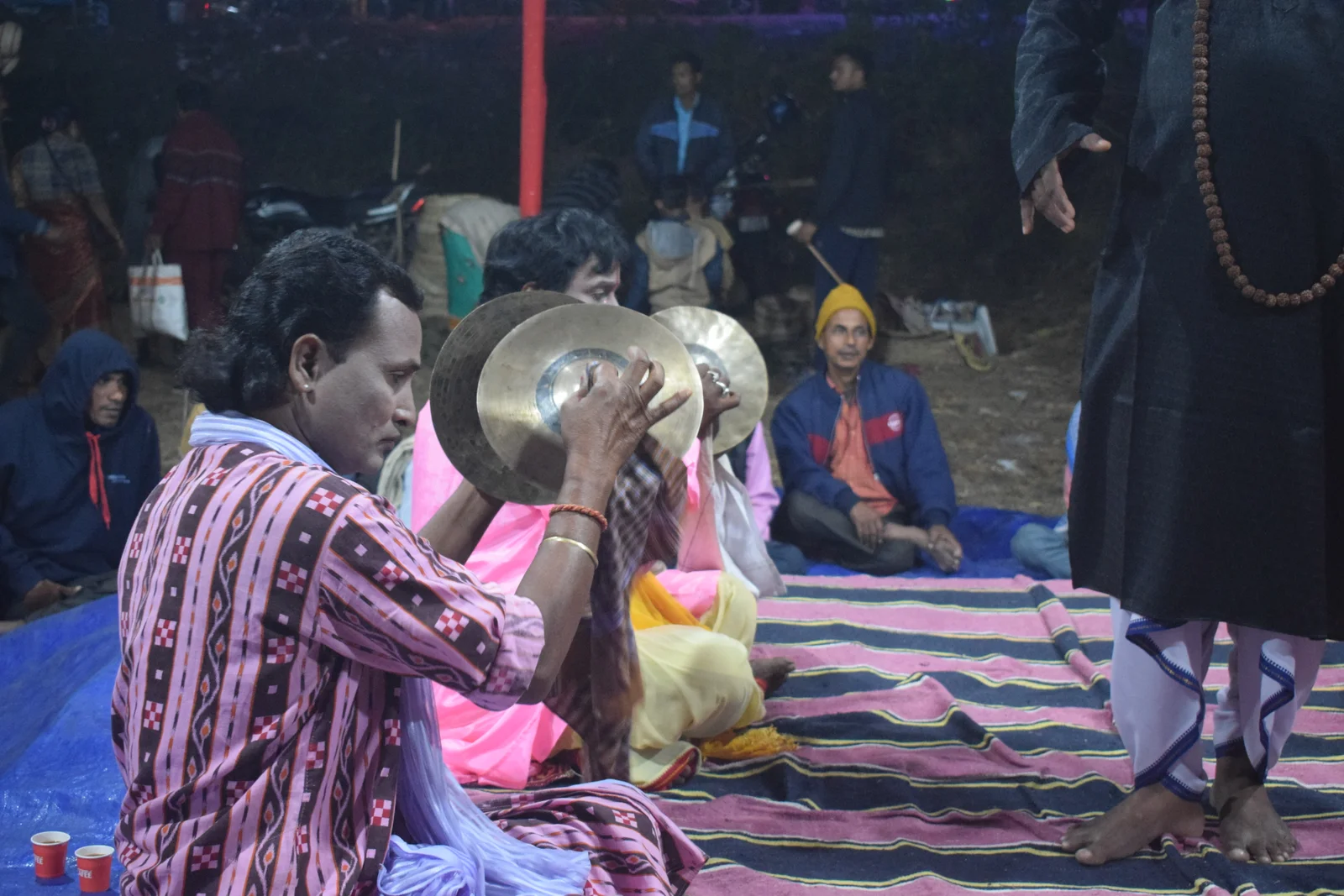
Cymbal players during Pala at Makar Mela, Bhadrak, 17 January 2025. Individual performers are not identified.
Sangram Keshari Senapati. Source · CC BY-SA 4.0.

A story in public life
Literary and devotional narration are not the only settings in which these skills have been used. Odisha’s Information and Public Relations Department, in its 2021–22 activities report, lists Daskathia and Palla among forms employed to communicate government plans and policies. The passage documents an administrative use of performance. It does not measure what audiences understood or how every artist chose a repertoire.7
This change of purpose raises an interesting listening question. When a performance carries an assigned message, what room remains for a question, a joke or a local example? A programme’s stated objective cannot answer that by itself. We would need to hear the performers and ask how they prepared the presentation.
The same care helps when watching a recorded epic episode. Keep track of who is speaking: the narrator, a character, or a performer commenting on the story. Note when an old verse is quoted and when an explanation begins. A translation should make these distinctions visible, so that a poet is not credited with a later joke and an artist’s interpretation is not mistaken for the source text.
An archive of Pala or Daskathia becomes more useful when it keeps the surrounding information. The item’s name, the occasion and the source work matter alongside the lead singer’s name. Accompanying artists need credits too. A clear recording of an answering voice may explain an exchange that a camera fixed on the principal performer leaves incomplete.
For the listener, the task is less elaborate. Allow time for the explanation and the response. A familiar story may disclose an unfamiliar comparison; a small shift of wording may carry a sharp social judgement. Pala and Daskathia reward attention to that work of interpretation, where poetry meets the knowledge and expectations of the people hearing it.
Footnotes & Sources
- Kalahandi district, Culture and Heritage. Art Forms table, entries 17 and 18, Palla and Daskathia. Local descriptions of ensembles, objects and repertoire. ↩
- Umesh Patra, Tracing the History and Evolution of Pala. Lokaratna X, 2017; PDF pp. 47–49. Forms and the Harischandra/chamara example. The author’s observations are attributed, not presented as new fieldwork. ↩
- Sitakant Mahapatra, Poetry as Performance. NCPA journal 11(1), 1982, printed pp. 32–33. Palia, satire and the Gopabandhu parody. Prose paraphrase only; no poem or translation reproduced. ↩
- Basista Kumar Behera, Daskathia - A Birds Eyeview. Odisha Review, August 2012, pp. 83–84. Roles, wooden instruments and devotional explanation; proposed origin chronology not adopted. ↩
- Sangeet Natak Akademi, Jagannath Behera. Awards 2009, printed p. 38. Named teachers and multilingual reading, as described in the award citation. ↩
- Narthaki, Pala and Daskathia Utsav. Report dated 27 July 2012, on the 19–21 July festival. Named artists and repertoire; historical programme credits, not a current schedule. ↩
- Odisha I&PR Department, General Activities 2021–22. Standing Committee report, printed p. 16 / PDF p. 18, “Song & Drama.” Public communication use; no audience-impact claim. Web sources checked 10 November 2026. ↩
Photographs retain their individual licences, linked beside each caption. All are reproduced full frame and scaled, with format conversion only. Adaptations of the Nalconagar and Bhadrak photographs must retain their stated share-alike or compatible licences. The Puri image has documented Government of Odisha permission through Wikimedia Commons. No photograph is presented as fieldwork by the author.
Suggest an update
Share a correction or source for this chapter. GitHub submissions are public. Please omit private contact details and consent documents.