
Part 5 · Making, Wearing and Building
Chapter 28 of 48
Cloth in Everyday and Ceremonial Life
Wearing, giving and the meanings of cloth
Cloth changes as it moves. Spread flat, a sari displays its borders; gathered around a body, those borders turn, overlap and disappear into folds. In the opening photograph, women walk along the narrow banks of rice fields in Odisha. Their clothes differ in colour, pattern and arrangement. The scene invites us to begin with movement: walking, bending, carrying and working, rather than a garment displayed in isolation.1
Threads of Place followed the making of textiles. This chapter follows their use: the decisions of a wearer, the relationship expressed by a gift, and the passage of woven words into worship. These are connected histories, but their meanings belong to particular people and occasions. A textile can be beautiful to a distant viewer while carrying much more specific significance for the person who wears, makes or offers it.
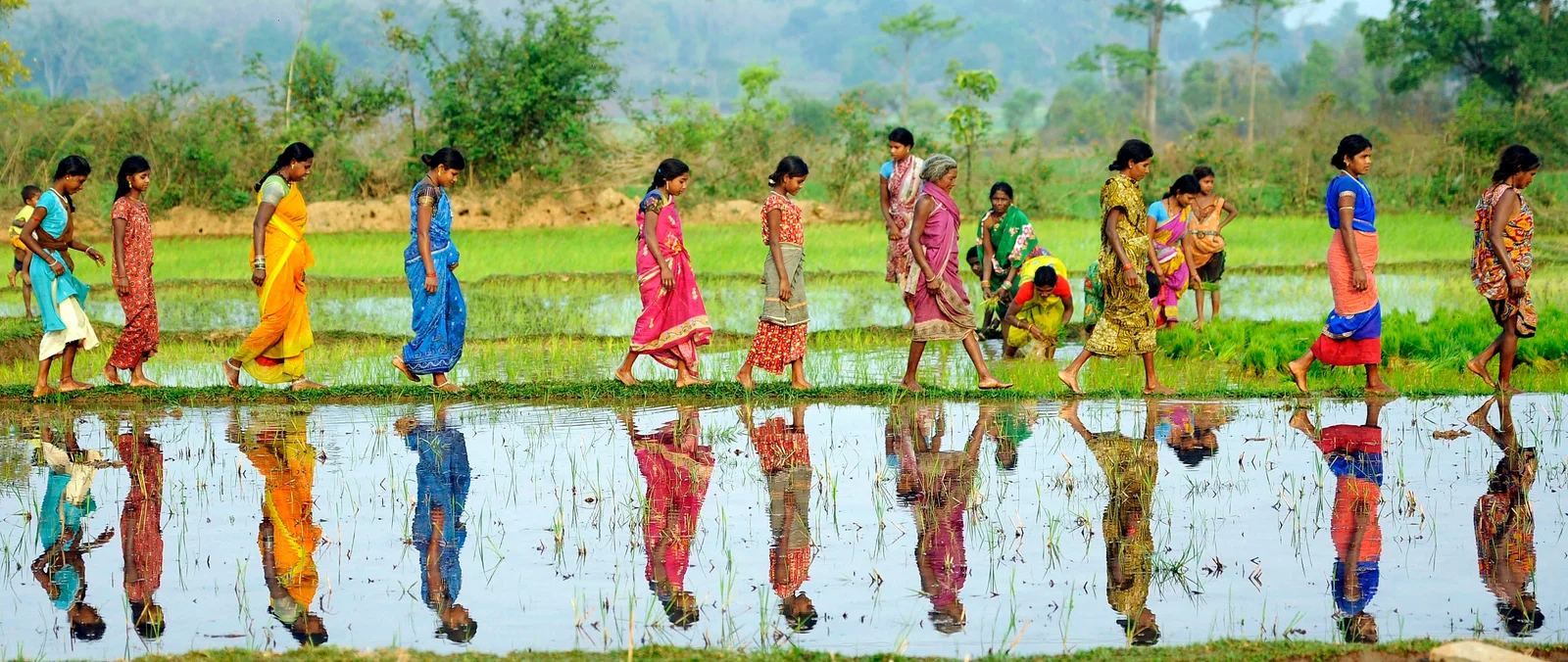
Women in rice fields, Odisha. The source does not identify the garments or their makers.

Dress belongs to a person
The portrait below, identified by its source as a Koya woman in Odisha, brings cloth into conversation with adornment. White clothing frames layered necklaces; red bangles sit beside larger metal ornaments. The arrangement is the visible fact. Her name and her explanation of these objects are not supplied with the photograph, so their personal meanings remain outside our account.2
Looking closely at one person is a useful beginning for a cultural history of dress. A community name does not tell us everything about an individual wardrobe. Nor can a photograph establish the fibre, maker or price of a garment. What it can preserve is a particular combination: the way a fold meets a necklace, the fall of a sleeve, a gesture that changes the whole arrangement.
Adornment deserves attention in its own right. When clothing is detached from the person and labelled only by weaving technique, these relationships disappear. Here, the portrait asks us to keep the wearer in view.
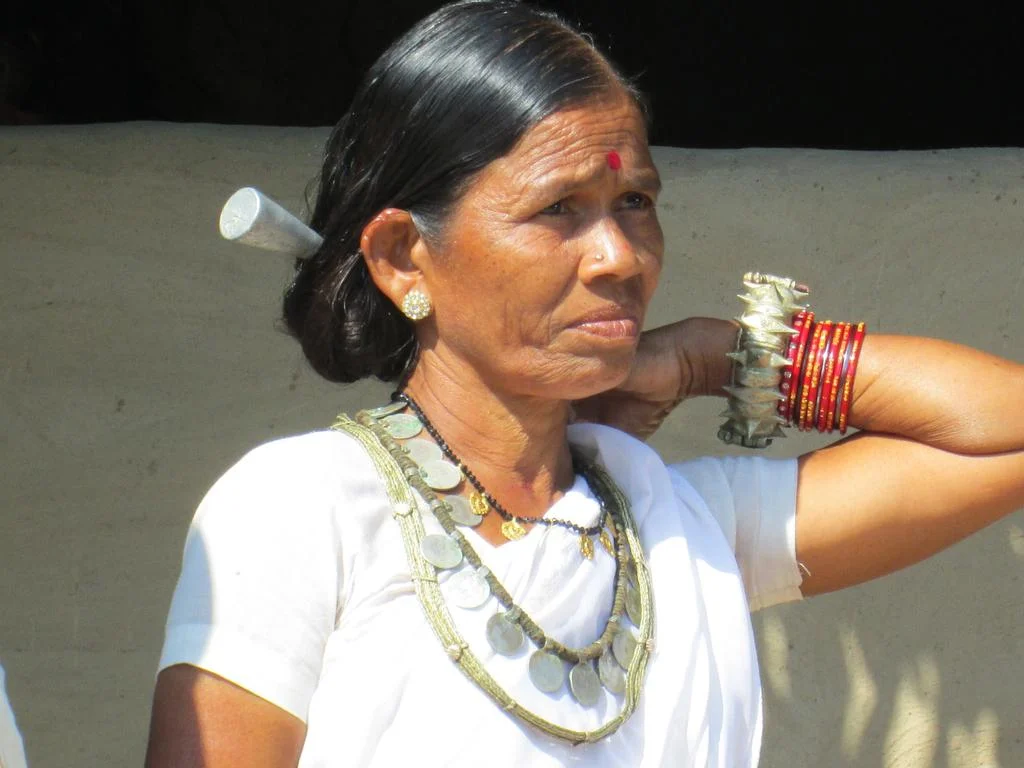
A Koya woman in Odisha, as identified by the source. Her individual name is not recorded.

Words worn in worship
At Nuapatna, the relationship between cloth and its recipient reaches into Jagannath worship. Manan Kapoor’s account for Sahapedia, drawing on weaver and textile historian Surendar Meher, describes Gita Govinda fabrics woven there for draping Jagannath. Verses from Jayadeva’s poem become part of the textile itself.3
The Impart encyclopedia identifies Gitagovinda khandua as silk ritual cloth with a stanza worked into the field through weft ikat. In this process, the yarn is patterned before weaving: the letters must emerge as threads are brought into alignment. Reading and making meet in a surface intended for devotional use.4
The photographed example lets us see that meeting. Light-coloured letters run across a red ground, surrounded by patterned bands. Its source identifies it as Gita Gobinda Khandua; it does not establish that this particular piece was used in the shrine. The distinction leaves its visual interest intact. A poem has acquired weight, texture and folds, and the act of offering cloth brings the work of a weaving community into a sacred relationship.
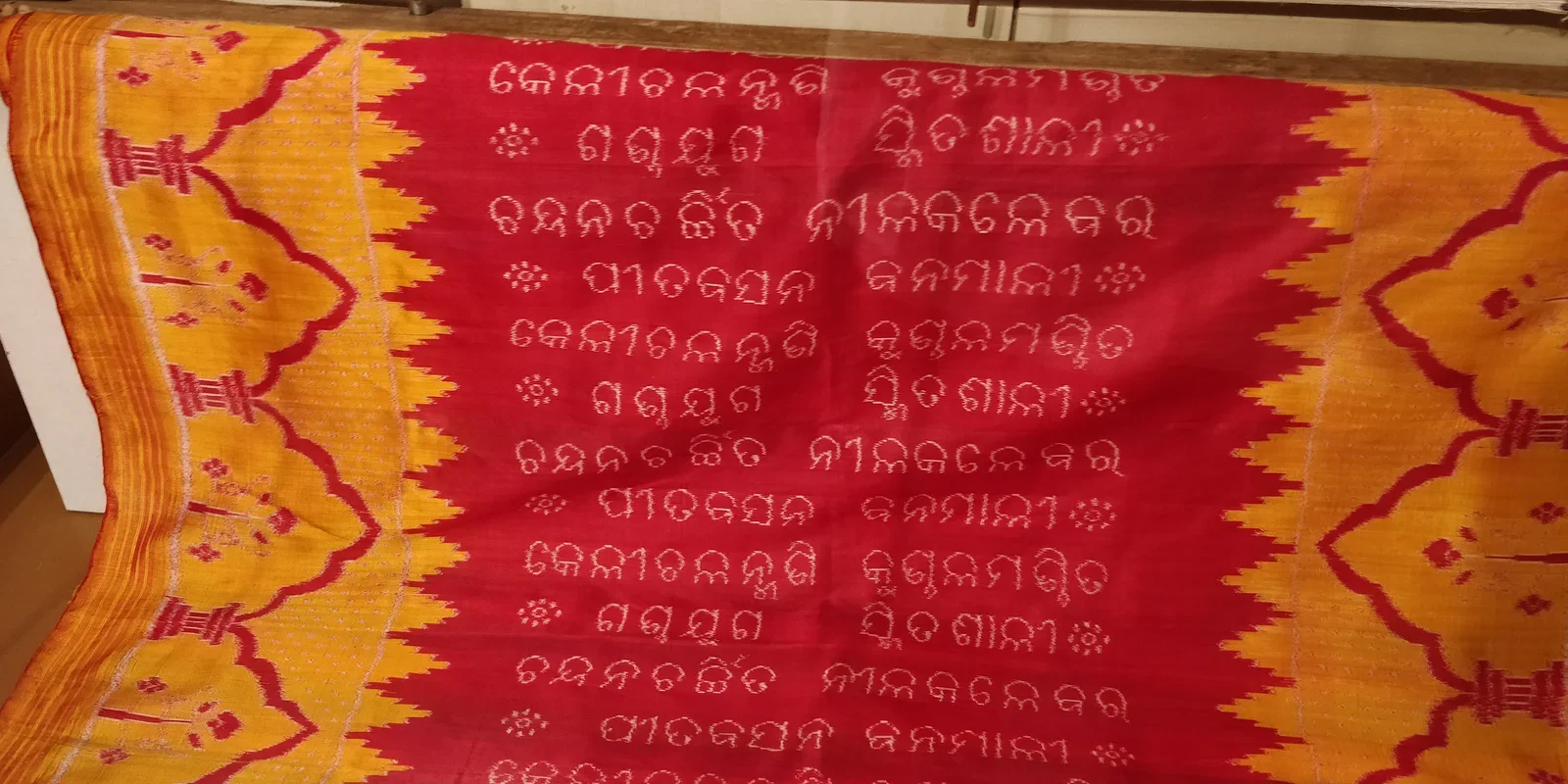
Gita Gobinda Khandua: woven lettering on a red ground. Identification follows the photographer.
Prateek Pattanaik. Source · CC BY-SA 4.0. Resized and converted to WebP; full frame retained. Derivative available under CC BY-SA 4.0.

Embroidery as a relationship
Among the Dongria Kondh of the Niyamgiri hills, Kapdaganda brings making, wearing and giving together. Impart describes these embroidered cloths as gifts for important life events, including a bride’s gift to her husband, and gifts to parents, siblings and other close relatives. Men and women wear them on ceremonial occasions. The base fabric and the embroidery also connect different kinds of labour: the account associates the cloth with Domb weavers and the stitching with Dongria Kondh women.5
Kanak Rajadhyaksha’s field account for Sahapedia records women describing Kapdagonda as an expression of love. They make pieces for relatives, lovers and themselves. Her account also makes room for individual differences: not every woman embroiders, and those who do fit the work into available time. This matters in a history of dress. A celebrated community practice still consists of personal skills, choices and hours of work.6
Rajadhyaksha describes festival and wedding use, including women’s three-piece arrangements around the waist and neck. A textile sold elsewhere as a shawl therefore carries a history of wearing that the shop label alone cannot convey. She also records women’s explanations of particular motifs: the linga triangle refers to the mountain deity Niyam Raja, while kairi diagonals represent cultivated fields. These meanings are attributed to that account, rather than treated as a universal dictionary for geometric ornament.6
Giving adds another dimension to the finished surface. A border can be admired by anyone; the knowledge of who stitched it for whom belongs to a relationship. Keeping that history with the cloth allows the recipient, as well as the maker, to remain part of its story.
An occasion changes the cloth
The difference between everyday and ceremonial use can be worked into a textile’s design. Impart’s survey of Odisha ikat describes a historical distinction between shorter, simpler sari end panels for ordinary use and more elaborate patterned panels for special occasions. It also records changes in sari dimensions and end-panel arrangements over time. Dress has a history of adjustment, not a single permanent form.4
An occasion also changes what we notice. In a field, the arrangement of clothing can be read through movement and work. In a gift, we look for the relationship between giver and recipient. In the Gita Govinda textile, words and devotional purpose draw the eye. These examples do not yield one costume for Odisha. They show several ways in which cloth participates in life.
When a textile enters a family collection, a museum or a new market, a useful record begins with concrete questions. Who made it? Who wore it? Was it purchased, given or commissioned? What did its owner call it, and which occasion brought it out? Answers may differ even for pieces that look alike. Recording a remembered gift or a wearer’s preferred arrangement can be as valuable as naming the weave.
The photographs in this chapter leave us with three scales of attention: a line of people moving through a working landscape, one person’s arrangement of cloth and ornaments, and lettering woven across a ceremonial textile. Together with the accounts of Kapdaganda, they return us to the human life of fabric. Cloth is handled, adjusted, given and worn; those actions belong beside its pattern in the cultural record.
Footnotes & Sources
- Justin Kernoghan / Trócaire, women in Odisha rice fields. Photograph and source description. The source does not identify the wearers or their textiles. ↩
- Government of Odisha, A woman from Koya Tribe, Odisha. Source identification and photograph. Individual name and ornament meanings are not recorded. ↩
- Manan Kapoor, Ikat, the Sacred Thread. Sahapedia; discussion of Nuapatna devotional textiles, citing Surendar Meher. ↩
- Impart Encyclopedia of Art, Odisha Ikat. 21 April 2022. Gitagovinda khandua, weaving, historical everyday and special-occasion sari designs. ↩
- Impart Encyclopedia of Art, Kapdaganda. 21 April 2022. Gifting, ceremonial wear and the relationship between base cloth and embroidery. ↩
- Kanak Rajadhyaksha, Kapdagondas: Motifs and Technique. Field account of makers, wearing arrangements and motif explanations; source spelling retained in title. ↩
- Prateek Pattanaik, Gita Gobinda Khandua. Photograph, 2018. Identification follows the photographer; no claim of use of this particular piece in the shrine. ↩
Each picture links to its source and licence. Images are reproduced full-frame, resized for layout and converted for document rendering; composition is unchanged. The Khandua image is reused from Threads of Place under CC BY-SA 4.0. Sources checked 10 November 2026. This review chapter synthesises published documentation and close looking; it does not report new field interviews.
Suggest an update
Share a correction or source for this chapter. GitHub submissions are public. Please omit private contact details and consent documents.