
Part 5 · Making, Wearing and Building
Chapter 27 of 48
Threads of Place
Weaving traditions across Odisha
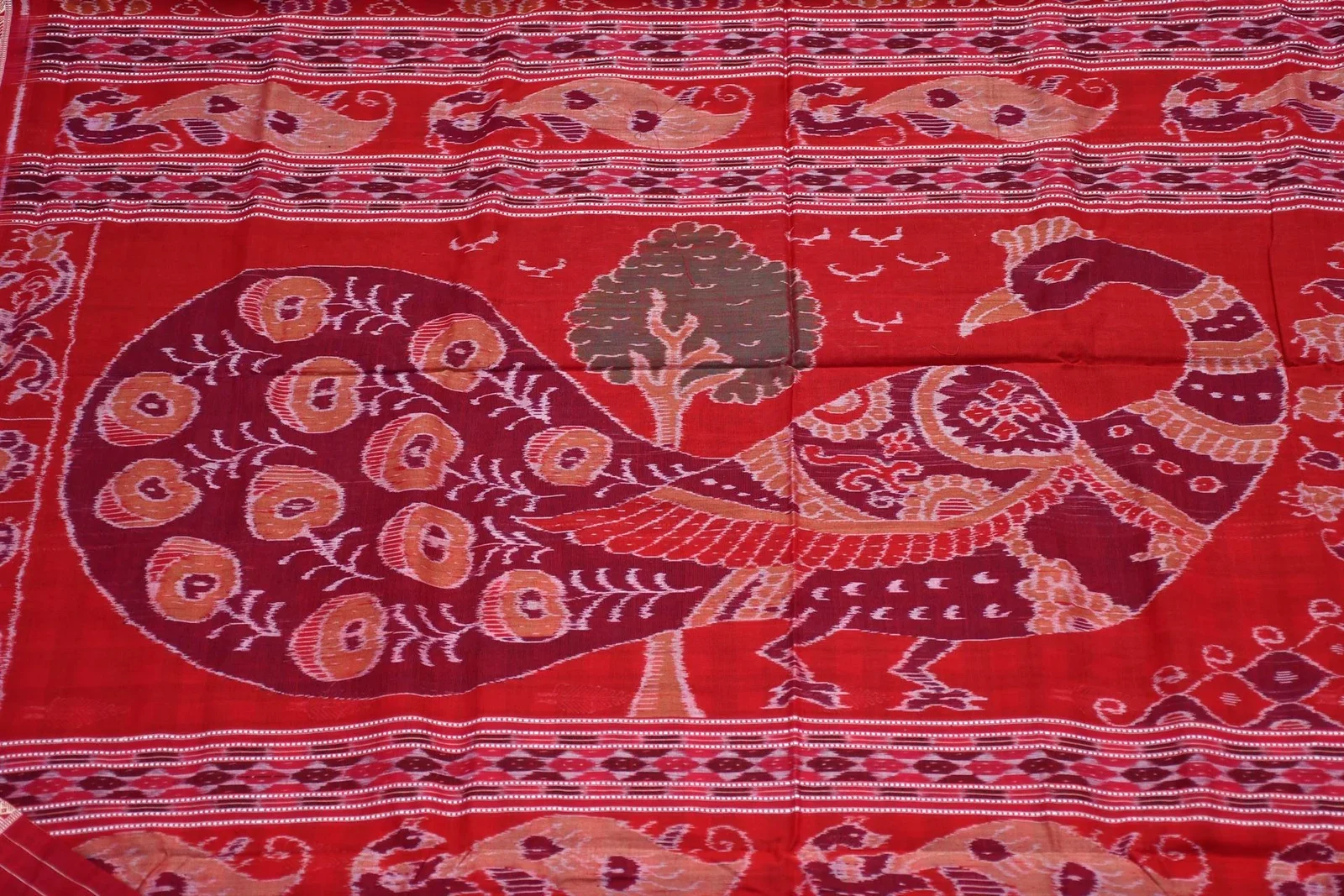
A Sambalpuri sari pallu with peacock motifs · photograph by Rahul191313.
Rahul191313. Source · CC BY-SA 4.0. Resized and converted to WebP; full frame retained. Derivative available under CC BY-SA 4.0.

Begin with the end of a sari. In the photograph, peacocks and floral shapes spread across a red pallu, the decorated end panel. Your eye can follow the figures before you know the name of the weave. Looking longer brings another question into view: how did these shapes become part of the fabric?
Across Odisha, that question leads in different directions. It can take us to yarn tied before dyeing, a border built with additional threads, lettering woven into devotional cloth, or the preparation of colour from roots. The place names associated with these textiles offer a useful beginning. Understanding their differences requires attention to the material and the work itself.
This chapter follows selected traditions from the western weaving centres towards Nuapatna and Maniabandha, south to Berhampur, and through Kalahandi and Koraput, before turning to tasar silk. It is a journey through documented practices, with each textile asking us to notice something different.
The pattern begins before the cloth
In bandha, colour is planned while the yarn is still separate. The National Institute of Design’s documentation of Sambalpur weaving describes selected lengths being tied so that they resist dye. Tying and dyeing may be repeated to establish different areas of colour; the prepared yarn is then woven. The image on the finished surface depends on decisions made earlier, when no complete cloth was yet there to see.1
Warp names the lengthwise yarns held on the loom; weft is the yarn carried across them. Those simple terms help us follow the work, but a textile’s regional name does not specify every choice of fibre or dye. The Sambalpur process recorded by NID uses cotton and synthetic dyes. Bandha should therefore not be taken as a blanket claim of natural dyeing.1
The state handloom department lists Bargarh for cotton tie-dye, silk and furnishing textiles. That range helps us understand Sambalpuri weaving as a production landscape rather than a single design. A sari may first attract us through colour or a familiar motif; tracing its making brings us to the preparation of yarn, the organisation of work and the skill of keeping a design aligned.2
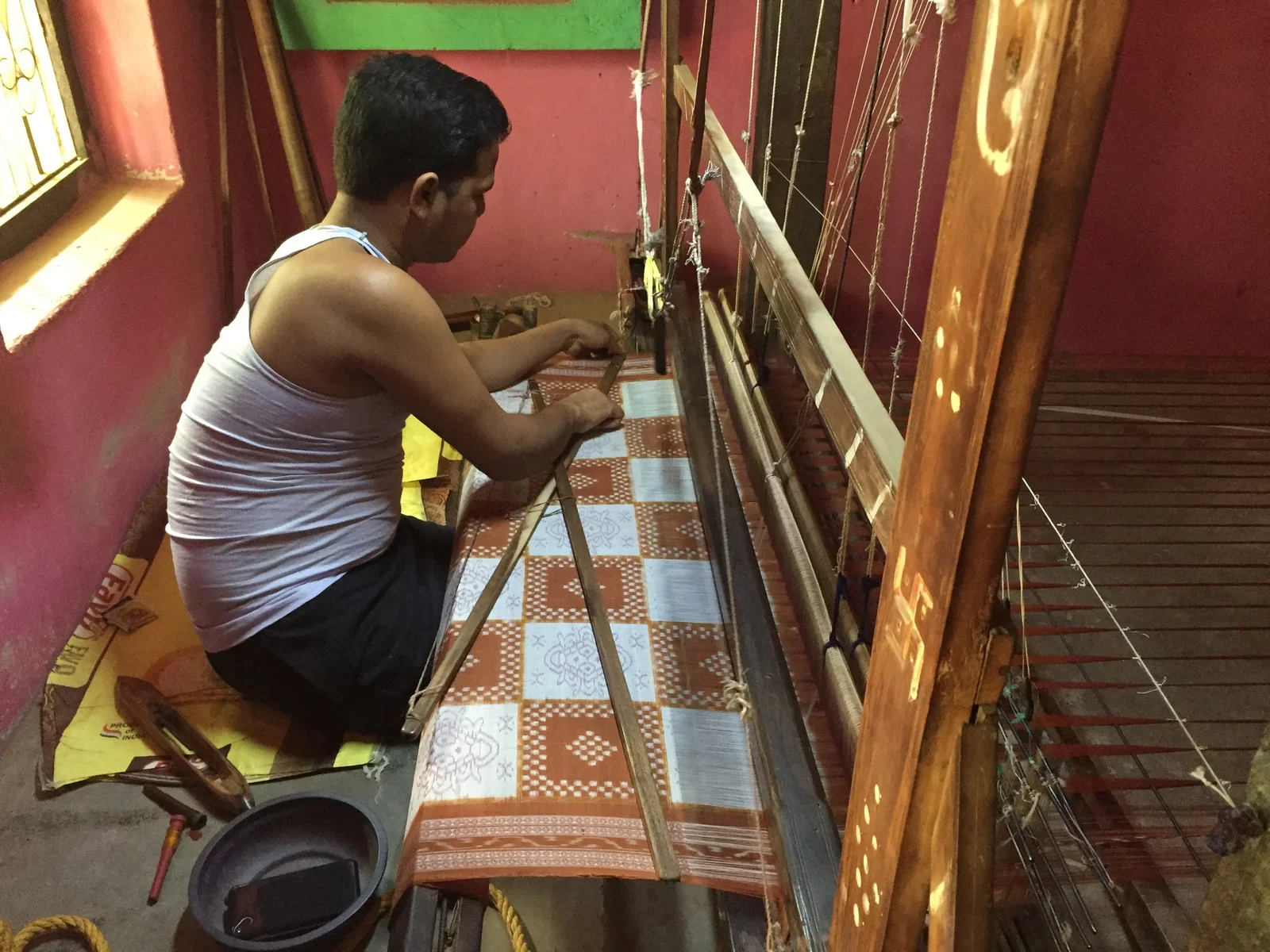
Sambalpuri sari weaving · the image record does not identify the weaver.
Saileshpat. Source · CC BY-SA 4.0. Resized and converted to WebP; full frame retained. Derivative available under CC BY-SA 4.0.

Names beside the loom
A description of technique becomes more useful when it also records the person responsible for a particular work. The official Odisha weaver directory credits Swarnalata Meher with a Bapta sari combining silk warp and cotton weft. It credits Debaki Meher with a cotton Dasa Phulia example incorporating calligraphy and supplementary threads. These are individual documented works, not a definition of everything sold under a regional label.3
The distinction changes how we read a textile photograph. A caption may identify the tradition while leaving the maker unknown, as in the weaving photograph reproduced here. We can acknowledge the photographer accurately without filling that gap with a guessed name. In future documentation, the name of the person at the loom—and the names of others involved in the cloth—deserve as much care as its colour and pattern.
When words enter the weave
At Nuapatna, cloth also leads into literature. Sakshi Gambhir’s documentation for IDC, IIT Bombay connects calligraphic textiles bearing verses from the Gita Govinda with offerings to Jagannath at Puri. The handloom department lists Nuapatna for silk Khandua and calligraphy textiles. In this setting, writing can become something woven and offered, as well as something read.24
The accompanying photograph is identified by Prateek Pattanaik as a Gita Govinda Khandua. Rows of lettering occupy the red and yellow textile. Its particular passage has not been transcribed here: identifying a genre of cloth is different from establishing the exact words on an individual piece. Nor does the photograph establish its weaver or the ritual history of this specimen.
The Nuapatna process account describes planning for thread density, tying selected sections of weft, dyeing and weaving. Several people contribute to the sequence. Calligraphy on cloth is therefore both a literary presence and a demanding arrangement of yarn.5
Nearby Maniabandha belongs to the wider weaving landscape discussed alongside Nuapatna in Cuttack’s district export plan. Reading the two places together gives a sense of regional connection; it need not erase their distinct identities. A village name is most informative when it accompanies a specific maker, material and account of work.6
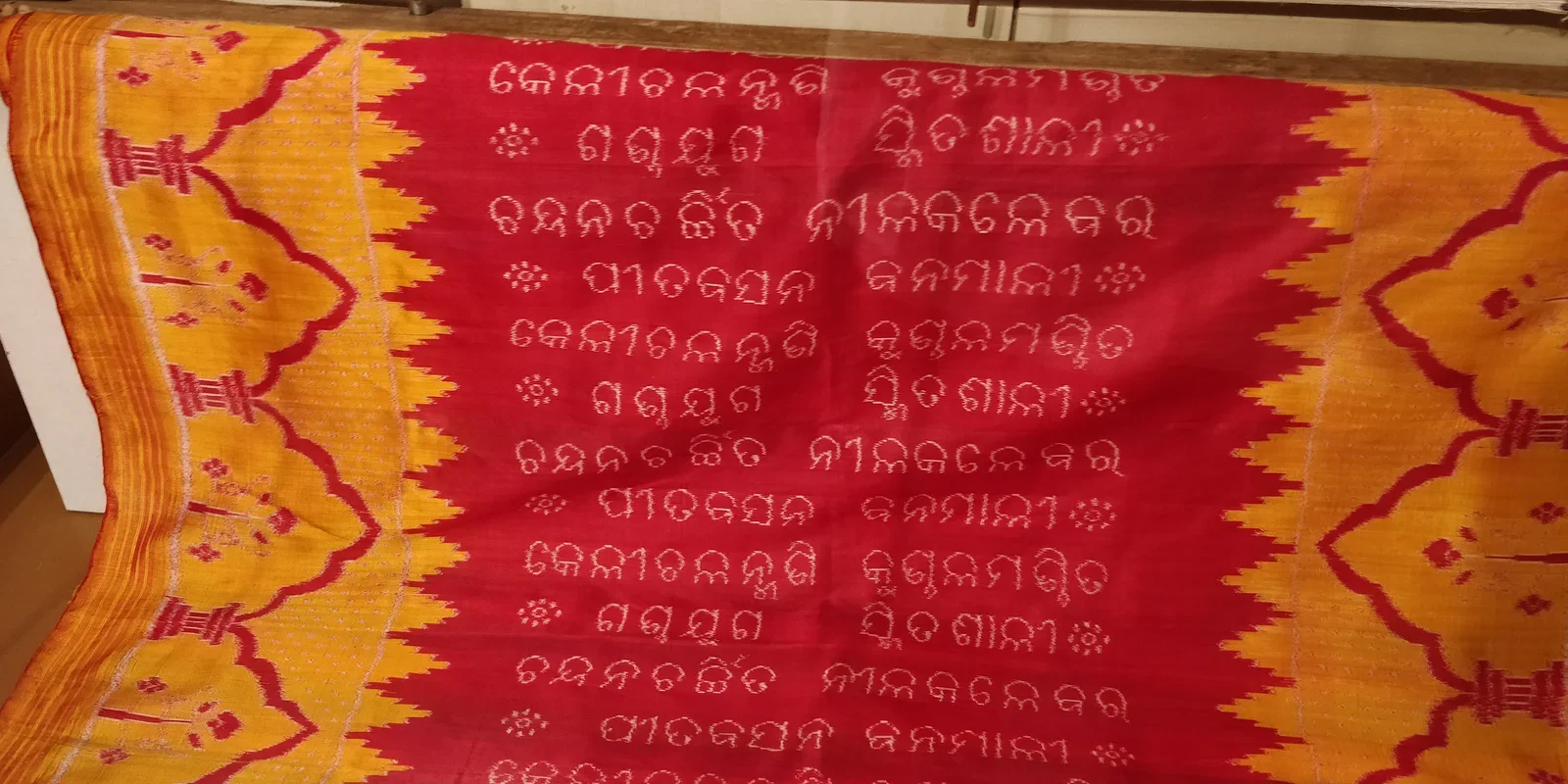
Gita Govinda Khandua · photographed in 2018; identified by the photographer.
Prateek Pattanaik. Source · CC BY-SA 4.0. Resized and converted to WebP; full frame retained. Derivative available under CC BY-SA 4.0.

Three ways to read a border
Bandha does not explain every patterned surface. Bomkai offers a different construction to examine. The India Handloom Brand specification describes a three-shuttle border, additional warp threads in the border and additional weft in the body and pallu. These extra threads help form designs within the woven structure. The department lists silk Bomkai among the products of Sonepur and Boudh; such production associations should be kept distinct from the history of the name and its connection with Bomkai village in Ganjam.27
Berhampuri Patta brings another southern textile into view. The official directory describes its examples as silk in both warp and weft, with temple-shaped kumbha borders and an extra-weft end panel called Salari anchal. Ruchira Ghose’s Mapping Indian Textiles distinguishes the Berhampur sari from the joda worn by men. Looking at the end panel and border together helps us recognise different kinds of work within one cloth.38
In Kalahandi, Habaspuri invites a similar close reading with its own construction. Ghose describes additional warp threads forming temple motifs along the border, and additional weft designs in the pallav. Fish, flowers and kumbha are among the motifs she records. The official directory likewise describes a plain weave enriched by extra-warp and extra-weft designs.38
Placed beside one another, these descriptions offer a small vocabulary for seeing. A design may depend on colour prepared in yarn, on additional threads, or on a combination of decisions. Similar-looking motifs do not necessarily imply identical methods. The pleasure of comparison lies in learning to see the differences.
Kotpad and the work of colour
In Kotpad, Koraput district, the preparation of colour deserves a chapter of attention within the making of cloth. The Development Commissioner for Handlooms associates the tradition with the Mirgan community and describes aul-root dyes producing a palette that includes red, maroon, brown and black. Its account follows preparation, washing, drying and dyeing before weaving, and names both cotton and tussar among the materials used.9
Dastkari Haat Samiti’s 2017 documentation makes the designs more particular. With text by Jaya Jaitly, photographs by Chirodeep Chaudhuri and credit to artisan Gobardhan Panika and the community, it presents fish, crabs, vessels and other forms drawn from everyday surroundings. The named documentation is valuable because it brings an individual and a community into the account, alongside the finished textile.10
A motif is a starting point for interpretation, not permission to invent a meaning. Its name and significance should come from an identified source or from the maker’s own explanation. Similarly, the documented use of a root dye describes a process; it does not establish the fibre, dye or environmental performance of every piece offered as Kotpad cloth.
Before silk reaches the loom
Tasar, also commonly written tussar, directs attention further back in the making of a textile. Before yarn can be arranged on a loom, there is a cocoon. The basket photographed at the Odisha Crafts Museum in 2018 preserves a view of that material stage. It is a museum display, rather than a photograph of current production.
The Central Silk Board’s Keonjhar reference lists Arjun and Asan among tasar host plants, in forests and raised plantations. Its technical account distinguishes cocoon processing, reeling, spinning and preparation for weaving. Following the material therefore brings plants, silkworms and several kinds of work into a story that might otherwise begin only with a finished sari.1112
The department’s weaving-centre list associates tasar textiles with Mayurbhanj, Gopalpur, Fakirpur and Mankidia. The cluster table places Rasulpur’s Gopalpur in Jajpur district. This is a different Gopalpur from the coastal town in Ganjam. Even a familiar place name needs its geographical context.213
A weaving centre does not by itself tell us where a particular cocoon was raised or where its yarn was processed. Keeping those stages separate makes the account more informative. It also leaves room for the people whose work precedes weaving to enter the textile’s recorded history.
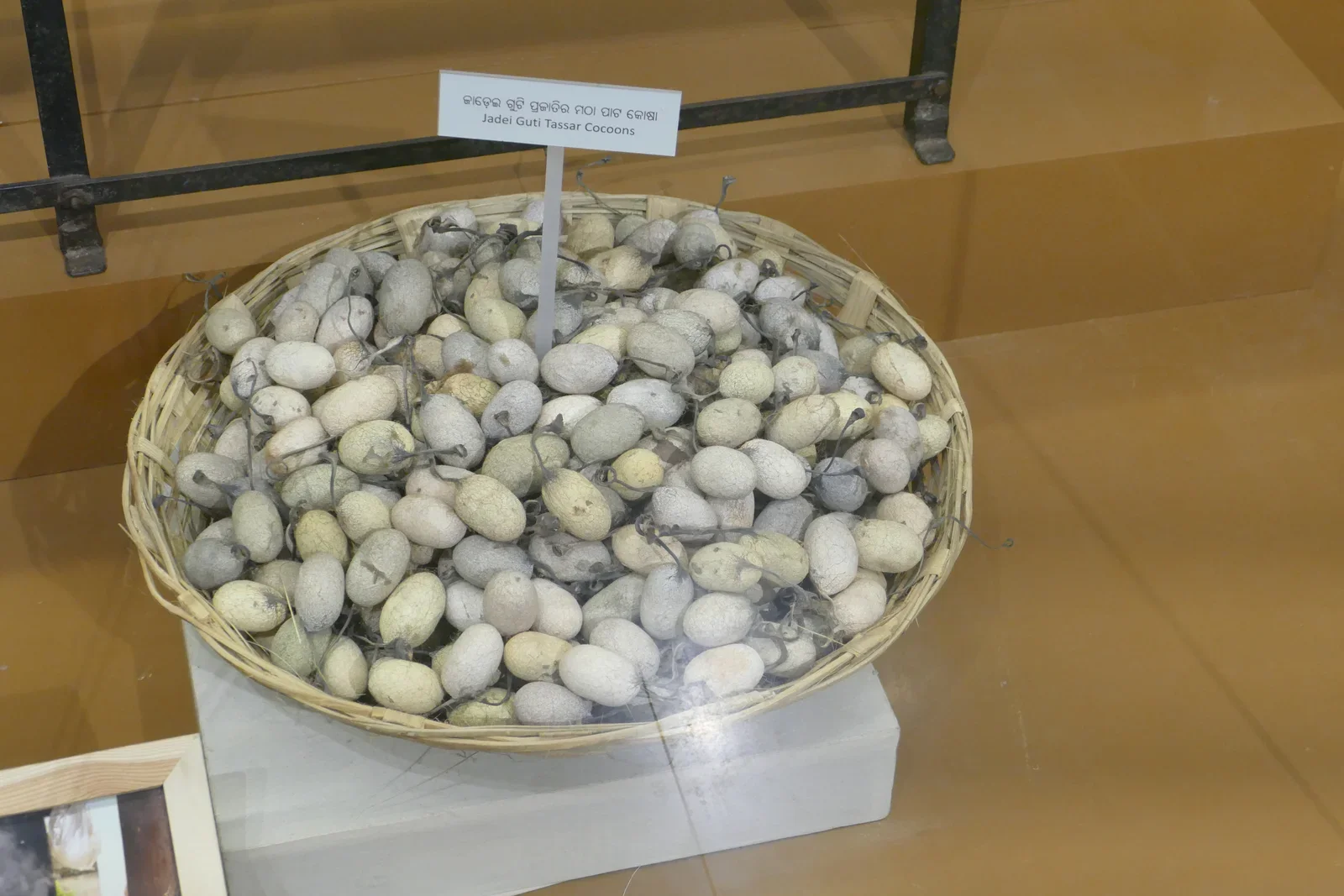
Tasar cocoons at the Odisha Crafts Museum · photographed on 29 October 2018.
Kritzolina. Source · CC BY-SA 4.0. Orientation corrected, resized and converted to WebP; full frame retained. Derivative available under CC BY-SA 4.0.

Keeping the work with the cloth
These textiles belong together in an Odisha cultural edition because they reward comparison while resisting a single formula. Prepared colour, supplementary threads, woven lettering and the transformation of a cocoon reveal different paths towards a usable fabric. Their names locate traditions; close descriptions reveal choices within them.
For a family retaining a cherished sari, a museum recording a textile, or a reader choosing a new piece, a few details can preserve much of what a label leaves out: the maker or production group, the place of making, the fibre, the technique and the story attached to the piece. Record what is known, keep an uncertain attribution open, and ask how the cloth should be cared for.
The peacocks at the opening of this chapter will still be beautiful when we return to them. What changes is the attention we bring. We can now look beyond the finished pattern towards the decisions and people that gave it form.
Footnotes & Sources
- National Institute of Design, Saree Weaving — Sambalpur: Making Process. Documented tying, dyeing and weaving sequence; the recorded process uses cotton and synthetic dyes. ↩
- Government of Odisha, Important Handloom Centers. Departmental associations of weaving centres and products. Used as a production reference, not an origin chronology or current visitor directory. ↩
- Development Commissioner for Handlooms, Odisha Weaver and Cooperative Product Directory. Undated. PDF pp.10–11: Swarnalata Meher and Debaki Meher; pp.19–20: Berhampur Patta examples; p.4, row14: Habaspuri. Descriptions apply to listed examples. ↩
- Sakshi Gambhir, Ikat Textiles of Nuapatna, IDC IIT Bombay. Literary and devotional context of calligraphic textiles. ↩
- Ikat Textiles of Nuapatna: Process, IDC IIT Bombay. Pattern planning, thread density, resist-dyeing and weaving. ↩
- Cuttack District Export Action Plan. Maniabandha and Nuapatna as a weaving cluster; read with the Project Odisha Maniabandha research record. ↩
- India Handloom Brand, Bomkai Saree. PDF p.1: three-shuttle border, extra-warp and extra-weft construction. ↩
- Ruchira Ghose, Mapping Indian Textiles, IGNCA, August 2017. PDF p.67: Berhampur sari and joda; p.68: Habaspuri construction and motifs. Other historical or botanical claims in the report are not adopted. ↩
- Development Commissioner for Handlooms, Sustainability in the Handloom Traditions of India. Printed p.36 / PDF p.49: Kotpad, Mirgan community, aul-root dyes and material preparation. ↩
- Dastkari Haat Samiti, The Colours and Motifs of Kotpad Textiles, 2017. Text by Jaya Jaitly; photographs by Chirodeep Chaudhuri; artisan Gobardhan Panika and community credited. Images from this source are not reproduced. ↩
- Central Silk Board, Keonjhar: Varieties of Silkworm Food Plants. Arjun and Asan in the tasar host-plant account. ↩
- Central Silk Board, Processing of Tasar Cocoons. General technical description of processing, reeling, spinning and weaving preparation; not a survey of Odisha workshops. ↩
- Government of Odisha, Important Handloom Clusters. Rasulpur (Gopalpur) is listed in Jajpur district; distinguished here from Gopalpur-on-Sea in Ganjam. ↩
The four photographs are reproduced under Creative Commons Attribution ShareAlike 4.0. Existing full-frame derivatives were resized and converted for this chapter; the tasar image also retains the previously corrected orientation. The reproduced image derivatives remain under CC BY-SA 4.0. See each linked source for the original record.
Suggest an update
Share a correction or source for this chapter. GitHub submissions are public. Please omit private contact details and consent documents.