
Part 6 · Food, Work and Ecology
Chapter 35 of 48
Forest, Hill, River and Coast
Gathering food and keeping it through the seasons
A meal carries the work of places beyond the kitchen. Fruit must be recognised and gathered; a catch must reach shore; food intended for later must be dried or stored. Odisha’s forest and fishing landscapes become easier to understand when we follow those tasks and the people who perform them.
This chapter moves between local accounts: mahua use among Santhal residents near Similipal, forest-product collection in Kendujhar, fishing at river mouths and Chilika, and the work of preserving fish. Leaf cooking connects gathering with the household fire. These settings reveal different kinds of knowledge, each learned through particular materials, seasons and livelihoods.
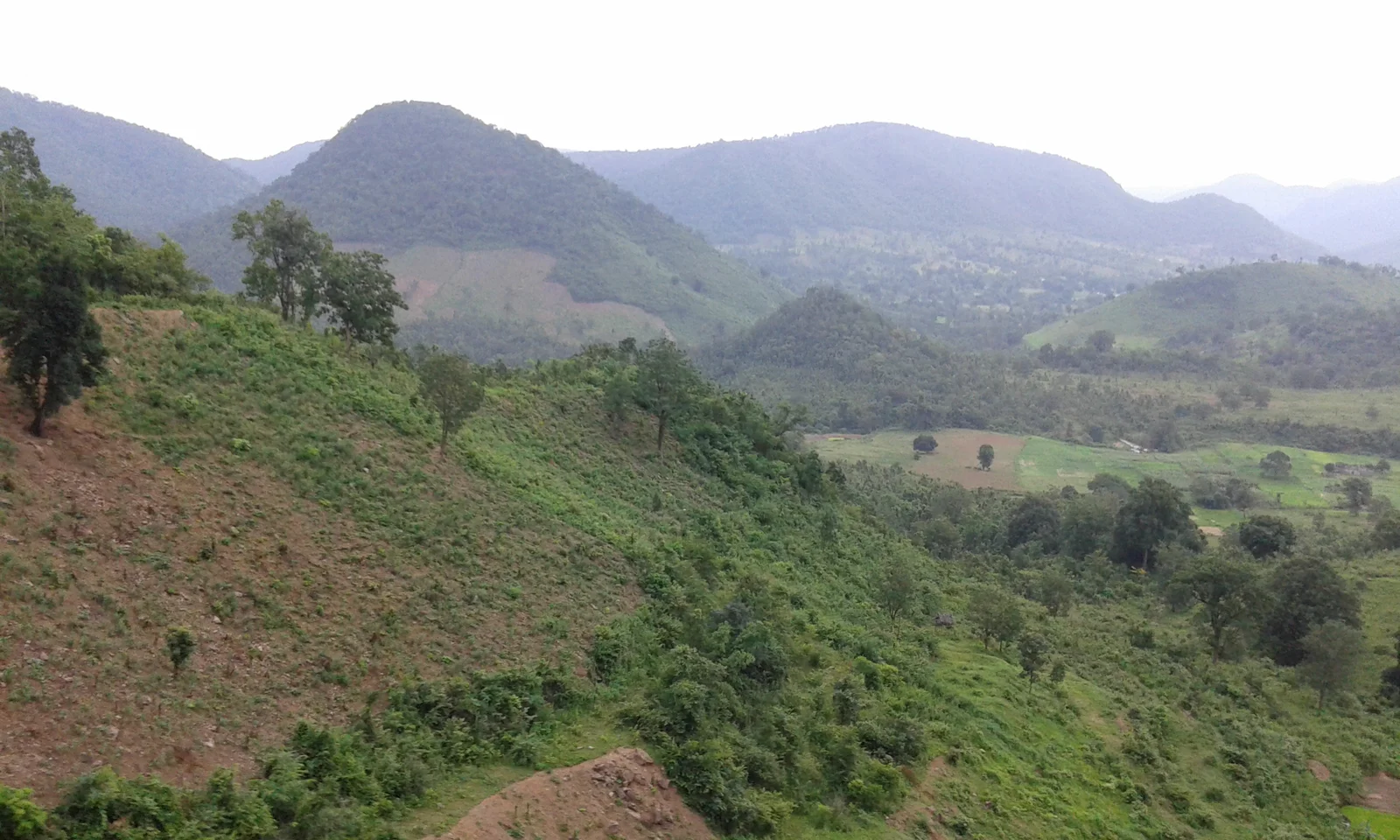
Hills and cultivated ground in Koraput district, photographed towards Rayagada, 7 August 2015. A regional landscape, not the Chandbill study site.
Kkmishra1960. Source · CC BY-SA 4.0. Existing full-frame photographic copy resized; no crop, recolouring or content alteration.

Knowing the forest season
Jamu, kendu, bara and kantei koli appear among the fruits described by the Regional Plant Resource Centre in Bhubaneswar. Its account recalls collection for household use and exchange in village markets, and explains the purpose of its wild-fruit conservation garden. Keeping these plants in a collection preserves material for study; knowing when and how a fruit is used also requires the knowledge of people who gather it.1
A 2016 paper by Behera and colleagues describes mahua use among Santhal residents of Chandbill, Bangiriposi, based on 2009 fieldwork. Flowers were gathered from private and forest land in March and April, commonly by women and children early in the morning, then carried home for use or sale.2
Drying and storage influenced what happened next. The researchers describe households selling flowers to intermediaries because storage space and money were short.2 Keeping a seasonal food for later was consequently a decision about household resources as well as technique.
Mishra and Pradhan’s 2018 Kendujhar study covered 120 households in six villages of Patana and Bansapal. It recorded both household consumption and sale of collected forest products, including edible and non-edible materials. Storage, collection time and pricing were among the reported difficulties.3 Those findings locate forest foods within household work and exchange, without making every product a food or every collection a commercial harvest.
Names matter in this setting. A local fruit name, the part collected and the place of collection belong together. The broad category “forest food” is useful only if it leaves those distinctions visible.
Where rivers meet fishing waters
At Balaramgadi, the Budhabalanga reaches the Bay of Bengal. Jitu Mishra’s 2019 account describes fishing boats and trawlers at the harbour and catches unloaded for auction. River mouth, landing place and market occupy the same working landscape, although they involve different tasks and scales of fishing.4
Chilika offers another relationship between inland water and the coast. The Chilika Development Authority describes a lagoon whose productivity supports fish and shellfish, with freshwater inputs and seasonal changes in salinity among the conditions shaping its ecology.5 The water is a habitat and a place of work; changes in one affect the possibilities of the other.
An IUCN account published on 11 November 2026 follows fishers in Kalupada who stay on the lagoon overnight to guard nets and catch. Children sometimes accompany their fathers and learn through participation.6 A photograph of a boat can suggest travel, but this account adds the hours of waiting and attention that a landscape view cannot show.
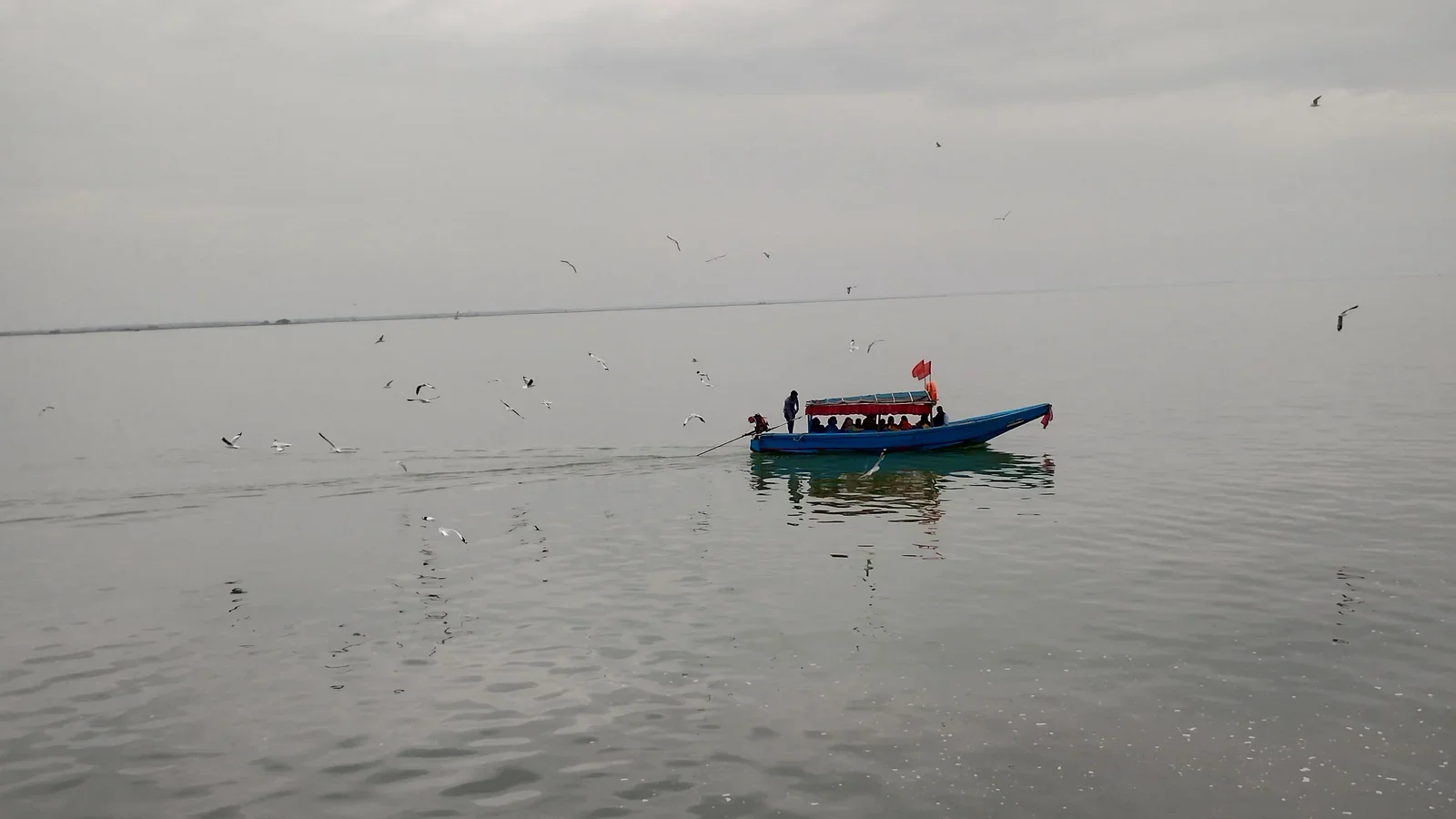
A boat and birds on Chilika, January 2026. The people and the boat’s purpose are not identified in the source.
Hellohappy. Source · CC BY-SA 4.0. Existing full-frame photographic copy resized; no crop, recolouring or content alteration.

Keeping fish and earning from it
Fishing work continues after a boat returns. IUCN’s November 2026 account introduces Subarna Sadhab of Pathara, who had spent nearly forty years selling fish. She travelled with other women to Balugaon and nearby markets. Her account of the physical strain of selling reminds us that the fish economy includes carrying and prolonged market work as well as catching.6
Drying creates another chain of tasks. In an October 2025 WorldFish report, Premalata Behera of Dalimbapur describes difficulties with open-air drying, including contamination by birds, insects and dust. She and other members of the Maa women’s self-help group received a solar tunnel dryer through a collaborative project. Training covered washing and drying, packaging, labelling and pricing.7
The report presents cleaner products and improved selling conditions as outcomes of that project.7 It is a particular group’s experience, rather than a measure of every dried-fish business in Odisha. The practical lesson is that a preservation technique depends on more than sunshine: the drying space, protection of the product and the route to a buyer all matter.
Sukhua also belongs to the kitchen as a family of preparations. Tanuja Tripathy’s Kokali Sukhua Rai uses dried fish with mustard and garlic paste, onion, tomato and mustard oil.8 This named contribution supplies a cook’s version, not a fixed recipe for every household. The vernacular fish name is retained here without assigning it a biological species.
The two accounts meet at the ingredient. The processor works to preserve fish that someone else will choose and cook. Recording the dish alongside that work gives a fuller sense of what reaches the table, while leaving room for households that prepare sukhua differently or do not eat it.
Leaves at the household fire
A leaf can form part of the cooking vessel. Away in the Kitchen’s 2024 account of patrapoda describes food enclosed in leaves, with the wrapping taking the direct heat while moisture is retained inside. The author’s home versions include fish and mushrooms prepared with an Odia-style spice paste. The ingredients change while the parcel remains the organising idea.9
Leaf choice and heating method need to be considered together. The same account discusses banana and other leaves, and distinguishes roasting or searing from steaming. Enduri pitha, enclosed in turmeric leaves and steamed, shows why wrapping alone cannot identify the technique. Its comparison with Bengali paturi also places Odisha’s practice beside a neighbouring culinary tradition without claiming a single origin.9
In Chandbill, the mahua study records flowers and rice ground into a paste, enclosed between sal leaves and fire-cooked. The authors call it cake.2 A gathered flower, cultivated grain and leaf wrapper meet in this preparation; its recorded form belongs to that local account.
Such accounts make the leaf worth noticing before it is discarded. A food history concerned only with the finished dish would miss the wrapping material and the cook’s choice of heat. The parcel connects plant knowledge with the management of a fire, just as a drying place connects a catch with a later meal.
Across these places, continuity depends on opportunities to practise. A person needs access to the ingredients, time to do the work and someone from whom to learn. The forest collector, fish seller and cook each hold part of that knowledge. Their names and circumstances belong beside the food, so that a remembered taste does not become detached from the people who make it possible.
Footnotes & Sources
- Regional Plant Resource Centre · Wild Edible Fruit Garden. Names, household use, market exchange and conservation purpose. No present-day abundance or statewide diet figures inferred. ↩
- Behera and colleagues · Mahua use among Santhal residents. Annals of Tropical Research 38(1), 2016, pp. 94-104; 2009 fieldwork. Collection and storage on pp. 96-97; sal-leaf cake on p. 98. Author-uploaded text consulted. ↩
- Mishra and Pradhan · Forest products in Kendujhar. Indian Journal of Agricultural Marketing 32(3), 2018. Abstract: 120 households, six villages, Patana and Bansapal. Includes edible and non-edible products; fieldwork year unspecified. ↩
- Jitu Mishra · Chandipur and Balaramgadi. Odisha Tourism, 10 October 2019. Dated account of the Budhabalanga river mouth, boats, landings and auctions. ↩
- Chilika Development Authority · Environments. Lagoon ecology, freshwater inputs, seasonal salinity and fishery productivity. Historical numerical inventories are not used as current totals. ↩
- IUCN · Sustaining fishing traditions at Chilika. 11 November 2026. Kalupada fishing routines and Subarna Sadhab’s market work. Reported experience, not independent fieldwork for this chapter. ↩
- Baishnaba Charan Ratha · Premalata and solar-dried fish. WorldFish, 8 October 2025. Dalimbapur and the Maa women’s group; processing and business training. Project-reported outcomes, not statewide earnings. ↩
- Tanuja Tripathy · Kokali Sukhua Rai. Contributor recipe on Odia Recipes. Used for ingredients and a named preparation; species identification and shelf-life claims are not adopted. ↩
- Away in the Kitchen · Patrapoda Paturi and Bhapa. 4 March 2024, updated 21 March. Attributed home-cooking account of leaf parcels, heating methods and regional comparison. ↩
Both photographs are reproduced full-frame from existing credited project copies, resized without content alteration under CC BY-SA 4.0. Creator, source and licence links accompany each caption. They show regional landscapes, not the named participants or preparations discussed. Sources checked 13 November 2026.
Suggest an update
Share a correction or source for this chapter. GitHub submissions are public. Please omit private contact details and consent documents.