
Part 6 · Food, Work and Ecology
Chapter 36 of 48
Markets, Makers and Cultural Livelihoods
Making a living through skill and exchange
A painted cloth, a woven sari or a bright appliqué hanging enters a market carrying hours of work. Its journey may begin in a household workshop and continue through a trader, a fair, a cooperative outlet or an online order. Each route connects making to buying in a different way.
Odisha’s cultural livelihoods become clearer when we follow these routes. This chapter moves from weekly markets and artisan villages to organised marketing and changing demand. It asks what a sale tells us, what it leaves out, and how the people who make an object can remain visible after it leaves their hands. A well-attended market and a secure livelihood are related achievements, but one does not automatically establish the other.
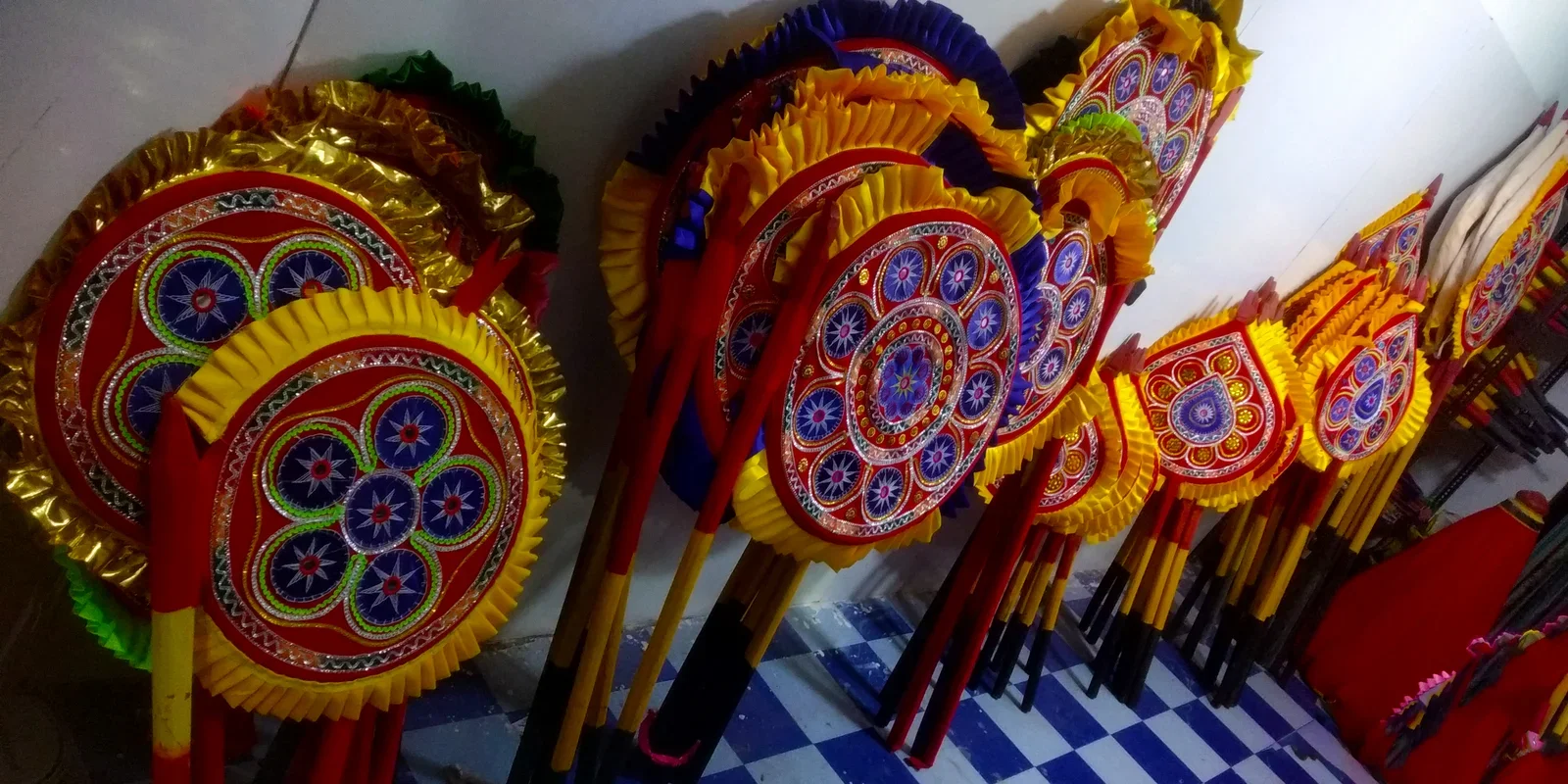
Pipili appliqué display, photographed in 2022. The individual makers are not named in the source.
Rahul Mukherjee. Source · CC BY-SA 4.0.

The weekly market and the artisan village
At Onukadelli, near Duduma, the weekly haat is identified by the Koraput district administration as a Thursday gathering attended by Bonda people and visited by tourists.1 The meeting of trade and tourism deserves care: a market is a place where people conduct their own business, even when it also interests an outsider.
A visit can begin with what is being exchanged and how the market works. Who has brought something to sell? Who has come to buy? How far must a seller travel? These questions bring economic activity into view. Asking permission before making portraits and respecting a seller’s time allow curiosity to coexist with the ordinary work of the market.
Raghurajpur offers a different relationship between making and selling. Sucharita Sahoo’s 2014 feature for the Press Information Bureau describes a village producing paintings, palm-leaf work, carved objects and toys. It records sales through NGOs, participation in exhibitions and visits by domestic and overseas travellers.2 The account shows several channels operating around the same place.
A workshop visit can let a buyer see an object before it is finished and hear about its making. An exhibition carries that work beyond the village. Both encounters may help a maker find customers, but they involve different demands on time, travel and presentation. The evidence of a sales channel is not yet evidence of what each household earns.
The weekly haat and the artisan village should therefore retain their different identities. One concentrates exchange on a recurring market day; the other brings visitors into a place of production. Neither can be understood fully from the visitor’s experience alone.
The organisations between maker and buyer
Utkalika’s institutional account dates the Odisha State Co-operative Handicraft Corporation to 1959 and identifies support for artisan marketing as a founding purpose. Its activities include exhibitions, raw-material support, training and product development. The organisation also describes its own online shop and partnerships with other e-commerce businesses.3
This is an intermediary role, but the word intermediary does not explain the terms of a transaction. A useful assessment asks what work an organisation undertakes: finding customers, displaying products, arranging transport or holding stock. It also asks when the maker is paid, who sets the price and who carries the risk if an item remains unsold.
Mission Shakti’s account of its partnership with ORMAS places women’s producer groups and self-help groups within a wider programme of market access. It names packaging, labelling, branding, buyer meetings, retail outlets and exhibitions, alongside working capital and training.4 These activities recognise that the ability to make a product and the ability to sell it require different resources.
ORMAS also describes Pallishree Melas organised alongside events such as Rath Yatra at Puri and Balijatra at Cuttack.5 A cultural gathering can thus become an occasion for commerce. The fair offers a meeting point, while the maker still needs to turn that encounter into a workable order, a payment or a continuing customer relationship.
Collective and institutional channels matter because they can distribute the work of reaching buyers. Their value to producers is best examined through the terms of participation and the results over time, rather than through the visibility of a stall or a brand alone.
What a selling price can tell us
The price attached to a finished sari is a price for the object at that point of sale. It is not, by itself, the weaver’s wage. To understand a livelihood, we need to know whether the maker owns the product or is paid for a particular task, what expenses they bear, and how much time the work takes.
Where a maker sells their own work, gross receipts still have to be considered alongside materials, hired labour, transport and other costs. Where someone works for a task payment, the relevant questions include the rate, the hours required and the regularity of orders. These are different arrangements and should not be combined into a single claim about artisan income.
The photograph below makes one stage of production visible. It records Sambalpuri sari weaving, but the source does not identify the weaver or his payment arrangement. His work deserves recognition without attaching an invented income to his image.
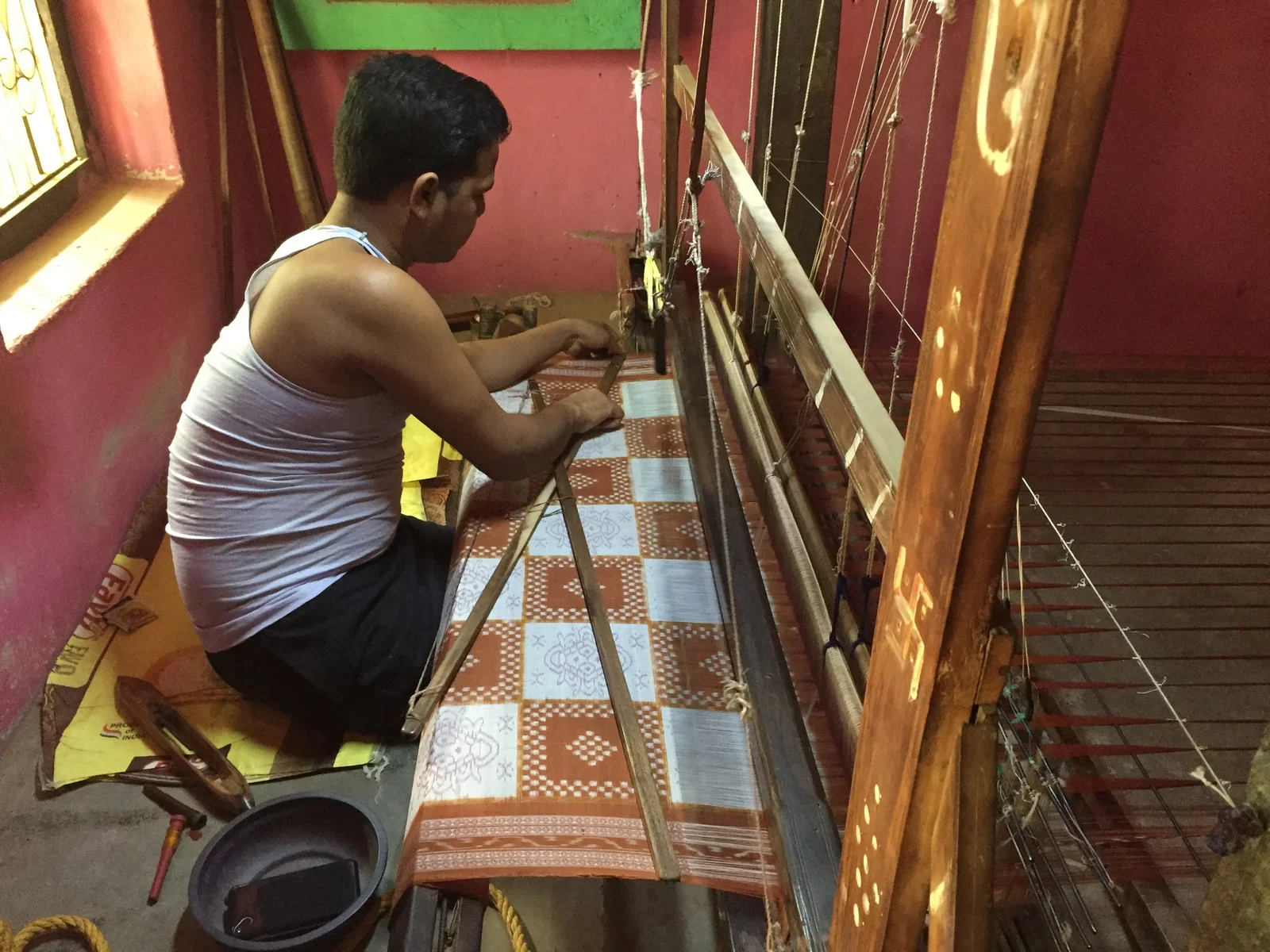
Sambalpuri sari weaving · the image record does not identify the weaver.
Saileshpat. Source · CC BY-SA 4.0. Resized and converted to WebP; full frame retained. Derivative available under CC BY-SA 4.0.

Changing demand and the future of making
Changes in marketing are also changes in what makers are asked to do. Utkalika’s account includes product development and online selling alongside exhibitions.3 Reaching a distant customer raises practical questions about photographs, descriptions, packaging, delivery and returns. A wider audience creates possibilities, while the work of serving that audience still has to be organised and paid for.
Pipili provides a recent example of how these questions enter public policy. On 4 June 2026, the Chief Minister’s office announced the laying of the foundation stone for a Pipili Chandua Handicraft Hub. The announcement described a proposed raw-material bank and training in digital marketing and packaging, including support for women’s self-help groups.6
These are announced provisions, not demonstrated increases in earnings. Their eventual significance will depend on access, implementation and use. A raw-material service becomes meaningful through its availability and terms; marketing training becomes meaningful when a producer can apply it to orders that are worth fulfilling. The distinction keeps an account of cultural development grounded in the working lives it seeks to support.
Tourism likewise needs to be considered beyond visitor numbers. A useful question is whether an encounter leads to a sale on acceptable terms, repeat business or recognition of the maker. A visitor can contribute by asking who made an object, listening to the explanation of its work and recording the maker’s name when sharing it.
Cultural livelihoods continue through the ability to practise a skill and make a living from it. Markets, organisations and visitors all help shape that possibility. Following an object beyond admiration towards its terms of production and exchange gives its maker a fuller place in Odisha’s cultural story.
Footnotes & Sources
- Koraput District Administration · Onukadelli. Weekly market and Bonda participation. Used for these particulars; the page’s outdated ethnographic terminology is not adopted. ↩
- Sucharita Sahoo · The land of artisans Raghurajpur. Press Information Bureau, 11 April 2014. Craft production, NGOs, exhibitions and visitors; no current household-income claim inferred. ↩
- Utkalika · Our Story. Institutional history and description of marketing, raw-material support, product development and online channels. ↩
- Department of Mission Shakti · ORMAS partnership. Programme description covering women’s groups, market access, packaging, working capital and training; objectives are not treated as measured results. ↩
- ORMAS · Exhibitions. Description of Pallishree Melas alongside religious and cultural events, including Rath Yatra and Balijatra. ↩
- Chief Minister’s Office Odisha · Pipili Chandua Handicraft Hub. 4 June 2026. Foundation-stone announcement and proposed facilities; completion and income effects are not asserted. ↩
Both photographs are reused from this edition’s credited research collection under CC BY-SA 4.0. The existing full-frame WebP images are resized for the page without further content alteration. Creator, source and licence links appear in the captions. Sources checked 13 November 2026.
Suggest an update
Share a correction or source for this chapter. GitHub submissions are public. Please omit private contact details and consent documents.