
Part 6 · Food, Work and Ecology
Chapter 34 of 48
Sacred Food and Shared Meals
Offerings labour and the meaning of sharing
An earthen pot of rice can be read in several ways: as food, as the work of cooks and potters, and as an offering returned to devotees. At Puri, Mahaprasad joins these meanings. Odisha Tourism describes it as food offered at the Jagannath temple and shared as an expression of devotion and community.1
The sacred meal has a life beyond its ingredients. This chapter follows the passage from preparation to offering and distribution, then turns to Ananta Basudeva in Bhubaneswar and to food observances during Kartika. The questions are practical as well as devotional: who makes the meal possible, how does it reach people, and what does sharing mean in a particular place?
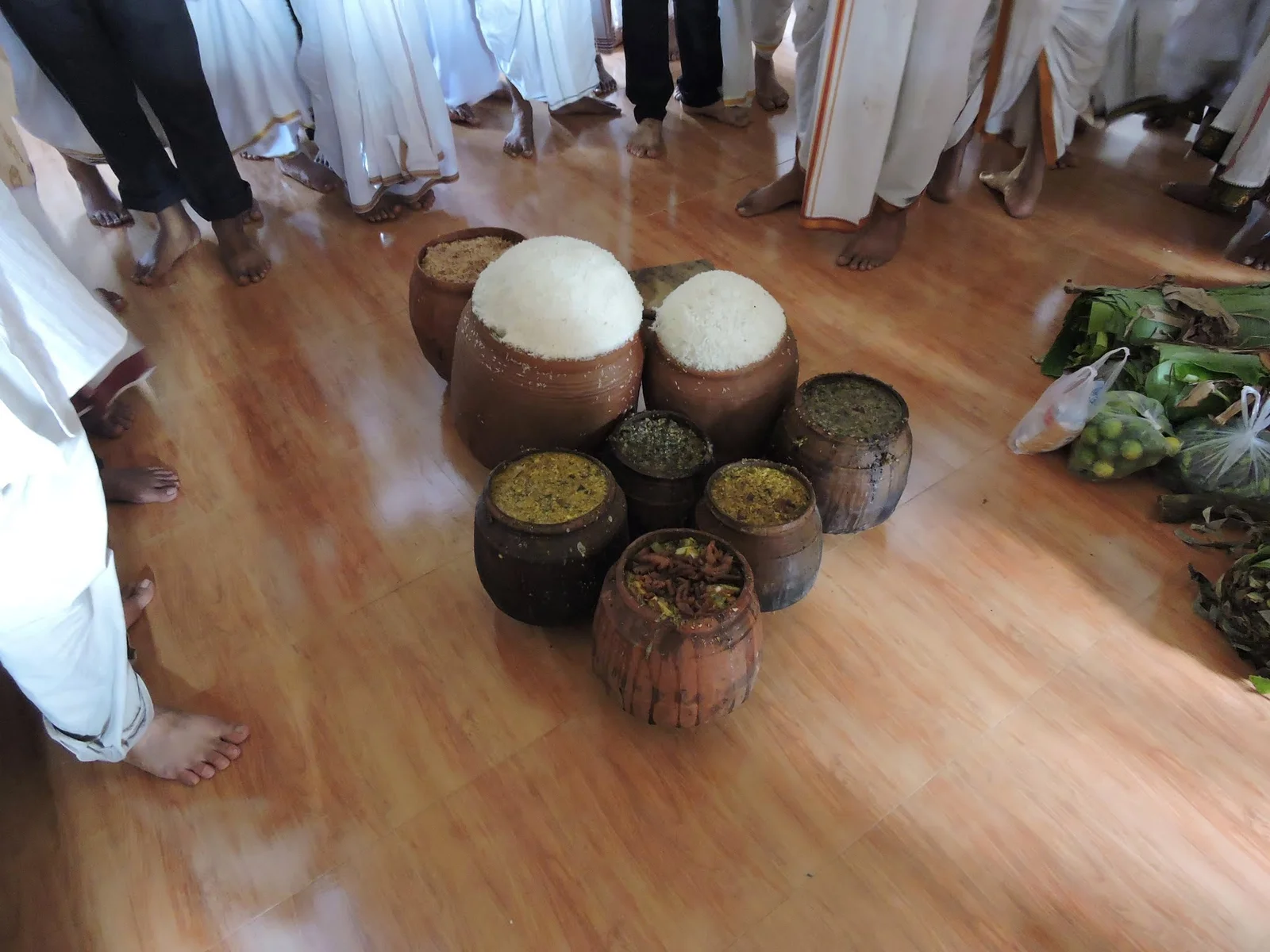
Mahaprasad in earthen pots at Puri, 2015, as identified by the photographer.
Yuv103m. Source · CC BY-SA 4.0.

From offering to shared food
Mahaprasad’s identity rests on its ritual relationship to the deity. D’source’s documentation of Puri temple pottery describes food offered first to Jagannath and then to Bimala, after which it is regarded as Mahaprasad.2 A preparation with similar ingredients elsewhere is not made identical by its recipe alone. The offering is part of what the food means.
Rice, lentils, vegetables and milk-based preparations belong to the repertoire described by Odisha Tourism. Its account identifies earthen pots and wood-fired cooking, and locates the distribution of Mahaprasad at Ananda Bazar inside the temple premises.1 For a devotee, receiving the food extends worship into the act of eating.
Ananda Bazar is also a place of sale. In a 2013 account of the temple economy, Abhimanyu Dash describes Suar cooks preparing food at their own cost, offering it and selling it to pilgrims. He notes that demand changes with festivals and family ceremonies.3 Sacred significance and payment coexist here. Calling the meal shared should not imply that every portion is distributed without charge.
The ideal of eating across social distinctions is central to accounts of Mahaprasad.12 It needs to be considered alongside access to the institution. Odisha Tourism’s visitor guidance states that the Jagannath temple restricts entry to non-Hindus.4 The language of equality around food therefore does not mean unrestricted admission to every sacred space.
Keeping these distinctions visible allows a fuller account of hospitality. There is the food’s ritual status, the way it is obtained, the people with whom it is eaten, and the rules governing the place. Each belongs to the experience; none should be made to stand for all the others.
The people behind the pot
The meal begins before the kitchen fire is lit. D’source’s study, credited to Bibhudutta Baral, Divyadarshan C. S. and Aakash Sharma of NID Bengaluru, documents temple pottery at Puri. Clay is prepared, shaped and dried before firing; finished vessels are then supplied to the temple. The study also records the Kumbhar Pada potters’ association.2
A vessel’s plain appearance can conceal the judgment needed to make it. The potter works with clay consistency, shape and drying; the kitchen depends on the resulting object. Looking at sacred food through its containers brings a craft community into view, alongside the better-known religious institution.
Dash’s 2013 account names another chain of work. Bojhias carry Mahaprasad from offering areas to Ananda Bazar. Workers prepare vegetables and grind spices, while Suar cooks undertake the cooking. The account also describes food portions called khei received by servitors for service.3 These details belong to that dated study, but they show why “the temple kitchen” is too broad a phrase to identify everyone’s contribution.
Devotional service is consequently also skilled labour and livelihood. A description that praises abundance without naming the work can leave its makers invisible. Equally, sales revenue alone cannot tell us what a household earns after its costs, or how regularly a worker receives an assignment.
To follow a pot to the meal is to follow several kinds of knowledge. It asks us to notice preparation, carrying and cleaning alongside cooking, and to recognise that the experience of receiving food depends on work distributed across many hands.
Another kitchen in Bhubaneswar
At Ananta Basudeva temple in Bhubaneswar, sacred food is also part of the institution’s public identity. Odisha Tourism describes its Abadha tradition and associates the Bhoga Mandapa with offerings.5 The temple provides a second setting for thinking about food, worship and gathering, with its own history and routines.
The photograph below, taken in 2017, makes the material setting unusually visible. Earthen vessels stand in groups; firewood lies nearby; people carry, prepare and move between work areas. It is Ananta Basudeva’s kitchen, not a photograph of the kitchen at Puri.
The image brings the discussion back to effort. A sacred meal requires ingredients and fuel, but also room to work, vessels to handle and people who know the sequence. The food offered to a deity remains connected to this ordinary, demanding world of preparation.
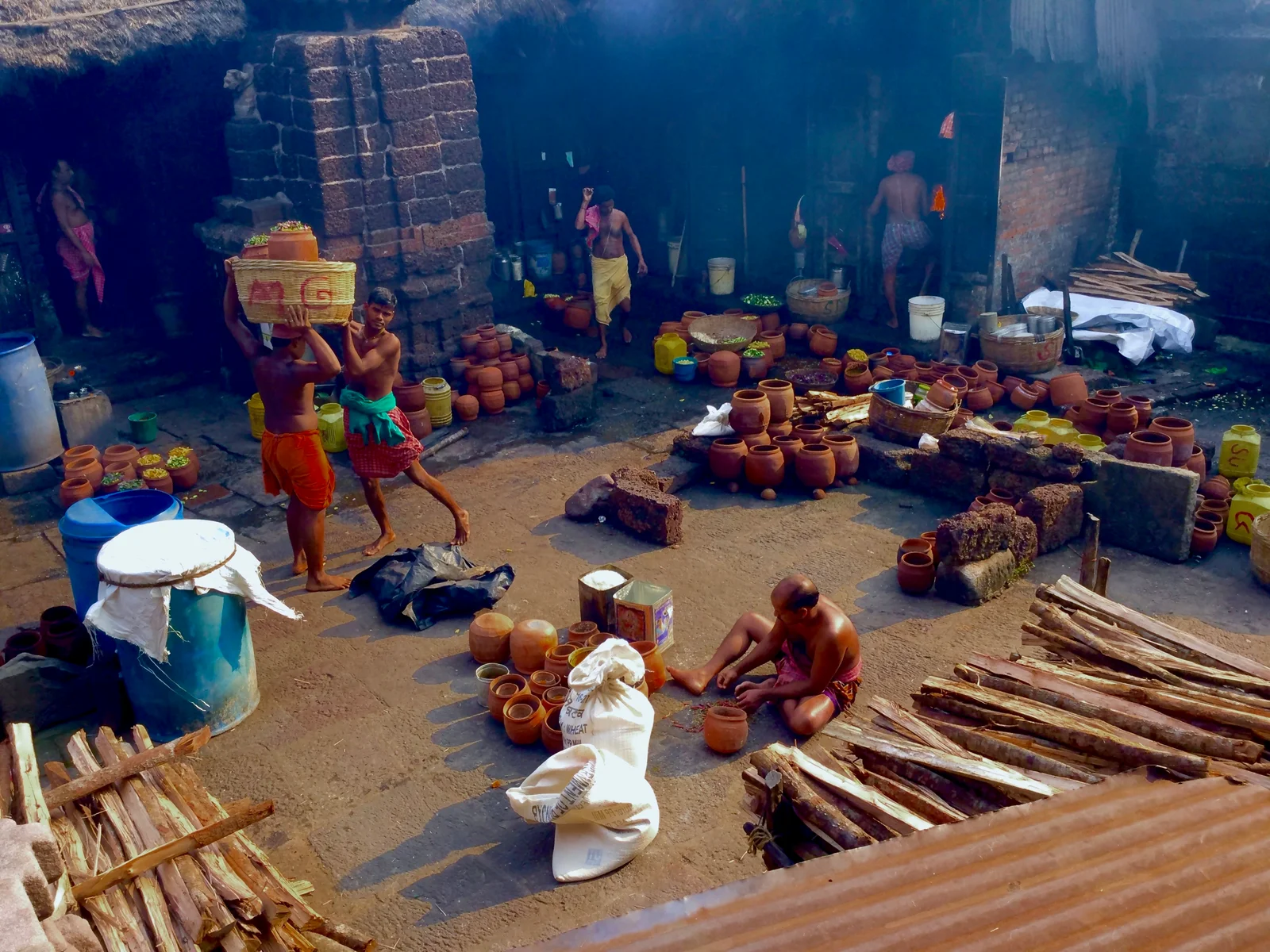
Ananta Basudeva temple kitchen, Bhubaneswar, 26 November 2017. People pictured are not named in the source.
Prateek Pattanaik. Source · CC BY-SA 4.0.

Observance at the household scale
Sacred food also takes shape through choices about what to eat and what to set aside. The Visit Bhubaneswar account describes Habisha Dalma in connection with Kartika observance: unroasted moong, no turmeric, a restricted selection of vegetables such as elephant apple and raw banana, and pepper rather than chilli.6 This is one documented description, not a recipe binding every household.
Benudhar Patra and Punit’s 2018 study discusses Kartika brata at Puri, particularly in relation to widows. It examines Puranic prescriptions concerning food and the observance of vows.7 Such texts help explain religious ideals; they cannot, by themselves, tell us how every woman experiences the observance or what she eats today.
A household practice becomes more intelligible when its participant is allowed to describe it. Which restrictions does she follow? Who buys and prepares the ingredients? Does she cook for herself, join others or rely on someone’s care? These questions place agency and circumstances beside prescription, without assuming that one account represents all devotees.
The scale changes between a household pot and a temple kitchen, but both require repeated acts of provision. A meal must be planned, cooked and served; a vessel must be made or obtained. Attention to those tasks does not diminish devotion. It shows how devotion is sustained in material life.
Sacred food is therefore worth recording in more than a menu. Its story includes the offering, the maker, the carrier and the eater, as well as the conditions under which they meet. A shared meal can express belonging while also prompting questions about who can participate and whose work receives recognition.
Footnotes & Sources
- Odisha Tourism · Mahaprasad. Official overview: offerings, ingredients, earthen-pot cooking, Ananda Bazar and the ideal of sharing. ↩
- Baral, Divyadarshan and Sharma · Temple Pottery. D’source, NID Bengaluru. PDF pp. 3–5 and 10: ritual sequence, potters’ association, materials and process. No output or income figures adopted. ↩
- Abhimanyu Dash · Economic Condition of the Temple and Sevakas. Odisha Review, November 2013, pp. 1–4, especially 2–3. Historical description of cooks, carriers, preparation work, khei and sales. ↩
- Odisha Tourism · Travel Do’s and Don’ts. Religious-site guidance on entry restrictions; checked 13 November 2026. ↩
- Odisha Tourism · Ananta Basudeva Temple. Official account of the Abadha tradition and the offering hall in Bhubaneswar. ↩
- Visit Bhubaneswar · Odia Cuisine. Dalma section, Habisha paragraphs. Used for the specific preparation described; no claim of uniform household practice. ↩
- Patra and Punit · Seeking Refuge in the Lord. Odisha Review, November 2018, pp. 33–38. Kartika brata, widowhood and Puranic prescriptions; especially p. 36. ↩
Both documentary photographs are reproduced full-frame and resized without content alteration under CC BY-SA 4.0. Source, creator and licence links appear in the captions. Puri and Bhubaneswar are identified separately. Sources checked 13 November 2026.
Suggest an update
Share a correction or source for this chapter. GitHub submissions are public. Please omit private contact details and consent documents.