
Part 2 · Faith, Seasons and Shared Spaces
Chapter 7 of 48
Jagannath and the Many Worlds of Puri
Devotion service and the life of a sacred city
The temple tower is Puri’s most recognisable landmark, but the worlds gathered around Jagannath extend beyond its outline. They include the daily work of service, the public road along which the deities travel, the preparation of food and the songs through which a devotee addresses the Lord. Each offers a different way into the city.
Jagannath is worshipped with Balabhadra and Subhadra. The district’s account places the present great temple in the twelfth-century world of the Ganga ruler Anantavarman Chodaganga.1 That historical association is one part of the story. Sacred narratives, inscriptions and continuing practices preserve other kinds of memory. Reading them together allows the temple to appear as a living institution, sustained by people as well as stone.
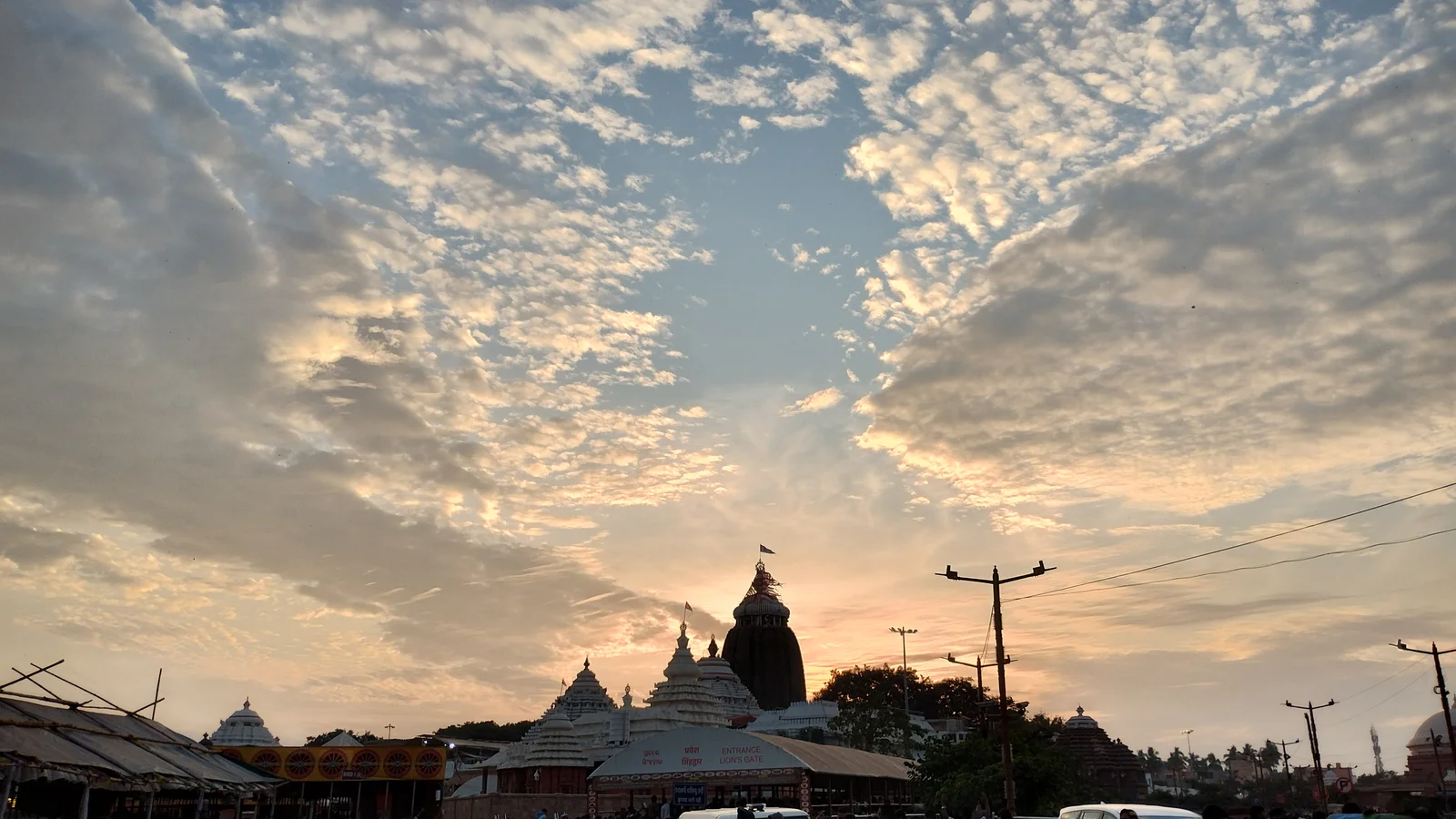
An exterior evening view of Jagannath temple, Puri, photographed on 10 January 2026.
Hellohappy. Source · CC BY-SA 4.0.

Sacred narrative and historical time
In the Purushottama Kshetra narrative of the Skanda Purana, King Indradyumna seeks a place where he can behold the deity. Vidyapati travels on his behalf and encounters Visvavasu, a Sabara devotee, in a forest setting. In G. V. Tagare’s translation, Visvavasu welcomes the traveller and offers hospitality; Vidyapati asks to see Nilamadhava.2
This meeting gives the forest devotee a central place in the telling. Knowledge of the deity is already present before the royal seeker arrives. It would diminish the narrative to reduce Visvavasu to a passing figure on the way to the king’s achievement. It would also ask the text to do something different from its purpose if its sacred chronology were turned directly into a modern historical date.
Inscriptions provide another kind of evidence. D. C. Sircar edited four records in the Patalesvara shrine within the temple complex. His discussion distinguishes the Madala Panji’s construction tradition from Ganga dynastic records crediting Chodaganga, and notes the scholarly interpretation that Anangabhima completed work begun by Chodaganga.3 The question concerns stages of building and patronage, rather than a simple choice between a true story and a false one.
One record, dated by Sircar to 1225, concerns land granted to support offerings of milk, ghee, rice and curds to Purusottama. Here the historical record brings cultivation into the sacred centre. Worship required continuing material provision, and a donor made arrangements for that provision to endure.3
The sacred story and the inscription answer different questions. One makes a divine presence known through a journey and an encounter; the other records an act of support. Neither, by itself, establishes the first moment of worship at Puri. Their value grows when their differences remain visible.
Service as knowledge and livelihood
The temple’s ritual life depends on sevayats, or servitors, whose responsibilities form an organised system of service. A study published in 2019 by S. Samanta, R. K. Nanda and P. Rautaray examined the social and economic circumstances of these ritual functionaries. Its fieldwork took place from October to December 2017.4
The researchers found variation in earnings according to the kind of service and the days allotted to it. They also described younger family members seeking other employment while continuing to take their turn in ritual service. Their study acknowledges that permission and access shaped the selection of participants.4
These findings invite attention to the household behind the ritual role. Devotion and livelihood can coexist without the latter cancelling the former. The continuity visible to a pilgrim depends on people maintaining knowledge, organising their time and earning enough to sustain their families.
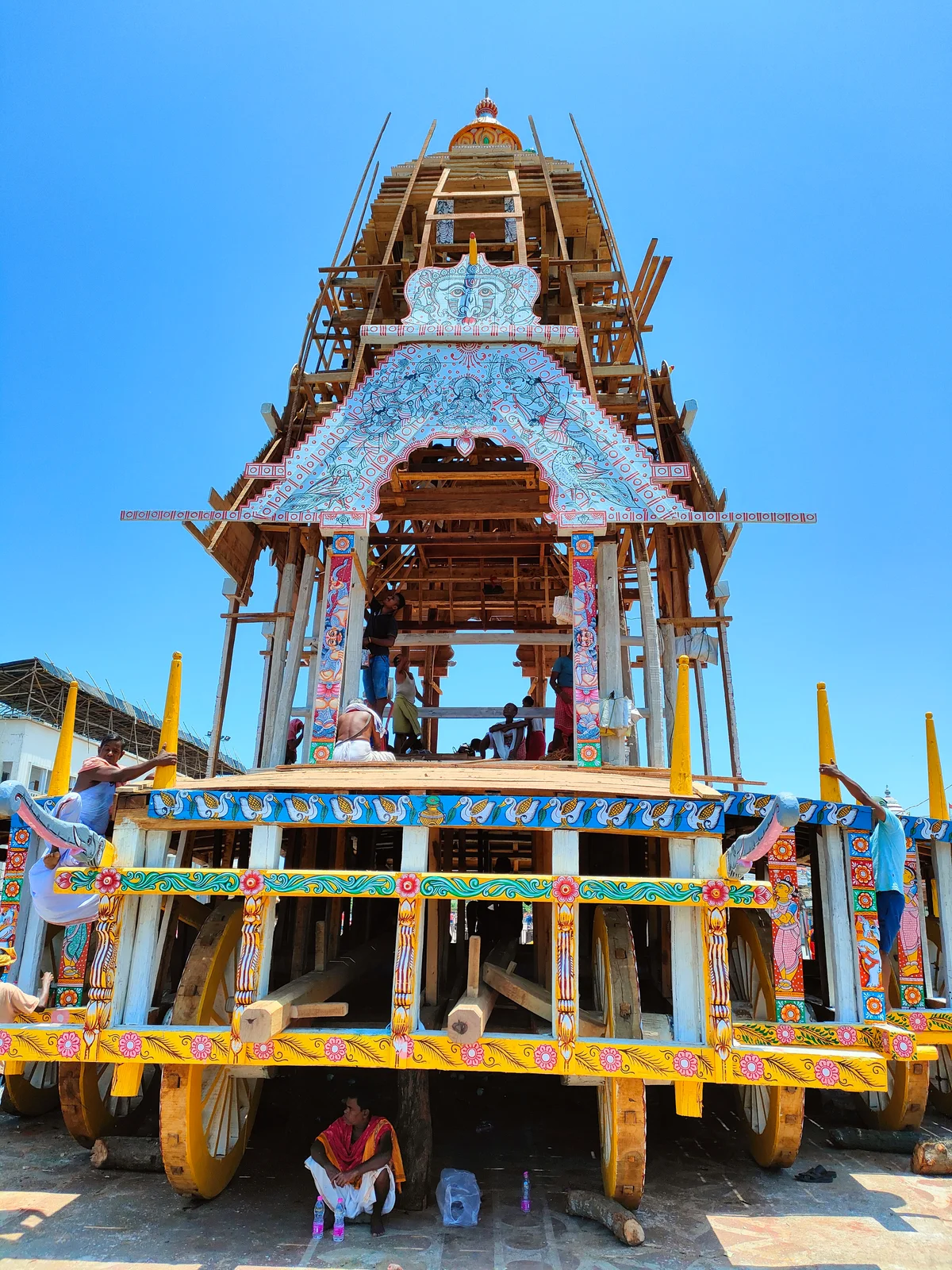
A chariot under construction, dated 26 June 2022 in the file record. The people pictured are not individually named by the source.
ArunKuRout. Source · CC BY-SA 4.0.

Food and the material life of worship
Mahaprasad brings worship into the act of receiving and eating food. Incredible India’s temple account describes daily cooking in earthen pots and identifies the food as a sacred offering.5 The vessel matters as well as the dish: material, handling and preparation belong to the practice, not merely to its presentation.
The thirteenth-century land grant offers a historical counterpart to that present description. It records resources directed towards offerings; it does not establish that today’s recipes or kitchen arrangements have remained unchanged.3 Continuity can be understood through the recurring commitment to feed the deity, even while the detailed history of ingredients, labour and supply needs its own evidence.
A meal also changes the scale at which a pilgrimage is remembered. The great tower may be seen from a distance, while food is received and shared at close quarters. In that movement from monument to meal, the institution becomes part of bodily experience: waiting, hunger, taste and the company in which one eats.
To write about this world only through quantities would miss much of its meaning. Claims about the largest kitchen or the greatest number of meals can obscure more useful questions: who prepares the food, how work is organised, and how devotees understand what they receive. The servitors’ livelihood study reminds us that institutional grandeur does not imply identical circumstances for everyone who serves.4
The history of food at Puri therefore belongs beside the history of patronage and skill. A grant of agricultural land, a cooking pot and an allotted turn of service illuminate different parts of the same relationship. Sacred value is made present through material work, repeated from day to day.
When the deities take the road
Ratha Yatra changes the relationship between the temple and the city. Jagannath, Balabhadra and Subhadra travel on three wooden chariots along Bada Danda, the Grand Road, towards Gundicha Temple. The return journey is known as Bahuda Yatra.6 Worship becomes visible through movement across a public urban space.
The finished chariot can seem a single magnificent object. The construction photograph on the preceding pages shows a different state: exposed timber, wheels and painted components before the covering is complete. Incredible India’s account of Puri identifies Akshaya Tritiya as the occasion when master carpenters begin making the chariots.7 The festival thus has a season of preparation as well as a day of departure.
A road ordinarily understood as a route through town becomes a place towards which people direct their attention. That transformation depends on the workers who prepare the vehicles, the servitors who conduct the rites and the people who gather to witness them. The public spectacle joins forms of effort that are less easily seen.
The photograph below records the chariots before the return journey in 2015. It captures one moment in a particular year, with the crowd filling the foreground. It lets us see the scale of gathering without making every person in it stand for the same experience or reason for being there.
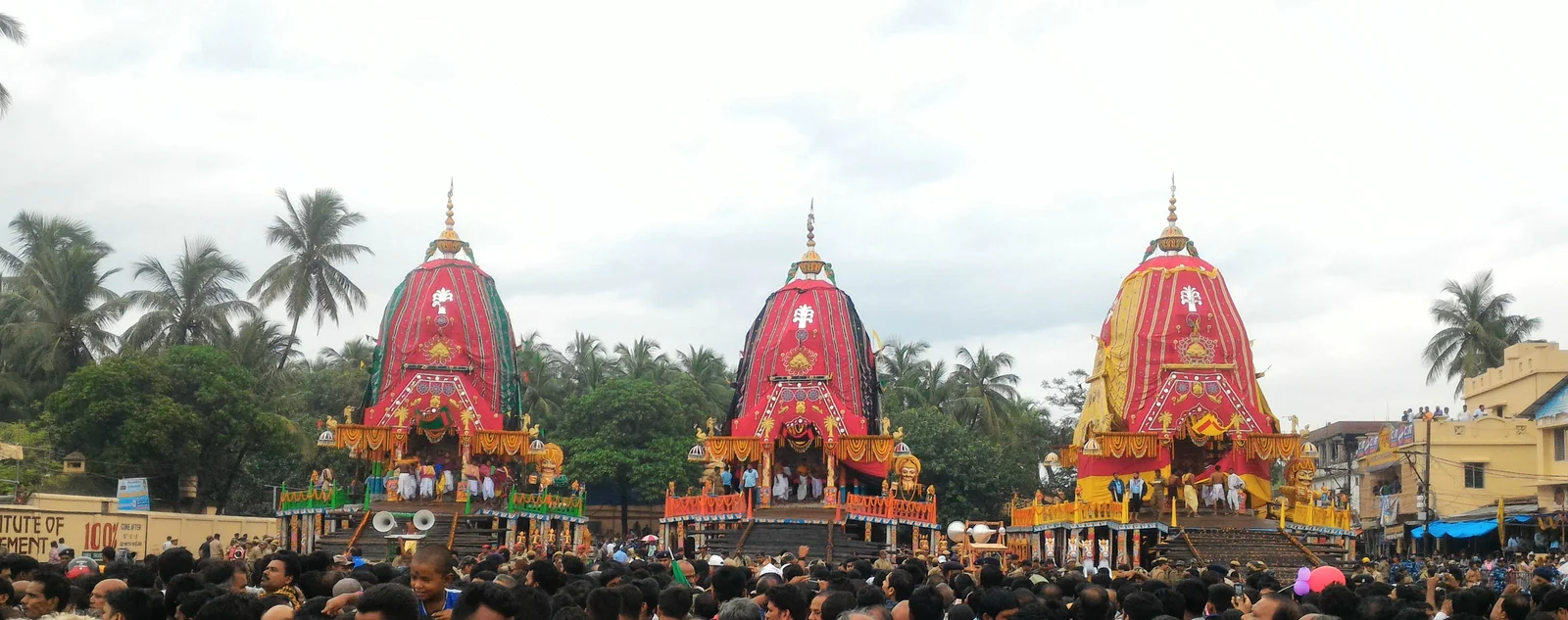
Chariots at Gundicha Temple before Bahuda Yatra, 26 July 2015.

A voice beyond the threshold
Salabega’s devotional voice complicates any easy equation between access to the temple and attachment to Jagannath. In his essay “Songs of Salabega”, Subas Pani places the poet in the first half of the seventeenth century and recounts his exclusion from the temple because he was the son of a Muslim. Pani describes his devotion to Jagannath, identified with Krishna, and his view of Patitapabana from Bada Danda.8
The account places longing at a threshold. The poet’s place in devotional memory does not erase the boundary he is said to have faced. Instead, it asks the reader to hold belonging and exclusion in the same view. A song can address a deity intimately even when the singer cannot enter the institution associated with that deity.
The distinction remains relevant to a present account of Puri. Odisha Tourism’s published guidance identifies restrictions on non-Hindu entry to the Jagannath temple.9 Public participation in a procession, devotion expressed in song and admission to the interior are different forms of relationship. They should not be collapsed into a general claim that everyone participates on the same terms.
Reading the many worlds together
The many worlds of Puri meet without becoming identical. A donor’s inscription records provision; a sacred narrative tells of revelation; a servitor maintains a responsibility; a pilgrim waits for a glimpse. The maker’s skill and the poet’s longing each bring something that a view of the building alone cannot explain.
This is why the temple belongs in a cultural history as both a sacred centre and an institution of work, memory and encounter. Respectful attention can hold devotion and historical inquiry together. It can recognise the force of a shared celebration while asking whose labour supports it and how people’s access differs. Puri becomes richer to read when none of these questions is allowed to stand for the whole.
Footnotes & Sources
- Shree Jagannath Temple. Puri district administration. Deities and twelfth-century association with Chodaganga; not a complete building chronology. ↩
- The Story of Indradyumna. Skanda Purana, Purushottama Kshetra Mahatmya, chapter 7, especially verses 48–50 and 82–99; G. V. Tagare translation. Sacred narrative. ↩
- Puri Inscriptions of Anangabhima III, Saka 1147 and 1158. D. C. Sircar, Epigraphia Indica XXX, article 34, printed pp. 197–198 (PDF pp. 274–275). Construction traditions and the 1225 offering grant; dating follows the editor. ↩
- A socio-economic study of ritual functionaries. S. Samanta, R. K. Nanda and P. Rautaray, Cogent Social Sciences 5 (2019), 1669382. See abstract and methods, including access-based sampling limitations. ↩
- Sri Jagannath Temple. Incredible India, “Divine flavours and festive fervour”. Used for Mahaprasad and earthen-pot cooking; promotional scale claims omitted. ↩
- Rath Yatra. Incredible India / Odisha Tourism. Chariot journey and festival sequence. No crowd total or current travel schedule adopted. ↩
- Things to Do in Puri. Incredible India. Chandan Yatra passage identifies Akshaya Tritiya as the start of chariot construction. ↩
- Songs of Salabega. Subas Pani, Orissa Review, June 2004, pp. 1–3. Attributed literary and devotional biography; no song lyrics reproduced. ↩
- Travel Dos and Donts. Odisha Tourism. Published entry restriction consulted 9 November 2026; not a guide to individual eligibility or visiting arrangements. ↩
Photographs are reproduced full frame, with metadata orientation applied and scaling for the page; no crop or recolouring. Captions link to the original records and licences. The temple and construction images retain CC BY-SA 4.0 terms; the Bahuda Yatra photograph is offered under CC0 1.0. No reconstructed or generated scenes are included.
Suggest an update
Share a correction or source for this chapter. GitHub submissions are public. Please omit private contact details and consent documents.