
Part 1 · Land, History and Belonging
Chapter 6 of 48
Odisha Beyond Its Borders
Work language and belonging across distance
Odisha does not end at the state boundary. Its cultural life also takes shape in a worker’s room in Surat, an association meeting in North America and a language lesson in Chennai. These places belong to different histories of movement. A journey made for wages, one made for education and a childhood spent outside Odisha do not produce the same relationship with home.
What connects them is the work of making a life across distance. People find accommodation and employment through others, create occasions to gather, and decide what to teach their children. Sometimes return remains a plan; sometimes belonging grows in more than one place. Following these relationships reveals a cultural geography made by people as well as by borders.
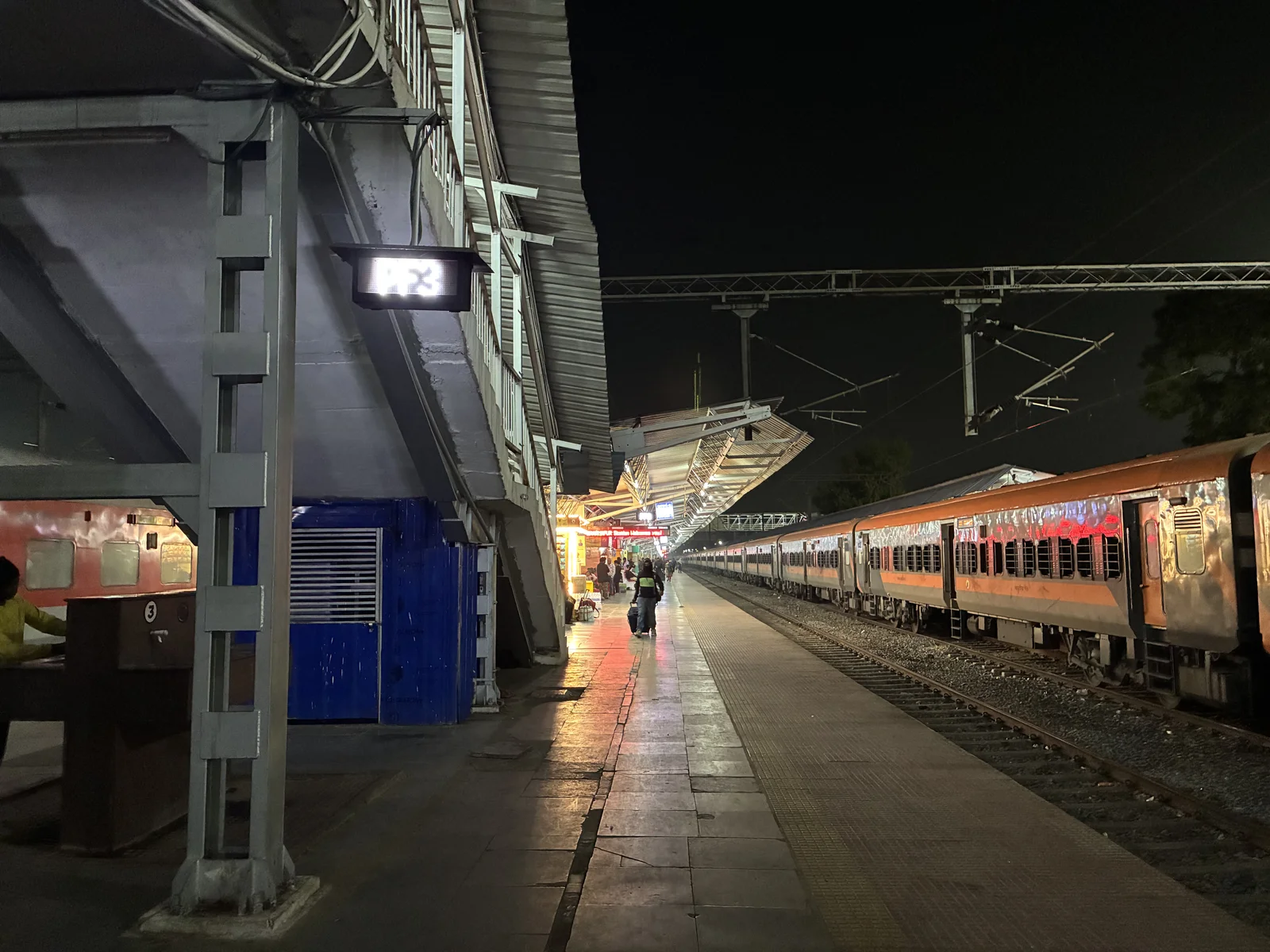
Brahmapur railway station at night, 8 January 2026. A view of the departure setting; neither the passengers nor the train are identified here as migrants or a Surat service.
Mouryan. Source · CC BY-SA 4.0.

The route to Surat
In Aishwarya Mohanty’s 2024 reporting from Kalamba in Ganjam, Kamallochan Sahoo recalled first travelling to Surat at eighteen. An uncle had gone before him. The presence of people he knew helped make the journey imaginable: work, accommodation and food did not have to be found entirely alone. He also remembered the attraction of the clothes and goods that returning workers brought with them.1
The same report recorded another experience. Mitika Nayak, from Bada Badangi, described caste discrimination during his two years in Surat, including being made to eat and live separately. Migration had not left the village’s hierarchies behind. Taken together, the accounts show how a network can offer security to some while leaving others excluded.1
The cultural meaning of a journey lies partly in these unequal possibilities. A familiar language can help someone find their way, but shared regional origin does not guarantee equal treatment. The words “Odia community” become more useful when they leave room for those differences.
Reetika Revathy Subramanian’s 2019 reporting for the People’s Archive of Rural India brings women’s work into this picture. Renuka Pradhan, from Sanabaragam in Ganjam, removed loose threads from machine-embroidered sarees in her home in Surat. The work required care: damage to the cloth could be charged to her. Production entered the same small space in which family life took place.2
The report also described Shanti Sahu working with her daughter Asha. Asha had left school after the available Odia-medium schooling ended at Class 8 and private education proved unaffordable. Elsewhere in the neighbourhood, Ranjita Pradhan organised work for other women after approaching factory owners directly.2 These are dated accounts of particular lives, but they widen the story of migration beyond the male mill worker.
Home, in these accounts, is both a remembered place and a room where income has to be earned. The making of a life away from Odisha includes the organisation of work and schooling, as well as the festivals through which that life becomes publicly visible.
Finding one another far away
An association begins with a practical discovery: other people nearby share something that matters to you. The New York and New Jersey chapter of the Odisha Society of the Americas remembers the late 1960s through small gatherings in houses and apartments. Its account places the home of Krushna Mohan Das in Cambria Heights among the settings where an organisation took shape.3
That chapter history also describes the gathering of names for a North American directory in 1970. It dates the first OSA convention to 17 October that year, in Hartford, Connecticut. A list of addresses and a meeting place helped turn scattered acquaintances into a wider association.3
The modest objects in this history deserve attention. A directory makes someone reachable. A programme gives a meeting a sequence; a souvenir preserves names that might otherwise disappear. Cultural institutions need these ordinary forms of organisation before they can present a performance or sustain an annual gathering.
The Odisha Society of New England’s own history traces the wider organisation’s beginnings to a New England initiative in 1969. It recalls a community puja in an apartment in 1976, a public-park picnic in 1982 and the formation of the regional society in 1983.4 These dates describe different stages of association building, rather than a single moment when a complete institution appeared.
Gatherings do more than recreate a familiar occasion. They give people reasons to meet repeatedly, allow newcomers to enter a circle and create experiences that children can remember for themselves. The place of celebration becomes part of the memory: an apartment or park in America can acquire a family significance alongside places in Odisha.
Association histories are accounts of the people who organised and participated. They illuminate a substantial part of life abroad without representing everyone who migrated. Those who did not join, could not attend or expressed belonging in other ways remain part of the larger story.
A language learned beyond home
Chennai offers a reminder that living beyond Odisha need not mean living outside India. The Prabasi Odia Cultural Society describes itself as an organisation for Odia families and individuals in Chennai and Tamil Nadu, founded in 2008. Its Ama Chatasali initiative teaches children to speak, read and write Odia, alongside cultural material that includes stories, music and dance.5
The society’s own description places attachment to Odisha alongside participation in Chennai’s life. That pairing matters. A child can belong to the city where they grow up while learning a language associated with parents or grandparents. The lesson need not ask them to choose one home and surrender another.
In North America, the Odisha Society of the Americas describes both remote and in-person Odia teaching. Its language programme also uses songs, speeches and plays around community celebrations, and vocabulary and speaking competitions at conventions.6 The language is being given occasions for use, as well as being taught as a subject.
These activities suggest a distinction between inheritance and access. A language may be described as someone’s mother tongue even when that person has had little opportunity to learn it. A class can provide an entry point without treating difficulty or hesitation as a failure of belonging.
There is also a difference between rehearsing a performance and being able to sustain an ordinary conversation. Both have value, but neither automatically supplies the other. The strongest cultural learning leaves space for questions, mistakes and changing interests. Children need opportunities to make something with a language, not only to demonstrate that they have received it.
Placed beside Asha’s account in Surat, organised heritage teaching raises a further question: who can continue learning, and under what conditions? Language attachment is shaped by time, income and available schools. Celebrating it is most meaningful when those practical conditions remain in view.
A chariot in another city
A photograph of a Ratha Yatra chariot in London offers a different kind of crossing. ISKCON’s account of its fiftieth London festival traces the first procession to 1969, from Hyde Park to Trafalgar Square. It credits the initiative to the movement’s early American devotees in London.7
This is a history of religious circulation as well as migration. A festival strongly associated with Jagannath and Puri can gather people whose ties to Odisha differ, or who have no family origin there. The London event should therefore not be treated as a photograph of an exclusively Odia diaspora.
The chariot’s presence among London buildings makes that distinction visible. The festival enters a new urban setting, with its own organisers, audience and devotional history. The connection to Odisha remains significant, but the public life built around it also belongs to the people and city in which it takes place.
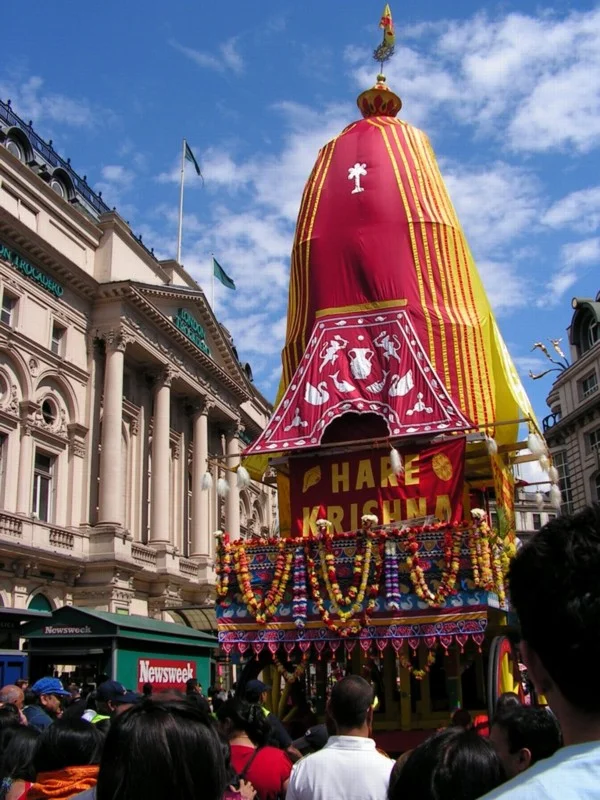
An ISKCON Ratha Yatra chariot in London, catalogued as 2007. The photograph documents a public festival, not the regional origins of its participants.
GourangaUK. Source · CC BY-SA 2.5.

More than one place to belong
The worker’s room, the association directory, the language class and the street procession reveal different ways of carrying attachments across distance. None is a complete measure of cultural belonging. Public celebration is easier to photograph than care, work or an unfinished conversation; an organisation’s archive is easier to find than the memories of someone who never joined it.
Keeping these forms together changes what counts as a cultural history. The person who arranges work, the woman who fits paid production around domestic life and the volunteer who prepares a lesson all help make collective life possible. Their circumstances differ sharply, but their labour belongs in the account alongside the stage and the festival.
Home can remain a village or neighbourhood in Odisha without making every other place temporary. It can also become a relationship that changes across generations. Some people return; others build lasting lives elsewhere. Their children may inherit a name, learn a language later or discover a tradition through friends rather than family.
Odisha beyond its borders is therefore an open history of relationships. Its continuity depends on people finding ways to meet, learn and support one another. Its richness also lies in the new experiences they bring to those relationships: experiences that enlarge what home can mean.
Footnotes & Sources
- Of caste, climate and the creation of one of India’s busiest migration corridors. Aishwarya Mohanty, The Migration Story, 23 December 2024. Named accounts from Ganjam; no population estimate is adopted here. ↩
- Pulling out threads for 500 minutes every day. Reetika Revathy Subramanian, People’s Archive of Rural India, 25 June 2019. Household work and schooling accounts reflect the reporting date. ↩
- About Us and History of this Organization. OSA NY/NJ. Institutional recollection of New York gatherings, the directory and the Hartford convention of 1970. ↩
- About and Our History. Odisha Society of New England. Institutional chronology of the 1969 initiative and subsequent regional activities. ↩
- Prabasi Odia Cultural Society and Ama Chatasali. Chennai society’s own account of its foundation, activities and teaching aims. Programme description, not an evaluation of learning outcomes. ↩
- Odia Learning. Odisha Society of the Americas. Programme description in Odia; paraphrased here in English. ↩
- 50th ISKCON London Ratha Yatra Festival. ISKCON News, 2018 festival announcement, quoting coordinator Titiksu das on the first London procession in 1969. An organiser’s historical account. ↩
Both photographs are reproduced full frame with orientation corrected from image metadata and scaled for the page; no crop or recolouring. Source and licence links appear in the captions. The station photograph retains CC BY-SA 4.0 terms and the London photograph CC BY-SA 2.5 terms. All online sources were consulted in November 2026. Institutional histories and programme descriptions are attributed to the organisations that publish them.
Suggest an update
Share a correction or source for this chapter. GitHub submissions are public. Please omit private contact details and consent documents.