
Part 8 · Modern Media and Cultural Futures
Chapter 47 of 48
Modern Art, Photography and Public Heritage
Making images and learning to look
A painting, a museum label and a photograph of a temple each direct attention. They select something for us to see, while leaving other things outside the frame. Odisha’s visual life includes this work of interpretation as well as the objects and places being represented.
Modern artists give inherited forms new purposes; illustrators build worlds on a page; public murals address people passing in the street. Museums and heritage walks arrange encounters with the past. Looking closely at these practices reveals how culture becomes public—and why a familiar image should still invite questions about its maker, setting and audience.
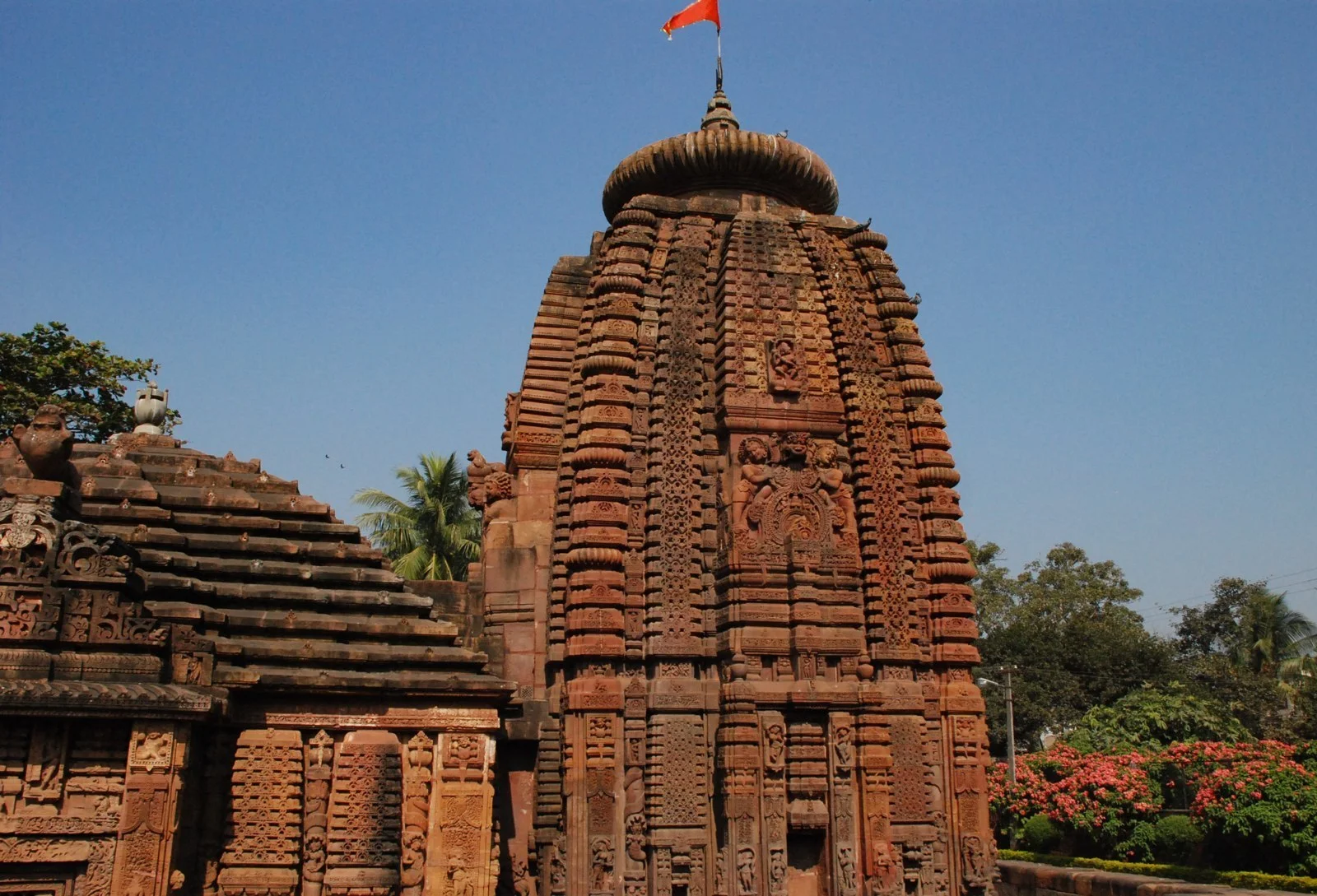
Mukteswar temple, Bhubaneswar, photographed in 2007. A monument within a larger inhabited landscape.
Bikashrd. Source · CC BY-SA 4.0. Resized and JPEG-compressed for the website. Responsive display may crop the view. Adaptations retain the stated share-alike licence.
Modern art across places and materials
Jatin Das offers one route into this field. The National Gallery of Modern Art, Mumbai, records his work Lovers as a pen-and-ink image of a seated couple. Its catalogue identifies his birth in Mayurbhanj and training at the Sir J. J. School of Art in Bombay, and draws attention to his interest in the human body and the possibilities of line.1 The record connects a particular work to a life that moved between places.
This is a useful starting point for looking at modern art from Odisha. Regional belonging need not mean that every picture illustrates a recognisable monument, costume or festival. Gesture, tension, intimacy and the handling of a material can matter as much as the subject’s location. A work may carry relationships with home without becoming a diagram of local identity.
Sculpture expands those possibilities into physical space. The President’s Secretariat’s 2025 profile of Odisha-born Adwaita Charan Gadanayak describes his work with abstract sculpture and identifies the Police Memorial in New Delhi among his projects.2 Such work asks viewers to consider mass, surface and placement as well as likeness. A public memorial also connects artistic decisions with the institutions and collective memories that commission it.
Collecting can propose another relationship between forms. JD Centre of Art’s collection account brings modern art and Jatin Das’s own work together with traditional arts, textiles, hand fans, films and books.3 That range invites comparison without making the objects interchangeable. A fan has a history of use; a painting has its own material and exhibition history. Bringing them into conversation is a curatorial choice, not proof that their differences have disappeared.
Images in books and on public walls
Illustration reaches many readers before they enter a gallery. In a picture book, an image helps establish who is present, how a place feels and what happens between one page and the next. It can extend a sentence or tell something the words leave unsaid. Decisions about line, colour and sequence are therefore part of the storytelling.
Bakul Foundation describes work with children’s authors and illustrators to create Odia picture books. Its education account also records the Udayanath Award for children’s book illustration, begun in 2015.4 This places illustration within a network of writers, artists, readers and encouragement. The making of a book involves more than supplying decoration after a story is finished.
A public wall has a different audience. People encounter it while travelling, working or waiting, often without having chosen to look at art. Bakul’s arts account describes a Wall of Peace painted after the violence in Kandhamal, involving professional artists and students. It records the same wall being repainted as the Wall of Water on World Water Day in 2013.5 The changing surface documents successive attempts to address public concerns.
Such an example also raises questions that remain useful beyond one project. Who chooses the subject? Whose account of a place becomes visible? Who maintains the work after its opening? A mural may invite reflection, advertise an institution or make an ordinary route more memorable. Calling it public art should begin discussion about its relationship with the public, rather than end that discussion.
Artists, illustrators and participants need names in this history. A city’s visual identity is made through individual labour and collaboration, even when the finished image is later described simply as local culture.
The photograph and its missing name
The photograph below shows an artisan displaying work in a painted doorway in Raghurajpur. It brings together a person, an object and a working environment. The photographer is credited, but the source does not identify the artisan by name. That absence matters: the image lets us see more than its accompanying record allows us to know.
A photograph can preserve a meeting, a surface or a moment of change. It also reflects where someone stood and when the shutter was pressed. Its date is not automatically the date of the building or artwork it depicts. Careful captions distinguish observation from identification, acknowledge missing information and keep the maker’s credit attached as the image travels.
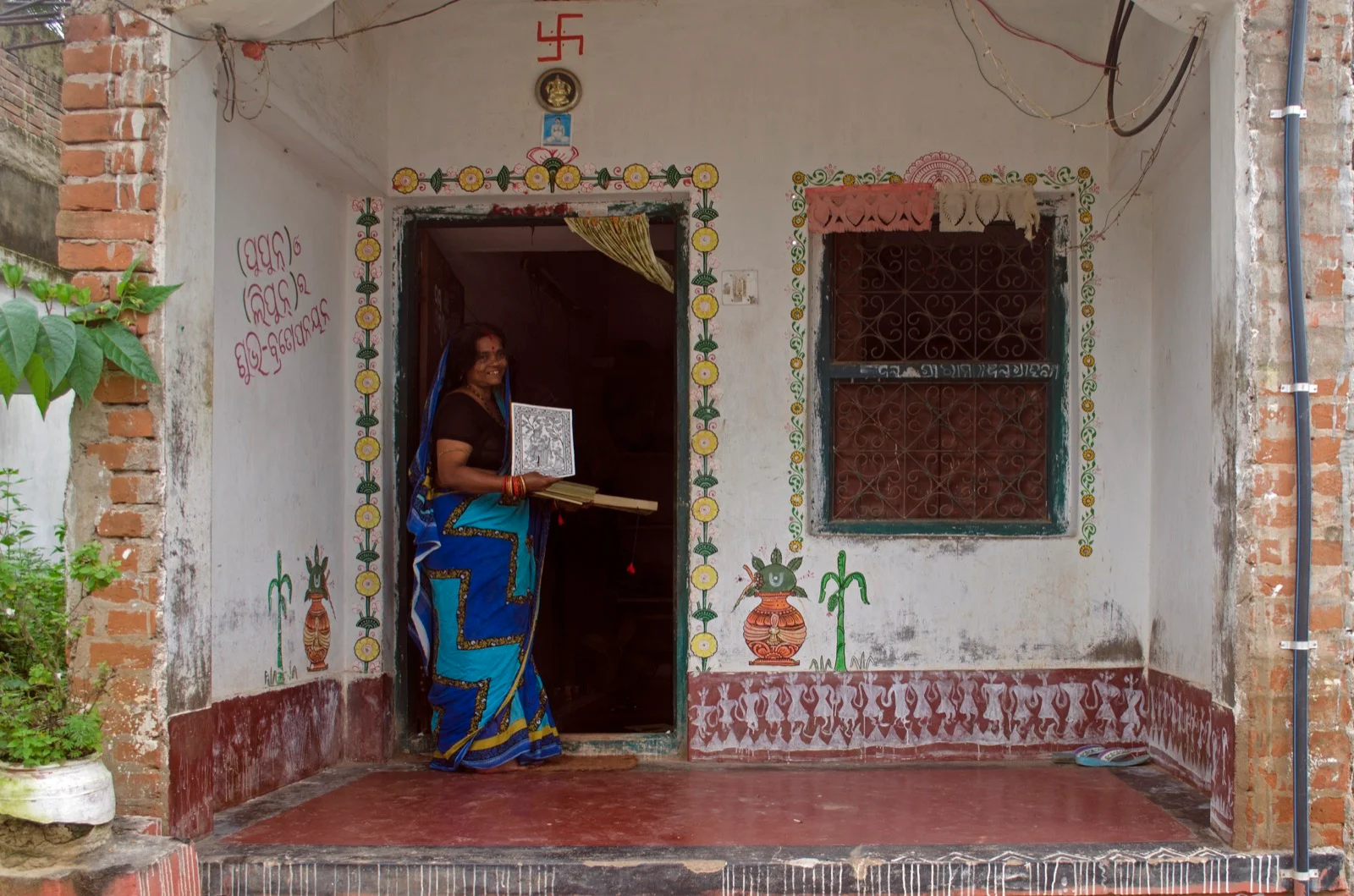
An artisan displays her work in Raghurajpur, photographed in 2018. The source does not record her name; the image is discussed here as a photograph of a working setting.
Rangan Datta Wiki. Source · CC BY-SA 4.0. Resized from the original photograph for local delivery. Full-frame display requested. Adaptations retain CC BY-SA 4.0.
Museums and walks as acts of interpretation
A museum brings objects into new relationships. Odisha Tourism’s description of Kala Bhoomi, the crafts museum in Bhubaneswar, presents galleries of carving, terracotta, metalwork and textiles alongside opportunities to encounter artisans at work.6 The description suggests a way of connecting a finished object with processes of making. It should not be read as a guarantee that a particular demonstration is available on every visit.
A display also depends on words. A label can identify a maker, place, material and use, or reduce a complex object to a broad category. The sequence of rooms encourages some comparisons and makes others less likely. Visitors can ask how objects were acquired, what is known about their histories and whether the people represented have helped explain them.
Outside the museum, a heritage walk arranges a sequence through inhabited space. The Bhubaneswar Development Authority’s account of Ekamra Heritage Walks links temples with surrounding settlements, rituals and festivals.7 This is a broader invitation than looking at isolated monuments. Streets, water, shops and patterns of everyday movement also shape how a place is understood.
A route remains a selection. The guide’s explanation, a resident’s memory and a written record may emphasise different things. Their differences can make a walk more thoughtful when clearly acknowledged. Worship and work continue while visitors look; a doorway or courtyard does not become freely available for photography simply because it appears along a heritage route.
Public heritage grows through these encounters between making, showing and interpreting. It asks for accurate credits, room for different memories and attention to the people who inhabit celebrated places. A painting can unsettle a familiar view; a photograph can preserve a detail; a walk can return that detail to its surroundings. Each offers a way to look again.
Footnotes & Sources
- NGMA Mumbai · Lovers by Jatin Das. Accession 1392. Catalogue description, medium, biography and figure drawing; the work is not reproduced here. ↩
- President’s Secretariat · Adwaita Charan Gadanayak. Padma awards 2025, PDF page 33. Official biographical account of sculpture and the Police Memorial. ↩
- JD Centre of Art · Collection. Institutional collection account. Holdings are not treated as proof of permanent public display; no visit schedule supplied. ↩
- Bakul Foundation · Education. Odia picture books, work with authors and illustrators, and the Udayanath Award. ↩
- Bakul Foundation · Arts. Organisation’s history of the Wall of Peace and Wall of Water, 2013. No independent impact claim. ↩
- Odisha Tourism · Kala Bhoomi. Museum interpretation and craft displays. Promotional description; demonstrations and visitor arrangements may vary. ↩
- BDA · Ekamra Heritage Walks. Programme description connecting monuments and living settlements. Historical schedules and prices are not reused. ↩
Mukteswar photograph: Bikashrd, CC BY-SA 4.0. Raghurajpur photograph: Rangan Datta Wiki, CC BY-SA 4.0. Source and licence links appear in the captions. Retained photographs are resized for the page without intentional cropping or added elements. They document heritage settings; neither is presented as an example of the modern artworks discussed in the text.
Continue reading


Suggest an update
Share a correction or source for this chapter. GitHub submissions are public. Please omit private contact details and consent documents.