
Part 4 · Music, Dance and Theatre
Chapter 19 of 48
Listening to Odisha
Breath, metal, movement and the sounds of work
To listen to a place is to notice more than its best-known songs. A shell sounded by a player, a struck metal disc and the movement of a loom lead towards different kinds of knowledge. Each has a maker, a setting and someone who knows what to listen for.
This chapter opens the musical part of the edition through those relationships. It begins with the conch ensemble, follows the mahuri into another gathering, and turns towards the metalworker and the workshop. Odisha emerges through particular occasions and skills, rather than a single soundtrack.
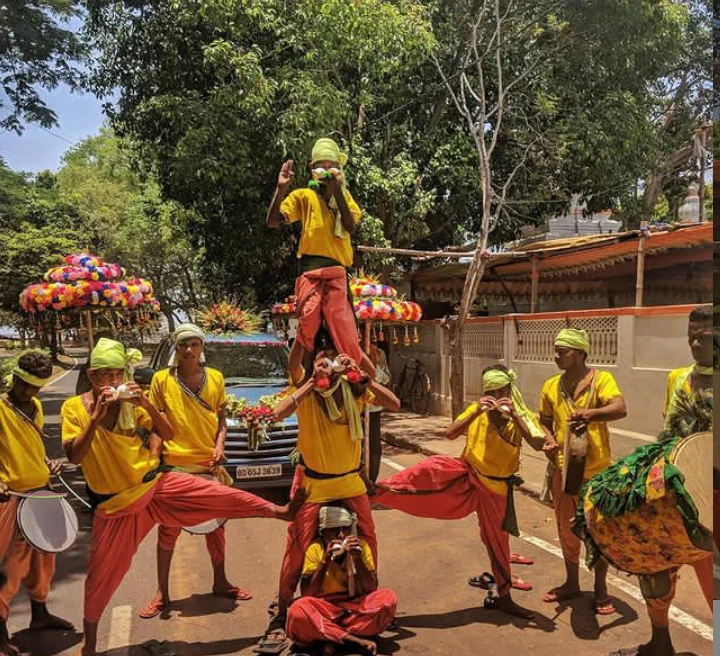
Conch players and drummers in a photograph catalogued as Jodi Sankha, 2024. The file record does not identify the troupe.
SuhasiniPadhi. Source · CC BY-SA 4.0.

Breath in company
In the Eastern Zonal Cultural Centre’s account of Thakurani Jatra, published in the 2012 Republic Day programme, Jodi Sankha belongs to Ganjam’s religious processions. Conch playing and bodily movement form a combined presentation. The accompanying instruments named are dhol, changu and mahuri. The shell may first catch our attention, but the account directs us towards a group.1
The photograph on the opening page makes that company visible: conch players occupy different levels while drummers stand beside them. It records one arrangement, not a diagram that every troupe must follow. Its energy comes from bodies supporting, balancing and playing together. Looking closely suggests a question for listening: how do musicians coordinate what an audience experiences as one performance?
Mahuri leads us into a second setting. An Indian Council for Cultural Relations programme describes the instrument, also spelt Muhuri, with a double reed, a wooden body and a flared wooden bell. Its Bajasal entry places mahuri with dhol, nishan, tasha and jhanj in a western Odisha dance associated with marriage celebrations.2
Another witness is a particular instrument in Berlin’s Ethnologisches Museum. The catalogue records a mahuri with seven finger holes and a decorated metal bell; its reed support and mouthpiece are missing. The contrast with the programme’s wooden bell is worth retaining. These are descriptions of different examples, not competing instructions for one standard instrument.3
The museum object also brings absence into view. We can read its dimensions and examine its construction, but a missing mouthpiece and an absent player leave part of the story untold. The museum’s 2019 donation date records an acquisition, not the instrument’s invention. To understand its working life we would need the knowledge of musicians and makers as well as the surviving object.3
Metal, hands and occasions
Ringing has a history of skilled work behind it. “Metal Craft of Orissa,” published in 2004, distinguishes ghanta, a gong, among beaten-metal products, from ghanti, a bell, among cast brass objects. The article places their manufacture within Kansari metalworking, alongside utensils, lamps and other objects. Sound-making shares a workshop world with everyday use.4
The same account describes ringing during arati and offerings, and rhythmic gong playing during the Car Festival. Kalahandi’s district culture table gives another setting: Ghanta Vadya group performance around Bhawanipatna and Kesinga at auspicious events. An object handled in worship and an ensemble of players call for different kinds of attention.45
Names help, but the object and its use must stay beside the name. The cowbell pictured here is a separate museum example, not an illustration of a temple ghanti. It widens the chapter’s view of what deserves to be heard.
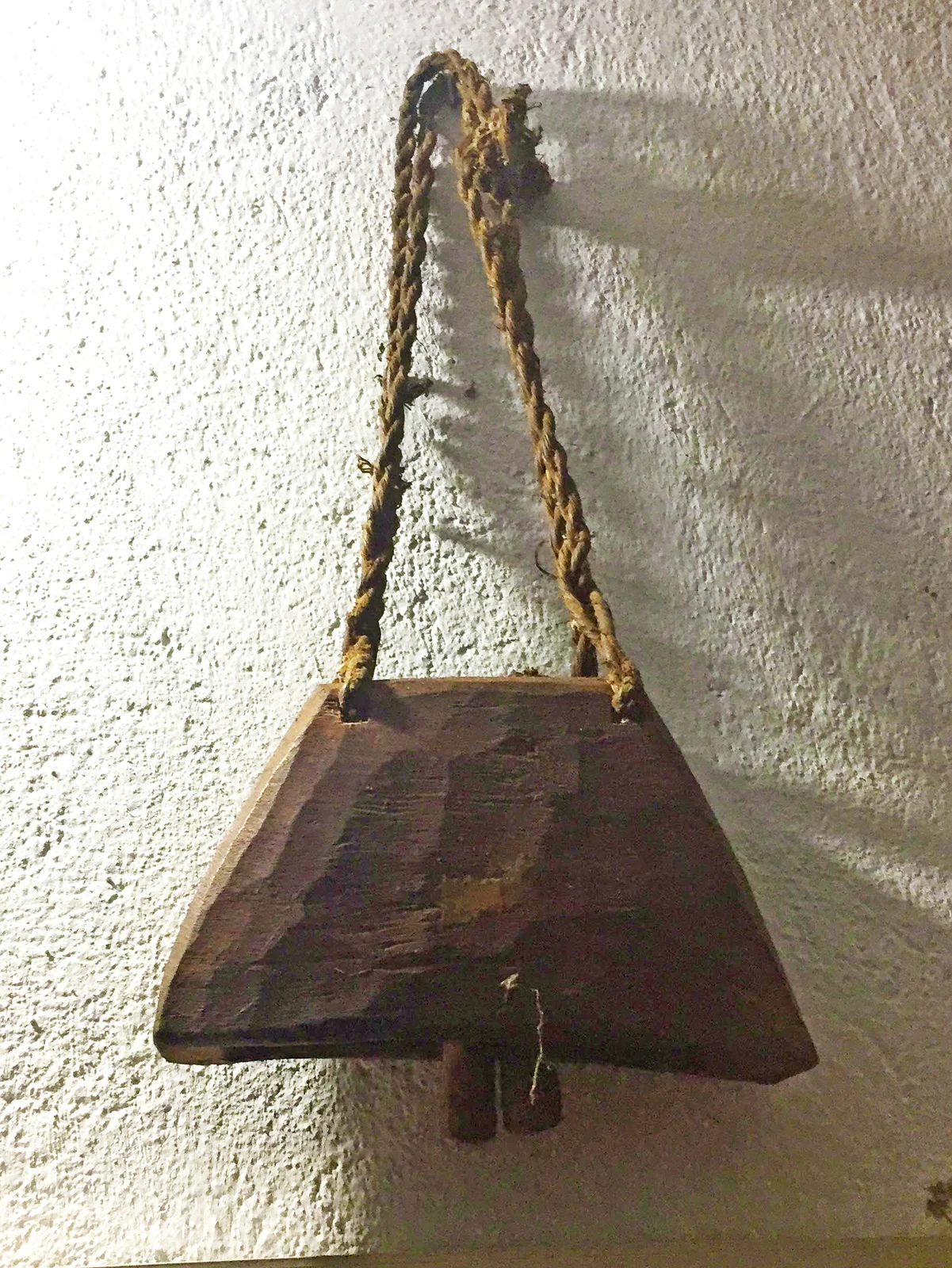
Cowbell displayed at the Tribal Museum, Koraput, photographed in 2017. Maker and specific community are not identified in the image record.
Subhashish Panigrahi. Source · CC BY-SA 4.0.

Beyond the concert platform
Subhashish Panigrahi photographed the cowbell at the Tribal Museum in Koraput in December 2017. The image record identifies it as an artefact collected from a local Indigenous community without naming that community or its maker. Its suspension and sounding parts are visible; its particular history remains a question.6
We can let that question lead beyond display cases. Who made the object? Who attached it, repaired it or recognised it at a distance? What mattered to the person who used it? Such questions connect sound with daily responsibilities. They also prevent a museum label from becoming an invented account of village life.
Work offers another way of listening. A loom photograph shows hands, thread and a working position; it does not reproduce the sounds of that moment. To hear a workshop well, we would need to connect a sound with an action and the worker’s explanation. A pause might be an adjustment, a check or simply a rest. The observer cannot decide which by admiring the rhythm.
Film can help make these relationships available to a wider audience. PSBT’s catalogue identifies Biswanath Rath’s Kotpad Weaving: The Story of a Race Against Time as a 2018 documentary, 29 minutes long, in Odia and English. Its subject includes the textile tradition and natural dyeing. The credits name Vinayak Dasgupta as editor and sound recordist, and Sudharshan Lingam as sound designer and mixer.7
Those credits remind us that recorded sound has makers too. A documentary offers an arranged encounter, shaped by choices of recording and editing. Its catalogue is a route towards viewing, not a substitute for hearing the film. No account of its soundtrack is claimed here.
A small practice of attention
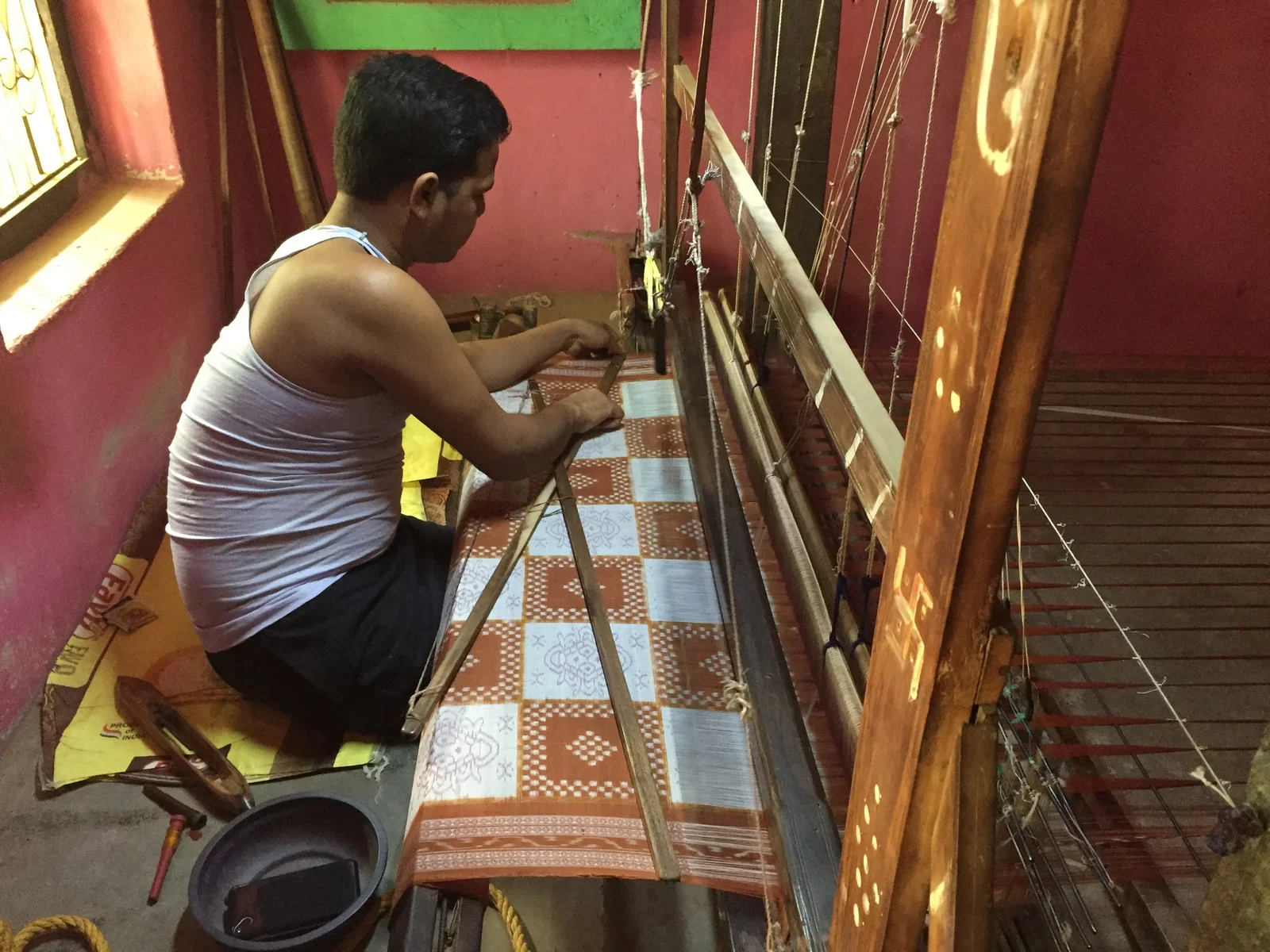
Sambalpuri sari weaving. This photograph illustrates work at a loom; it is not a Kotpad workshop or a still from Rath’s film. The weaver is unnamed in the file record.
Saileshpat. Source · CC BY-SA 4.0.

At a welcomed performance, begin by following one sound. Then notice the people around its player: who enters, who waits, who carries the pulse, who responds to movement? At a workshop, begin with the task. Ask the maker which detail matters, rather than turning useful labour into background music.
These are listening invitations, not reports of field visits. A useful note would preserve the place, occasion, player’s or maker’s preferred name, and what they explained. Recording and public sharing need their own agreement. Sometimes listening and remembering are enough.
The chapters that follow take up songs, dances and theatre in greater detail. Carry this habit into them: attend to the supporting musician as well as the central performer, to the tool as well as the finished object, and to the person whose knowledge makes the sound intelligible. A cultural history becomes richer when hearing is joined to learning.
Footnotes & Sources
- Eastern Zonal Cultural Centre, Thakurani (Goddess) Jatra. Republic Day programme, 2012, printed p.35 (PDF p.36). Supports Ganjam setting, combined conch playing and movement, and accompanying instruments. Ranapa is described separately. ↩
- ICCR, Kala Vishwa programme: Tribal Folk Dance by Shri Rajesh Maharana. PDF p.2, Bajasal and Muhuri entries. Undated programme; double reed, wooden bell and ensemble described. No origin date or current performance schedule inferred. ↩
- Ethnologisches Museum, Berlin: Mahuri, VII c 1005. Museum record via Deutsche Digitale Bibliothek; English text marked machine-translated. Seven holes, metal bell and missing components refer to this object. Donation recorded in 2019. ↩
- Metal Craft of Orissa. Orissa Review, November 2004, pp.54–56, especially p.55. Product descriptions distinguish ghanta and ghanti more clearly than the later general ritual paragraph. A dated craft account, not a statewide rule. ↩
- Kalahandi district: Culture & Heritage. Art Forms table, row 15, Ghanta Vadya. Local ensemble setting around Bhawanipatna and Kesinga. Underlying account undated; troupe-size figures are not used as current statistics. ↩
- A cowbell in the Tribal Museum, Koraput. Photograph and metadata by Subhashish Panigrahi, 18 December 2017. Used for the displayed object and documented location, not a community attribution or acoustic claim. ↩
- PSBT: Kotpad Weaving: The Story of a Race Against Time. Producer’s catalogue: Biswanath Rath, 2018, 29 minutes, Odia and English; includes production and sound credits. A viewing lead; the full film was not auditioned for this chapter. ↩
Three credited documentary photographs under CC BY-SA 4.0; resized, with full frames retained. The loom image reuses the edition’s verified textile asset. No generated images or new field recordings. The conch file’s prose also describes stilts; that conflated description is not adopted. Review draft prepared 10 November 2026.
Suggest an update
Share a correction or source for this chapter. GitHub submissions are public. Please omit private contact details and consent documents.