
Part 3 · Languages, Literature and Oral Memory
Chapter 18 of 48
Stories Passed from Voice to Voice
Tellers, listeners and the lives of a tale
A story survives through the person who tells it again. A remembered exchange becomes dialogue; a pause invites a question; a familiar ending acquires the weight of a particular voice. To encounter Odisha’s oral storytelling is therefore to meet people, as well as plots.
Musamoni Panigrahi’s recorded telling in Baleswari Odia offers one such meeting. Filmed by Subhashish Panigrahi in January 2014, it preserves a named speaker and a regional form of speech. The recording lets a future listener return to a particular telling, rather than imagine a single voice speaking for all Odisha.1
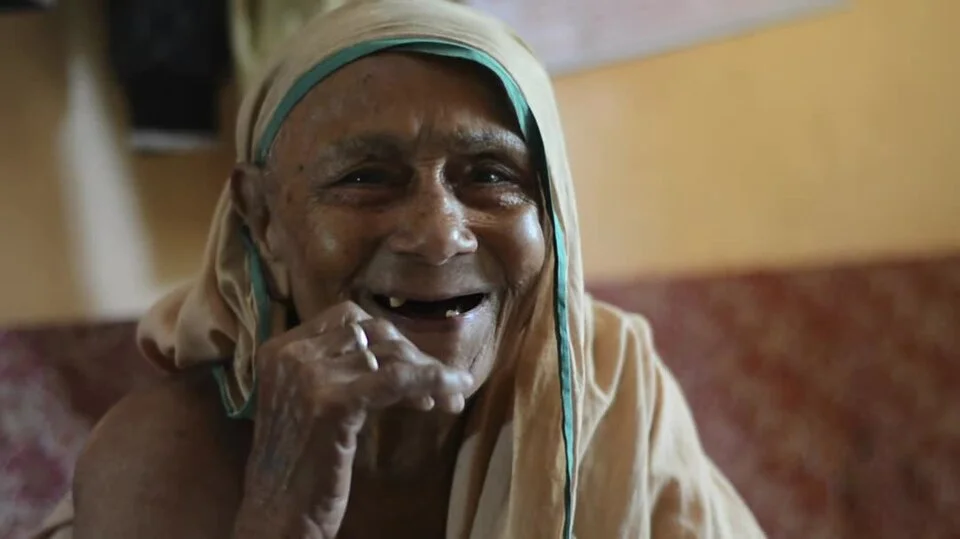
Musamoni Panigrahi telling a story in Baleswari Odia. Preview still from the recording dated 20 January 2014.
Subhashish Panigrahi. Source · CC BY-SA 3.0.
A widow answers through a riddle
In the recording’s English subtitles, a widow approaches a judge with her baby. Her husband has died, and others have taken their land using a forged impression of his finger. Asked for family names, she must negotiate a convention that prevents her from speaking her husband’s name directly. Her answer turns to arithmetic: fourteen multiplied by four, then four added, produces sixty. The name is explained as Sathia.2
The episode places verbal ingenuity beside material vulnerability. A woman seeking help has to make herself understood within a rule that constrains her speech. The puzzle is therefore more than a detachable joke. In this reading, its pleasure comes from watching an apparently blocked conversation become possible.
The subtitles also register a question from the listener, laughter and, towards the end, difficulty recalling part of the tale. These details belong to the encounter. An edition that tidied them all away would give us a smoother plot, but a poorer sense of how remembering happens.2
We should keep the teller’s account distinct from documentary history. A story can carry ideas about authority, widowhood and cleverness without establishing that its narrated incident occurred. Equally, an English rendering cannot carry every sound and association of Baleswari Odia. The linked recording and subtitles allow readers to move beyond this brief paraphrase.
That attention to the event has a scholarly counterpart. Sanjaya Kumar Bag’s study of western Odisha brings the kathani, its kathak or teller, and its performance into the same discussion. It asks us to consider social setting alongside narrative content. Here, the widow’s problem and the exchange between speaker and listener are both part of what makes the story worth attending to.3
A teller has a name
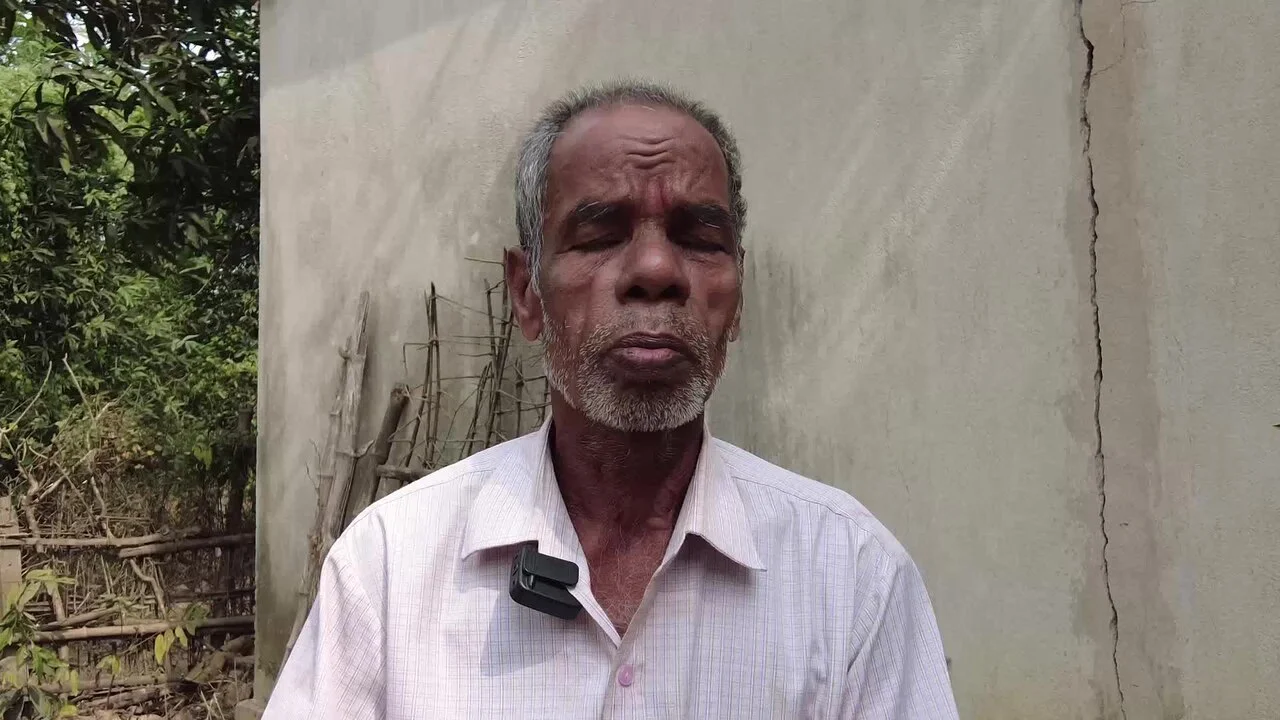
Ratnakar Sutar narrating Shagadiara Katha. Preview still from the recording dated 18 January 2025.
Sangram Keshari Senapati. Source · CC BY-SA 4.0.
An archive entry for Shagadiara Katha identifies Ratnakar Sutar as its narrator and Sangram Keshari Senapati as its maker. It dates the recording to 18 January 2025 and preserves a telling lasting more than thirteen minutes. Those particulars give the story a visible human source.4
The distinction between narrator and recorder matters. One supplies the telling; the other makes this particular record available. A useful caption keeps both names. It also gives the recording date without suggesting that the story itself began on that day.
For this chapter, the entry documents an act of narration; we do not offer an unverified synopsis of its plot. Readers can follow the source link to hear the performance. Beside Musamoni’s recording, it reminds us that an oral archive need not consist only of anonymous fragments from an unspecified past. It can hold identifiable tellings made in different years, inviting comparison without forcing them into a single standard version.
When words are sung
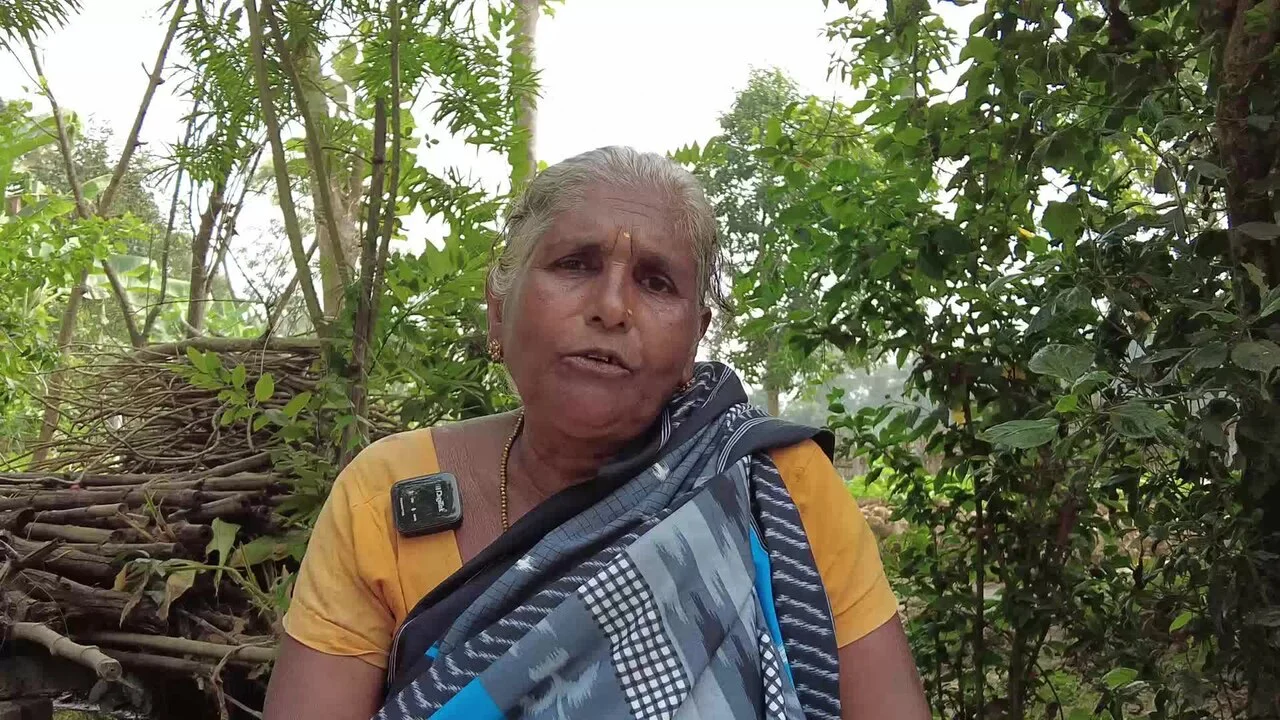
Shantilata Dwibedi reciting an Odia marriage kandana. Preview still from the recording dated 3 December 2023.
Sangram Keshari Senapati. Source · CC BY-SA 4.0.
Voice carries more than prose tales. A recording made by Sangram Keshari Senapati on 3 December 2023 names Shantilata Dwibedi as the reciter of an Odia marriage kandana. It is presented here as a documented recital, not as evidence that the camera witnessed a wedding.5
Lullabies and children’s rhymes offer another route into this world. Pratap Kumar Dash discusses nanabaya gita within a wider field of Odia oral expression: words used around feeding, play, comfort and sleep, alongside songs and narrative performances associated with other occasions.6
A lullaby need not unfold a complete adventure to give a child a small world to inhabit. Repeated sounds, an address to someone absent, an animal or a familiar household action can sustain attention. Reading these forms beside folktales broadens our idea of transmission: what passes onward may be a rhythm, a relationship or a way of addressing another person, as well as a sequence of events.
The journey into print, and back
A printed collection gives a tale another kind of home. Ram Narayan Das’s Kathalahari, in its 1927 sixth edition, includes Halahal Kumar or Sashisena Abhimanyu. Our existing research on Sashisena distinguishes this collected folktale from Pratap Ray’s literary poem. The printed witness should be named when we use it, rather than silently folded into a universal account of the story.7
This is one reason to welcome differences between versions. A changed name, an altered punishment or a different place of reunion may be the very feature that reveals how a story has travelled. Comparison begins by asking which book, which teller and which occasion supplied the passage. It does not require us to decide immediately that one version is right and all the others defective.
The same care can guide a family recording. Ask the teller what they call the story, who they learned it from, and whether they remember hearing it another way. Leave room for an interrupted sentence, a correction or a listener’s question. With the teller’s agreement, keep the original recording beside any edited transcript or translation, and record how it may be shared.
These are editorial practices proposed for this edition, not claims that every storyteller follows the same rules. Odisha’s languages and communities do not fit into one household scene or one inherited repertoire. The examples here open a few doors; they cannot stand for the whole house.
What joins them is the possibility of return: to a speaker’s name, to the words of a particular version, to the person who helped preserve it. A book can offer that route back. The next telling, however, still needs someone willing to listen.
Footnotes & Sources
- Musamoni Panigrahi: storytelling in Baleswari Odia. Recording by Subhashish Panigrahi, 20 January 2014. File description identifies teller, speech variety, date and maker. ↩
- English subtitles to Musamoni Panigrahi’s telling. Opening through approximately 1:05 for the widow’s appeal and numerical name; closing exchange for recollection. Paraphrase, not a new verbatim translation. The recording is a narrative witness, not verification of its events. ↩
- Sanjaya Kumar Bag, Folktales of West Odisha: A Study. Indian Journal of Multilingual Research and Development 1(1), 2020, pp.16–26; DOI 10.34256/ijmrd2013. The published abstract frames folktale, teller, performance and social context. ↩
- Shagadiara Katha, narrated by Ratnakar Sutar. Recording by Sangram Keshari Senapati, 18 January 2025, 13 min 23 sec. Used for identified performance and image provenance, not a plot summary. ↩
- Odia marriage Kandana, recited by Shantilata Dwibedi. Recording by Sangram Keshari Senapati, 3 December 2023, 1 min 36 sec. Metadata identifies a recital; it does not establish a wedding setting. ↩
- Pratap Kumar Dash, Traditional Odia Oral Narratives. Full title: Socio-cultural and Literary Potential of the Traditional Odia Oral Narratives: A Critical Review. IJHSS 9(5), 2022, pp.39–44, especially section 4, pp.40–41. A literary review, not a survey of all households. ↩
- Ram Narayan Das, Kathalahari, sixth edition, 1927. Digitized Odia collection. Halahal Kumar or Sashisena Abhimanyu, including printed pp.65–66 (PDF pp.74–75). Consulted alongside the project’s Sashisena research dossier; kept distinct from the Pratap Ray poem. ↩
Three documentary video-preview stills, with maker, narrator, source and license credited. Images are resized without cropping or retouching. The stills retain the Creative Commons licenses indicated in their captions. Source links also lead to the recordings. Review edition prepared 10 November 2026.
Suggest an update
Share a correction or source for this chapter. GitHub submissions are public. Please omit private contact details and consent documents.