
Part 4 · Music, Dance and Theatre
Chapter 20 of 48
Odissi Music and Its Literary Worlds
Poetry, melody and the people who carry a song
A poem becomes a different encounter when someone sings it. Words acquire duration; an address to a beloved can linger; a returning phrase can bring a listener back to an unresolved feeling. Odissi music invites us to hear literary imagination through the choices and knowledge of musicians.
Its vocal life deserves attention in its own right. Utkal University of Culture’s 2023–24 postgraduate syllabus in Odissi Vocal places practical singing beside notation, repertoire and theory. Champu, Chhanda, Choutisha and Gita Govinda appear as subjects for study and performance. The curriculum offers a doorway into a substantial musical world, extending beyond accompaniment for dance.1
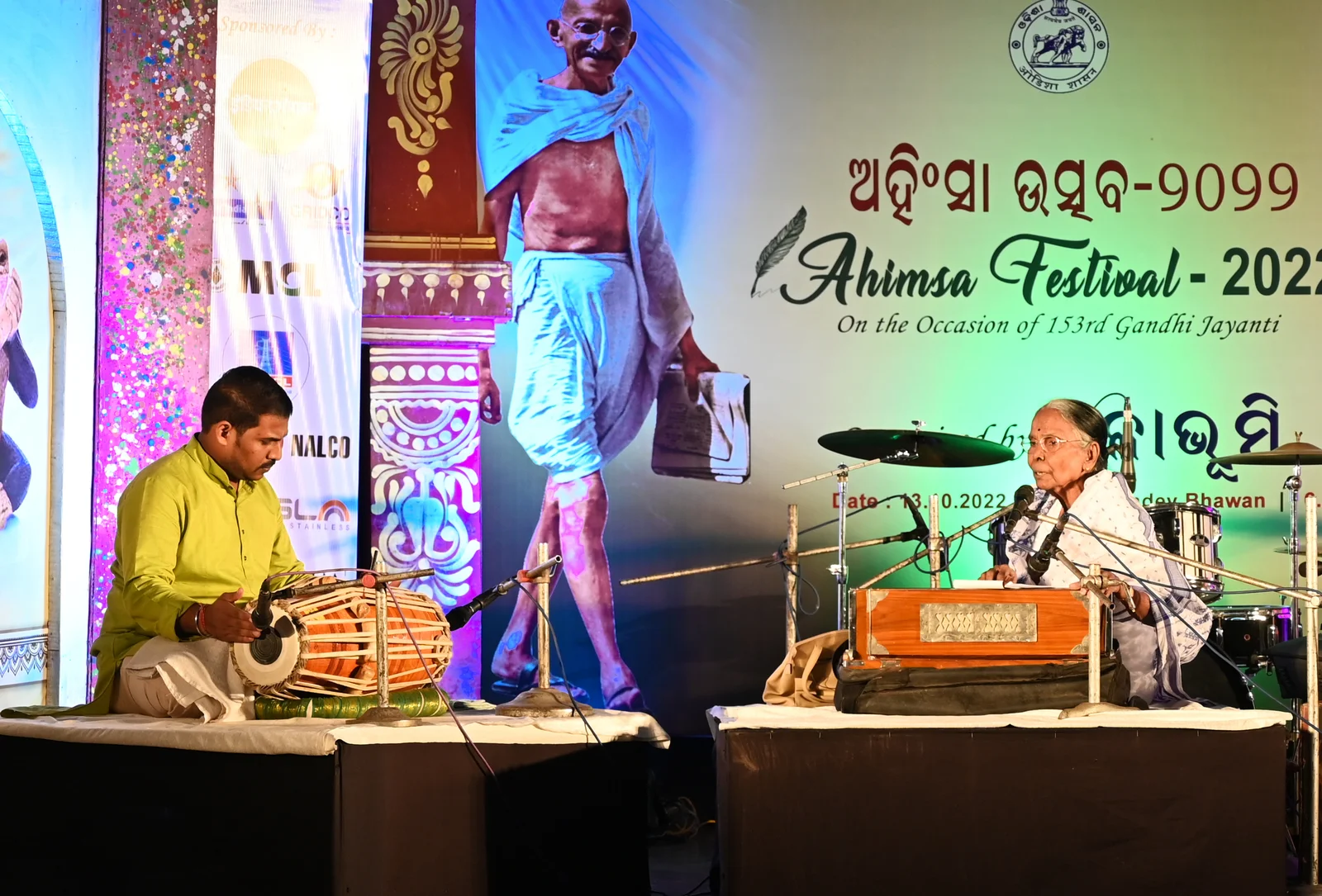
Shyamamani Devi singing at Ahimsa Utsab, 13 October 2022, with Soumya Ranjan Nayak on mardala.
Prateek Pattanaik. Source · CC BY-SA 4.0.

The poem is part of the music
Writing in the Music Academy’s 1958 journal volume, Kalicharan Pattanaik emphasised the literary character of Odissi song. His discussion attends to the thought carried by a stanza and to the sound of its words. Read as a musician’s historical account, it encourages us to ask what a sung phrase is saying, as well as how it moves.2
Kavisurya Baladeva Rath’s Kishorachandrananda Champu provides a meeting place for those questions. Pattanaik describes Sanskrit prose alongside a poetic portion governed by raga and tala, with songs ordered through letters from ka to ksha. The theme centres on Radha and Krishna. He also recalls arranging Champus for dramatic presentation on his stage in 1932: a later act of interpretation, distinct from the composition of the work.2
The alphabetic design gives a listener something to recognise, but it cannot supply an entire performance. A written sequence does not tell us how a particular singer will hold a syllable, shape a line or respond to an accompanist. Literary form and musical learning meet in the rendition.
A useful recorded example appears in Prateek Pattanaik’s Odissi Project. The catalogue identifies Balaram Gouda of Naikanipalli, Ganjam, as the lead vocalist for Nua-nata-patali-mukuta He, the nga song from the Champu, in raga Kumbhakamodi. It also names Bhimasen Mahankud and Praphulla Swain for mardala and khola, and Gaurahari Khuntia and Jagannath Dora for gini and other accompaniment.3
Follow the linked catalogue to the recording with those names in mind. The encounter is no longer simply with an anonymous “traditional song.” There is a literary work, a named rendition and a company of musicians. This chapter identifies that route for listening; it does not offer a transcription or detailed analysis of the audio.
Longing, persuasion and a new rendition
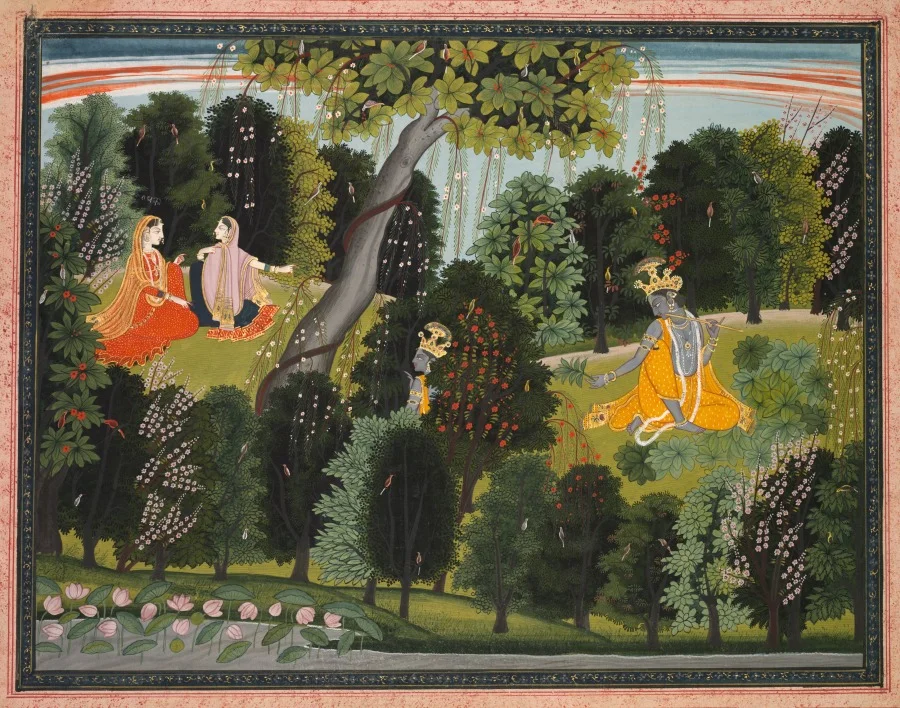
Sakhi persuades Radha to meet Krishna, c. 1820–25, attributed to Purkhu. Bequest of Mrs. Severance A. Millikin, 1989.334. A Gita Govinda illustration from northern India.
Jayadeva’s Gita Govinda offers another literary world. In this painting, Radha’s confidante encourages her to meet Krishna. The Cleveland Museum identifies Krishna twice: preparing leaves at the right and watching from among the trees. Persuasion, anticipation and waiting occupy a single picture. A song has to unfold its emotional movement through time.4
One documented contemporary interpretation is Virahī, part of Bijayini Satpathy’s ABHIPSAA (2021). Its production credits identify Raghunath Panigrahi’s song composition of a Gita Govinda ashtapadi as the basis. Bindhumalini Narayanaswamy is the singer; Srinibas Satapathy supplies the prelude composition, melodic arrangement and flute; Shivshankar Satapathy supplies rhythm composition, mardala and manjira; Agnimitra Behera plays violin.5
The poet, song composer, singer, arranger and choreographer occupy different places in this chain. Keeping their credits together makes interpretation visible: a literary work reaches another audience through several kinds of creative labour. The painting illustrates the literary world, not this particular production.
Raga, tala and the work of listening
For a beginning listener, raga and tala name two different aspects of musical organisation: melodic character and rhythmic cycle. They are useful questions to ask about a rendition, alongside its text and poet. Learning their names begins an enquiry; hearing how a musician develops them requires time and guidance.
The Odissi Music database gives Adatali as fourteen matras, divided 4 + 3 + 4 + 3. A matra is the unit counted within the cycle. Speaking those groups makes their organisation apparent, but does not reproduce the drum syllables, hand gestures or phrasing of a performance.6
A song’s occasion is another piece of information. Pattanaik’s catalogue lists Chandramani Lenka’s Jhulibe Ta Aja Kunje Barajaraja as a Jhulana Jatra song in raga Kamodi and tala Adatali. Festival, melody and cycle belong together in its record without becoming interchangeable labels.3
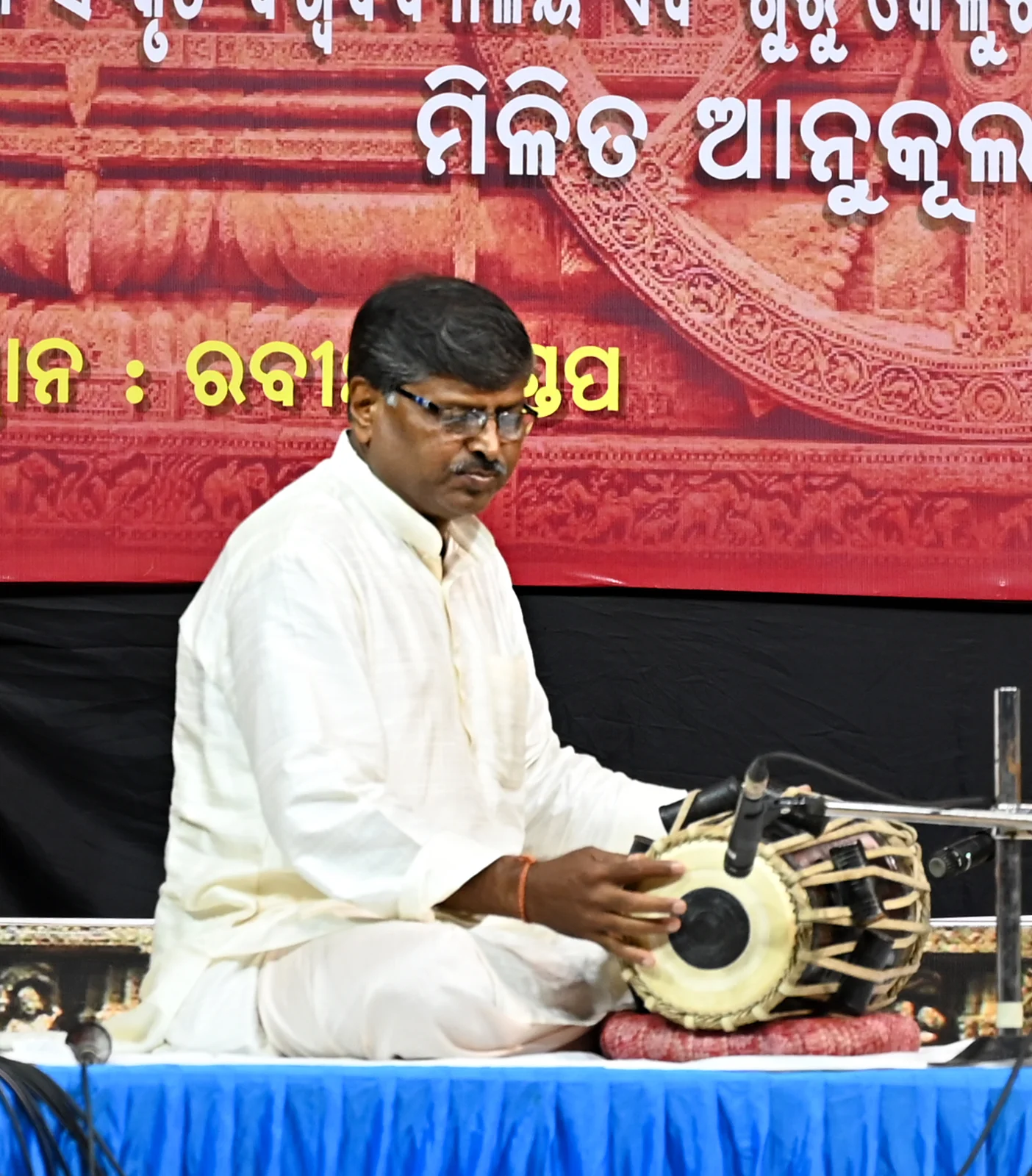
Guru Sachidananda Das playing mardala at Sanskruti Bichitra: Odissi Asara, 12 September 2019. A separate performance from the examples discussed here.
Prateek Pattanaik. Source · CC BY-SA 4.0.

What a teacher and an archive preserve
Learning involves more than finding a title. The university syllabus asks for notation, practical presentation and oral examination, and includes study of guru parampara. Its combination of tasks makes an important point: written knowledge and demonstrated musical understanding are related, but neither simply replaces the other.1
The Odissi Research Centre’s institutional handbook describes another effort to keep repertoire available. Established in July 1986, the centre worked on music as well as dance. Its publication account records cassette volumes of Kishore Chandrananda Champu, notation with accompanying recordings under the name Champu-Sarani, and work on Chhanda. These are records of institutional activity, not dates when the traditions themselves began.7
The handbook also describes listening and viewing with teachers in its archive. That setting matters. A recording can preserve a voice, but a teacher can direct attention to a detail that a newcomer has not yet learned to hear. A notation can help a learner return to a passage, while the recorded rendition supplies information that the page leaves open.7
Preservation also involves choices. The centre describes a wish to bring greater uniformity to Champu singing. A reader can recognise that institutional aim while still asking how different teachers and performers shape a song. A reference edition is valuable without being mistaken for every rendition that has existed.
Begin, then, with one work and one credited performance. Read enough of the poem to follow its speaker and situation. Listen once for the voice and again for the surrounding musicians. If an explanation is available, return after hearing it. The same line may now reveal a literary turn, a rhythmic meeting or a detail of expression that passed unnoticed before.
The literary worlds of Odissi music are sustained in this repeated encounter: poets provide words, musicians give them a particular sounded life, teachers make attentive learning possible, and listeners return. A song’s history remains connected to the people who help it be heard.
Footnotes & Sources
- Utkal University of Culture, Odissi Vocal syllabus, 2023–24. PDF pp.4–6 (printed pp.1–3): theory, notation, repertoire, guru parampara and practical papers. Dated curriculum evidence; not a current admissions notice. ↩
- Kalicharan Pattanaik, Odissi Music. Journal of the Music Academy Madras, XXIX (1958; published 1959), printed pp.87–88 (PDF pp.93–94). Champu, literary character and the author’s recollection of staging in 1932. Historical perspective, not a complete origin chronology. ↩
- Prateek Pattanaik, The Odissi Project. Sections 1–2: Balaram Gouda, the nga Champu song and ensemble credits; Chandramani Lenka, song list item 6. Catalogue with listening links; raga and tala identifications are the documenter’s, not independent audio analysis. ↩
- Cleveland Museum of Art, Sakhi persuades Radha to meet Krishna. Gita Govinda illustration, c.1820–25, attributed to Purkhu; northern India, Pahari kingdoms. Bequest of Mrs. Severance A. Millikin, 1989.334. Description supports the reading of the scene; image CC0. ↩
- Bijayini Satpathy, ABHIPSAA: A Seeking (2021). Music credits, item 2, Virahī. Distinguishes Panigrahi’s song composition, singer, melodic and rhythm arrangements, instrumentalists and Satpathy’s choreography. Production credits only; audio not analysed. ↩
- Odissi Music database, Adatali. Details list fourteen matras in four divisions: 4+3+4+3. Used as a bounded counting example, not a complete notation or instruction in playing. ↩
- Guru Kelu Charan Mohapatra Odissi Research Centre, RTI handbook. Manual 1: establishment, archive, and Publications; Books & Cassettes. Undated institutional account; no claim of current stock or public access. Its aim of uniformity is attributed to the centre. ↩
Two documentary photographs by Prateek Pattanaik (CC BY-SA 4.0) and one museum painting (CC0), with source links in the captions. Full frames retained; resized for layout. The northern Indian painting is a literary illustration, not an Odisha artefact. No generated imagery. Review edition prepared 10 November 2026.
Suggest an update
Share a correction or source for this chapter. GitHub submissions are public. Please omit private contact details and consent documents.