
Part 2 · Faith, Seasons and Shared Spaces
Chapter 11 of 48
Muslim and Christian Lives in Odisha
Places of worship and the work of belonging
A shrine courtyard in Cuttack, a church entrance in Bhubaneswar, a hospital serving Nabarangpur: each opens a different view of Odisha. Muslim and Christian histories belong within the region’s cultural life, alongside the temple landscapes, festivals and literary traditions through which it is often introduced.
This chapter follows selected places and institutions to explore worship, learning, craft and public service. Its subjects are communities with their own religious commitments and internal differences. Their lives cannot be gathered into one story of harmony, nor reduced to episodes of conflict. The buildings pictured here offer starting points; schools, books and personal testimony take us further into the work of belonging.
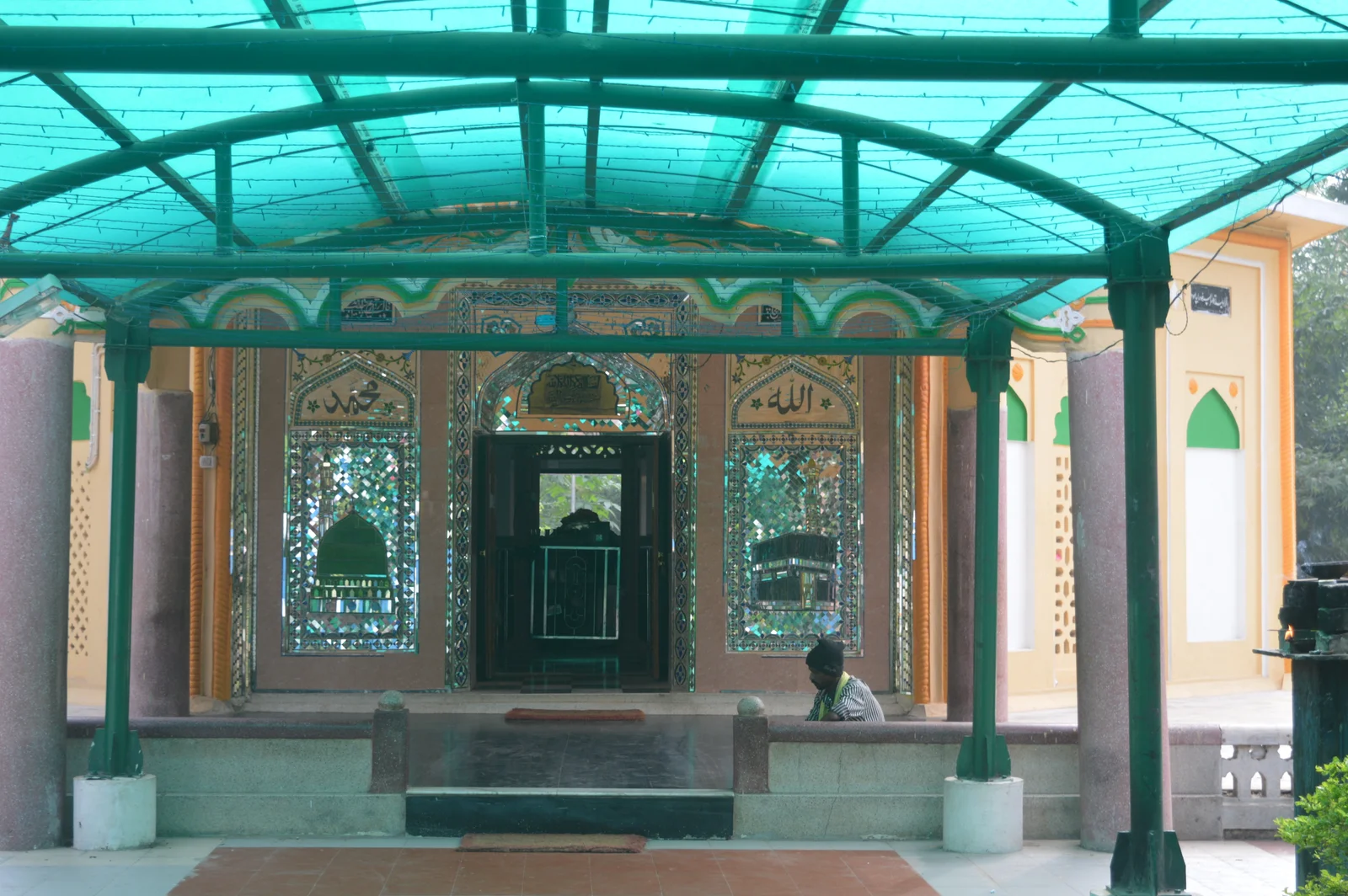
Within the Qadam Rasool complex in Cuttack, photographed 28 November 2015.
Coldbreeze16. Source · CC BY-SA 4.0.

A courtyard in Cuttack
The National Mission on Monuments and Antiquities records Kadam Rasul in Cuttack, on Jail Road, dating the site broadly to the seventeenth and eighteenth centuries and noting a Persian inscription from Aurangzeb’s time.1 Such a record places Islamic heritage within the city’s historical fabric. It also gives us a useful discipline: attach claims to a particular site, rather than treating every mosque or shrine as interchangeable.
The courtyard photograph shows patterned surfaces, a shaded approach and a doorway into the shrine. These details suggest how much a religious place contains beyond the silhouette of a dome: spaces for arrival, waiting and attendance. A picture cannot tell us the beliefs of the person within it. It can, however, encourage a closer way of looking at a building that remains part of an inhabited city.
A heritage itinerary is only one route into Muslim life. The history of learning offers another. According to its institutional account, the Odisha State Board of Madrasa Education was established in 1971; earlier, students’ examinations had been administered through the Bihar board. Its functions include examinations, courses of study and recognition of affiliated madrasas.2 This history concerns the practical organisation of education as well as religious learning: where students obtain credentials, who sets examinations and how institutions connect with the state.
The craft beyond a single community
Pipili’s appliqué offers a different connection. In a 2015 Odisha Review essay, Manoj Mishra describes chandua’s relationship with Jagannath’s processional traditions and its expansion into domestic and decorative products. He also records participation by young Muslim makers beyond the craft’s earlier association with the Darji caste.3 This is a dated observation about a particular craft, not a count of its workforce today.
The connection deserves attention without being turned into a fable in which difference disappears. Cloth has to be selected, cut, stitched and sold. Recognising Muslim participation means recognising labour and skill within a familiar Odishan art. A buyer who sees only the finished umbrella or wall hanging may miss the people whose livelihoods give the object its continuing life.
Christian words in an Odia world
Christian printing forms part of the history of modern Odia reading. Historian Pritipuspa Mishra dates the establishment of the Orissa Mission Press at Cuttack to 1838. Earlier Odia Christian texts had been printed at Serampore. The Cuttack press produced religious tracts and editions of the Bible, but also a dictionary and school textbooks.4
The evangelical purpose of this work matters. These publications sought to persuade, and some directly criticised established religious practices. Their contribution to print culture therefore belongs to a history of argument as well as education. Odia became a medium through which Christian teaching addressed readers; the expanding world of print also served needs extending beyond conversion.
The photograph of the Church of Christ in Bhubaneswar brings the relationship between faith and language into a later cityscape. English names the institution at the gateway; Odia lettering appears on the church behind it. The visible coexistence of scripts is a modest but concrete reminder that religious identity and a regional language need not occupy separate worlds.
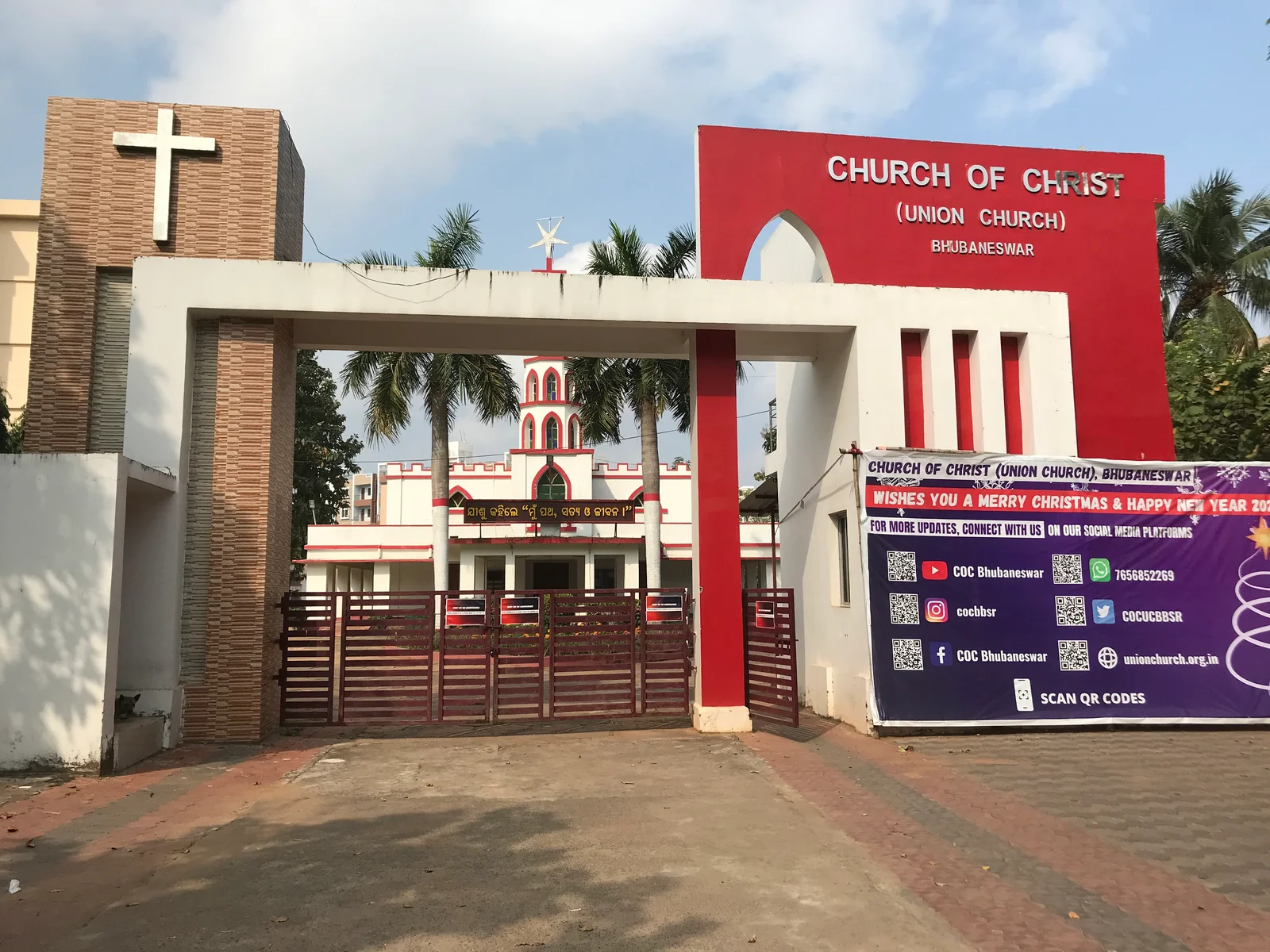
Church of Christ or Union Church at Unit 4 in Bhubaneswar, photographed 3 February 2022.
Subhrasingh. Source · CC BY-SA 4.0.

A southern Christian landscape
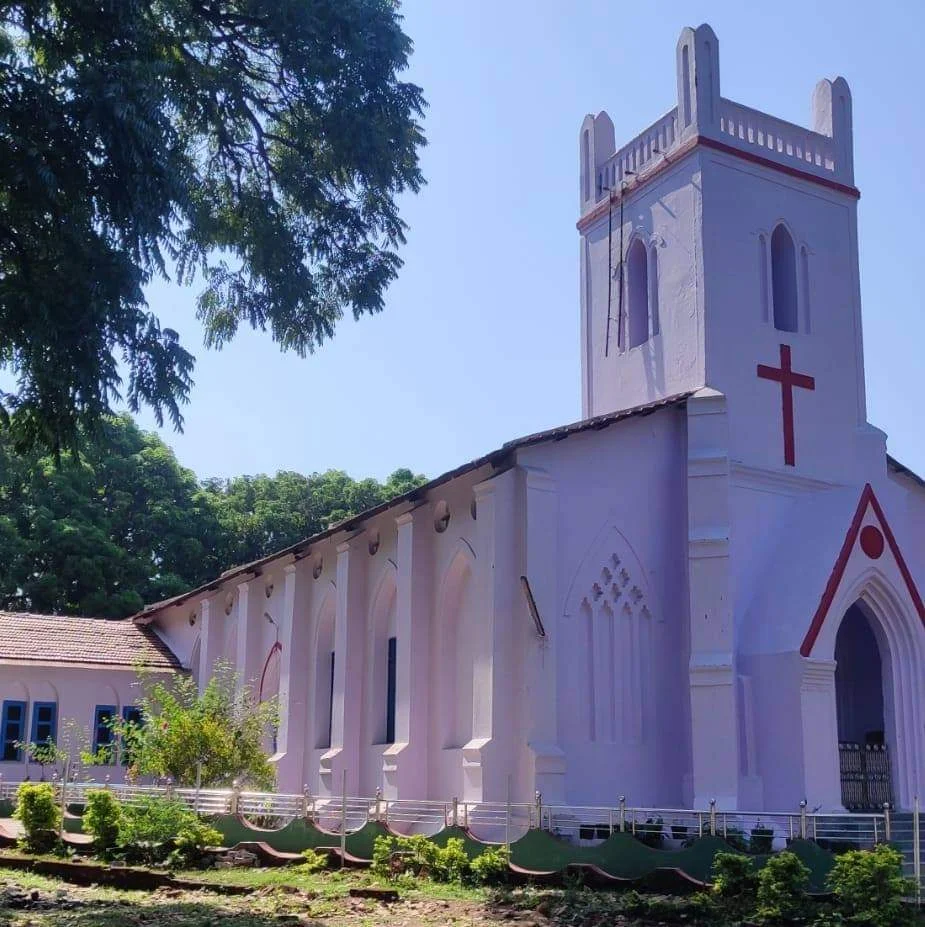
Jeypore Evangelical Lutheran Church in Jeypore, photographed 29 June 2021.
RudolphHitz. Source · CC BY-SA 4.0.

Christian life in Odisha also has a substantial southern geography. The National Council of Churches in India traces the Jeypore Evangelical Lutheran Church to the Breklum mission’s work in the former undivided Koraput district, identifying 1882 as its founding year.5 This Lutheran history differs from the Baptist printing story in Cuttack and from Catholic institutions elsewhere. The church photograph locates one strand of that history in Jeypore.
A personal account makes the institutional story more tangible. In a 2023 Lutheran World Federation interview, Dr Santosh Kumar Nag described himself as a fourth-generation Lutheran from a rural, lower-middle-class family. He had initially wanted to study engineering; after entering medicine, he chose to serve at Christian Hospital Nabarangpur. He explained affordable care and the training of healthcare workers as expressions of faith.6 His account joins professional decisions to local responsibility. It is testimony from a participant, rather than an independent assessment of the hospital’s services.
Schools and shared aspirations
A school can maintain a religious character while serving pupils from different communities. New De Paul School in Berhampur describes itself as a Catholic institution, primarily serving Christian educational needs but open to other communities. It explicitly retains a Christian identity and worship.7 Its own account allows us to see openness and religious distinctiveness together, without assuming that one requires the other to vanish.
Institutions also face material difficulties. Elizabeth Gangmei and Gowramma I.P., writing in the Journal of Indian Education in 2018, examined selected Muslim and Christian elementary schools in Odisha. Their purposively selected study identified problems involving infrastructure, teacher appointments and access to professional development.8 Its findings should not be applied to every minority school or treated as a present-day census. They nevertheless bring teachers and classrooms into a story too easily confined to founders and monuments.
The everyday questions are consequential: whether a classroom has the facilities it needs, whether a teacher can learn new methods, whether a school can take part in wider educational networks. Such matters belong in a cultural account because institutions help shape the opportunities through which children enter public life. Religious communities are also communities of parents, pupils and workers.
Remembering harm and rebuilding trust
Shared life has also been damaged by violence. In October 2009, a World Council of Churches report described its team’s visit to Christians displaced by the 2008 attacks in Kandhamal. Survivors spoke about destroyed homes, lost relatives and fear of returning. The report also documented efforts to rebuild houses and relationships, including local committees and cooperation among church bodies.9
This account should be read as a dated report from a visiting church delegation, with testimony from affected people. It cannot stand for every experience in Kandhamal. It does establish why rebuilding cannot be measured only in repaired walls. Home also requires confidence that one can remain, practise a faith and live alongside neighbours without coercion.
The sites and accounts gathered here do not exhaust Muslim or Christian Odisha. They show why neither community belongs at the margins of its cultural history. A shrine, a printed page, a stitched textile, a classroom and a hospital each reveal a different kind of participation. Attending to them means making room for religious conviction, skilled work, unequal conditions and the patient effort required to sustain a shared place.
Footnotes & Sources
- National Mission on Monuments and Antiquities, “Kadam Rasul”. Record OR12000399, drawing on an INTACH listing (1988). Used for location, broad period and inscription; anomalous classification fields are not adopted. The photograph’s spelling follows its Commons source. ↩
- Odisha State Board of Madrasa Education, “About OSBME”. Institutional account of the 1971 establishment and examination functions. Used for organisational history, not school quality, enrolment totals or individual recognition advice. ↩
- Manoj Mishra, “Artisan Villages of Odisha: A concept of Open Air Museum”. Odisha Review, April 2015, printed pp. 80–83, especially Pipili on pp. 82–83. The filename differs from the printed pagination. Muslim participation is reported as a 2015 observation, not a current workforce estimate. ↩
- Pritipuspa Mishra, “Vernacular Publics: A Modern Odia Readership Imagined”. Chapter 2 of Language and the Making of Modern India (Cambridge University Press, 2020). See the discussion of the Orissa Mission Press and Odia publishing. This chapter follows Mishra’s 1838 date; some other histories give 1837. ↩
- National Council of Churches in India, “Member Churches”. Jeypore Evangelical Lutheran Church entry. Founding account is attributed to this church-network source; the photograph is not evidence for the age of the building. ↩
- Lutheran World Federation, “India: Affordable healthcare, an expression of God’s love”. 10 February 2023. Interview with Dr Santosh Kumar Nag about his upbringing, training and work at Christian Hospital Nabarangpur. His account is paraphrased and explicitly attributed. ↩
- New De Paul School, Berhampur, “About the Management”. The school’s description of its Catholic character and openness to other communities. An institutional self-description, not an independent evaluation or admissions guide. ↩
- Elizabeth Gangmei and Gowramma I.P., “Educational Challenges of the Minority Educational Institutions at Odisha”. Journal of Indian Education 44(1), May 2018, pp. 89–99. Both authors appear on the PDF; the landing page lists only Gangmei. Used for the purposive study’s identified challenges, not statewide generalisations. ↩
- World Council of Churches, “Christians begin to rebuild their lives in Orissa”. 7 October 2009. Report of a Living Letters delegation’s visit, survivor testimony and reconstruction work after the 2008 Kandhamal violence. No casualty totals or present-day conditions are inferred. ↩
All three photographs are reproduced full-frame and resized for layout, without changes to their content. Each caption links the creator’s source page and the CC BY-SA 4.0 licence, which continues to apply to the photograph. The Jeypore image is lower resolution than the other two and is kept smaller for this review. No generated imagery is used. Sources were consulted on 10 November 2026. This chapter draws on published research and attributed accounts; it does not claim new interviews or fieldwork.
Suggest an update
Share a correction or source for this chapter. GitHub submissions are public. Please omit private contact details and consent documents.