
Part 3 · Languages, Literature and Oral Memory
Chapter 15 of 48
Poets, Storytellers and the Changing Literary World
Who speaks and who is heard
A girl listens to her father sing. An exiled queen wakes to a forest that welcomes her. Another queen looks back on the cost of a life remembered chiefly through other people’s victories. Literature brings these experiences into view by deciding whose feelings deserve our attention.
This chapter follows a small group of works across Odisha’s literary world. It moves from Sarala Das’s epic imagination through Fakir Mohan Senapati’s short fiction and Gangadhar Meher’s poetry to Pratibha Ray, women’s writing in translation and Haldhar Nag. The selection offers a route into reading, rather than a complete history. Its central question is how an inherited story changes when its centre of attention moves.
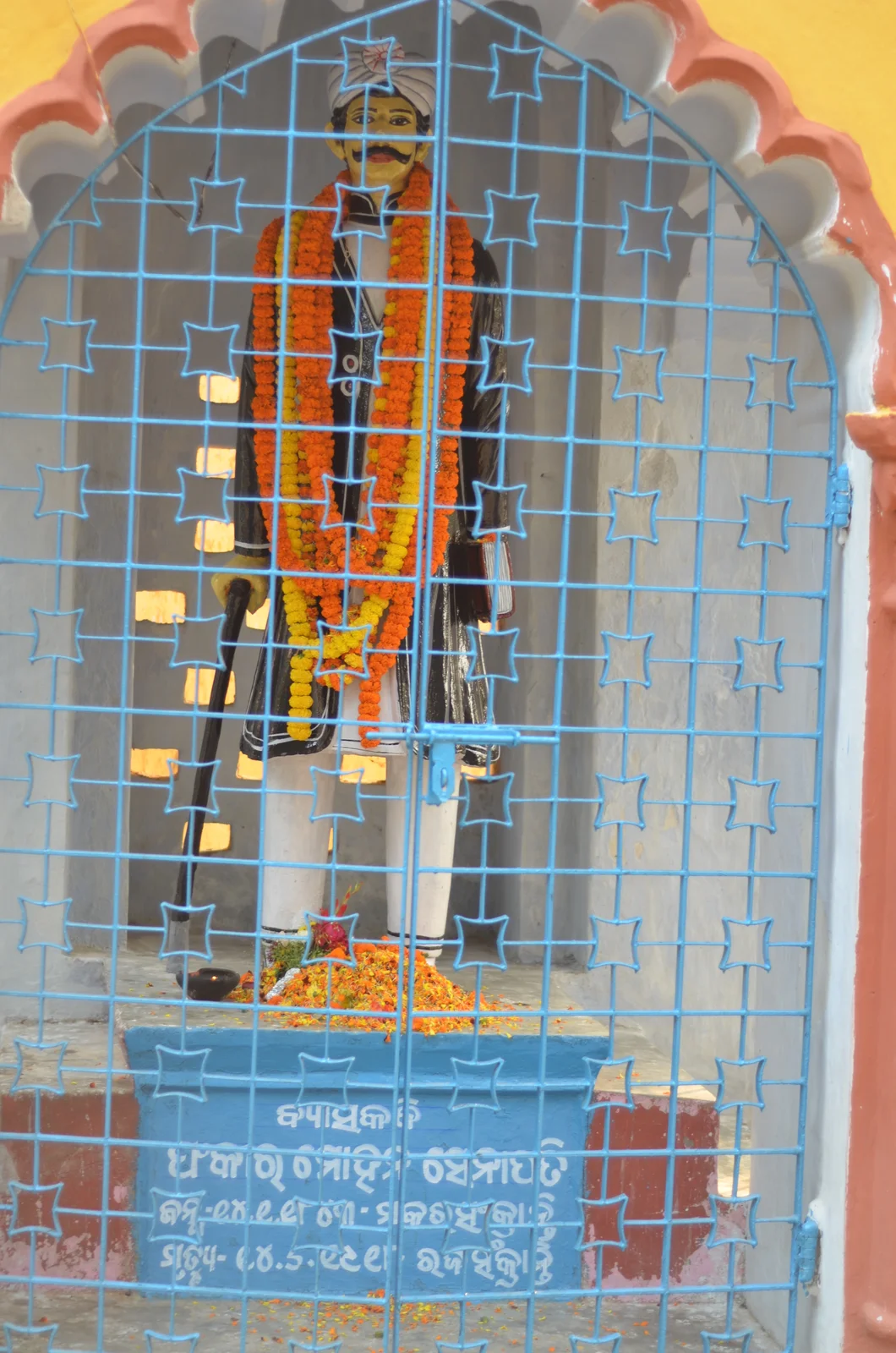
Fakir Mohan Senapati remembered at Santikanan, Balasore, 2014. A commemorative statue.
Subhashish Panigrahi. Source · CC BY-SA 3.0.

An epic open to argument
Sarala Das’s fifteenth-century Mahabharata invites us to think of retelling as an act of authorship. A familiar narrative can acquire different moral pressures in another poet’s hands. B. N. Patnaik’s account of Sarala’s work offers a particularly striking example in Sakuni, a character often remembered chiefly for intrigue.1
In Patnaik’s reading, Sakuni recognises his responsibility for the deaths of his nephews and of innocent soldiers. He chooses death on the battlefield over returning to rule. The interest lies in the burden of responsibility that this interpretation gives him. A figure associated with manipulation becomes capable of judging the consequences of his own actions.
This is a useful way to enter an epic without reducing it to a set of exemplary heroes and villains. Ask what a retelling makes newly difficult to judge. The discussion here follows Patnaik’s interpretation; it does not claim to settle every episode or manuscript reading in Sarala’s vast work.
Rebati and the wish to learn
Fakir Mohan Senapati’s Rebati begins inside a household. The child already participates in a world of words: she hears her father’s devotional singing and reading, learns songs and sings them herself. Her wish for lessons grows within this existing intimacy with language. Her father and the teacher Basudev support her, while her grandmother insists on the domestic skills expected of a girl.2
The opening makes the conflict painfully concrete. Rebati wants to learn; the adults disagree about what a girl should be allowed to know. Reading the story through that exchange keeps her desire in view before later suffering threatens to overwhelm it.
A close reading can pause here, at the household argument, rather than hurry toward a moral extracted from the ending. Who recognises the child’s eagerness? Who sets the boundaries of her future? The short story makes such ordinary speech worthy of sustained attention. A cultural history of literature needs this domestic scale alongside the great events of epic.
A forest receives Sita
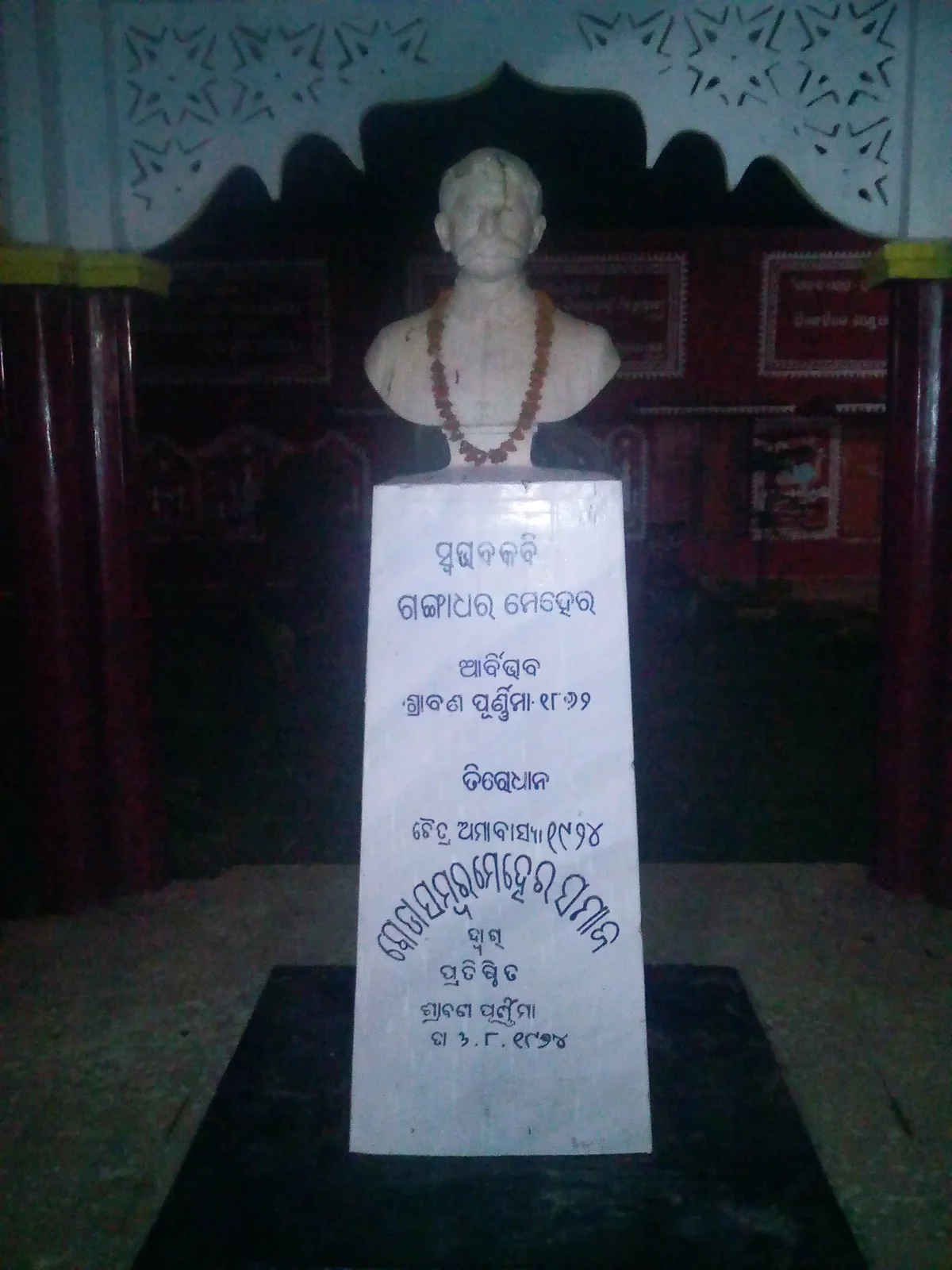
A statue of Gangadhar Meher at RBHS, Padampur. Photograph uploaded in 2015.
Prakash C Dash. Source · CC BY-SA 4.0.

In Gangadhar Meher’s Tapasvini, the Ramayana’s aftermath becomes the setting for Sita’s life in exile. Canto IV, available in Harekrishna Meher’s English translation, opens with dawn approaching her dwelling. Dew, leaves, birds and breeze participate in a welcome that grants the abandoned queen dignity.3
The scene is tender without being free of pain. Sita rises with Rama still in her thoughts and asks that he be blessed. Later, the river Tamasa receives her with the intimacy of an embrace. Speaking of her own journey, the river links perseverance to the water she gives those along her banks.
Nature here does more than furnish a beautiful background. It becomes a company of attentive beings around a woman who has suffered. That reading should retain the poem’s particular understanding of devotion: Sita’s fidelity remains central. Reading through a translation also means hearing the translator’s choices of rhythm and vocabulary. Harekrishna Meher’s rendering gives access to the scene without replacing the sound of Gangadhar’s Odia.
Draupadi looks back
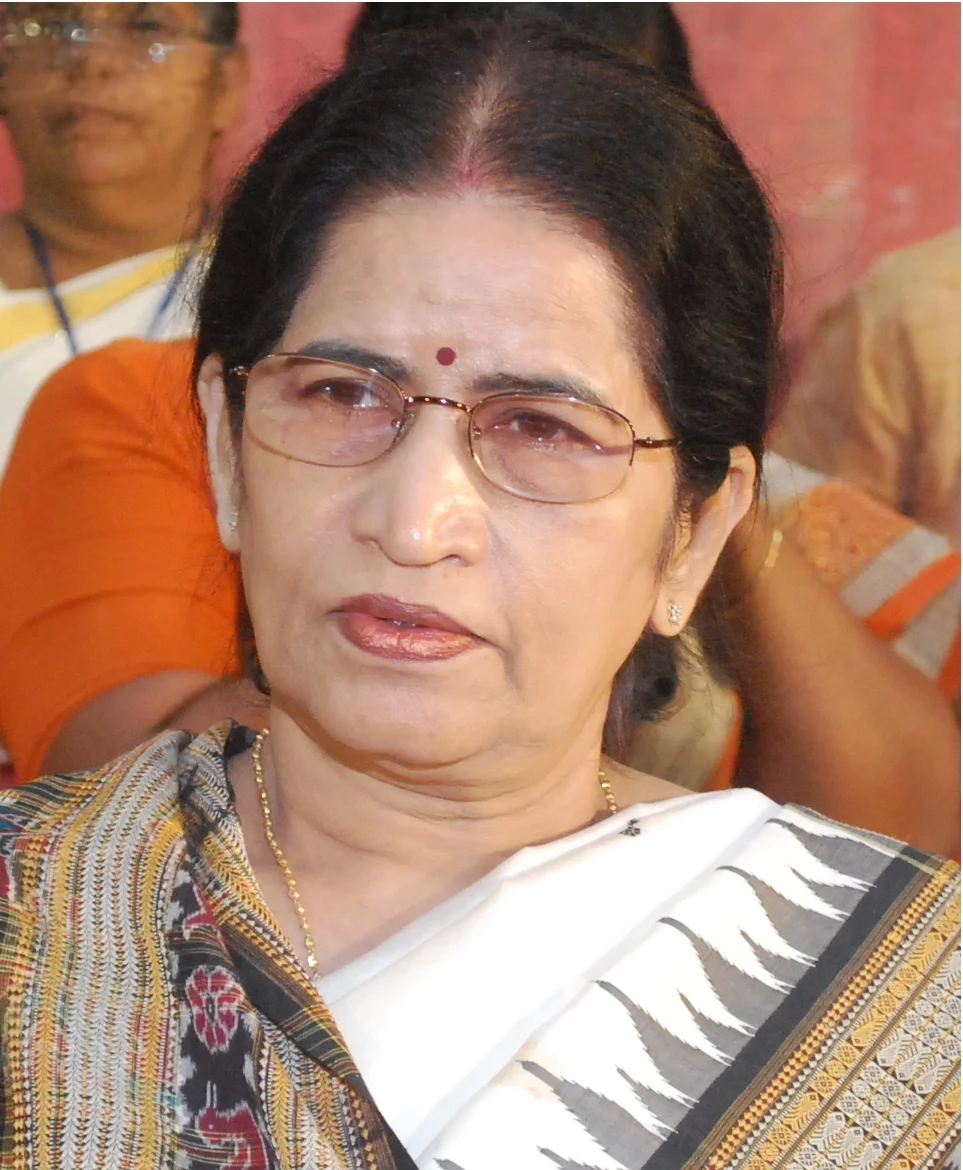
Pratibha Ray photographed in Kollam on 15 May 2010.
Kannan Shanmugam. Source · CC BY-SA 3.0.

Pratibha Ray’s Yajnaseni returns to the Mahabharata through Draupadi’s consciousness. In the English excerpt published on Ray’s website, the approach to the end of life becomes an occasion for questioning attachment, desire and the meaning of what has been endured.4
The Himalayan ascent supplies a stark image. Draupadi falls; her husbands continue. Her reflections make the cost of the journey personal. The reader meets a consciousness measuring its own experience, rather than simply a figure moving toward an ending already known from epic.
Placed beside Tapasvini, this passage suggests a rewarding comparison. How does each work allow a woman to speak from within a sacred story? Where does tenderness lead, and where does questioning begin? These are distinct literary projects, not interchangeable statements on womanhood. Their differences make the comparison worth pursuing. The website does not identify the translator of this excerpt, so its English wording is not attributed here to a named translator.
A larger circle of readers
A literary world also changes through the work of selection and translation. Spark of Light, edited by Valerie Henitiuk and Supriya Kar and published by Athabasca University Press in 2016, brings together short stories by women writers of Odisha in English. Its contents place Reba Ray, Binapani Mohanty, Pratibha Ray, Sarojini Sahoo and many others within one reading journey.5
The anthology’s range matters. Women’s writing becomes visible as a field of differing voices, periods and concerns. The publisher identifies class, poverty, violence and family among its themes. Readers can follow these concerns across stories while resisting the temptation to make any single author speak for all women. The open-access edition also provides a practical next step: begin with a story, read its contributor information and notice who translated it.
Haldhar Nag widens the linguistic frame. A Lehigh University literary profile identifies his language as Kosali, also called Kosali-Sambalpuri or Sambalpuri. It describes poetry that reworks mythological stories while also addressing land, agriculture and environmental concerns. Its discussion points readers to Surendra Nath’s English translations in Haldhar Nag: Selected Poems, published by Black Eagle Books in 2020.6
This is a reminder to keep Odisha’s literary geography open. A chapter centred on Odia should not absorb every neighbouring voice into that label. Language names, local audiences and the conditions of translation deserve attention in their own right. A translated collection is an invitation to seek the poet’s spoken and written language, as well as an opportunity to encounter the work in English.
Returning to the works
The most useful next step is to read slowly. Begin with the family conversation in Rebati; then compare the welcome offered to Sita with Draupadi’s recollection of abandonment. Return to an epic character whose motives once seemed settled. In each case, attend to the person speaking, the person listening and the experiences left outside the frame.
Odisha’s literary world grows through the making, reinterpretation and translation of stories. Each encounter can lead us toward another writer, another language and another experience that deserves to be heard.
Footnotes & Sources
- B. N. Patnaik, Aadi Kavi Sarala and His Mahabharata. 7 November 2019. Critical account used for the dating and the interpretation of Sakuni; not a collation of the Odia epic. Accessed 10 November 2026. ↩
- Fakir Mohan Senapati, Rebati, in Galpa Swalpa. Odia Wikisource community transcription. This chapter reads the opening household scenes and the discussion of Rebati’s education; no claim of a critical edition is made. Accessed 10 November 2026. ↩
- Gangadhar Meher, Tapasvini, Canto IV. English translation and introduction by Harekrishna Meher, posted 3 July 2007. Reading based on stanzas 1–11. Paraphrase only; no modern translated verse reproduced. Accessed 10 November 2026. ↩
- Pratibha Ray, Jajnaseni. English excerpt on the author’s website. Used for Draupadi’s reflections and the Himalayan ascent. The page does not identify its translator; original publication dating is not asserted here. Accessed 10 November 2026. ↩
- Spark of Light: Short Stories by Women Writers of Odisha. Edited by Valerie Henitiuk and Supriya Kar. Athabasca University Press, December 2016. Publisher description and contents consulted; the page links the open-access book. Accessed 10 November 2026. ↩
- Haldhar Nag: Author Profile. Lehigh University, Adivasi Writers project, associated with Amardeep Singh and Srishti Raj. Used for language naming, thematic overview and the Surendra Nath translation reference; not presented as a close reading of the complete collection. Accessed 10 November 2026. ↩
All three photographs are reproduced from Wikimedia Commons under the licenses linked in their captions. Images retain their full frames; orientation is corrected where required and size and file format are adjusted for the page. The photographs retain their respective Creative Commons licenses; their inclusion does not imply the photographers’ endorsement. The two statue photographs document commemoration, not the writers’ lifetime appearance.
Suggest an update
Share a correction or source for this chapter. GitHub submissions are public. Please omit private contact details and consent documents.