
Part 4 · Music, Dance and Theatre
Chapter 24 of 48
The Stage, the Street and the Festival
Prahallad Nataka, Danda Nata, Sahi Jatra, Dhanu Jatra and touring theatre
A king commands a child from a raised platform. A costumed figure advances through a Puri street. In Bargarh, a river and a neighbouring settlement acquire names from Krishna’s story. These theatres ask us to notice where a performance happens, and how people gather around it.156
Prahallad Nataka, Danda Nata, Sahi Jatra, Dhanu Jatra and touring theatre bring different obligations to their audiences. A devotional vow, a neighbourhood procession and an evening’s entertainment cannot be understood through costume alone. Each needs its own account of place, preparation and participation.
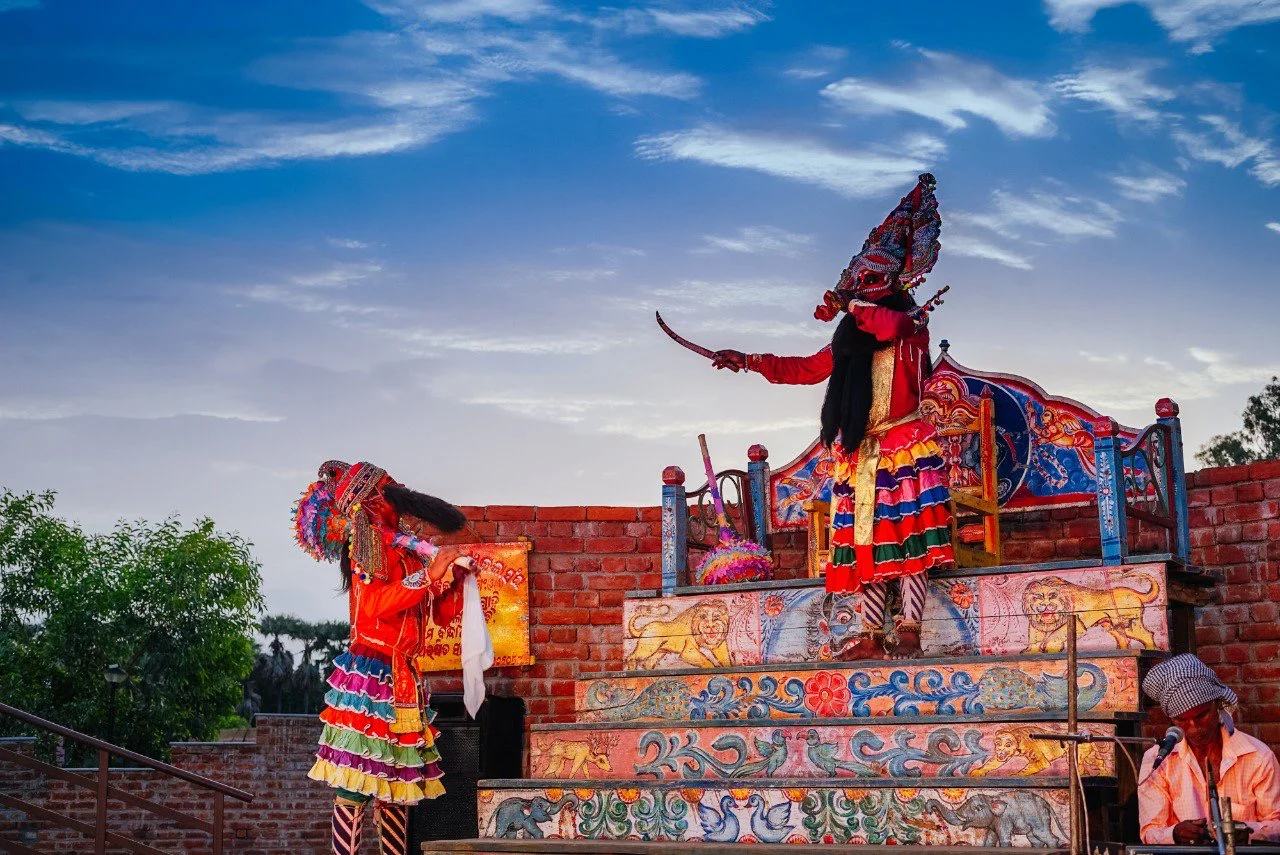
Prahallad Nataka at the Crafts Museum, 24 June 2018. The source does not name the performers.

Prahallad Nataka: the king and the child
In Ganjam’s Prahallad Nataka, also called Raja Nata, Hiranyakashipu demands the submission of his son Prahallad. The boy’s devotion to Vishnu brings the confrontation to its resolution through Narasimha. The familiar story becomes musical theatre: songs and spoken passages carry an argument about authority and faith.12
The gahaka, or lead vocalist, guides the chorus and comments on the action. A raised throne helps make the king’s position visible. Listen to how a declaration acquires weight through the accompanying voices; watch how an entrance establishes a character before the confrontation begins. The theatre’s nineteenth-century courtly history is important, but the sources differ over precise dating and authorship.1
Prateek Pattanaik’s documentation names Sri Lakshmi Nrusingha Natya Sansada of Burupada, with A. Rajendra Patro as Raja, Kalia Gouda on mukhabina and Tukuna Swain on mardala. Such credits let us recognise a particular ensemble and its work, beyond the name of a form.2
Danda Nata: devotion and dramatic play
The Ganjam District Gazetteer describes Danda observances in Chaitra, with groups travelling between villages and a closing Meru Yatra at Maha Vishuba Sankranti. Devotion to Shiva and Kali frames the occasion. Dhuli, Pani and Agni Danda belong to its ritual vocabulary; the gazetteer also names dhol, mahuri, jhanja and ghanta among the instruments.3
Aswini Kumar Mishra distinguishes daytime ritual from the Suanga and Leela of the night. His examples include Shiva and Parvati and the bird-catcher pair, Chadheiya and Chadheyani. Mythological figures enter a world of farming, conversation and dramatic humour.4
This shift matters to a reading of the whole event. A demanding observance and a comic exchange may belong to different moments of the same gathering. Isolating one spectacular scene can obscure the changes of mood that make the occasion intelligible. The local sequence deserves attention alongside the individual act.
Sahi Jatra: the neighbourhood performs
In Puri, Sahi Jatra brings performance into the streets around Ramnavami in Chaitra. The IGNCA and Sangeet Natak Akademi’s Akhyan programme describes a procession whose crossings become arenas for dancers, acrobats and costumed figures. It names Rama, Ravana, Parasurama, Hanuman, Sugrib and Angad among the characters.5
The photograph below preserves one such local association: its source identifies Parasurama with Harachandi Sahi. A character known across the Ramayana world also belongs to a particular neighbourhood’s presentation. Keeping that place-name in the caption makes the image more informative than a general label such as “festival performer.”
Follow the space around the figure as well as the figure itself. A procession’s approach, a pause at a crossing and the gathering of spectators are parts of the theatrical encounter. The street changes its use as the performance moves through it.
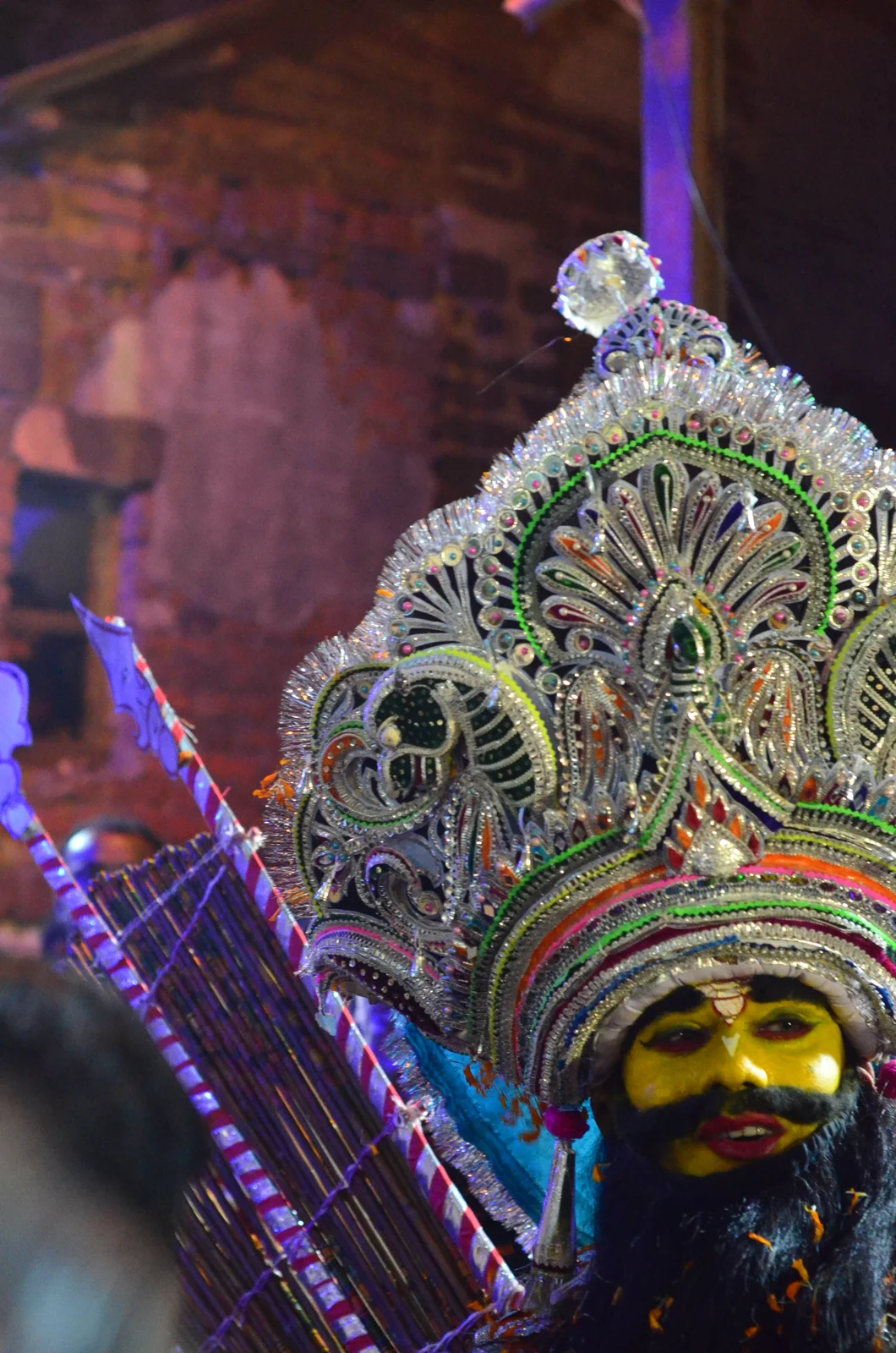
Parasurama in Sahi Jatra, Harachandi Sahi, Puri, 2018; identification follows the source record.
Prateek Pattanaik. Source · CC BY-SA 4.0.

Dhanu Jatra: a landscape becomes a story
Bargarh’s Dhanu Jatra extends the acting space across a town, a river and a neighbouring settlement. Bargarh becomes Mathura, Ambapali becomes Gopapura, and the Jeera represents the Yamuna. Over eleven days, Krishna’s story and the rule and defeat of Kansa unfold across this shared geography.6
The district’s account places the festival’s beginning in the harvest season of 1947–48, linking its celebration to the mood of Independence. The story is older than this particular public form. That distinction allows the festival to have a modern civic history as well as a sacred narrative.6
The gateway pictured below makes the transformation tangible. An ordinary route is given a theatrical threshold. Read alongside the festival’s geography, it invites us to think about spectatorship as movement: following a story may also mean travelling between the places that represent it. No single stage photograph can contain that experience.
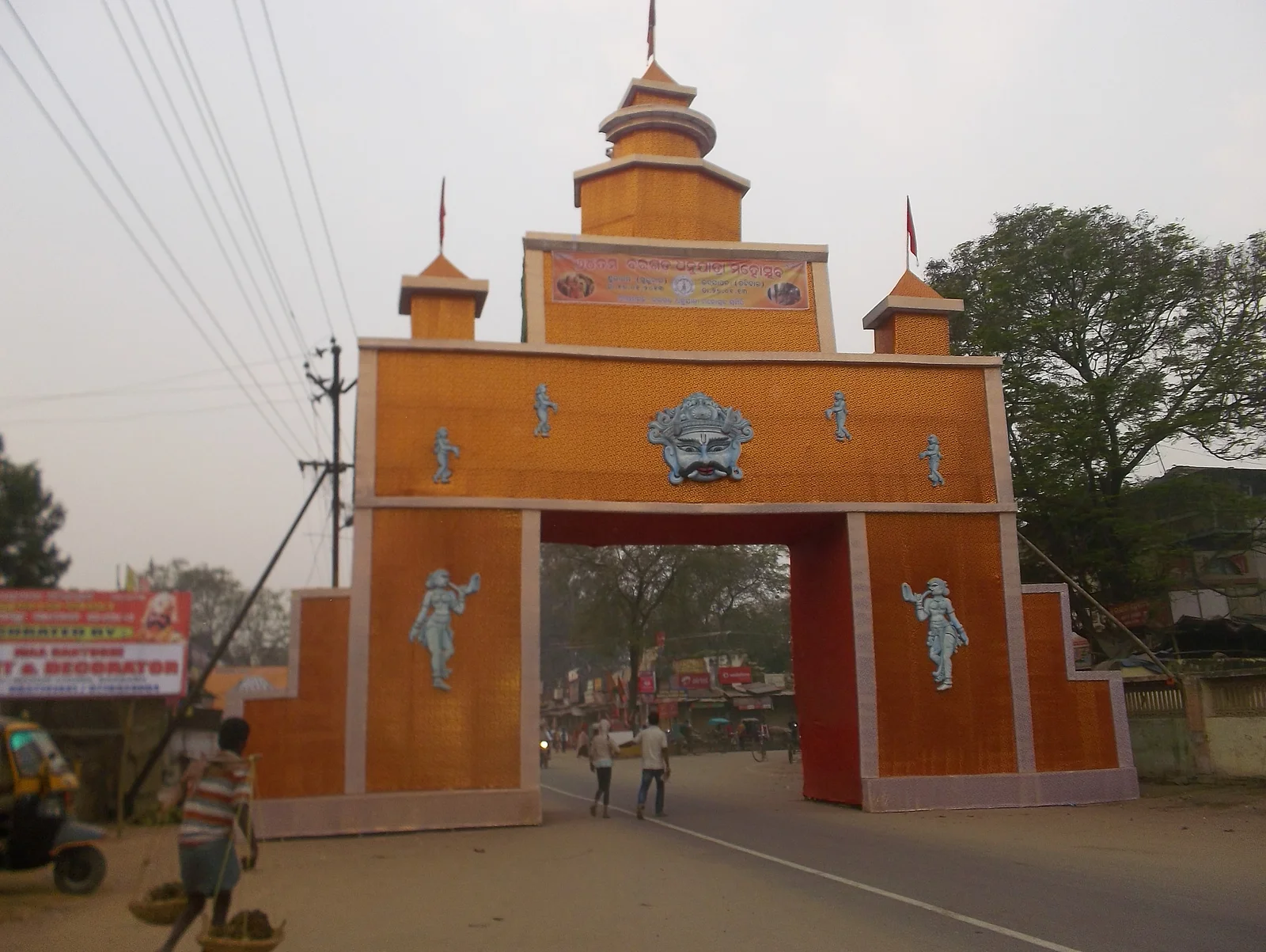
Entrance to Mathura Nagar during Bargarh Dhanu Jatra, 21 January 2013.
Sudhansu Bhusan Baghar. Source · CC BY-SA 3.0.

Touring theatre and the work of a company
The word jatra also belongs to Odisha’s popular theatre companies, often called gananatya. This use needs to be distinguished from a festival name such as Dhanu Jatra. Impart’s account traces modern Odia jatra through late nineteenth-century Balasore, exchanges with Bengali theatre, and the musical resources of Suanga and Leela. It describes Baishnab Pani’s Gitabhinay as an important combination of music, verse, humour and familiar speech.7
Its history is also a history of support. Early companies could be attached to a local patron; the decline of zamindari patronage changed that arrangement. The same account discusses women’s entry into performance in the mid-twentieth century and the later influence of cinema. Touring theatre should therefore be approached as a changing profession, with artistic choices shaped by changing audiences and institutions.7
A useful record of a touring production would follow the company as well as the play. Who writes and revises the dialogue? Who rehearses the music, assembles the acting space and moves the equipment? How does a scene reach spectators on different sides? These questions give the supporting work a place beside the leading actor’s performance.
An older theatre essay preserved by Heritage Odisha argues that an arena and its entrance passages are active parts of performance. It describes actors addressing spectators around them and ceremonial approaches to the playing area. The argument remains a useful way to examine staging: ask what a production needs its space to do.8
Across the five traditions, the stage can be a platform, an arena, a crossing or a network of places. Their differences deserve to remain visible. So do the people who teach, sing, organise and perform. A cultural archive becomes more useful when it keeps the company, locality, occasion and version with the story, allowing the next reader to find a particular artistic world again.
Footnotes & Sources
- Impart, “Prahlad Natak” (2022). Performance text, gahaka and staging. Exact origin dates and sole authorship are not asserted here; the project’s earlier research records disagreement. ↩
- Prateek Pattanaik, “Prahallada Nataka”. Documentation and credited Burupada ensemble. Credits refer to that recording project, not the Crafts Museum photograph. ↩
- Government of Odisha, Ganjam District Gazetteer. Printed pp.459–460 and 463: Danda Nata and Danda Yatra. District description; not a current programme or a universal rule for all groups. ↩
- Aswini Kumar Mishra, “Dandanata: The Performative Dance”. Odisha Review, April 2022, pp.62–69, especially pp.64–65. Used for ritual/theatre distinction and dramatic pairs; origin speculation and inconsistent calendar wording are not adopted. ↩
- IGNCA and Sangeet Natak Akademi, Akhyan (2010). “Sahi Jatra,” printed p.83 (PDF p.43). Programme account of processions, characters and performing spaces; not a current route or schedule. ↩
- Bargarh District, “Culture & Heritage”. Dhanu Yatra section: eleven-day structure, festival geography and the district’s 1947–48 origin account. Claims of a world size record are not used. ↩
- Impart, “Odia Jatra” (2022). Historical synthesis covering early companies, Gitabhinay, patronage, women performers and cinematic influence. Not a survey of current touring companies. ↩
- Heritage Odisha, “Traditional Peoples Theatre of Odisha”. Opening essay on arena staging and entrance passages. Undated republication of an older theatre argument; historical totals and universal claims are not adopted. ↩
Three documentary photographs are reproduced with source and licence links in their captions. Images retain their full frames; orientation and file format were normalised for layout, with no retouching. Each photograph remains under its stated licence. This is a desk-researched review chapter, not a report of field visits or practitioner interviews. Sources and picture records checked 10 November 2026.
Suggest an update
Share a correction or source for this chapter. GitHub submissions are public. Please omit private contact details and consent documents.