
Part 5 · Making, Wearing and Building
Chapter 26 of 48
Palm Leaf, Paper and the Work of the Hand
Engraving, manuscripts and the shape of a story
A palm-leaf book asks the reader to notice its construction. Narrow strips, pierced for a cord and protected by covers, hold writing and images in a sequence. The hand that opens the book meets work already done by other hands: preparing, cutting, inscribing and arranging.1
This chapter follows those material decisions into visual storytelling. It moves from an engraved leaf to a painted paper page, asking how a surface gives a story its shape. The materials connect literary and craft histories, while each surviving object preserves its own date, makers and history of use.
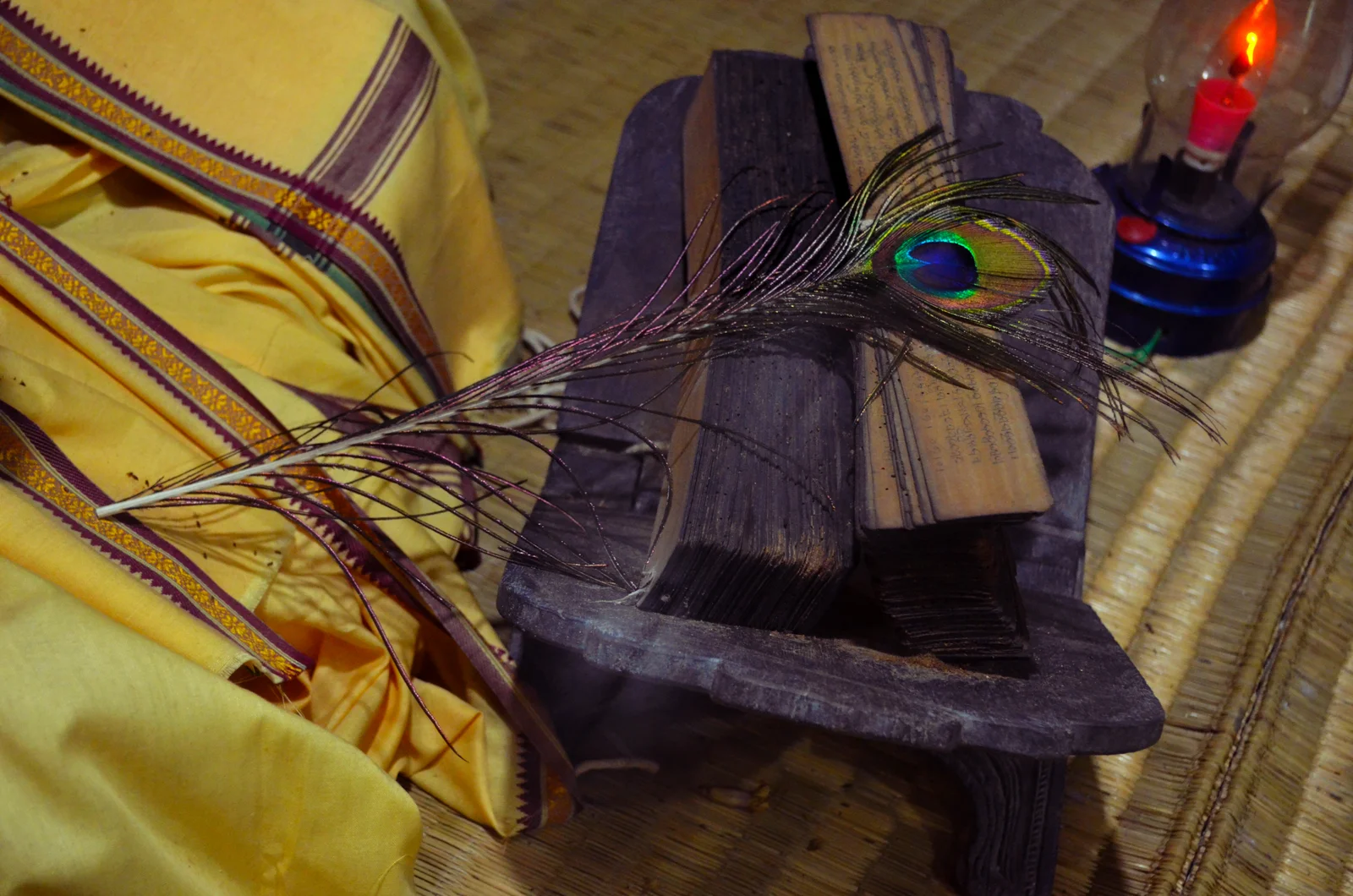
Gita Govinda display at the Odisha State Museum, photographed in 2013. The date of this manuscript copy is not established here.
Subhashish Panigrahi. Source · CC BY-SA 3.0.

A line cut into a leaf
In Joanna Williams’s account of Odisha’s illustrated pothis, a lekhani, or stylus, makes a channel in the prepared palm leaf. A darkening substance rubbed into the surface makes the incised marks easier to see. Text was commonly laid out first, with spaces left for pictures and their captions.1
A cut line demands attention to a surface that can split. The mark has depth as well as direction. This makes the process different from laying a brushstroke over paper, even when both eventually appear as a dark outline in a reproduction. Material and movement are joined in the act of drawing.
The NID documentation published through D’source describes a living Talapatra Chitra practice in which prepared strips are joined in a folding arrangement. Drawing, engraving, rubbing colour into the incisions and wiping the surface form successive stages. Some examples include additional colour or carefully cut openings.2
These folding pictures and the stacked leaves of a book should be examined as distinct objects. Their arrangements permit different ways of opening and viewing. A reader may move through a manuscript leaf by leaf; an unfolding image can gradually reveal a larger composition. A photograph showing only the open front cannot explain all of these movements.
The Government of Odisha’s craft account describes both lettering and pictorial designs on palm leaf, and names epic incidents, deities, animals and plants among its subjects.3 Such breadth is a reminder to begin with the object in front of us. A leaf bearing writing need not be an illustrated epic, and a recently made engraved picture need not be a manuscript.
For a first close look, follow one contour until it meets another. Notice where the maker leaves space around a figure, where an ornament becomes dense, and where the composition accommodates a hole or edge. Those choices are small, but they determine how much a narrow surface can hold.
A literary world along a narrow strip
The Cleveland Museum of Art identifies the leaf reproduced below with Upendra Bhanja’s romance of Chandrabhanu and Lavanyavati. It dates the object to the late eighteenth century. In the passage illustrated, the romance retells the battle of Rama and Ravana. A literary work can thus hold another familiar narrative within it.4
The museum’s description identifies the many-headed Ravana near the right of the battle scene and the army of monkeys and bears extending across the leaf. It explains the black lines as incisions made with a stylus and darkened with charcoal.4 The technique and the crowded subject can be considered together: each small figure must remain legible within a tightly limited height.
The reproduction presents two views of the leaf. Follow the lower scene horizontally, noting how bows, bodies and raised limbs create a succession of directions. The open binding hole interrupts the field, but the composition continues around it. A practical feature of the book becomes something the image has to work with.
This is an illustration associated with Bhanja’s text, not evidence that the poet drew the image. The writer, the copyist and the illustrator are different roles, even when the surviving record cannot supply every name. Separating them gives artistic interpretation its place beside literary authorship.
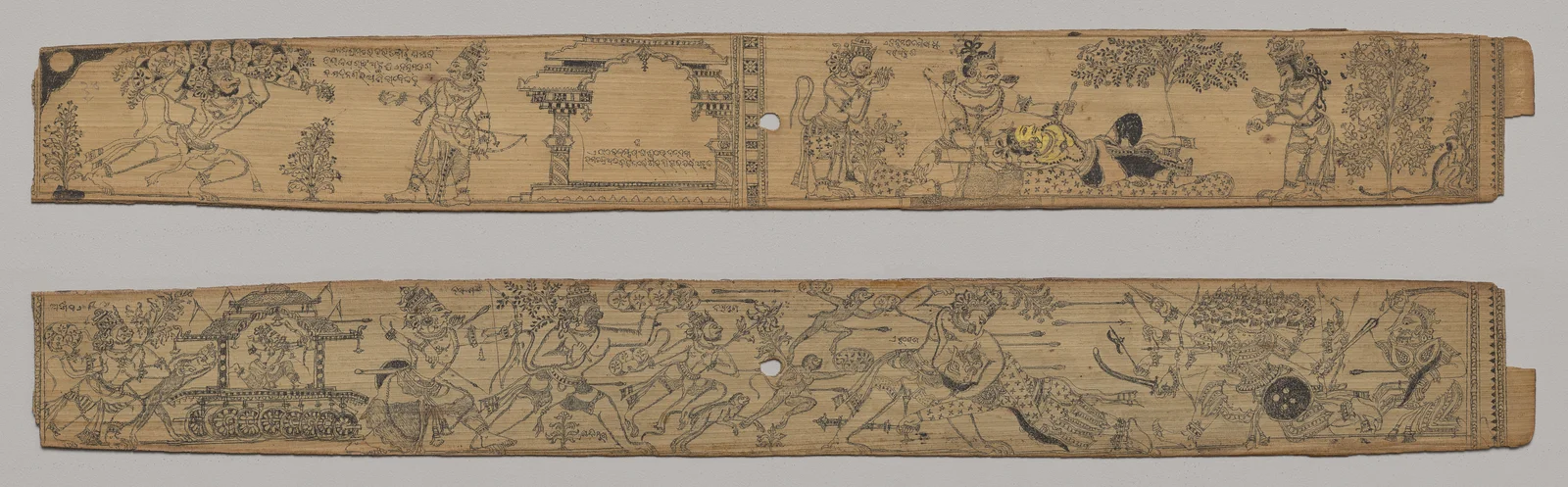
Two views of a leaf from a Lavanyavati manuscript, Odisha, late 1700s. Unidentified maker; charcoal on palm leaf. Accession 1979.21.
Cleveland Museum of Art, Edward L. Whittemore Fund. Source · CC0.
Paper gives the scene another shape
In the Met’s Odisha painting dated 1840, Krishna and Balarama arrive at the Yamuna on their journey towards Mathura. The museum identifies the work as a page from a dispersed Bhagavata Purana, made with ink and opaque watercolour on paper.5
The picture occupies the upper part of the page, with writing beneath it. A diagonal river, coloured trees and the chariot organise a broad field above the text. Compared with the palm-leaf scene, this page gives the eye more room to move vertically as well as sideways. That is a comparison of these two objects, rather than a rule for every work in either material.
Paper also carried smaller pictures. The British Library catalogues five gouache paintings made by Puri chitrakars around 1960 and acquired near the temple. Their subjects include animals, a milkmaid and Krishna’s encounter with Bakasura.6 Material alone does not determine whether an image belongs to a book, a devotional purchase or another use.
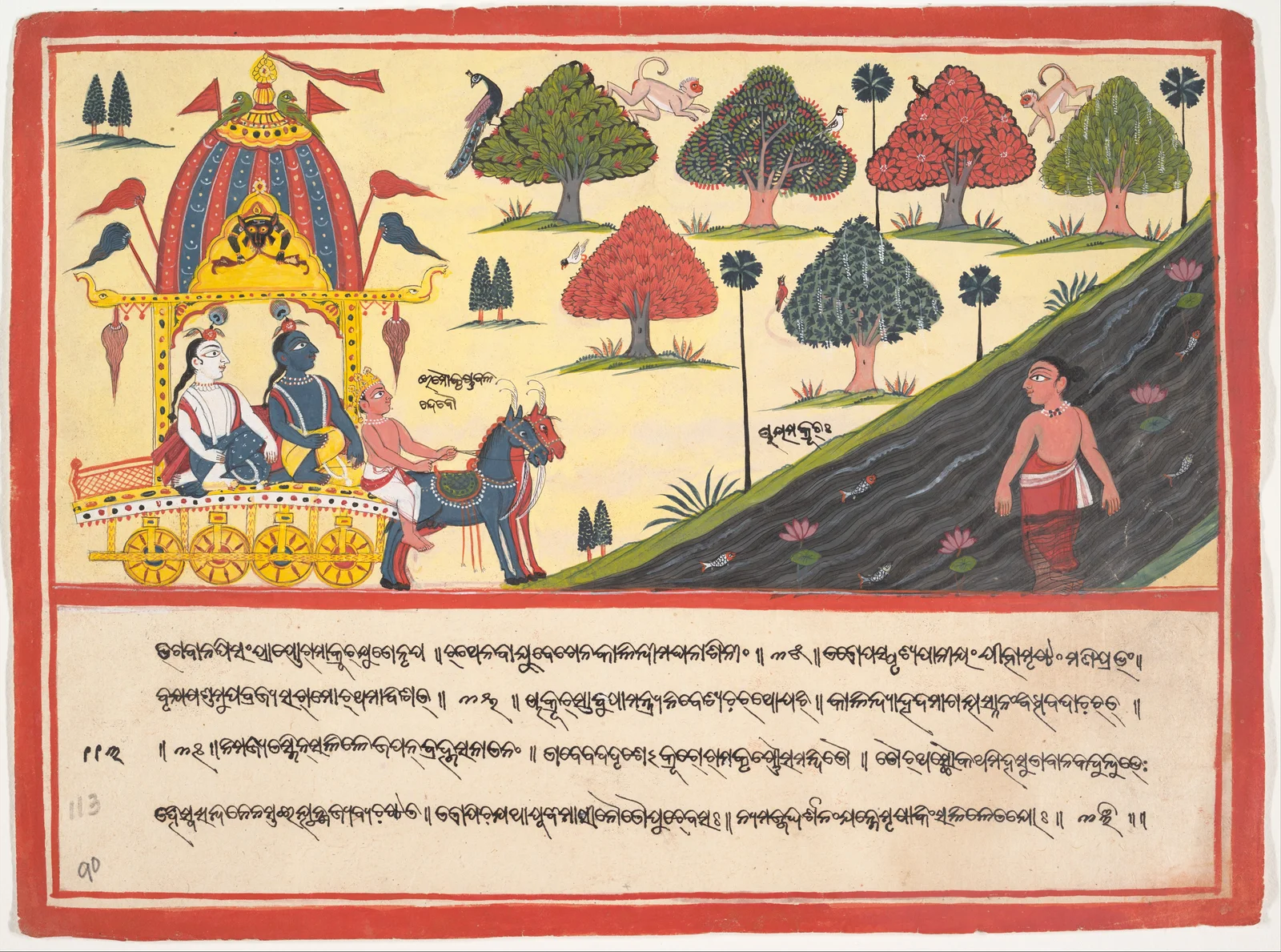
Krishna and Balarama by a River, Odisha, 1840. Unidentified painter; ink and opaque watercolour on paper. Accession 1981.461.
The Metropolitan Museum of Art, Gift of William H. Wolff, 1981. Source · Public domain / CC0.
Keeping the work and its relationships together
A manuscript is more than a succession of attractive pictures. Its order connects words, episodes and pauses. Williams points out that disassembly can disturb that order; original page numbers, where present, can help recover it.1 A beautiful isolated leaf may therefore preserve a scene while losing part of the reading experience that once surrounded it.
The museum labels used here make this problem visible through words such as “leaf” and “dispersed.” A photograph and an accession number let a reader locate an object, but they cannot by themselves reunite a book. Comparing text, dimensions, ornament and surviving sequence requires more evidence than a shared subject or visual resemblance.
The same care with identity matters for contemporary work. A Talapatra Chitra made for display, an illustrated manuscript copy and a paper painting can share stories while serving different purposes. Recording how an object opens, how its parts are joined and which side is shown helps preserve those differences.
An informative record should keep the maker’s name, the title or subject, the stated materials, the dimensions and the date together. Where a name or date is unknown, leave that uncertainty visible. The date of a poem does not automatically date a copy, and a photograph of a manuscript does not establish that it was written by the poet whose work it contains.
The work of the hand continues in the way these objects are described. A caption can preserve a copyist’s name or erase it; a photograph can retain the edges and binding holes or leave them outside the frame. Looking at the whole object gives future readers more to work with. The story belongs both to the marks on the surface and to the material arrangement that lets those marks be read.
Footnotes & Sources
- Joanna Williams, The Two-Headed Deer (1996). University of California Press, chapter 2, pp.44–46: palm-leaf books, stylus, text and image, stringing and disrupted page order. Historical account; processes described here are not conservation instructions. ↩
- Bibhudutta Baral, Divyadarshan C. S. and Sandhya B., Palm Leaf Painting. NID Bengaluru, D’source, “Bhubaneshwar, Orissa,” pp.4 and 9–13. Tools, assembly and engraving in a documented craft process; not a universal chronology. ↩
- Government of Odisha, “Palm Leaf Painting”. General description of lettering, designs, supports and subjects. Broad claims about origins and antiquity are not used. ↩
- Cleveland Museum of Art, Lavanyavati leaf, 1979.21. Eastern India, Odisha; late 1700s; charcoal on palm leaf; 4.8 × 40.2 cm. Museum identification of the embedded battle narrative and incising technique. Image CC0. ↩
- The Metropolitan Museum of Art, Krishna and Balarama by a River. 1981.461; Odisha, 1840; ink and opaque watercolour on paper, 23.8 × 32.1 cm. Museum subject identification; comparisons of page space are this chapter’s visual reading. ↩
- British Library, Add Or 1957–1961. Catalogue record 032-003279989: five gouache paintings on paper by Puri chitrakars, c.1960. Indexed record inspected; these works are discussed but not reproduced. ↩
The museum photograph by Subhashish Panigrahi retains its CC BY-SA 3.0 licence. The Cleveland and Metropolitan Museum images are available under their open-access terms, linked in the captions. Images retain their full frames, with format conversion and resizing for layout; no retouching or generated imagery. The photograph’s Gita Govinda identification follows its source, not a verified copying date or autograph attribution. Sources checked 10 November 2026.
Suggest an update
Share a correction or source for this chapter. GitHub submissions are public. Please omit private contact details and consent documents.