
Part 5 · Making, Wearing and Building
Chapter 25 of 48
Pattachitra and the Painted Story
Cloth, colour, devotion and the learning of a line
A fine brush touches a surface already crowded with figures and patterned borders. The photograph below records an artist at work in Raghurajpur in 2013. It offers a useful beginning for Pattachitra: a picture takes shape through many decisions, each made at the scale of a line.
The name joins patta, cloth, with chitra, picture. In Odisha, the tradition is closely associated with Jagannath and Puri, while its subjects extend through the stories of Krishna, Rama and other sacred figures.1 To look closely is to follow both the painted story and the work that makes it visible.
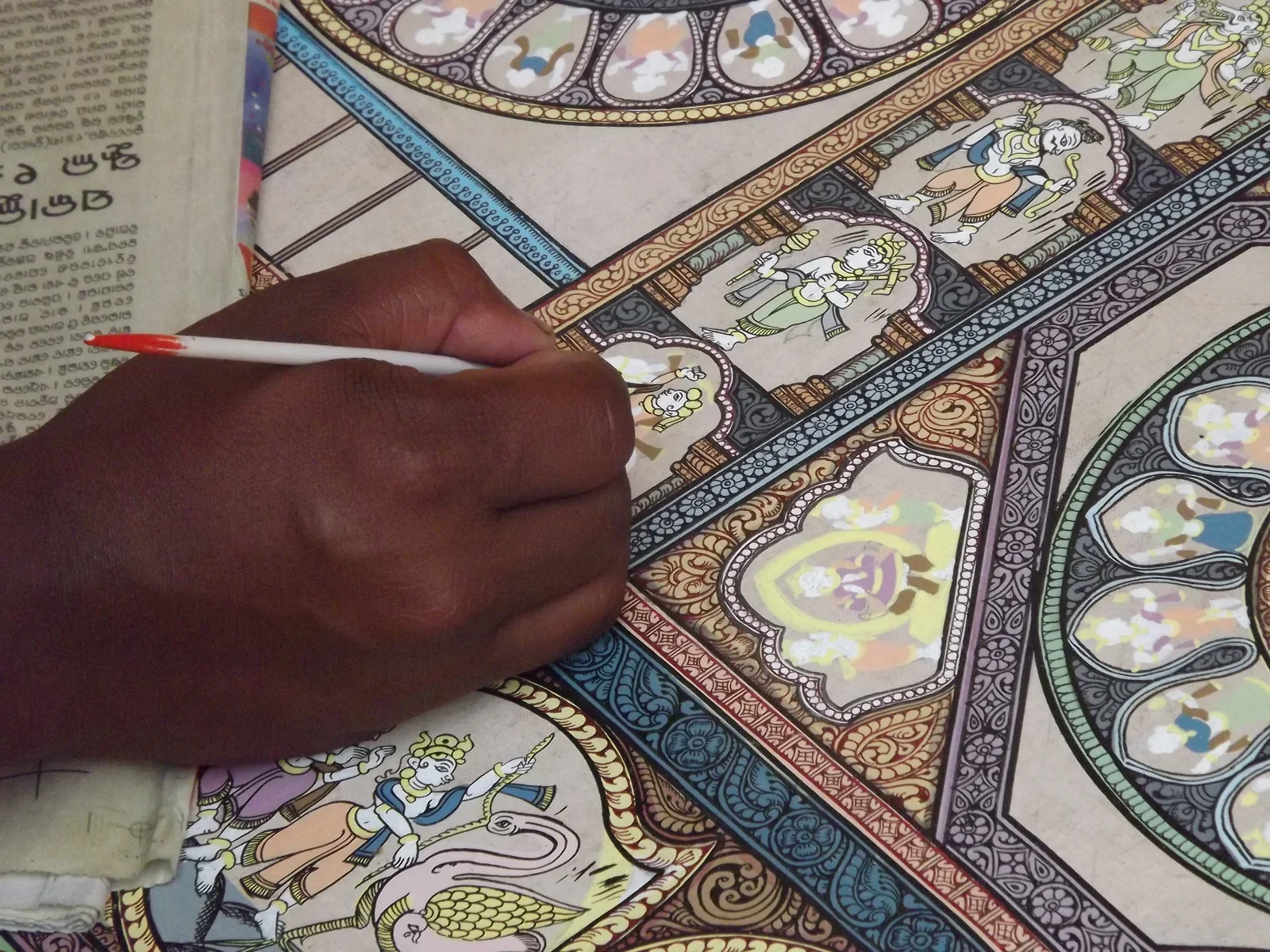
Painting in Raghurajpur, 21 March 2013. The source does not name the artist.
Sumit Surai. Source · CC BY-SA 4.0.

Before the story, a surface
A cloth painting begins before the first figure appears. The Government of Odisha’s process account describes a coating of chalk and tamarind-seed glue that prepares the cloth to receive paint. Borders are completed first; a brush sketch follows, then areas of flat colour and fine black lines. The account also describes a lacquer finish.2
This sequence makes preparation part of authorship. The support must receive a delicate stroke without losing its edge. A border must hold together across the whole picture. A small adjustment to an outline can change how an eye, a hand or a fold of clothing is read. The finished surface conceals much of this succession of tasks.
The same official account describes colours from vegetable, earth and mineral sources, including lampblack and shell white. It also records painting on wooden objects, tussar silk and coconut shells.2 These descriptions establish a repertoire of materials and supports; they do not identify the ingredients of every painting in a shop or collection. The medium of an individual work should remain attached to its own maker’s account or catalogue record.
Looking at a reproduction, begin with the relationship between colour and contour. Where does a dark line separate two neighbouring forms? Where does a repeated ornament make a border seem continuous? These are questions that can be explored without first identifying every character. They give the eye a route into the painting.
A narrative reading can then ask something more precise. Is the composition centred on a deity, arranged in episodes, or built around a single encounter? A picture may invite several kinds of attention: recognition of a familiar subject, delight in a repeated pattern, and slow discovery of smaller scenes. The viewing order need not be settled by the first glance.
A temple carried in a picture
In this Puri painting, dated by LACMA to about 1875–1900, Jagannatha, Balabhadra and Subhadra occupy the central shrine. The museum identifies the conch beneath them with the land of Puri and notes the avatars of Vishnu arranged in a band beside the deities.3
The temple is presented through many small compartments. Look from the central figures to the surrounding shrines, then outward to the floral border. The composition makes room for repeated acts of discovery while preserving a clear centre of attention.
LACMA relates this kind of image to the nineteenth-century pilgrimage trade: visitors could take a painted reminder of Puri home with them.3 A portable picture could therefore carry more than a view of a building. It could preserve a devotional relationship with a place, bringing the remembered shrine into another household.
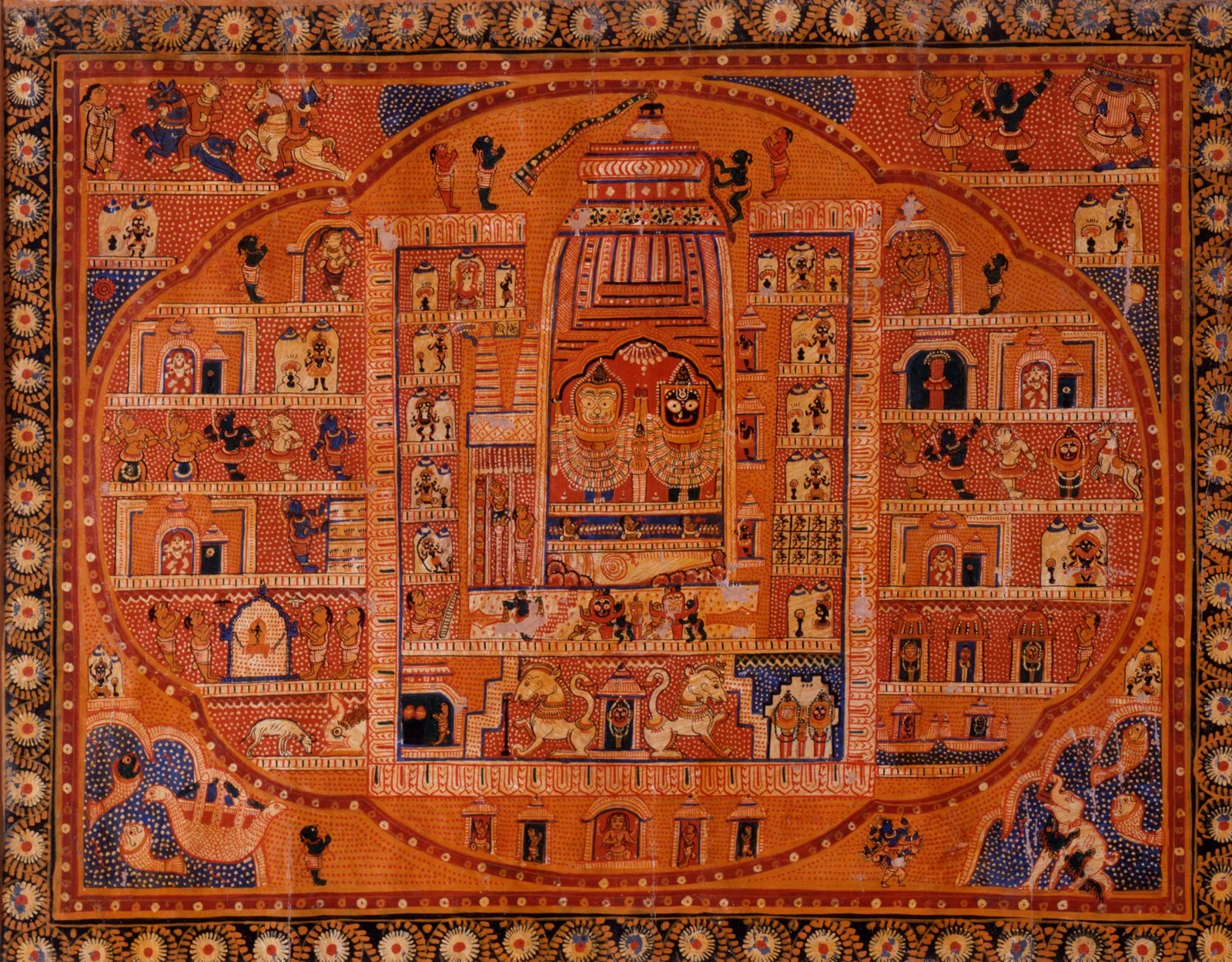
Jagannatha, Balabhadra and Subhadra in the Jagannatha Temple. Unidentified Puri painter, c.1875–1900; opaque watercolour on cloth.
LACMA, Indian Art Special Purpose Fund, M.82.107. Source · Public domain.

The centre and the surrounding world
The larger historical painting below, now in the Wellcome Collection, also places the three deities at the centre. Its catalogue dates it to about 1880–1910 and identifies the medium as tempera on canvas. Human and sacred figures, animals and buildings fill the surrounding field.4
Compare it with the preceding picture. Both give the temple’s central tower a commanding position, but their smaller spaces are organised differently. Here, dense ranks of figures and buildings encourage the eye to move across the width of the cloth. The comparison reveals choices within a shared subject, rather than a single design mechanically repeated.
Pattachitra’s wider repertoire includes Krishna’s childhood, the encounter with Kaliya, the Dashavatara and episodes of the Ramayana.1 A title can establish the subject without explaining every scene. For a particular work, a painter’s explanation or a detailed catalogue may help distinguish a sequence of events from figures brought together for another purpose. Recognition is a beginning; the arrangement is part of the story too.
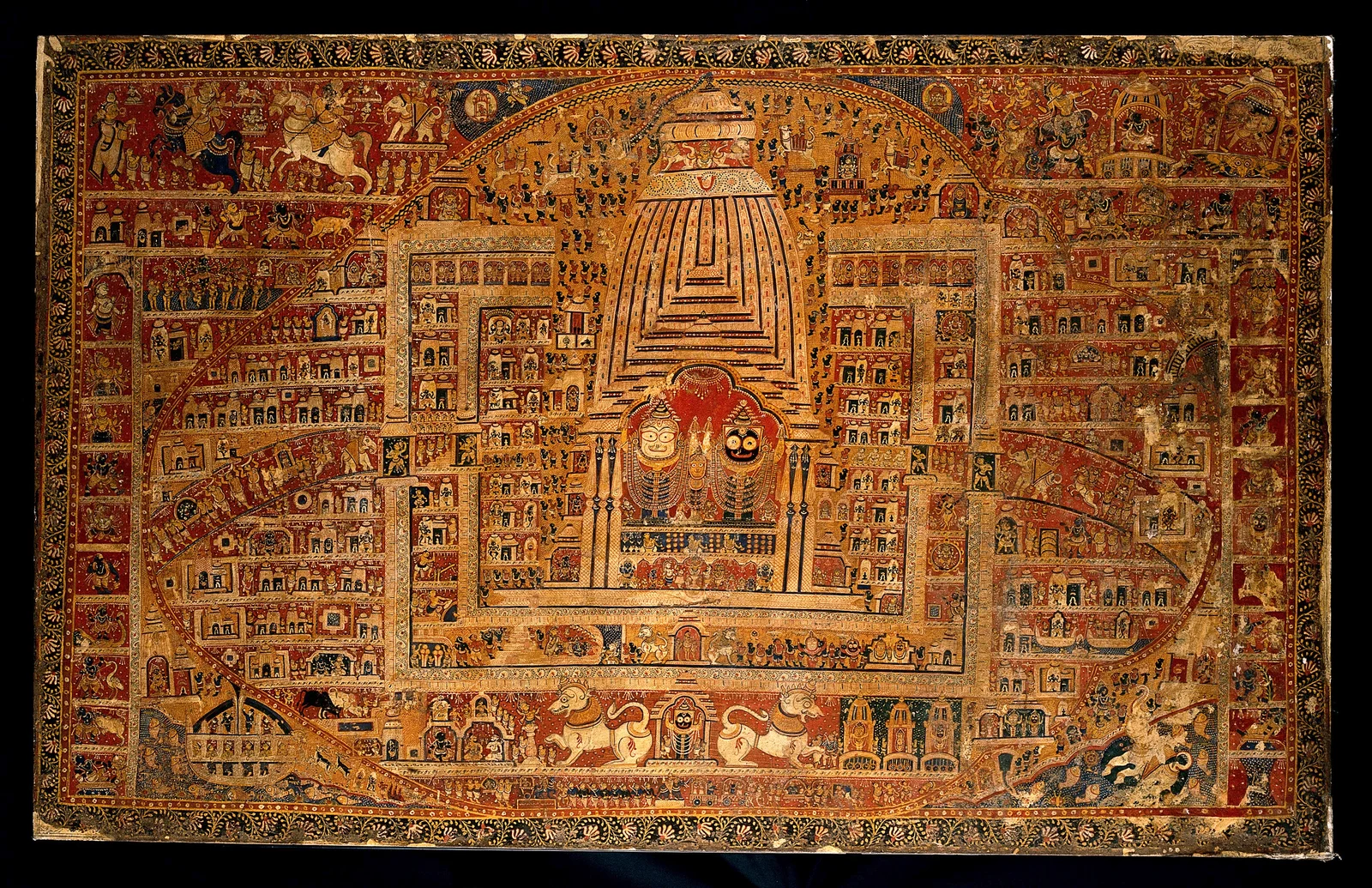
Balarama, Subhadra and Jagannath in the temple at Puri. Unidentified painter, c.1880–1910; tempera on canvas (current catalogue).
Wellcome Collection, 45186i; image V0017732. Source · CC BY 4.0 image record.

Learning a line, sustaining a livelihood
Joanna Williams’s study describes learning within a family or a master’s household. Pupils began with practice tasks, later filling images drawn by the teacher or working on borders. A large painting could involve several hands. Sketchbooks and retained drawings helped preserve subjects that were not painted frequently.5
This is knowledge acquired through practice and correction. A description of family transmission should leave room for the time spent learning, and for the contributions of assistants and collaborators. The border is not merely spare work around a master’s image; it is also a place where control of line and repetition can be developed.
Mamata Tripathy’s 1998 study of Raghurajpur describes painting as household work, with women and men contributing to its preparation and production. She also records training programmes, exhibitions, changing markets and the participation of painters from outside the Chitrakara community.6 Her account is a historical study, not a census of the village today. It helps show why a craft practice and a community identity should not be treated as identical.
The Puri district profile presents Raghurajpur as a place of several crafts: patta painting, palm-leaf engraving, carving, toys and masks, alongside its Gotipua associations.7 A visit can therefore open onto several kinds of skilled work. The village name is a useful point of entry, but a fuller account should also identify the artist, teacher, workshop and particular object.
For a new commission, keep the maker’s name, title, date, dimensions and stated materials with the picture. Ask how the subject was chosen and whether others contributed. Such details make it possible to return to the work as a particular creation. They also prevent the story of Pattachitra from ending with an anonymous image: the painted world has makers, and their names belong with it.
Footnotes & Sources
- Impart, “Odia Pattachitra” (2022). Used for the name, Puri association and range of subjects. Its proposed origin date is not adopted as a verified founding date. ↩
- Government of Odisha, “Patta Chitra”. Description of cloth preparation, painting sequence, pigments and additional supports. This is a general process account, not material analysis of the pictured works. ↩
- LACMA, Jagannatha, Balabhadra, and Subhadra in the Jagannatha Temple. M.82.107; Puri, c.1875–1900; opaque watercolour on cloth. Object record and curatorial interpretation of the central icons, conch, avatars and pilgrimage use. ↩
- Wellcome Collection, temple painting, 45186i. Puri, c.1880–1910; tempera on canvas, 122 × 194.5 cm. Current catalogue terminology is used; the older Commons image record calls it oil painting. Visual comparisons are this chapter’s reading. ↩
- Joanna Williams, The Two-Headed Deer (1996). University of California Press, pp.59–61, “Paintings of the Chitrakaras”: manufacture, collaborative work, apprenticeship and drawings retained as models. Historical field research. ↩
- Mamata Tripathy, “Folk Art at the Crossroads of Tradition and Modernity”. JASO 29(3), 1998, pp.197–211; especially pp.201–202 and 209–211. Household work, training and changing production and markets; not a current demographic claim. ↩
- Puri District, “Raghurajpur”. Official destination description of the village’s crafts and Gotipua. No current workshop availability, opening hours or fees are inferred. ↩
Picture credits and reuse links accompany all three images. The workshop photograph is the project’s resized WebP copy of Sumit Surai’s photograph; it retains CC BY-SA 4.0. The LACMA reproduction is marked public domain. The Wellcome reproduction retains its Commons CC BY 4.0 credit; the current collection record also marks the work public domain. Full frames are retained, with format conversion for layout and no retouching. Desk-researched review draft; no new field visit or interview is claimed. Records checked 10 November 2026.
Suggest an update
Share a correction or source for this chapter. GitHub submissions are public. Please omit private contact details and consent documents.